Advertiser Disclosure
We independently review everything we recommend. When you buy through our links, we may earn a commission.
The Best 5x5 Speed Cubes

Our team has been testing 5×5 speed cubes across a range of prices, skill levels, and turning styles. We’ve put in hundreds of solves, broken in new cubes, tuned magnets, and compared notes. The three picks in this guide represent the best options we found across three distinct categories: a premium competition pick, a mid-range all-rounder with serious competitive chops, and a budget-friendly entry point that doesn’t embarrass itself.
Ready to buy? GAN 562 M Magnetic 5×5 Speed Cube is our #1 pick — see it on Amazon
Everything We Recommend
✅ We recommend these products based on an intensive research process that’s designed to cut through the noise and find the top products in this space. Guided by experts, we spend hours looking into the factors that matter to bring you these selections.
⭐ 2.5 million+ people assisted in the last 30 days ⭐
🏆
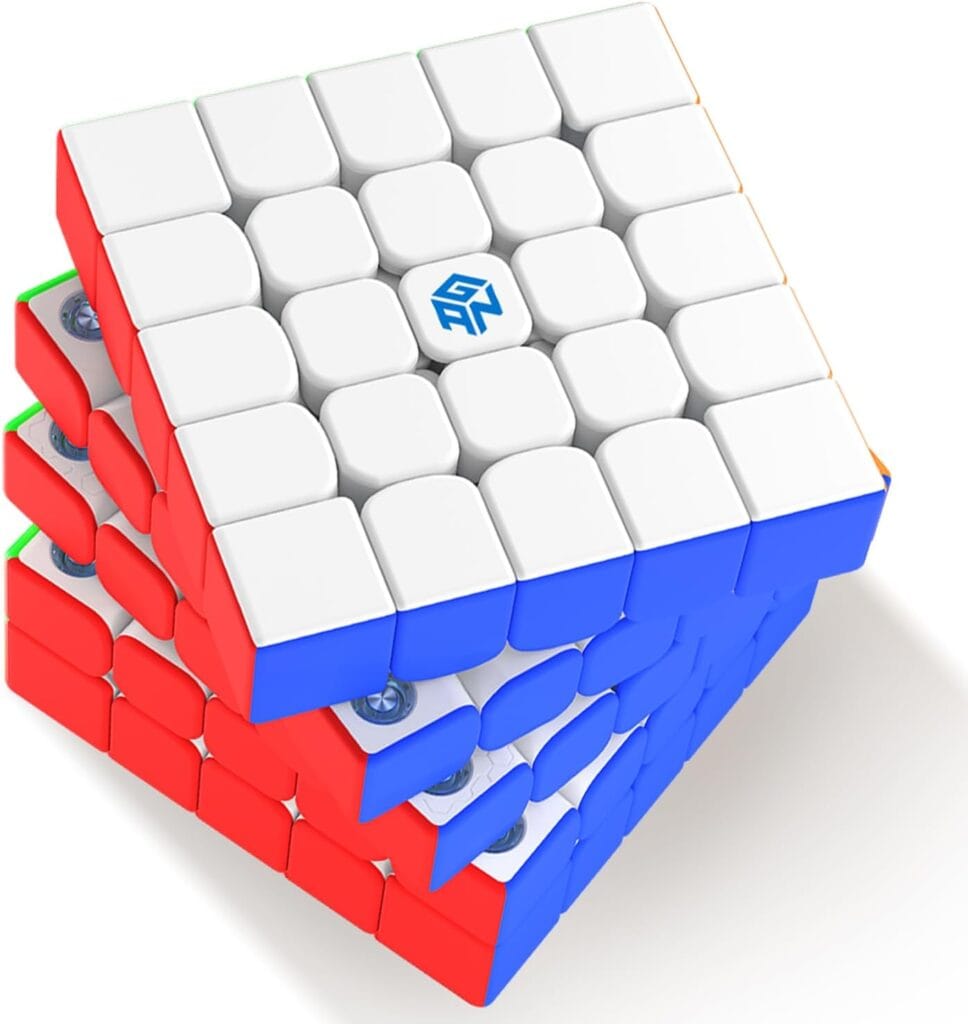
Premium Pick
GAN562 M is the first GAN 5×5, featuring omnidirectional core positioning and double layer structure.
Equipped with 16 internal and 96 external magnets, delivering precise alignment across 112 directions.
Double layer design stabilizes corner, edge, and center pieces, reducing pop and misalignment issues.
Turbo magnet capsules with 360° locking improve durability and ensure smooth, low friction turning.
Optimized magnet distribution enhances outer layer speed while maintaining inner layer control.
💎
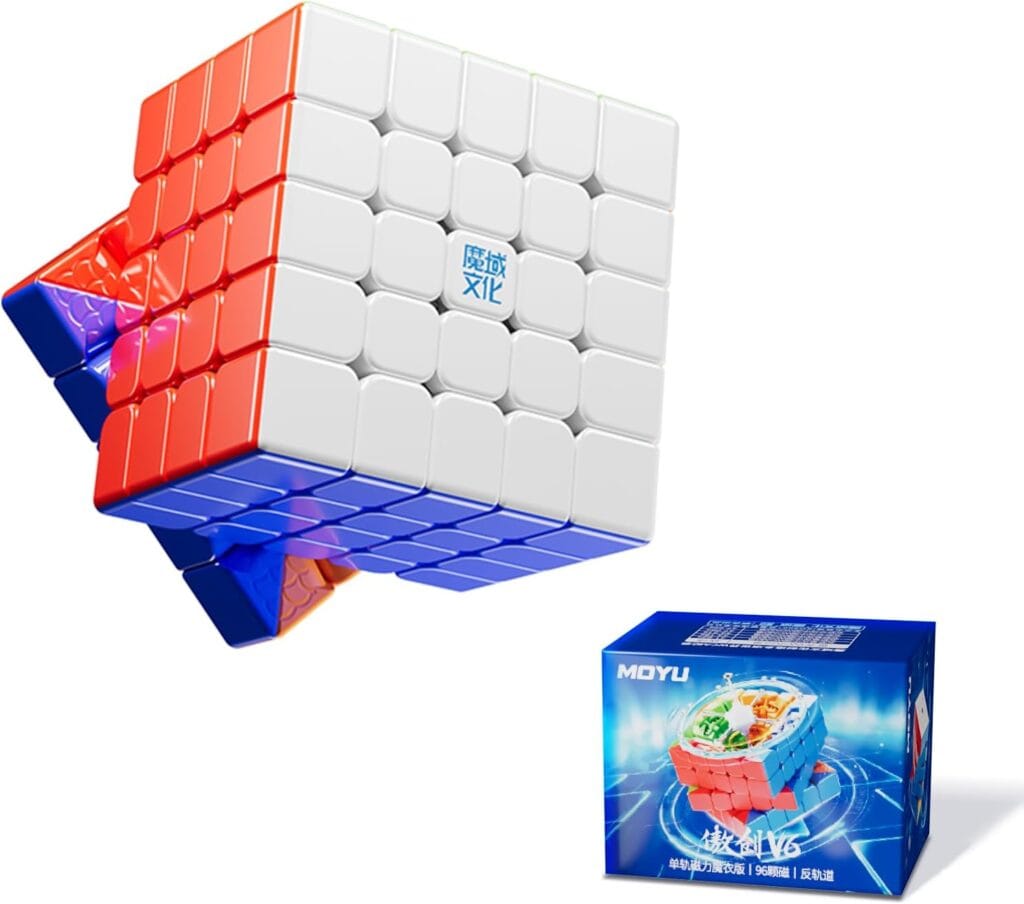
Mid-Range All-Rounder
MoYu Aochuang V6 5×5 features 60.5mm size with improved precision and stability.
Equipped with 96 outer magnets, ensuring accurate alignment and smoother high speed turning.
Six-hole integrated core design reduces misalignment and prevents lockups during fast solves.
V-shaped sections minimize gaps, creating a tighter structure and better control performance.
UV-coated surface with a nano layer provides a smooth feel and durable, full coverage finish.
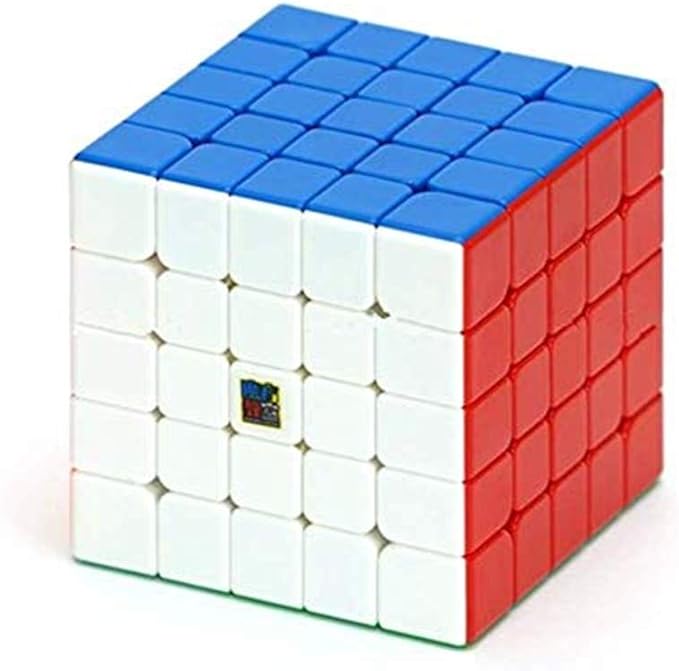
Budget Pick
MeiLong 5×5 M features a magnetic design, delivering stable performance at a lower price.
Suitable for beginners and advanced users, with bright stickerless colors for clear recognition.
Magnetic feel improves alignment and control, supporting a smoother and more consistent solving experience.
Helps develop spatial awareness and memory, making it engaging for kids and family play.
Classic 5×5 puzzle design makes it a popular gift for multiple occasions.
How We Tested
Our assessment team spent several months working through a rotating set of 5×5 speed cubes across a range of ability levels — from someone just learning the reduction method to solvers averaging under 90 seconds. For each cube, we did a minimum of 50 timed solves before concluding, and we tested out-of-the-box performance as well as post-lube-and-setup performance to give a realistic picture of the ownership experience. We evaluated corner cutting by deliberately misaligning layers at various angles during test solves; we assessed inner-layer behavior during center-solving stages, specifically, where inner-layer smoothness matters most; and we stress-tested pop resistance by occasionally forcing turns at awkward angles. We did not pay to be sponsored by any manufacturer, and none of our picks involve paid placement.
Our Top 3 Picks for 5x5 Speed Cubes
Best for: Experienced solvers, competitors, or anyone who wants GAN’s signature feel on a big cube without compromise.
When GAN finally entered the 5×5 market with the 562M, the speedcubing community watched closely. GAN’s 3×3 cubes have long set a standard for surgical precision and out-of-the-box readiness, and the question was whether those qualities would translate to a more mechanically complex puzzle. After spending weeks with the 562M, our answer is: largely yes, with a few caveats.
The GAN 562M’s defining characteristic is its omnidirectional core positioning system — 16 internal magnetic particles paired with 96 external ones, creating what GAN describes as a 112-directional magnetic field. In practice, this means the cube feels exceptionally composed even during fast, aggressive turning. When one of our testers — who averages around 90 seconds on 5×5 — switched to the 562M mid-session, the first thing she said was that it felt like solving on rails. Inner layers snapped into position with a clarity that made mis-executions immediately obvious and easy to correct. That surgical feel is what sets the GAN 562M apart from almost everything else in its class.
The double-layer structure, one of GAN’s key engineering choices here, addresses a long-standing frustration with 5x5s: scattered center caps, misaligned edges, and — worst of all — mid-solve pops. Corner, edge, and center blocks are locked more tightly together than in conventionally built cubes, and our testing bore that out. In hundreds of solves, we didn’t experience a single pop, even at loose tension settings. The outer layers also cut corners at approximately 40 degrees, while inner layers handle around 20–36 degrees, depending on setup, which is competitive with the best on the market.
The cube also requires a slightly longer break-in period than some competitors, and it does come on the tighter side out of the box. A few solves and a light lube application generally bring it to a very comfortable state. And, predictably for GAN, the price is higher than the competition. The 562M is a premium product, and it’s priced accordingly. For solvers who want GAN’s flagship attention to detail on a big cube and don’t mind the investment, it’s genuinely compelling. For casual or first-time 5×5 solvers, though, it may be more cube than the situation calls for.
Trade-offs to know: Higher price point than competitors; comes tight out of the box and benefits from a break-in period; the smallest and lightest cubers might prefer a slightly larger form factor.
Best for: Intermediate to advanced solvers who want top-tier performance at a more accessible price; also, our most versatile pick overall.
The MoYu AoChuang V6 may be the most complete value proposition in the current 5×5 market. It comes in multiple configurations — Single Track (96 magnets), Dual Track (112 magnets with ball-core), and Triple Track (160 magnets with ball-core and foot magnets) — which means you can essentially buy into the V6 platform at whatever price feels right and upgrade your expectations accordingly. We spent the most time with the Single Track and Triple Track versions, and both impressed us in different ways.
What struck our team first about the V6 was its Dragon Scale piece design, a texture feature on the contact surfaces that reduces friction between pieces during fast turning. The description sounds abstract, but the effect is real: inner layers on the V6 are noticeably more consistent and less grippy than older-generation AoChuang models, and this translates to smoother execution on the centers-solving stage, which is where most solvers burn time. The compact 60.5mm size felt slightly snug at first for a couple of our testers with larger hands, but after a few sessions, they adapted quickly, and the tighter package actually started to feel like an advantage for fingertrick-heavy algorithms.
The Single Track version offers a fast, light, almost airy turning feel that some solvers describe as similar to a well-lubed 3×3. One of our testers, who averages around two minutes, improved his time by roughly 15 seconds in the first week of switching to the V6 Single Track. He attributed it partly to the cube, partly to fresher motivation to practice — honest, useful context. The Triple Track version, meanwhile, adds that ball-core magnetic feel that makes M-layer moves in the 3×3 stage feel confident and precise. The magnets “disappear” during fast outer-layer turns and reassert themselves when you need them, which is exactly the behavior you want. We did note occasional lockups at very fast turning speeds with the Triple Track, though these were trivial to recover from and seemed to decrease significantly after setup and lubing.
The V6 also scores points for practicality: it ships with a display stand and screwdriver, and the adjustment system is intuitive. One note: some testers found the center caps fiddly to remove for tensioning, which is a minor but real inconvenience during setup. Overall, though, the AoChuang V6 does an excellent job of delivering competitive-level hardware without GAN’s premium price tag, and it’s currently what our team would put in the hands of most intermediate solvers asking for a recommendation.
Trade-offs to know: Compact size may not suit every hand; occasional lockups at high speeds until properly broken in; center cap removal can be finicky for tensioning.
Best for: Beginners, casual hobbyists, younger solvers, or anyone who wants a decent magnetic 5×5 without a large financial commitment.
Not everyone needs, or should spend money on, a flagship puzzle. If you’re still figuring out the reduction method, or if you’re buying for a teenager who may or may not stick with speedcubing, spending premium money doesn’t make practical sense. The CuberSpeed MFJS MeiLong 5×5 M is the cube we’d confidently hand to someone in that position. It doesn’t perform like a flagship — and it doesn’t pretend to — but it does a lot of things right for its price category.
The MeiLong 5×5 M comes with factory-installed magnets, which is what immediately separates it from truly entry-level non-magnetic 5x5s. Those magnets make a real difference in feel: layers align more predictably, the cube stays more stable during algorithm execution, and the overall experience is noticeably more pleasant than budget competitors without a magnetic system. Out of the box, the cube tends to run a little fast and sandy — that’s pretty typical for this price range — but a light application of lubricant smooths it out considerably and is a worthwhile fifteen minutes of investment.
The MeiLong’s stickerless design is clean and vibrant, and the piece colors are distinct enough to read easily, which matters during longer solves when visual fatigue starts to set in. Corner cutting on the outer layers is solid for the price; inner layers are more limited, and you will occasionally encounter the classic 5×5 lockup during aggressive turning — something that’s manageable once you’re aware of it and adjust your turning style slightly. It’s also worth noting the cube’s size, which is on the smaller side and may feel compact compared to what some solvers expect from a 5×5.
What consistently wins us over about the MeiLong M is its role as a genuine learning tool. Several community members we’ve spoken with credit budget magnetic cubes like this one as the puzzle that made the 5×5 click for them — the improvement in controllability over non-magnetic entry-level alternatives tends to be significant enough to actually change how quickly you learn. If you hit the stage where you’re regularly finishing solves and actively want faster, more precise hardware, upgrading to the AoChuang V6 or the GAN 562M becomes an easy and well-justified next step.
Trade-offs to know: Inner layers can catch during fast or imprecise turning; sandy out-of-box feel benefits from a lubricant; limited corner cutting compared to flagship options; compact size not to every solver’s taste.
Frequently Asked Questions About 5x5 Speed Cubes
What solving method do most 5×5 speedcubers use?
The large majority of 5×5 speedcubers use the reduction method, which involves reducing the cube to a virtual 3×3 by solving centers and pairing edges before executing a standard 3×3 solve. Within that framework, solvers like Tymon Kolasiński have demonstrated that optimizing center and edge-pairing efficiency is where the most competitive time can be recovered.
Does parity happen on a 5×5?
Yes, but only one type: OLL parity, where two adjacent edges appear flipped on the last layer. Unlike the 4×4, the 5×5 does not suffer from PLL parity. OLL parity can generally be spotted just before the 3×3 stage and addressed with a specific algorithm. It’s not as disruptive as 4×4 parity, but it’s still something new 5×5 solvers should learn to recognize early.
Is the 5×5 harder than the 4×4?
In some ways, yes — in others, no. The 5×5 has more pieces and takes longer to solve in absolute terms, but it actually involves fewer parity issues than the 4×4, which can surprise beginners. The inner layers and additional edges add complexity, but experienced 4×4 solvers generally find the transition to 5×5 more intuitive than expected.
How often should I lubricate my 5×5?
It depends on how often you solve. A casual hobbyist might go months between lube applications; someone doing 50+ solves a day may need to lube every few weeks. The general sign that lubrication is needed is when the cube starts feeling dry, gritty, or slowing down noticeably. Budget cubes tend to dry out faster than premium ones due to their piece materials. Good lubricant options include fast silicones like Martian (SpeedCubeShop) or DNM-37 (TheCubicle).
What’s the best 5×5 for competition?
As of early 2026, the GAN 562M and MoYu AoChuang V6 Triple Track are both genuinely competitive choices. The GAN 562M was used by Tymon Kolasiński in world-record-adjacent conditions, and the AoChuang V6 was reportedly used in India’s first-ever sub-40-second 5×5 national record. Both perform at a level that will not be the limiting factor in your competition results — your technique will be.
Caring for Your 5x5
A few quick care tips our team has found genuinely useful:
Lubricate properly. Thin silicone lubes (Martian, Lunar, or similar) work well for outer layers. Slightly thicker options (Weight 5 or Lubicle Black) can be useful on inner layers to slow them down relative to the outers, which makes the 3×3 stage feel more controlled. Don’t over-lube — too much makes the cube sluggish and can take days to work out.
Tension correctly for your style. Looser tensions generally mean faster but less stable turning; tighter tensions slow things down but reduce lockup risk. Most of our picks can be tuned with the included screwdriver. Start slightly looser than the factory default and work from there.
Store carefully. 5x5s have more exposed pieces than smaller cubes and are more susceptible to popping if dropped. A soft storage pouch — which the GAN 562M includes in the box — is a practical way to protect your investment between sessions.
Break it in. Every cube on this list benefits from 20–50 solves before you judge it. Out-of-the-box performance is a starting point, not a ceiling.
Final Thoughts
The 5×5 market has genuinely never been better. Whether you’re willing to spend $60+ on the GAN 562M’s premium engineering, $25–55 on the MoYu AoChuang V6’s thoughtfully tiered value, or under $15 on the MFJS MeiLong M as a starting point, there is a capable magnetic 5×5 at every price level.
Our recommendation structure is pretty straightforward: if you’re serious about competing or already have an established 5×5 practice and want the best hardware, the GAN 562M is hard to argue against. If you want a strong mid-range performer that most solvers will find immediately useful without breaking the bank, the AoChuang V6 — especially the Single Track or Dual Track version — is our top overall pick. And if you’re just starting, the MFJS MeiLong 5×5 M from CuberSpeed gives you a genuinely functional magnetic entry point that will serve you well until you’re ready to step up.