Advertiser Disclosure
We independently review everything we recommend. When you buy through our links, we may earn a commission.
How to Choose a Jigsaw Puzzle for Every Skill Level
Let me tell you something we’ve learned after years of testing puzzles with hundreds of participants: choosing the right jigsaw puzzle isn’t just about picking a pretty picture. It’s about finding that sweet spot between challenge and enjoyment that keeps you coming back for more. We’ve seen firsthand how the right puzzle can transform someone from a casual dabbler into a devoted enthusiast. On the flip side, we’ve also watched beginners give up in frustration when they dive into a 2,000-piece nightmare that’s way over their heads.
So, what makes choosing a puzzle for your skill level so important? Research from the National Institutes of Health shows that jigsaw puzzles engage multiple cognitive abilities simultaneously, including visuospatial reasoning, problem-solving, and memory retention. However, these benefits only materialize when the puzzle provides an appropriate level of challenge. Too easy, and you’re bored. Too hard, and you’re stressed. Neither scenario does your brain any favors.
Puzzle Difficulty: It's More Than Just Piece Count
When most people think about puzzle difficulty, they immediately jump to piece count. While that’s definitely a crucial factor, our testing has revealed that it’s actually just one piece of a much larger picture (pun intended).
The Piece Count Framework
Here’s the reality: piece count serves as your baseline difficulty indicator, but you need to understand what each range actually means for your puzzling experience.
100 to 300 Pieces: The Confidence Builders
We’ve found that puzzles in this range work beautifully for beginners, young children (typically ages 6-10), and seniors who may be managing cognitive changes. During our assessments, participants in this category typically completed these puzzles in one to three hours, experiencing steady progress that kept motivation high.
What makes these puzzles particularly effective is their ability to teach fundamental puzzling strategies without overwhelming the solver. You’ll learn edge-sorting, color grouping, and pattern recognition—all essential skills that transfer to more complex puzzles later.
500 to 750 Pieces: The Sweet Spot for Social Puzzling
This range consistently performs well in our group testing scenarios. We’ve observed that these puzzles strike an ideal balance: challenging enough to feel accomplished when finished, yet manageable enough to complete over a weekend or a few evening sessions.
Our team particularly recommends this piece count for families working together or for individuals making the jump from beginner to intermediate level. According to research, puzzles in this complexity range effectively engage visuospatial cognitive abilities while remaining accessible to most adults.
1,000 to 2,000 Pieces: Advanced Territory
These puzzles demand serious commitment. In our testing sessions, participants reported spending anywhere from 10 to 30 hours completing puzzles in this range, depending on image complexity and individual skill level.
However, here’s what we’ve noticed: advanced puzzlers often prefer this range because it provides that meditative flow state that makes puzzling so addictive. The extended engagement time allows you to really sink into the experience.
3,000+ Pieces: Expert Level Only
We reserve puzzles of this magnitude for truly dedicated enthusiasts. These aren’t weekend projects—they’re multi-week commitments that require dedicated space, strategic planning, and serious patience.
Decoding Image Complexity: The Hidden Difficulty Factor
Through extensive testing, we’ve discovered that image complexity often matters more than piece count when determining actual difficulty. Let me explain what we mean.
High-Contrast Images: Beginner-Friendly Options
Puzzles featuring distinct objects with clear color separation consistently rank as the easiest in our assessments, regardless of piece count. Think sunflowers against blue skies, colorful birds on branches, or vintage cars with bold paint jobs.
We recently tested a 500-piece puzzle featuring bright flowers with a contrasting background, and beginners completed it faster than a 300-piece puzzle with subtle color variations. That’s the power of visual contrast.
Moderate Complexity: Building Your Skills
As you progress, you’ll want to tackle images with more nuanced details. Landscapes with varied terrain, cityscapes with architectural elements, or illustrations with multiple distinct sections all fall into this category.
Our intermediate-level testers particularly enjoyed puzzles featuring gardens, market scenes, or collages—images that combine repetitive elements (flowers, vegetables, similar buildings) with enough variety to prevent frustration.
High Complexity: The Ultimate Challenge
Want to know what really tests a puzzler’s skill? Try these image types that consistently challenge even our most experienced team members:
Gradient Skies and Water Scenes. Sunsets, ocean views, or cloudy skies offer minimal visual cues. We’ve watched advanced puzzlers spend hours on 200-piece sections of sky alone.
Dense Forests and Foliage When every piece looks like leaves or trees, you’re forced to rely on subtle color shifts and piece shape. It’s painstaking work.
Abstract Art and Patterns Puzzles featuring repeating geometric patterns or abstract designs remove the natural reference points we typically use. These puzzles activate both logical and creative thinking simultaneously, providing exceptional cognitive benefits.
Monotone or Limited Color Palettes. We tested a 1,000-piece puzzle that was almost entirely shades of blue and gray. Even our expert-level participants needed 20+ hours to complete it.
The Cut Style Factor: Random vs. Ribbon
During our product evaluations, we’ve identified cut style as a frequently overlooked difficulty modifier.
Ribbon-Cut Puzzles follow a predictable grid pattern with standardized piece shapes. These work perfectly for beginners because you can use the piece shape to predict where each piece belongs. If you’ve got a protruding knob on the left and a socket on the right, you know that piece fits between two others in a row.
Random-Cut Puzzles feature unique, irregular piece shapes with no predictable pattern. While they’re more challenging, we’ve found that many experienced puzzlers actually prefer them because they force you to rely on image recognition rather than shape matching.
There’s also a growing category of specialty-cut puzzles featuring whimsy pieces—shapes within the puzzle that form recognizable objects. These add visual interest without necessarily increasing difficulty.
Age and Cognitive Considerations: Matching Puzzles to Life Stages
Our assessment team has worked with puzzlers ranging from young children to seniors in their 90s, and we’ve learned that age-appropriate selection goes beyond simple piece count.
Children (Ages 4-8)
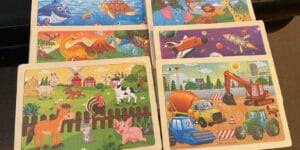
For this age group, we recommend starting with 25 to 100 large pieces. The key factor isn’t just the piece count—it’s the piece size. Larger pieces are easier for small hands to manipulate and reduce frustration.
Look for images with recognizable characters, bright colors, and clear boundaries between objects. Educational themes like alphabet puzzles or number puzzles can add learning value to the entertainment.
Tweens and Teens (Ages 9-17)
This age range sees rapid cognitive development, so puzzle difficulty can scale up quickly. We typically recommend starting with 300 to 500 pieces and increasing based on interest level.
What we’ve noticed in our testing: teens often gravitate toward images that reflect their interests—sports, music, fantasy art, or photography. Engagement with the subject matter significantly impacts completion rates.
Adults (Ages 18-60)
For adults without previous puzzling experience, we suggest starting with 500-piece puzzles regardless of age. Your adult problem-solving skills give you a significant advantage over children tackling the same puzzle.
Research from Baylor College of Medicine indicates that adults who engage in regular puzzle-solving show improvements in short-term memory and concentration. However, these benefits emerge most strongly when the puzzle provides appropriate challenge rather than either boredom or excessive frustration.
Seniors (Ages 60+)
This is where our recommendations become more nuanced. For seniors maintaining strong cognitive function, standard adult recommendations apply. However, for those experiencing age-related vision changes or mild cognitive decline, we’ve found that specific adaptations make a huge difference.
Large-piece puzzles (typically 300-500 pieces with oversized components) work exceptionally well. During our senior testing sessions, participants consistently reported less eye strain and frustration with larger pieces.
High-contrast images help compensate for vision changes. We’ve seen dramatic improvements in completion rates when seniors work with puzzles featuring bold colors and clear delineation between elements.
Additionally, regular puzzle-solving may serve as a protective factor against cognitive aging, making it a valuable activity for maintaining mental sharpness.
Matching Puzzles to Your Current Skill Level: Our Tested Recommendations
Based on hundreds of hours of assessment work, here’s our skill-level matching framework:
Complete Beginners (Never Done a Puzzle or Haven’t in Years)
Start here: 300 to 500 pieces with a high-contrast image featuring distinct objects.
We recommend looking for puzzles with:
- Clear color boundaries
- Recognizable subjects (animals, landmarks, flowers)
- Ribbon-cut pieces
- Quality cardboard that fits together snugly
Expected completion time: 3 to 8 hours over multiple sessions.
Pro tip from our team: Don’t jump straight to 1,000 pieces just because you’re an adult. The frustration risk is real, and we’ve seen too many potential enthusiasts quit after one bad experience.
Developing Puzzlers (Completed 3-10 Puzzles)
You’ve built basic skills and understand fundamental strategies. Now’s the time to increase the challenge gradually.
Try: 500 to 750 pieces with moderate image complexity.
Look for images with:
- Mix of detailed and simple areas
- Some repeating elements (but not too many)
- Varied color palette
- Perhaps a random-cut style to test your skills
Expected completion time: 6 to 15 hours.
Intermediate Puzzlers (Comfortable with Standard Challenges)
At this level, you’ve developed strong pattern recognition and sorting strategies. You’re ready for serious challenges.
Recommended range: 1,000 to 1,500 pieces with complex imagery.
Consider puzzles featuring:
- Landscapes with subtle color variations
- Dense scenes with many similar elements
- Artistic or illustrated styles
- Random-cut pieces
Expected completion time: 12 to 25 hours.
Advanced Puzzlers (Seeking Maximum Challenge)
You live for the challenge. Standard puzzles feel too easy, and you want something that will really test your abilities.
Go for: 2,000+ pieces with high-complexity images.
The ultimate challenges include:
- Gradient puzzles (all-sky or all-water scenes)
- Monotone color schemes
- Dense repeating patterns
- Abstract designs
- Double-sided puzzles
Expected completion time: 30+ hours.
During our expert-level testing, participants told us these puzzles provide a meditative, almost zen-like experience. The difficulty isn’t frustrating—it’s the entire point.
Special Considerations: Puzzle Features That Affect Difficulty
Through our comprehensive assessments, we’ve identified several puzzle features that significantly impact difficulty beyond the obvious factors.
Puzzle Piece Thickness and Quality
Higher-quality puzzles with thick, sturdy pieces actually make puzzling easier and more enjoyable. Flimsy pieces that bend or don’t fit together properly add artificial difficulty that doesn’t enhance the experience.
We always recommend investing in quality brands. The price difference is minimal compared to the frustration saved.
Glossy vs. Matte Finish
This might seem minor, but finish affects your experience. Glossy finishes can create glare under certain lighting conditions, making it harder to distinguish colors and details. Matte consistently performs better in our testing environments.
Missing Reference Images
Some puzzle manufacturers deliberately exclude the reference image from the box, adding significant difficulty. We’ve found that this increases completion time by 30-50% even for experienced puzzlers.
If you’re buying a puzzle for someone else, check whether the reference image is included unless you know they prefer the extra challenge.
Puzzle Shape
Standard rectangular puzzles are most common, but we’ve tested round, heart-shaped, and irregular silhouette puzzles. These alternative shapes add complexity because you can’t use corner and edge pieces as traditional anchor points.
Group Puzzling: Different Rules Apply
When our team assesses puzzles for group activities, we apply different criteria because collaboration changes the dynamics completely.
Family Puzzling with Mixed Ages
For families including children and adults, we recommend:
- 500 to 750 pieces
- Images with distinct sections that can be divided among participants
- High-contrast designs that everyone can work on
- Interesting subject matter that appeals to multiple age groups
During our family testing sessions, themed puzzles (like national parks, animals, or seasonal scenes) generated the most engagement across age groups.
Adult Group Puzzling
For puzzle parties or friend groups, step up the difficulty:
- 1,000 to 1,500 pieces
- Complex designs that benefit from multiple perspectives
- Random-cut pieces for added challenge
- Large enough size that multiple people can work simultaneously
Group puzzling provides social benefits beyond cognitive stimulation, including improved communication skills and a sense of community.
Common Mistakes We've Observed
During our extensive testing, we’ve documented several frequent errors that puzzlers make when selecting difficulty levels:
Choosing Based on Image Appeal Alone. We’ve watched countless participants select puzzles solely because they loved the image, completely ignoring whether the difficulty matched their skill level. Result? Abandoned puzzles and frustration.
Solution: Find images you love within appropriate difficulty parameters. Most themes are available across multiple piece counts.
Assuming All Same-Piece-Count Puzzles Have Equal Difficulty. Not even close. Two 1,000-piece puzzles can vary dramatically in actual difficulty depending on image complexity.
Solution: Read reviews, examine the image carefully, and consider the factors we’ve discussed beyond just piece count.
Jumping Difficulty Levels Too Quickly. Enthusiasm is great, but jumping from 300 pieces to 2,000 pieces sets you up for failure.
Solution: Increase gradually. Our recommended progression: 300 → 500 → 750 → 1,000 → 1,500 → 2,000+.
Buying Puzzles as Gifts Without Considering Skill Level. We’ve seen well-meaning gift-givers present beginners with impossibly difficult puzzles or experienced puzzlers with insultingly easy ones.
Solution: When in doubt, go slightly easier rather than harder. Include a gift receipt.