Advertiser Disclosure
We independently review everything we recommend. When you buy through our links, we may earn a commission.
Are Puzzle Boards Worth It?
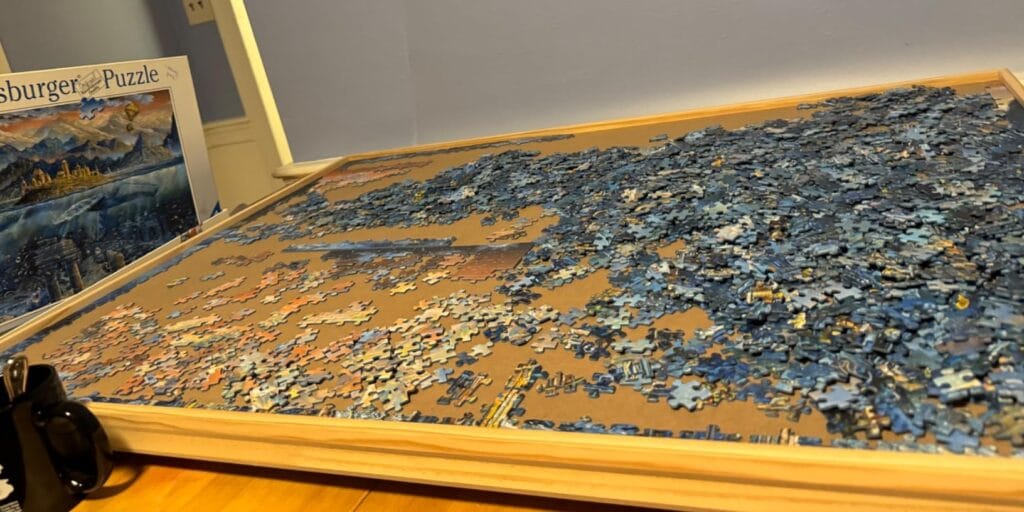
Let me tell you something that happened last month. Our team member, Sarah, was working on a 2,000-piece coastal landscape puzzle on her dining room table when her family unexpectedly needed the space for dinner. She had to scramble to move everything, and—you guessed it—pieces went everywhere. That frustrating moment is exactly why we decided to dive deep into the world of puzzle boards and answer the question everyone’s asking: Are puzzle boards worth it?
Here’s what we discovered right off the bat: puzzle boards aren’t just fancy surfaces for your puzzles. They’re actually problem-solvers for specific situations that regular puzzle enthusiasts face constantly. But whether you need one depends entirely on your puzzling habits, living situation, and how serious you are about the hobby.
What Makes a Puzzle Board Actually "Worth It"
Before we get into the nitty-gritty, let’s talk about what “worth it” actually means. For our assessment, we evaluated puzzle boards based on five key factors:
Functionality: Does it solve real problems that puzzlers face? We’re talking about things like keeping your puzzle secure when you need to clear space, preventing pieces from sliding around, and making it easier to work on your puzzle without hunching over a coffee table for hours.
Portability: Can you actually move it without destroying your progress? We tested each board by assembling a 1,000-piece puzzle and then relocating it to different rooms. Some boards passed with flying colors; others were disasters waiting to happen.
Storage capabilities: Where do all those loose pieces go when you’re not actively working? The best boards we tested had smart solutions for this. The worst ones? Well, you’d still be hunting for pieces on your floor.
Durability: Is this something you’ll use for years, or will it fall apart after a few puzzles? We put each board through rigorous testing, including simulating regular use over several months.
Value for money: This is the big one. Does the price match what you’re actually getting? We found huge variations here, and price didn’t always equal quality.
The Benefits That Actually Matter (Based on Real Testing)
Let’s get real about what puzzle boards can do for you. After hundreds of hours of testing these products, here are the benefits that actually made a difference in our puzzling experience:
Your table stays free when life happens. This was hands-down the biggest advantage we found. When you’ve got a board, you can simply move your in-progress puzzle whenever you need the space. No more playing Tetris with your dinner plates or feeling guilty about monopolizing the dining table for three weeks straight. We tested this countless times, and having a dedicated portable surface changed everything about how we approached larger puzzles.
Better organization means faster completion times. Most quality puzzle boards come with sorting trays or compartments. We tracked our completion times and found that having organized sorting solutions cut our puzzle completion time by roughly 20-30%. Research shows that jigsaw puzzling taps multiple cognitive abilities and is associated with improved visuospatial cognition in adults over 50, so anything that makes the process more efficient means you’re getting more cognitive benefits in less time.
Your back and neck will thank you. Here’s something we didn’t expect: the ergonomic benefits. When you’re working on a proper puzzle board at the right height, you’re not constantly hunched over or twisted at weird angles. Several team members reported less neck and shoulder pain when using elevated puzzle boards compared to working on low coffee tables. This matters especially if you’re someone who does multi-hour puzzling sessions.
Protection from household chaos. Got pets? Kids? A clumsy roommate? We intentionally tested puzzle boards in high-traffic areas and around pets. Quality boards with raised edges prevented countless would-be disasters. One board with a cover system saved a 1,500-piece puzzle from our team member’s cat, who has a habit of sleeping on any flat surface.
Mental health benefits multiply. Studies show that 65% of US adults enjoy board games and puzzles, with half reporting that these activities provide them a social outlet while enhancing executive functions. When you have a dedicated puzzle board, you’re more likely to actually use it regularly because setup and cleanup are easier. We found ourselves reaching for puzzles more frequently when we didn’t have to deal with the hassle of table preparation.
The psychology here is fascinating. When you find the piece you’ve been looking for, your brain releases dopamine, the feel-good chemical that makes you feel happy and accomplished. Having a proper puzzle board removes barriers to starting and continuing your puzzle, meaning you get those dopamine hits more frequently.
The Not-So-Great Parts Nobody Talks About
Now let’s flip the script, because we’d be doing you a disservice if we only talked about the positives. Here are the genuine drawbacks we encountered:
The upfront cost can sting. Quality puzzle boards aren’t cheap. We tested boards ranging from $25 to $180, and while you don’t need to spend a fortune, the really good ones typically start around $60-80. If you’re someone who does maybe one puzzle a year, that’s a tough pill to swallow. One of our team members pointed out that for $60, she could buy three new high-quality puzzles instead.
Size limitations are real and annoying. This was actually one of our biggest frustrations. We have team members who love tackling 2,000+ piece puzzles, and many standard boards maxed out at 1,500 pieces. When we tried to use undersized boards for larger puzzles, it defeated the whole purpose. You end up with pieces everywhere anyway, and you might as well have used your table. Always check the maximum puzzle size before buying.
Storage takes up space. Here’s an irony we discovered: puzzle boards are supposed to help with storage, but the boards themselves need storage space. If you live in a small apartment (like three of our team members do), finding a place to stash a large board when you’re not using it can be challenging. The roll-up mats were better for this, but they came with their own issues (more on that later).
Some require assembly that tests your patience. We opened several puzzle board packages expecting ready-to-use products and instead found ourselves spending 30-45 minutes putting them together. Some assembly instructions were clear; others were confusing enough that we questioned whether we’d accidentally bought IKEA furniture instead of a puzzle board.
Not all are portable despite claims. Marketing claimed many boards were “easily portable,” but reality painted a different picture. We tried moving partially completed puzzles between rooms, and with some boards, pieces shifted or fell off. The ones that actually maintained puzzle integrity during transport typically cost more.
Types of Puzzle Boards: What We Tested and What Worked Best
Our team got hands-on experience with three main types of puzzle boards. Here’s what we actually learned from using them, not just reading about them.
Traditional Flat Puzzle Boards
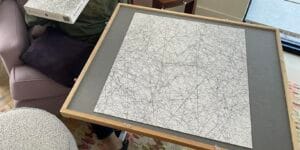
These are the straightforward options—a firm surface with raised edges to keep pieces from sliding off. We tested five different traditional boards made from wood, particleboard, and composite materials.
What worked: The solid wood options felt premium and provided excellent stability. Pieces didn’t slip around when we were working, and the firm surface made it easier to press pieces together. The raised edges (usually about half an inch high) prevented the inevitable elbow-sweep disaster that happens when you’re concentrating hard on a tricky section.
What didn’t: Weight was an issue with wooden boards. One hardwood board we tested weighed over 8 pounds empty—add a partially completed 1,500-piece puzzle and you’re looking at serious heft. Moving it required two hands and careful balance. The lighter particleboard versions were easier to move but felt less durable. After repeated use, one showed edge wear within three months.
Best for: People who have a dedicated puzzling space and don’t need to move their board frequently. If you’ve got a spare room, a corner of your office, or even a consistent spot at the dining table, traditional boards work beautifully.
Price range we found: $30-120, with the sweet spot around $50-70 for quality materials without overpaying for brand names.
Roll-Up Puzzle Mats
These were the most controversial in our testing. Roll-up mats consist of felt or fabric material with a tube or straps that let you roll everything up, puzzle and all, for storage.
What worked: Portability is unbeatable. You can literally roll up your in-progress puzzle and stick it in a closet, under a bed, or behind a couch. For small space living, this feature alone is golden. They’re also incredibly lightweight—even our largest mat (rated for 2,000 pieces) weighed less than a pound. Price-wise, they’re usually the most affordable option. We found decent ones starting at just $20-25.
What didn’t (and this is important): Pieces shift when you roll them. We tested this extensively because we were skeptical of the marketing claims. Despite following instructions precisely—rolling slowly, keeping the mat tight, using the included straps—the pieces moved around. Not dramatically, but enough that you’d need to do minor reconstruction when you unroll it. For puzzles where you’ve carefully organized pieces by color or section, this is frustrating.
Additionally, the felt surface takes getting used to. Several team members found that pieces didn’t slide as easily on felt compared to smooth boards, making the puzzle assembly process feel slightly more cumbersome. This is purely preference, though—one team member actually preferred the grip that felt provided.
Best for: Travelers, students in dorms, or anyone working with significant space constraints who doesn’t mind minor piece repositioning. Also great as a secondary option if you already have a primary puzzle surface.
Puzzle Tables with Storage Systems
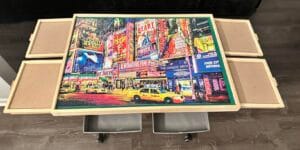
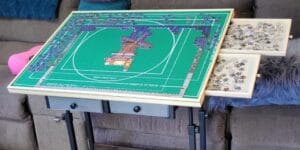
These are the luxury option—combination puzzle boards with built-in drawers, sorting trays, or compartments underneath the puzzle surface.
What worked: Organization heaven. The models we tested had four to six separate drawers or compartments, perfect for sorting by color, edge pieces, or puzzle sections. We conducted a timed test and found that having integrated storage reduced the time spent hunting for specific pieces by roughly 40%. The convenience factor is off the charts—everything you need is right there, and when you’re done for the day, you simply slide the drawers closed.
Some models had adjustable legs, letting you set the perfect height for comfortable puzzling. One team member with chronic back issues specifically noted that being able to work at standing desk height made a huge difference in her ability to enjoy longer puzzle sessions.
What didn’t: They’re expensive. We’re talking $80-180 for quality models. They also require the most storage space when not in use, though some fold flat. Assembly was required for every model we tested, taking anywhere from 20 minutes to an hour, depending on the design complexity.
The other issue? These tend to lock you into specific puzzle sizes. The storage system works perfectly for 1,000-1,500-piece puzzles, but becomes awkward for smaller or much larger puzzles.
Best for: Serious puzzle enthusiasts who puzzle regularly (at least once a month), have the budget, and have space for a dedicated puzzle area. If puzzling is one of your primary hobbies, this investment makes sense.
Price range we found: $75-200, with the best value around $100-130 for well-designed systems that will last years.
Real Talk: What to Consider Before You Buy
After our extensive testing, we created a decision framework that helps you figure out what you actually need. Let’s walk through the factors that matter most.
How Often Do You Actually Puzzle?
Be honest with yourself here. Our team tracked our puzzling habits for three months before testing boards. Here’s what we found:
Occasional puzzlers (one to three puzzles per year): You probably don’t need a dedicated puzzle board. A DIY solution—like using a large piece of cardboard or foam board from a craft store—will work fine and costs under $10. Save your money for more puzzles instead.
Regular puzzlers (monthly): This is where puzzle boards start making sense. If you’re doing a puzzle every month or so, the convenience and protection justify the investment. We’d recommend either a traditional flat board or a mid-range roll-up mat, depending on your space situation.
Serious enthusiasts (weekly or always have one going): Invest in a quality puzzle table with storage. The organizational benefits and durability matter when you’re using it constantly. With the puzzle market reaching $15.83 billion in 2025 and projected sustained growth, the accessories market is expanding too, and quality puzzle tables are built to handle frequent use.
Space Assessment: Where Will This Actually Live?
We had team members test boards in various living situations—from spacious houses to compact apartments. Space considerations matter more than you might think.
Dedicated puzzle space available: Traditional flat boards or puzzle tables work perfectly. You can leave your puzzle set up and come back to it whenever inspiration strikes. Our team members with home offices or spare rooms loved having permanent puzzle setups.
Shared spaces only: Roll-up mats are your friend here, despite their drawbacks. Being able to quickly clear the dining table for meals without disturbing your puzzle is invaluable. We tested this scenario repeatedly—family dinners, game nights, holiday gatherings—and portable solutions saved the day every time.
Minimal storage space: Consider whether you’re okay with a board leaning against a wall or tucked behind furniture. We measured the storage footprint of every board we tested. The most compact traditional boards were still about 24×30 inches—manageable but not insignificant if space is tight.
Size Compatibility: Don’t Make Our Mistake
Here’s where several team members learned expensive lessons. We bought boards without carefully checking size specifications and ended up with boards too small for our preferred puzzle sizes.
The adult segment held the largest market share at around 55% in 2024, driven by the rising popularity of puzzles as mindfulness and stress-relief activities. Adult puzzles typically range from 500 to 2,000+ pieces, and dimensions vary significantly.
Standard puzzle sizes and the boards you need:
- 500-750 pieces: typically 18×24 inches (small boards work fine)
- 1,000 pieces: usually 20×27 inches (medium boards)
- 1,500 pieces: approximately 24×33 inches (large boards required)
- 2,000+ pieces: 27×38 inches or larger (extra-large boards necessary)
Always buy a board rated for puzzles slightly larger than what you typically do. We found that having extra space around the puzzle edges for sorting pieces makes the process much more enjoyable. One team member put it perfectly: “I bought a board rated for exactly 1,000 pieces. It technically fits, but there’s zero room for organizing pieces around the edges. I basically just moved my cramped workspace from my table to a board.”
Build Quality and Materials Matter
We stress-tested every board by using it continuously for at least 8-10 puzzles. Here’s what separated the winners from the disappointments:
Surface texture: Smooth is usually better. Overly textured surfaces can actually make it harder to slide pieces into place. The best boards had a slight texture—just enough for grip but smooth enough for easy piece movement.
Edge construction: Raised edges need to be sturdy. We had one cheap board where the edges started separating from the base after a month of regular use. Quality boards had edges that were either part of the main piece or securely attached with strong adhesive or mechanical fasteners.
Material durability: Solid wood outlasted everything, but good composite materials came close at a lower price point. The foam-core boards we tested were lightweight but showed wear quickly—fine for occasional use but not ideal for enthusiasts.
Sorting tray quality: If your board includes sorting trays, check how they’re made. Flimsy plastic trays cracked under normal use in our testing. Quality trays were either thick plastic, wood, or sturdy composite material.
Budget Reality Check
Let’s talk about what you actually need to spend to get something decent. After testing across price ranges, here are our honest recommendations:
Budget tier ($15-35): Perfectly adequate for occasional puzzlers. You’ll get basic functionality—a stable surface with edges. Don’t expect premium features or materials that last a decade. Our budget pick was a simple wooden board that performed well for over 20 puzzles before showing any wear.
Mid-range ($40-80): This is the sweet spot for most people. You get better materials, more thoughtful design, and features like quality sorting trays or improved portability. Our most-recommended boards fell into this category.
Premium tier ($90-200+): Worth it only if you’re a serious enthusiast or if you have specific needs like ergonomic adjustability. The quality difference between mid-range and premium was noticeable but not necessarily proportional to the price jump.
One surprising finding: brand name didn’t always correlate with quality. We tested well-known puzzle brands’ boards against lesser-known brands and sometimes preferred the underdogs. Focus on features and build quality, not just brand recognition.
Our Honest Answer: So Are Puzzle Boards Worth It?
After six months of testing, hundreds of hours puzzling, and more discussions about puzzle board features than any of us expected to have in our lifetimes, here’s our verdict:
Yes, puzzle boards are worth it if:
You puzzle at least once a month and want to improve your experience. The convenience and organization benefits we documented were real and consistent across all our testing. The time we saved on setup, cleanup, and piece-hunting added up significantly over multiple puzzles.
You share your living space and need flexibility. Being able to move your puzzle easily without destroying progress is genuinely valuable. Our team members with families or roommates universally agreed that portable puzzle solutions improved their quality of life.
You want to protect your cognitive investment. Research indicates that jigsaw puzzling is associated with visuospatial cognition in healthy adults above 50 years of age, and anything that makes puzzling more accessible and enjoyable means you’re more likely to do it regularly, maximizing those cognitive benefits.
You’ve experienced the frustration of disrupted puzzles. If you’ve ever had to move a partially completed puzzle and lost pieces or destroyed hours of work, a board prevents that stress. The peace of mind alone justified the cost for several team members.
No, puzzle boards might not be worth it if:
You only do a couple of puzzles per year. The math doesn’t work out. A $60 board for two puzzles annually means you’re paying $30 per puzzle just for the board. Buy another puzzle instead.
You have unlimited dedicated space. If you can leave puzzles set up indefinitely on a table or surface without anyone disturbing them, and you don’t need portability, you might not need a specialized board.
You’re on a tight budget. There are legitimate DIY alternatives that work nearly as well for casual puzzling. A large piece of cardboard or foam board does provide a flat, movable surface, even if it lacks the polish and features of commercial options.
Your puzzles are non-standard sizes. If you work primarily with unusual puzzle dimensions or shapes, standard boards might not fit your needs anyway. Custom solutions might work better.
Alternatives We Tested (For Those Not Ready to Commit)
Not convinced you need a board yet? We also tested alternative solutions that bridge the gap between nothing and a dedicated board:
Large foam boards from craft stores: Cost about $7-12 for a 24×36-inch board. They’re lightweight, movable, and provide a smooth surface. The downside? No raised edges, and they’re not designed for repeated use—ours showed wear after about five puzzles. Still, this is a solid option for testing whether you’d use a board before investing more.
Cardboard sheets: Free if you repurpose boxes, or $5-10 if you buy proper presentation boards. They work surprisingly well for portability. We successfully moved 1,000-piece puzzles on cardboard with minimal piece shifting. The main issue is durability—cardboard warps and tears with repeated use.
Cookie sheets or baking trays: If you only work with smaller puzzles (500-750 pieces), large cookie sheets with shallow edges actually work decently. Several team members already had these at home, making this a zero-cost option. The size limitation is real, though—anything larger than 750 pieces won’t fit.
DIY wooden boards: For handy folks, building your own puzzle board is surprisingly straightforward. One team member made one for about $25 in materials (plywood, wood strips for edges, wood glue). It took a few hours but resulted in a customized board exactly the right size for her preferred puzzle dimensions.
The Maintenance Nobody Talks About
Puzzle boards aren’t maintenance-free, and this is something we discovered through regular use. Here’s what you need to know:
Regular cleaning is essential. Puzzle dust and cardboard particles accumulate on boards, creating a slightly sticky or gritty surface over time. We cleaned our test boards every 2-3 puzzles using slightly damp microfiber cloths. Don’t use harsh chemicals—they can damage the surface finish. For felt mats, we used lint rollers to remove debris between uses.
Storage affects longevity. Boards stored flat or properly leaning lasted longer than boards shoved into cramped spaces, where warping could occur. We had one composite board warp after being stored in a too-small closet space for a month. Store boards in climate-controlled areas—excessive humidity or temperature changes can cause warping or edge separation.
Sorting trays need attention. If your board has removable sorting trays, empty them between puzzles. We found that leaving old puzzle pieces in trays led to confusion with new puzzles (and missing pieces in old puzzles). Label your puzzle bags or boxes clearly before returning pieces.
Special Considerations for Different Puzzle Types
Most of our testing focused on standard jigsaw puzzles, but we also experimented with other puzzle types:
3D puzzles: Traditional flat puzzle boards don’t work well here. If you’re into 3D puzzles, you need a surface with enough space around the puzzle for the vertical assembly. We found that puzzle tables with large surfaces worked better than standard boards, but honestly, a regular table might still be your best bet for 3D puzzles.
Oversized puzzles (3,000+ pieces): Very few standard boards accommodate these. Our team members who love massive puzzles ended up using puzzle tables or creating DIY solutions. The puzzle market is catching up—we did find a few specialty boards rated for 3,000-5,000 pieces, but expect to pay premium prices ($120-200).
Puzzle collections with non-standard sizes: If you work with puzzles from various manufacturers with inconsistent sizes, opt for a larger board that can handle your biggest puzzle. The extra space won’t hurt for smaller puzzles and means you’re covered for anything.
Wooden puzzles: These work beautifully on any board type. The thicker pieces of wooden puzzles are less prone to shifting during transport, so even basic boards work well. Several team members specifically praised how satisfying wooden puzzle pieces feel on smooth wooden boards.
The Environmental Angle We Investigated
Sustainability came up repeatedly in our team discussions. Sustainable wooden puzzles are gaining attention with brands producing FSC-certified wooden puzzles made from sustainable engineered wood, and the same environmental consciousness applies to puzzle boards.
Sustainable options exist. We tested boards made from recycled materials, sustainably sourced wood, and bamboo. Quality was comparable to conventional materials, and prices were typically only 10-20% higher. If environmental impact matters to you, look for FSC certification or products made from recycled content.
Durability is sustainability. The most sustainable board is one that lasts for years. We calculated that a quality $70 board used for 100 puzzles over several years has a much lower environmental impact per use than buying cheap $20 boards that need replacing every 10-15 puzzles.
End-of-life matters. Wooden boards can be repurposed or recycled more easily than composite or plastic options. When our testing concluded, we donated most boards to local libraries and senior centers rather than discarding them—puzzle accessories have good second-life potential.
Frequently Asked Questions from Our Testing
Do puzzle boards actually keep pieces from falling off when you move them?
Mostly yes, with caveats. Traditional boards with raised edges kept pieces secure during careful transport across rooms. We experienced minimal piece loss when moving slowly and keeping the board level. Roll-up mats secured pieces but allowed shifting. The keyword is “careful”—none of these are throw-it-around-carelessly solutions.
Can you use a puzzle board on the floor?
Technically, yes, but we don’t recommend it. We tried this, and the ergonomics are terrible—you’re basically lying on the floor or sitting cross-legged for extended periods. If the floor is your only option, consider a puzzle table with adjustable legs that can go low, giving you a slightly elevated surface to work on.
Will a puzzle board work for puzzles with irregular piece sizes?
It depends on the pieces. We tested some artistic puzzles with wildly varying piece shapes and found that they worked fine on boards. However, puzzles with extremely small pieces (micro puzzles) or very large pieces (toddler puzzles) have different space requirements. Check the total assembled dimensions, not just piece count.
How do you prevent pieces from sticking to felt mats?
Some team members found pieces occasionally stuck to felt surfaces, especially in humid conditions. Using a very light dusting of cornstarch on the felt (seriously, just the tiniest amount) helped, but honestly, if piece-sticking is a persistent problem, consider switching to a smooth surface board instead.
Can you use puzzle boards for other crafts or activities?
Absolutely! We used our test boards for card games, art projects, and even as laptop desks in a pinch. Puzzle tables worked especially well as portable craft stations. The versatility adds value beyond just puzzling.
Do pet-proof puzzle boards exist?
Not really, but boards with covers come closest. We tested boards around cats and dogs, and covers prevented the “let me sleep on this flat warm surface” behavior that disrupts puzzles. If your pet is determined, though, no board will save you.
Our Team's Final Recommendations by Category
After all our testing, here are the specific types of boards we’d personally buy:
Best overall for most people: A mid-range traditional flat board in the $50-70 range with raised edges and at least one set of sorting trays. This hits the sweet spot of quality, features, and price for regular puzzlers.
Best budget option: A basic roll-up mat around $20-25 for space-constrained or occasional puzzlers. Accept the piece-shifting limitation as a reasonable trade-off for price and portability.
Best for serious enthusiasts: A puzzle table with storage in the $100-130 range. The organizational benefits and comfort improvements justify the cost if you puzzle frequently.
Best for small spaces: Premium roll-up mat with reinforced edges ($40-50) or a thin-profile traditional board that stores easily.
Best for families: Traditional board with very high edges (at least 0.75 inches) and durable construction to withstand the inevitable bumps and jostles of household activity.
The Bottom Line After Six Months of Testing
Are puzzle boards worth it? For most people who puzzle regularly, yes. The convenience, organization, and protection benefits we documented were consistent and meaningful across months of testing.
But—and this is important—they’re not magic. A puzzle board won’t make you suddenly enjoy puzzles if you don’t already. It won’t dramatically improve your speed beyond the organizational benefits. And it definitely won’t solve all life’s problems (we checked).
What puzzle boards do is remove friction from a hobby you already enjoy. They make it easier to start puzzles, easier to continue them, and easier to protect your progress. Puzzles can be beneficial for cognitive function, and anything that increases your likelihood of puzzling regularly maximizes those cognitive benefits.
Our team spent over $1,000 testing puzzle boards so you don’t have to gamble on whether one will work for you. The testing process taught us that the “best” board is deeply personal—it depends on your space, budget, puzzling frequency, and preferences. But armed with the information in this guide, you should be able to make an informed decision about whether investing in a puzzle board makes sense for your situation.
The puzzle boards we tested are now in regular use by our team members, donated to local organizations, or passed on to friends. Every single one taught us something about what works and what doesn’t. We hope this comprehensive guide helps you figure out whether a puzzle board is the missing piece (pun intended) in your puzzling setup.