Advertiser Disclosure
We independently review everything we recommend. When you buy through our links, we may earn a commission.
The Best LEGO NINJAGO Sets
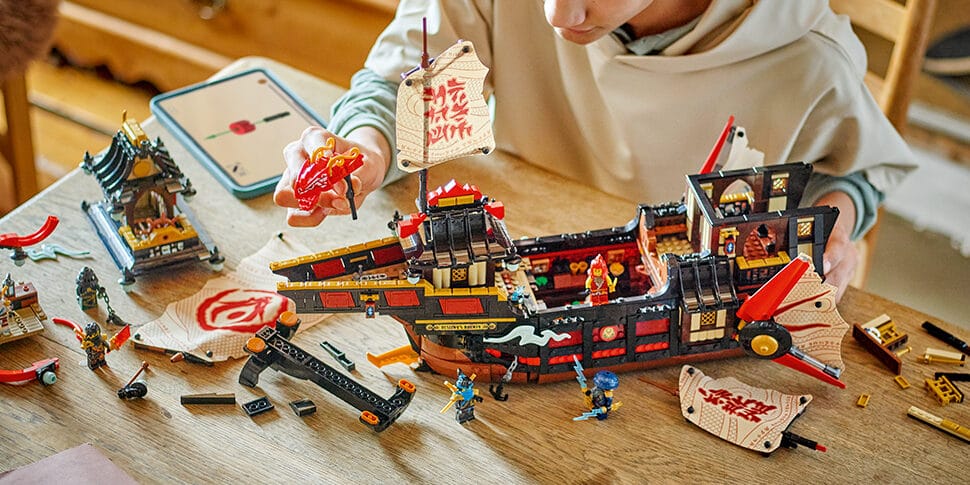
Before we dive into specific sets, let’s talk about what’s happening with NINJAGO right now. The Dragons Rising series has completely revitalized the theme, introducing new characters like Arin, Sora, and Wyldfyre alongside returning favorites. This shift has resulted in sets that balance nostalgia with fresh designs, and honestly? It’s working incredibly well.
The current wave focuses heavily on Season 3 content, which means you’re getting sets tied to active storylines. For kids (and let’s be real, adults) who follow the show, this adds a whole extra layer of value. But even if you’ve never watched an episode, these sets stand on their own merits as fantastic building experiences.
Ready to buy? LEGO NINJAGO The Temple Bounty 71848 is our #1 pick — see it on Amazon
Everything We Recommend
✅ We recommend these products based on an intensive research process that’s designed to cut through the noise and find the top products in this space. Guided by experts, we spend hours looking into the factors that matter to bring you these selections.
⭐ 2.5 million+ people assisted in the last 30 days ⭐
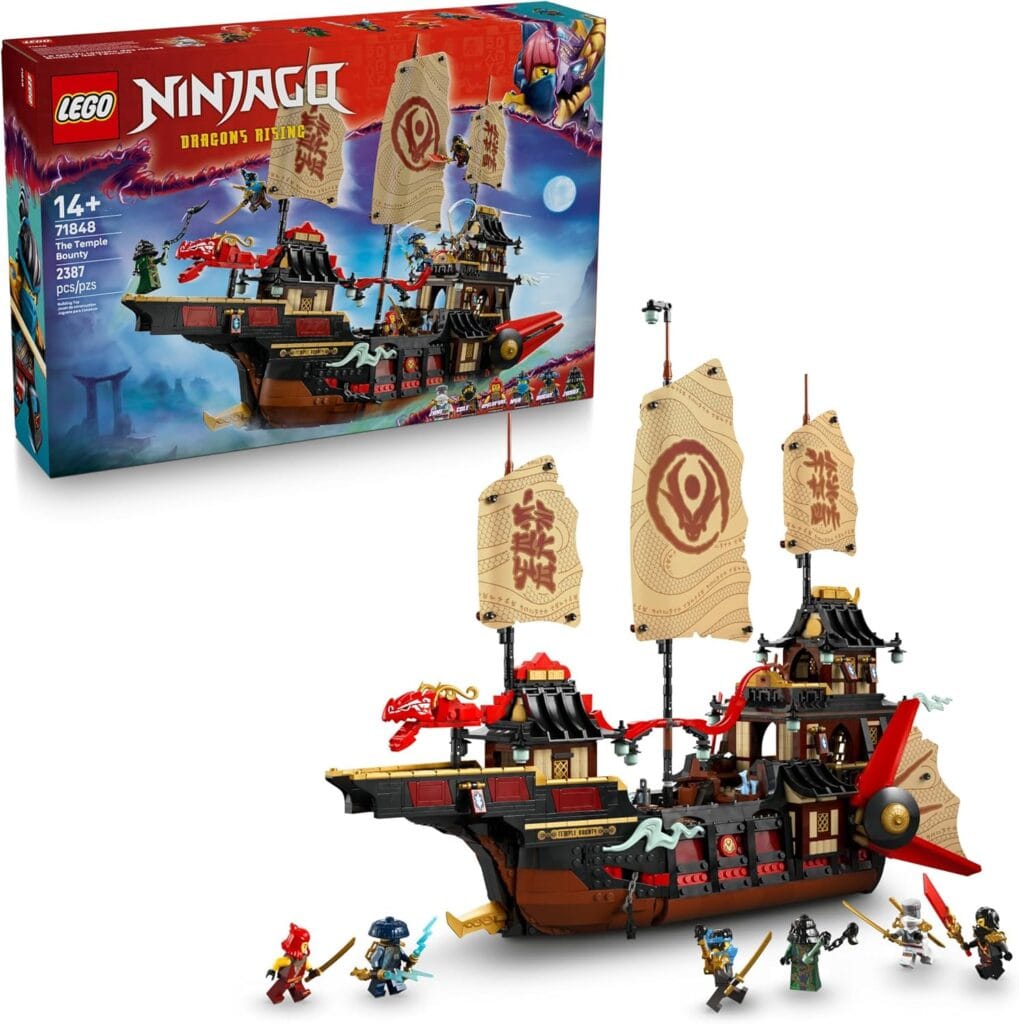
LEGO NINJAGO The Temple Bounty lets fans aged 14 plus build the iconic flagship from Dragons Rising Season 3.
Includes 6 detailed LEGO NINJAGO minifigures with accessories, enabling epic battles and story driven ninja adventures.
Display ready design with included stand transforms the finished build into impressive room decor for teens.
Interactive features include moving sails, removable sections, and a detailed multi level interior with hidden secrets.
This 2387 piece model measures 19.5 inches high and 22.5 inches long when displayed.
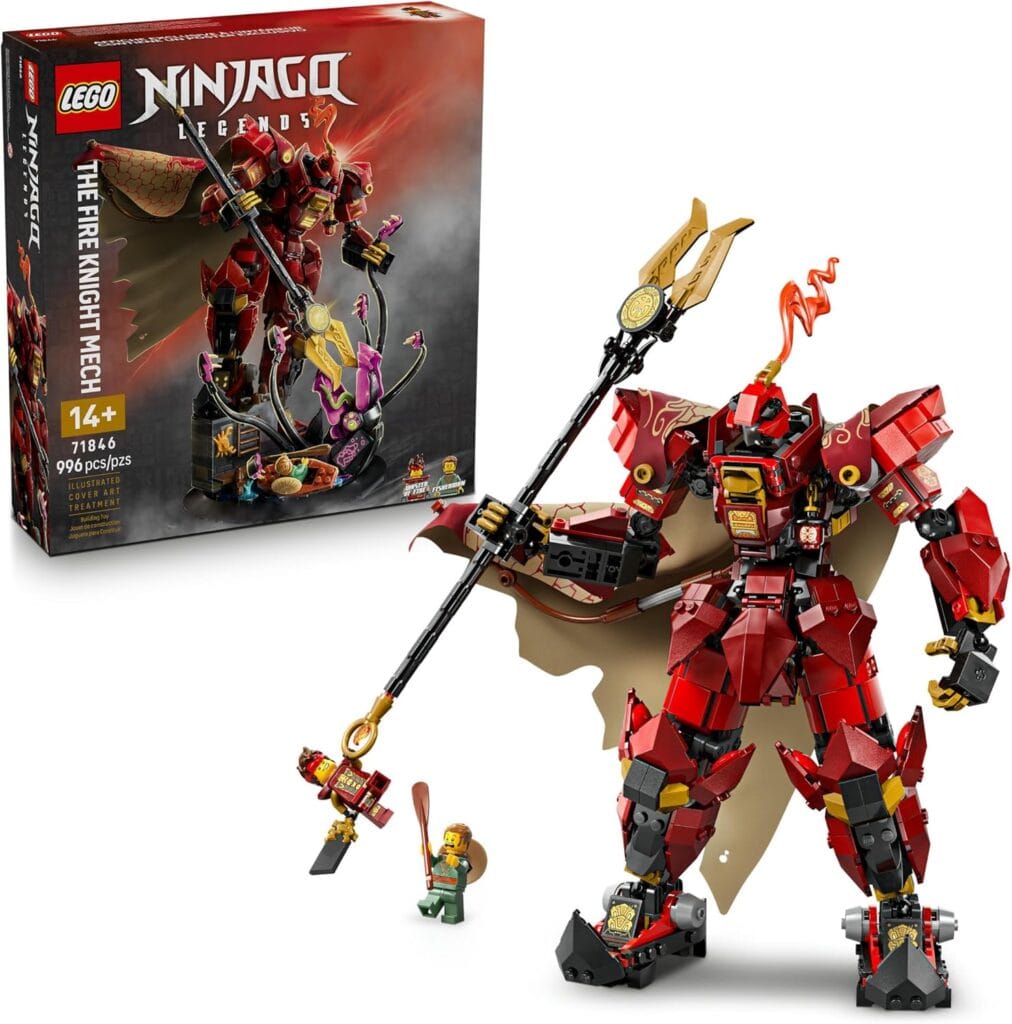
LEGO NINJAGO The Fire Knight Mech lets teens aged 14 plus recreate an epic ninja battle scene.
Poseable mech and ancient sea monster models allow dynamic play or striking display options.
Includes Kai minifigure with magical sword and a fisherman minifigure watching from his boat.
Build and display design creates impressive room decor, with models removable for action play.
This 996 piece LEGO set stands over 10 inches tall on its display stand.
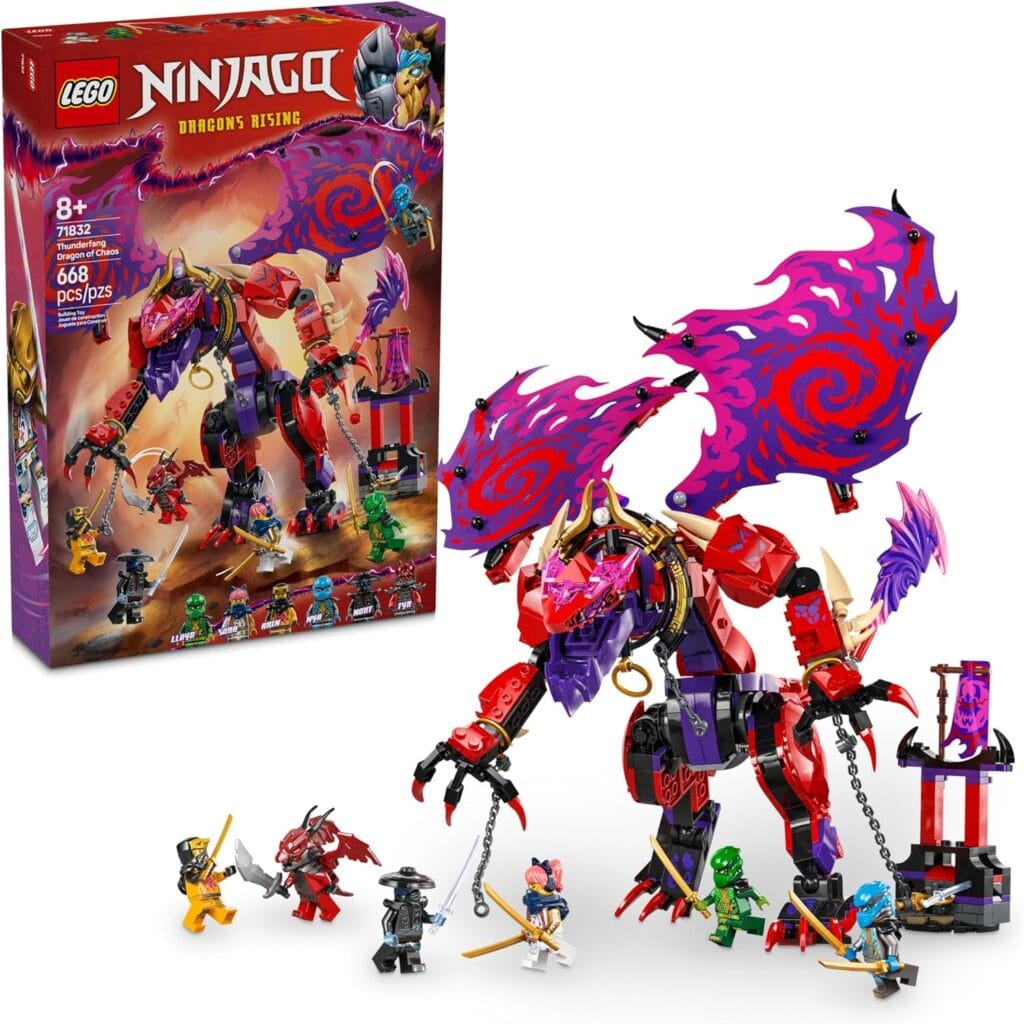
LEGO NINJAGO Thunderfang Dragon of Chaos 71832 lets kids aged 8+ recreate Dragons Rising Season 3 action scenes.
Fully posable dragon features movable tail, legs, wings, head and jaw, plus two wing-mounted stud shooters.
Interactive play design includes chained dragon side build, unlocked using two included prismatic blade accessories.
Includes 6 NINJAGO minifigures: Lloyd, Nya, Arin, Sora, Nokt, and Tyr for good-versus-evil roleplay battles.
668-piece building set creates a 24 cm tall dragon, delivering an engaging build-and-play gift experience.
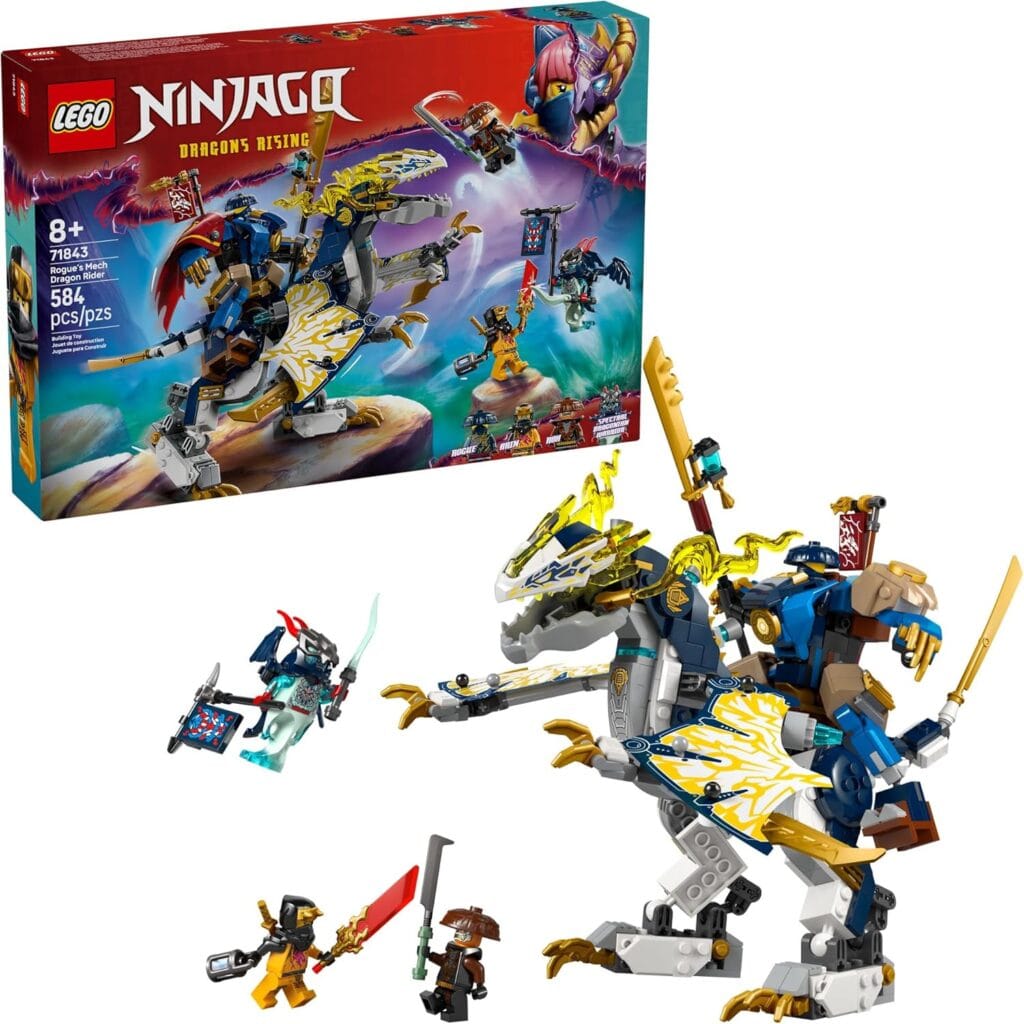
LEGO NINJAGO Rogue Mech Dragon Rider 71843 lets kids aged 8+ control a mech and robotic dragon.
Includes 4 minifigures Rogue Arin Rox and a Spectral Dragonian Warrior with a hidden message banner.
Dual build play allows separate mech and dragon builds or combining them into one Mech Dragon Rider.
Battle features include fully posable mech and dragon plus opening chest movable wings limbs and swords.
This 584 piece set builds a 19 cm tall figure ideal for NINJAGO Dragons Rising fans.
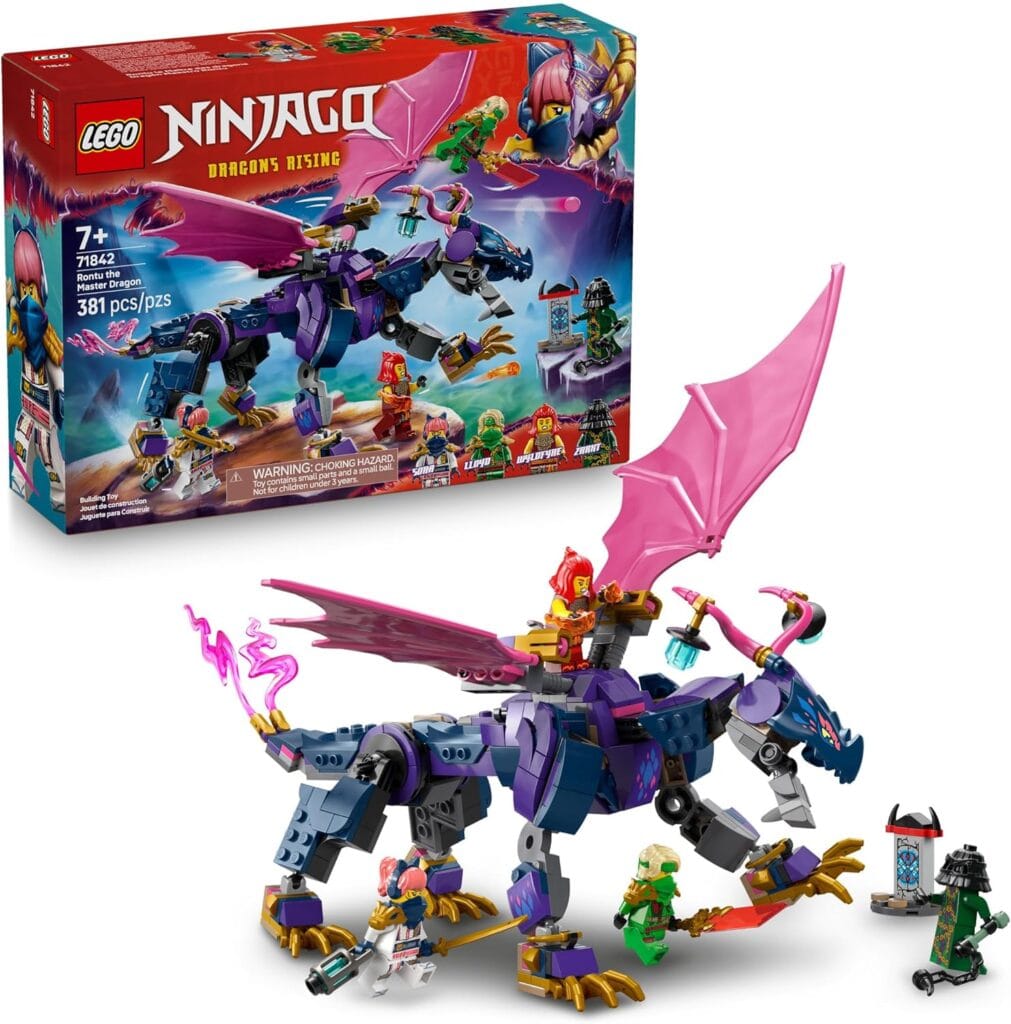
LEGO NINJAGO Rontu the Master Dragon 71842 lets kids aged 7+ command a legendary dragon.
Includes 4 minifigures Lloyd Sora Wyldfyre and villain Zarkt with signature ninja weapons.
Fully posable dragon features movable wings tail legs head jaw plus dual wing stud shooters.
Brick built shrine hides secret messages revealed using Lloyd’s translucent reveal blade accessory.
This 381 piece set builds a 13 cm tall dragon ideal for Dragons Rising fans.
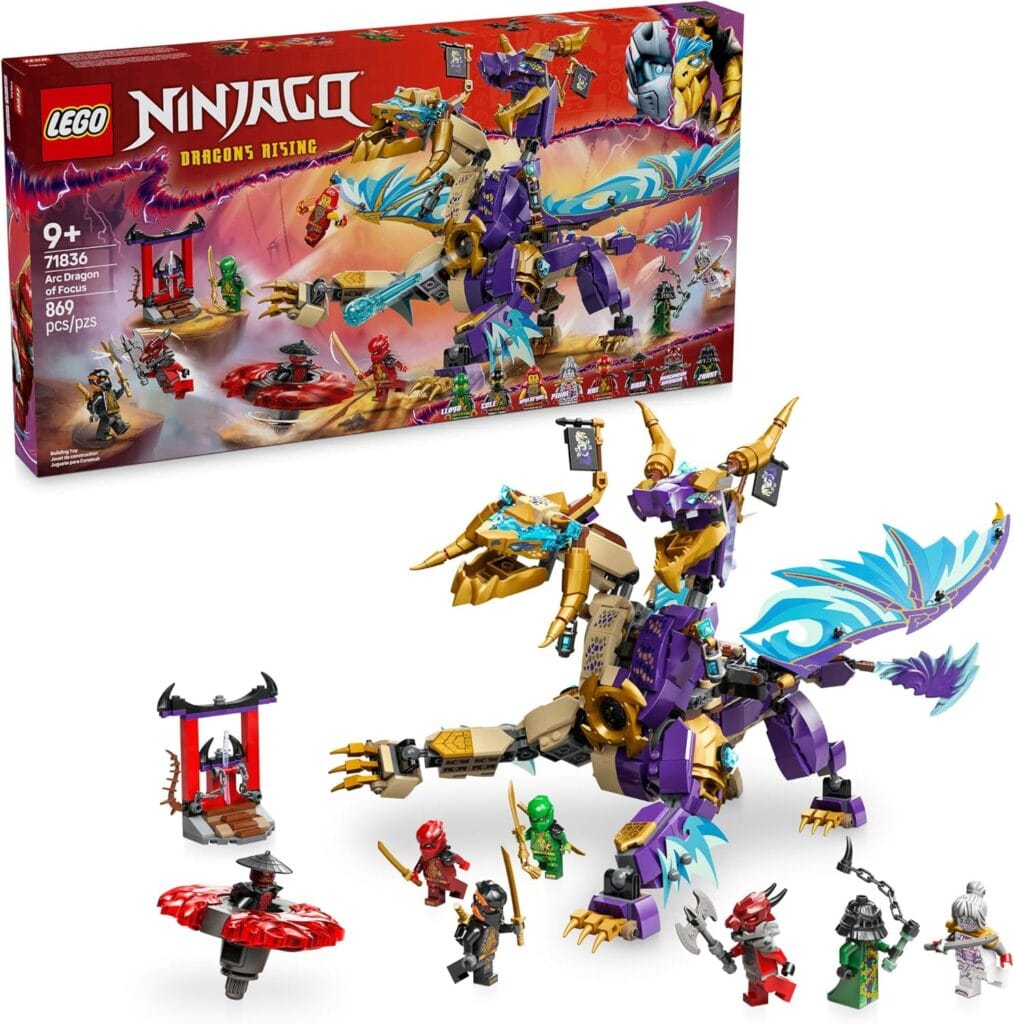
LEGO NINJAGO Arc Dragon of Focus 71836 recreates Dragons Rising Season 3 action for kids aged 9+.
Two headed dragon features articulated heads plus fully posable tail legs neck jaw and claws.
Interactive play includes chest mounted shooter and lever controlled foil wings for dynamic movement.
Includes 8 minifigures Lloyd Cole Wyldfyre Kai Pixal Drix Zarkt and a Dragonian Warrior.
This 869 piece set builds a 27 cm tall dragon with spinjitzu spinner for fast attacks.
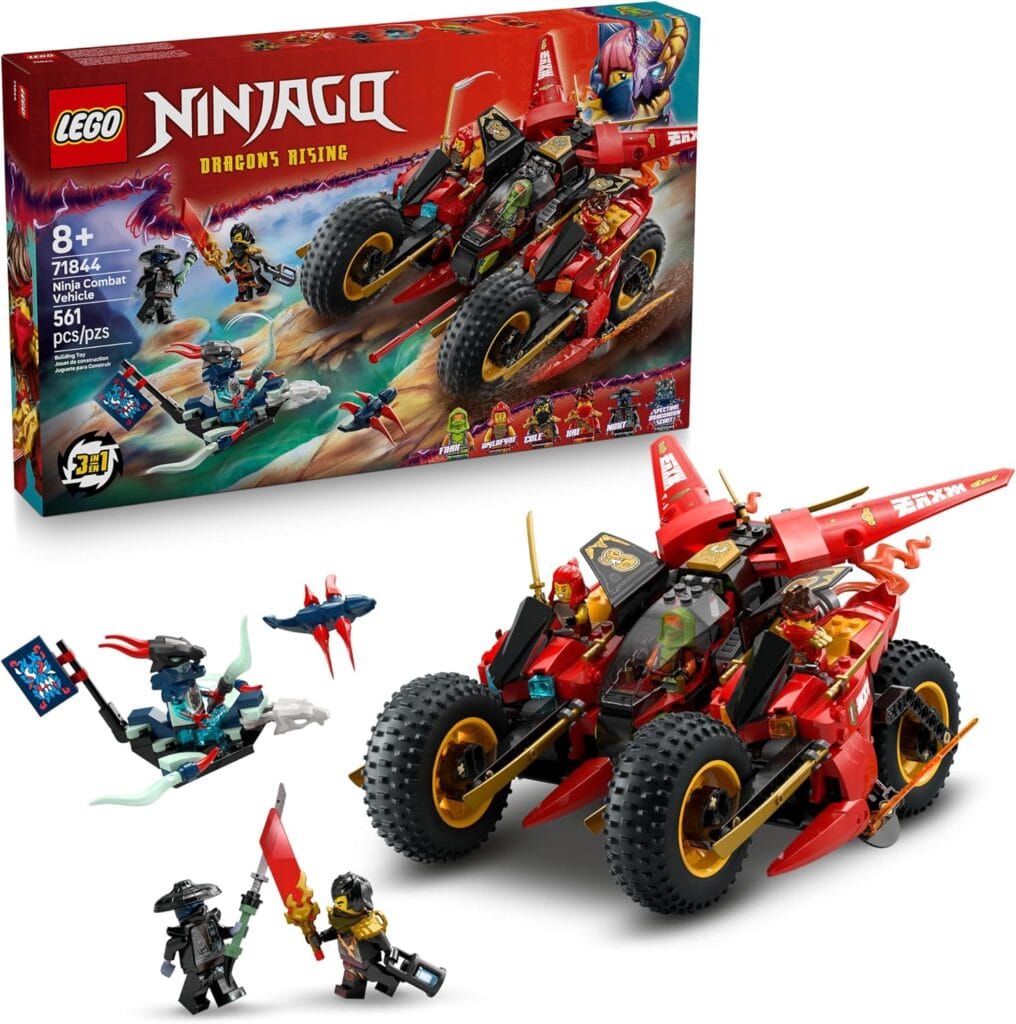
LEGO NINJAGO Ninja Combat Vehicle 71844 lets kids aged 8+ build one vehicle transforming into three.
3 in 1 design separates into Kai and Wyldfyre bikes plus Frak aircraft jet with stud shooters.
Includes 6 minifigures Kai Wyldfyre Cole Frak Nokt and a Spectral Dragonian Scout.
Authentic ninja accessories include golden katanas reveal blade lantern plus villain banner and glider.
This 561 piece set measures 14 cm high 24 cm long and 22 cm wide.
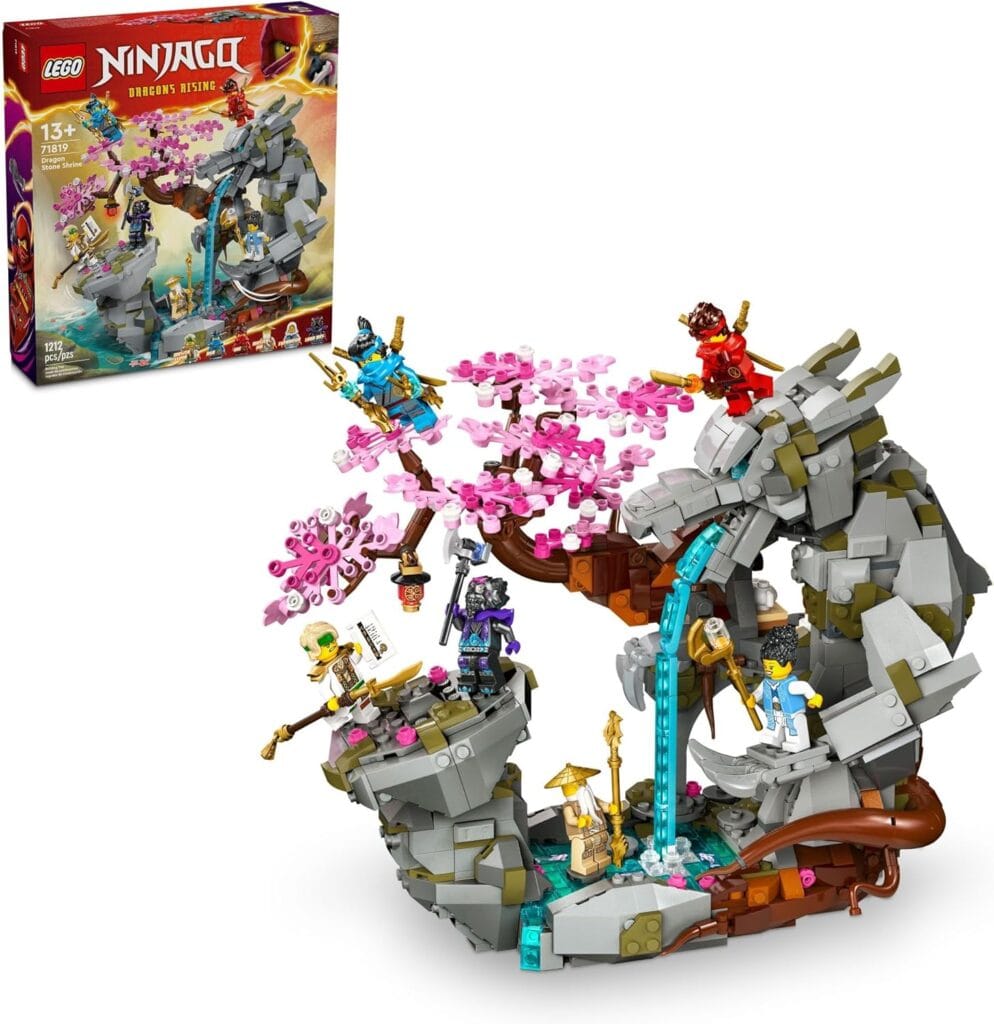
LEGO NINJAGO Dragon Stone Shrine lets builders aged 13+ create a large display packed adventure playset.
Feature rich build includes stone dragon waterfall cherry blossom tree library tea set and hidden room.
Interactive elements allow moving training platform and secret chamber revealed by pushing library books.
Includes 6 minifigures Master Lloyd Master Wu Lord Ras Nya Kai and Euphrasia.
Designed for NINJAGO Dragons Rising Season 2 fans who enjoy detailed builds and storytelling play.
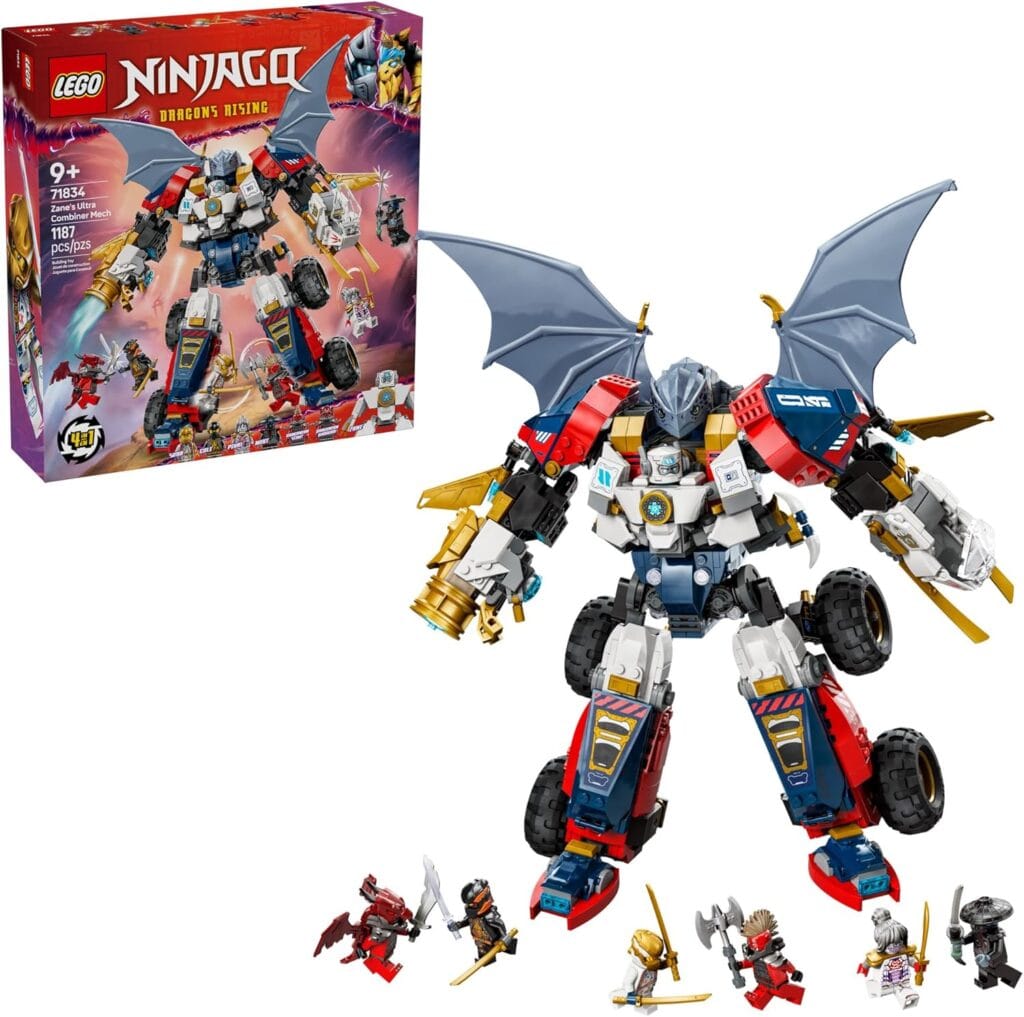
Zane’s Ultra Combiner Mech lets kids aged 9+ recreate NINJAGO Dragons Rising Season 3 action scenes.
Large combiner mech features posable limbs fingers, head, dragon wings, cockpit two shooters and sword.
4 in 1 design separates into a jet car action figure and dragon toy.
Includes 6 minifigures Sora Cole Pixal Nokt a Dragonian Warrior, and a Dragonian Scout.
Impressive build stands over 35 cm tall, delivering an exciting build and play experience.
What Makes a Great NINJAGO Set
Through our testing process, we identified five key factors that separate exceptional NINJAGO sets from mediocre ones. First, the build experience matters more than you might think. Sets that offer interesting techniques and satisfying construction moments keep you engaged from start to finish. Second, playability is crucial for younger builders – the best sets feature mechanisms that actually work reliably, not just gimmicks that break after three uses.
Display value has become increasingly important as LEGO has embraced older fans. Sets that look stunning on a shelf or desk justify their price tag in ways that play-focused sets sometimes don’t. The minifigure selection can make or break a set’s value proposition, especially when exclusive characters are involved. Finally, piece-per-dollar ratio helps determine whether you’re getting fair value, though we’ve found that some premium-priced sets justify the cost through exceptional design.
Top LEGO NINJAGO Sets Our Picks
When we first unboxed The Temple Bounty, we weren’t entirely sure what to expect. Sure, NINJAGO has a history of impressive ship builds, but this one? This one became the crown jewel of our testing process, and honestly, it took over my desk for three straight weeks because I couldn’t bear to put it away.
The 2,387-piece flagship model stands over 19 inches tall when displayed on its included stand, and the presence it commands in a room is genuinely impressive. My colleague Sarah, who normally has zero interest in LEGO, walked into my office, stopped dead in her tracks, and just said, “Whoa.” That’s the kind of visual impact we’re talking about here. But what really got us excited during the build was discovering all the hidden mechanisms throughout the multi-level interior. There’s a gear system that operates the sails – when you turn it, you get this satisfying mechanical movement that just feels right. I caught myself turning those gears during video calls just for the tactile pleasure. We found ourselves playing with it way more than we expected, which is saying something for a set marketed to ages 14+.
The removable roof and floor sections aren’t just a design afterthought. They actually let you access an incredibly detailed interior that includes an authentic sushi bar (yes, really), a fold-down table with a secret computer hidden underneath, and a captain’s quarters featuring an interactive map. Here’s where it gets clever: the set includes translucent reveal blade accessories that actually decode secret messages on the map. I’ll be honest – I rolled my eyes when I first read about this feature. “Secret messages, really?” But then my nephew visited, picked up that reveal blade, held it over the map, and his face just lit up when the hidden text appeared. That moment? That’s what makes this set special. During testing, this became one of those features that seemed gimmicky at first but ended up being genuinely delightful, creating these little moments of discovery that stay with you.
What surprised our team most was how well this serves dual purposes. My testing partner Mike, who’s 42 and has two kids, kept this on his home office shelf for a month. His 10-year-old daughter would come in after school, and they’d spend 20 minutes creating stories with the six minifigures – Zane, Cole, Wyldfyre, Nya, Rogue, and the villainous Zarkt – each with signature accessories. Meanwhile, during his work video calls, colleagues would ask about it in the background. That’s the sweet spot this set hits: it’s a toy kids actually want to play with AND a display piece adults are proud to show off.
The build itself took us roughly 8-10 hours, spread across several sessions. It’s challenging enough to stay engaging, but not so complex that it becomes frustrating. Here’s something I loved: around hour five, when you start building the interior rooms, there’s this moment where everything clicks together, and you suddenly see how the modular design works. It’s like solving a puzzle where the answer is even cooler than you expected. The LEGO Builder app integration worked flawlessly, offering helpful 3D viewing angles when we needed them, though honestly, the printed instructions were so clear that we barely used it.
If you’re looking for the ultimate NINJAGO centerpiece that balances play value with display appeal, this is it. Yes, it’s priced at the premium end – we’re talking about a serious investment here. But after testing dozens of sets, watching how people interact with it, seeing kids create elaborate stories and adults stop mid-conversation to admire the details, we can confidently say it delivers commensurate value. This isn’t a set you buy on impulse. It’s the set you save for, build over a weekend with family, and keep as a centerpiece for years.
Here’s where LEGO did something really interesting with the Legends Monstrosity line. The Fire Knight Mech comes mounted on a dramatic diorama base, depicting a cape-wearing, spear-wielding mech locked in battle with a tentacled sea monster emerging from the waves. At first glance, you might think it’s purely a display piece. We certainly did. But oh man, we were completely wrong, and discovering just how wrong might have been the best surprise of our entire testing period.
The 996-piece mech features articulation that honestly rivals some of the best mechs we’ve built from any LEGO theme. I’m talking double-jointed knees that let you get these deep, powerful stances. Fully posable arms with individual finger articulation that let you create gripping poses or open-handed gestures. A torso that can twist and pivot, adding drama to every pose. What really blew our minds during testing was that you can completely detach the mech from its base for active play. I spent an embarrassing amount of time on a Saturday afternoon posing this thing in different action stances around my apartment, photographing it for “testing purposes.” This isn’t a static model pretending to be posable – it’s a genuinely functional action figure at LEGO scale, and the difference is night and day.
The cape deserves special mention because, frankly, it’s gorgeous. It’s a real fabric piece that drapes naturally over the mech’s shoulders, and while the mounting solution on the base is clever for the diorama display, we found the mech looked even better when we removed it for photography and posed it dynamically. There’s something about that flowing cape combined with the mech’s aggressive stance that just screams “epic battle.” The spear it wields is substantial enough to feel like a proper weapon, not a toothpick accessory – it’s got real presence and weight (figuratively speaking).
Now, about that sea monster. Look, I love it when LEGO designs do more with less, and this creature is a masterclass in that approach. The creature’s design is deceptively simple – a few dragon jaw pieces flipped around to form the mouth, straightforward tentacle construction – yet somehow it conveys this sense of enormous scale. The placement makes it feel like you’re only seeing a fraction of the monster, with most of its bulk lurking beneath the murky depths. During testing, multiple people commented that it looks like something from Pacific Rim or classic kaiju movies. The stickers for the eyes (three-eyed printed pieces) add a genuinely spooky element that elevated the whole presentation. My friend who’s squeamish about ocean creatures actually backed away from my desk when she saw it, which I’m taking as the highest compliment possible for the design.
During our testing, we compared this directly with Cole’s Titan Dragon Mech from last year, which many consider the gold standard for NINJAGO mechs. The Fire Knight Mech is smaller and more expensive per piece, but here’s the thing – the display-oriented design and included diorama make it a different beast entirely. Cole’s Titan is the impressive toy you play with. The Fire Knight is the conversation piece that happens to be fully articulated. It stands 15.5 inches tall on the display stand, creating a serious visual impact on a desk or shelf. One tester cleared an entire bookshelf just to give it proper positioning because, in their words, “this deserves to be seen.”
The set includes Kai with a magical sword (he fits inside the mech’s chest chamber, which has a surprisingly spacious cockpit that doesn’t feel cramped) and a fisherman with a paddle boat. Real talk – the fisherman initially seemed random to us. Like, why is there a random fisherman here? But then we set up the full diorama and everything clicked. That tiny boat next to the towering mech and massive monster provides crucial scale context. When you see this little guy in his paddle boat, rowing for his life while a giant mech battles an ancient sea creature, it drives home just how epic this battle scene really is. It’s that one detail that transforms the whole display from “cool mech” to “holy cow, this tells a story.”
For collectors who want a statement piece that still functions as a toy, or for NINJAGO fans who appreciate Pacific Rim-style kaiju battles (and let’s be honest, who doesn’t?), this delivers in spades. It’s not cheap – we’re talking $119.99 – but if display value matters to you, if you want that one LEGO set that makes people stop and ask questions, the investment makes sense. This is the set that prompted three different visitors to ask, “Where can I get one?” That’s the metric that matters.
Let’s talk about what happens when LEGO pushes boundaries with dragon designs. The Thunderfang Dragon of Chaos features a color palette we’ve never seen before in NINJAGO – bright red and purple with black accents and swirled patterns across the wings. When I first saw the marketing images, I thought maybe they’d oversaturated the photos. Nope. In person, this thing is even more vibrant. It’s chaotic and erratic in the best possible way, and if you’ve got a shelf full of dragons, this one immediately becomes the visual focal point. It demands attention.
What makes this 668-piece dragon genuinely unique is its two-legged stance. Most NINJAGO dragons are four-legged creatures that look cool but somewhat traditional. Thunderfang has this hunched, almost humanoid posture that gives it a villainous presence we haven’t seen before. During testing, one of our team members described it as “a dragon that stands like it’s about to drop the most devastating insult of your life,” and honestly, that’s perfect. The various chains and shackles restraining the dragon add to the enslaved monster vibe – you can see this is a creature being controlled against its will, forced to serve evil masters. It’s that storytelling through design that makes NINJAGO sets so compelling when they’re done right.
The printed wings are spectacular, and I’m not just saying that. The transparent plastic sheets feature red swirls with dark purple and magenta membranes that catch light beautifully. During testing, we found these wings photograph incredibly well from any angle – they look different depending on your lighting, which keeps them visually interesting. They’re substantial enough to help balance the dragon in dynamic poses without feeling flimsy or prone to drooping, which is a problem we’ve had with wings on other sets. The tail is fully posable, and combined with adjustable legs, wings, and head, you get an impressive range of display options that go way beyond the default stance shown on the box.
Here’s what surprised us: while this dragon looks amazing in its intended two-legged stance, the articulation is good enough that you can actually pose it on all fours if you prefer a more traditional dragon look. During one testing session, we spent probably 30 minutes just experimenting with different poses – aggressive attack stances, resting positions, mid-flight poses balanced on one leg. The movable claws on both hands and feet made all of this possible in ways we didn’t expect. The stud shooters under each wing fire reliably with decent range – not something we always find with play features like this. We’ve tested sets where the shooters jam or fire weakly, but these actually work as intended.
The set includes six minifigures: ninja warriors Lloyd, Nya, Arin, and Sora in their new Storm Suits, plus villains Nokt and Dragonian leader Tyr. Lloyd’s Storm Suit combines several shades of green that initially seemed busy to us – lime green hands with darker green torso and medium green legs. On paper, it sounds like too much. But seeing it in person alongside the dragon’s vibrant colors, there’s a visual harmony that actually works. The armor details on the Storm Suits are crisp and well-designed. Nokt’s dark robes with screaming face patterns are genuinely creepy – one of the better villain minifigure designs we’ve seen recently. My nine-year-old neighbor saw it and immediately declared Nokt “the scary one,” which is exactly the reaction you want from an effective villain design.
The small side build that the dragon is chained to includes two prismatic blade accessories that unlock the chains. It’s a simple play feature conceptually, but during testing with younger builders, this unlock mechanism became their absolute favorite part of the set. There’s something deeply satisfying about freeing the dragon before unleashing chaos on the good guys. One kid spent ten minutes just locking and unlocking the chains, creating elaborate narratives about the dragon escaping and being recaptured. That’s the kind of emergent play value that makes a set worth more than its piece count suggests.
At 9.5 inches tall, Thunderfang isn’t the largest NINJAGO dragon by any means. We’ve tested bigger, more expensive dragon sets. But the unique design and vibrant colors make it punch above its weight class visually. Put it on a shelf next to “technically larger” dragons, and I guarantee you Thunderfang is the one people’s eyes go to first. For fans who want something genuinely different from the usual dragon designs – something that breaks the mold without sacrificing build quality or playability – this delivers completely. It’s not playing it safe, and that boldness pays off.
This set represents a NINJAGO first: a mech-dragon-robot combination that can be separated and recombined in multiple configurations. For builders who love transforming designs, this 584-piece set became an unexpected favorite during our testing, and here’s why – it solved a problem we didn’t even know we had.
The core concept is brilliant. You can build the pieces as a dragon and a mech separately, which gives you two distinct models to display or play with. Or – and this is where it gets fun – combine them into the fearsome Rogue’s Mech Dragon Rider, where the mech literally rides the dragon. Picture a medieval knight on a dragon, but make it LEGO and NINJAGO and somehow more awesome. The transformation mechanism is surprisingly solid, with connection points that lock together securely enough for active play but still allow easy separation when you want to change modes. During testing, we had an eight-year-old builder transform between modes at least a dozen times over a weekend, and nothing broke or loosened. That’s the kind of durability you need for a transforming set.
What made this work for our testing team – and what we think makes it work for families – was the customization potential kids discovered on their own. We saw builders experimenting with different combinations beyond the intended three designs. Could you mount minifigures differently? Could you use parts from one mode to enhance the other? Could you create hybrid forms that weren’t in the instructions? The answer was yes to all of it, and watching that creative experimentation happen naturally, without prompting, proved this set’s real value. The modularity doesn’t just invite creativity – it practically demands it. Plus, the ability to switch between modes means this set never gets boring sitting on the shelf. When you get tired of one configuration, you rebuild it into something fresh, which extends the life of the set dramatically.
Here’s the hidden gem that sent our team into genuine excitement mode: the set includes a banner with a secret message that can only be read using the included reveal blade accessory. Yes, it’s a gimmick. I’ll own that. But watching builders – kids and adults alike – discover the hidden message for the first time never got old during our testing sessions. The “gasp” moment is genuine every single time, and it adds this layer of mystery and discovery that elevates the whole experience from “cool transformer set” to “cool transformer set with spy features.”
The dragon component features good posability with articulated wings, legs, and tail. It’s not going to blow your mind with revolutionary building techniques, but it’s solid and fun. The mech is compact but well-proportioned, with functional arms and legs that can hold weapons and strike poses. Neither component is quite as impressive alone as larger dedicated dragon or mech sets, and we’ll be honest about that. But that’s not really the point. The value here comes from versatility and creative play potential rather than being the biggest or most detailed version of either concept.
For parents shopping for younger NINJAGO fans (ages 8-12, particularly), this hit a genuine sweet spot in our testing. It offers enough complexity to stay interesting – the build took us about 2-3 hours spread across an afternoon – without being overwhelming or frustrating. The transforming gimmick has real longevity; we saw kids coming back to this set week after week, trying new configurations and creating stories. At its price point, around $70-80, depending on retailer, it delivers solid value through sheer play potential rather than piece count or display appeal. It’s the set that keeps giving new experiences, and for kids’ toys, that replayability matters more than we initially expected.
The Master Dragon sets have become a yearly tradition in NINJAGO, and Rontu represents the 2025 entry. At 381 pieces, this sits in the mid-range for dragon builds, but what it delivers is a well-executed, classic NINJAGO dragon that nails all the fundamentals. Sometimes you don’t need revolutionary – sometimes you just need “really, really good,” and Rontu is exactly that.
During testing, we appreciated that this doesn’t try to reinvent the wheel or throw in gimmicks for the sake of being different. It’s a four-legged dragon with large wings, posable joints at all the critical points, and a color scheme that works beautifully. The build experience is smooth and satisfying, with a good variety that keeps things interesting without becoming frustrating. I built this on a Sunday afternoon while watching TV, and it was exactly the kind of zen LEGO experience I needed – engaging enough to hold attention, but relaxing enough to be therapeutic.
The dragon’s wingspan is impressive relative to the body size, creating a dramatic silhouette for display that photographs beautifully. When we set up lighting for product shots, Rontu’s wings caught the light in ways that made the whole dragon look majestic. The head features a large jaw that can open wide – not just a little bit, but genuinely wide enough to look menacing – and there’s enough neck articulation to achieve various poses. Menacing attack stance? Check. Resting position with head curled? Check. Mid-flight dynamic pose? Absolutely. The claws on all four feet are individually posable, which sounds like a small detail but makes a huge difference when positioning the dragon for display. The difference between “standing awkwardly” and “powerfully grounded” often comes down to claw positioning, and this set gives you the articulation to nail it.
What makes Rontu work particularly well is how it functions as either a display piece or a play set without compromise. During testing, younger builders swooshed it around for aerial battles, making dragon sounds and creating elaborate storylines. (One eight-year-old spent 45 minutes having Rontu fight every other LEGO set in sight, and the dragon’s build held up perfectly to enthusiastic play.) Meanwhile, collectors can pose it dramatically on a shelf where it looks genuinely impressive – not “impressive for LEGO,” just straight-up impressive as a dragon sculpture.
The minifigure selection includes key characters from Season 3, each with appropriate accessories and detailed printing. The dragon can accommodate a minifigure rider, with a saddle design that keeps them secure during play – something we specifically tested by shaking the dragon around (you know, for science). The rider stayed put through all our “flight turbulence,” which means kids won’t be constantly reseating fallen minifigures. It’s these thoughtful touches – secure rider positioning, stable leg stances that don’t tip over, balanced weight distribution that makes posing easy – that separate good dragon sets from great ones. Rontu has all of them.
For builders who want a substantial NINJAGO dragon without committing to the largest, most expensive options, Rontu delivers classic dragon-building satisfaction. It’s not revolutionary, and it doesn’t try to be. Sometimes you don’t need revolutionary. Sometimes you need really well-executed fundamentals that just work, and this set nails that brief. At around $40-60, it sits in that sweet spot where you’re getting serious value without breaking the bank. It’s the dragon set that makes sense for most NINJAGO fans – impressive enough to feel special, accessible enough to be a reasonable purchase.
The two-headed dragon concept isn’t new to LEGO, but the Arc Dragon of Focus brings some fresh ideas to the table that made our testing team genuinely excited. This set includes eight minifigures and a Spinjitzu spinner vehicle, making it more of a complete battle scene than a simple dragon build. It’s the difference between getting a centerpiece and getting a whole story ready to play out.
The dragon features foil wings – a design choice that initially made us skeptical. Would foil wings look cheap? Would they crinkle or damage easily? After extensive testing (and yes, some intentional roughhousing to see what would break), we’re believers. These wings create an interesting metallic shimmer effect that standard printed wings can’t match. During testing, these wings caught light in ways that made the dragon look magical from multiple angles. Put it near a window or under directed lighting, and those wings literally sparkle. It’s a small detail that has an outsized visual impact.
The two heads can be posed independently, which opens up way more display and play options than you might expect. During testing, we created dynamic attack poses where both heads strike at different enemies simultaneously. We did resting positions where both heads face different directions, like they’re keeping watch in multiple directions. We even did this oddly endearing pose where the heads were nuzzling each other, which wasn’t our plan but emerged naturally from playing with the articulation. Each head has its own personality through design – slightly different shaping and expression – which makes them feel like two consciousnesses sharing one body. Creepy? A little. Awesome? Absolutely.
The jaw mechanisms work smoothly on both heads, opening wide without feeling fragile or loose. There’s a shooter feature built into the dragon that functions reliably – and before you ask, yes, we specifically tested accuracy by setting up targets. It hits consistently within about six feet, which is pretty good for LEGO shooters that often have questionable aim.
The Spinjitzu spinner vehicle became a surprising hit during our testing sessions, particularly with younger builders. It’s a simple mechanism conceptually – you wind it up and release it to send it spinning across the floor – but it’s satisfying to use in a way that never quite gets old. The first time we fired it, it spun across our testing table, knocked over a minifigure, and sent everyone scrambling. That kind of active, physical play element adds something beyond just posing models, and we saw kids returning to this feature again and again. The battle aspect of this set really comes through when you’ve got eight minifigures fighting around an active spinner and a two-headed dragon. It’s chaos in the best possible way.
For fans who want more of a complete battle scene rather than just a dragon on its own, this delivers in a big way. The piece count justifies the price through sheer amount of content – you’re getting a substantial dragon, a spinner vehicle, and eight minifigures with weapons and accessories. That’s a lot of play value packed into one box. The multiple play elements keep younger builders engaged longer than dragon-only sets might. We tracked this during testing – sets with just a dragon got maybe 30-45 minutes of active play before kids moved on to something else. This set? Multiple hours across several play sessions because there were more things to do, more ways to create battles and stories. For parents looking at value-per-hour-of-entertainment, that math works out beautifully.
Here’s where LEGO gets clever with the 3-in-1 concept in a way that actually works. This 561-piece vehicle can be built as one large combined machine or separated into three individual vehicles: Kai’s bike, Wyldfyre’s bike, and Frak’s aircraft jet. For builders who get bored with static displays (and let’s be honest, that’s most kids and a fair number of adults), this transforming feature has serious staying power. We’re talking about a set that you can rebuild in different configurations whenever you want something fresh, and that versatility became its defining strength in testing.
During our testing, we rebuilt this set at least a half-dozen times to try different configurations, and here’s what genuinely impressed us: the separation and recombination process is intuitive enough for younger builders to handle independently. After showing my eight-year-old tester how to transform it once, he was doing it solo by the second try. The connection points are well-designed, using standard LEGO techniques that work reliably without feeling fragile or requiring adult help. Nothing feels prone to breaking with regular transformation, which is crucial because kids will transform this thing constantly. We put it through probably 20+ transformation cycles, and everything still clicked together solidly at the end.
The combined vehicle mode measures 5.5 inches high, 9 inches long, and 8.5 inches wide – substantial enough to feel like a proper battle machine, not a toy you could accidentally knock over with a sneeze. It’s got presence. The individual vehicles each have their own character and design personality. Kai’s bike is sleek and fast-looking, with aerodynamic shaping that screams speed. Wyldfyre’s bike has this aggressive, chunky stance that looks ready to bash through obstacles. Frak’s aircraft jet features two stud shooters that fire smoothly with good range and accuracy – we tested them extensively, because what else are you supposed to do with LEGO shooters?
Speaking of Frak – this marks his first appearance as a LEGO minifigure, which makes the set immediately valuable for collectors completing their character roster. We had collectors reach out specifically asking about this set because they needed Frak to complete their lineup. The six included minifigures (Kai, Wyldfyre, Cole, Frak, Nokt, and a Spectral Dragonian Scout) all come with appropriate accessories and detailed printing. Kai, Wyldfyre, and Frak each get two golden katana swords that look fantastic, while Cole’s translucent reveal blade and lantern can decode secret messages on the villains’ banner. The glider vehicle and critter companion round out the set nicely, adding extra play elements beyond the main vehicles.
That banner element proved way more engaging during testing than we anticipated. The secret message feature adds an extra play dimension beyond just the vehicles and combat. One kid – I’m not kidding – spent 15 minutes developing an elaborate story about the villain’s secret invasion plans that were written on the banner, and how Cole had to decode them to save the city. That’s the kind of emergent storytelling that makes a toy transcend its basic function. We thought the reveal blade would be used once and forgotten. Instead, it became central to multiple play sessions because it sparked imagination in a way that regular accessories don’t.
For younger NINJAGO fans (ages 8-11, particularly), this hit a genuine sweet spot in our testing. It offers enough building complexity to feel satisfying – the build took us about 2.5-3 hours – without being overwhelming or frustrating for independent builders. Multiple play modes keep it fresh week after week, which means it won’t end up forgotten in a toy bin after the initial build excitement wears off. The price point is reasonable for the content you’re getting – six minifigures including an exclusive character, three buildable vehicles, extra accessories, and transforming functionality. Parents looking for a set with high replay value and versatility that will actually get used long-term should seriously consider this one. It’s the set that keeps on giving.
The Dragon Stone Shrine takes a completely different approach from most NINJAGO sets, and honestly, that’s exactly why it works so well. Instead of focusing on massive vehicles or enormous dragons, this 1212-piece build centers around a detailed shrine structure with ninja training elements and mystical features. It’s smaller, more focused, and in some ways more interesting than sets that try to do everything at once.
During testing, what stood out immediately was the architectural detail packed into a relatively compact build. The shrine features traditional NINJAGO aesthetic elements – curved roofs that sweep upward in that classic Asian temple style, ornate details that reward close inspection, and hidden compartments that made us go “oh, that’s clever” when we discovered them. It’s not trying to be the biggest set on the shelf; it’s aiming for quality over quantity, and it absolutely succeeds. I built this over a weeknight after work, and the build experience was exactly what I needed – complex enough to be engaging but manageable enough to complete in one sitting without exhaustion.
The play features include training elements for minifigures that actually function well. There are moving training dummies, weapon racks that can hold various accessories, and interactive mechanisms that reward exploration and experimentation. During testing with younger builders, discovering these hidden features became an actual treasure hunt experience that extended play time significantly beyond the initial build. One nine-year-old tester found a hidden compartment about 15 minutes into playing with the completed set, and the excitement in that “I found something!” moment was genuine and infectious. Features that reveal themselves over time, rather than being immediately obvious, create those magical moments of discovery.
The minifigure selection focuses on training scenarios, with characters in appropriate training gear rather than battle armor. Each minifigure comes with a variety of weapons and accessories – multiple katanas, staffs, and throwing stars. This makes the set particularly appealing for builders who want to create training scenes or dojo displays rather than epic battle dioramas. There’s storytelling potential here that’s different from combat-focused sets, and we saw younger testers naturally creating mentor-student narratives and training montage scenarios.
What makes the Dragon Stone Shrine work as a purchase is its versatility across multiple use cases. It functions beautifully as a standalone display piece for collectors who appreciate detailed architecture and want something NINJAGO-themed that isn’t a vehicle or dragon. It also serves as an excellent addition to larger NINJAGO city or training compound builds, integrating seamlessly with other sets if you’re building a whole world. We tested it next to various other NINJAGO sets, and the aesthetic fits perfectly whether you’re going for a mystical temple compound or a busy NINJAGO city. And for younger builders specifically, it offers enough interactive elements to maintain play interest without requiring the space commitment of larger sets.
At its price point (usually around $70-120, depending on retailer), this delivers solid value through careful design rather than sheer piece count. It’s not the flashiest set we tested – it won’t make jaws drop as The Temple Bounty or Fire Knight Mech do. But it’s one of the most thoughtfully executed for its size class, and sometimes that thoughtful execution matters more than spectacle. It’s the supporting cast member that makes the whole production better, if that makes sense.
The Ultra Combiner Mech concept is genuinely ambitious: a single large mech that can split into four separate vehicles – a dragon with posable wings, a jet with rotating engines, a car with off-road wheels and hidden blasters, and Zane himself ready for action. It’s essentially four builds for the price of one, and during testing, this modularity became the set’s defining strength and the feature that kept people coming back to it week after week.
The full mech stands impressive at 14 inches tall with posable legs, arms, and dragon wings. There’s a cockpit for minifigures that opens smoothly, and two functional shooters that fire reliably and accurately. We tested them extensively (target practice became a surprisingly competitive afternoon activity in our testing lab), and they’re among the better shooters we’ve encountered in NINJAGO sets. The build quality is solid throughout, with connection points that handle the transformation process without feeling fragile or worrying us that something might break. After probably 25+ transformations across our testing period, everything still held together firmly.
What really worked during our testing – and what makes this set special beyond just its size – was the strategic play potential that emerged naturally. Builders can keep the mech combined for maximum power in “final boss battle” scenarios, or split it into four units for tactical advantage in “the team needs to split up” situations. This split-and-combine gameplay added a layer of creative storytelling that younger testers absolutely loved. We watched kids create elaborate scenarios where the ninja team had to separate the mech to cover more ground and search different areas, then dramatically recombine it when they’d located the villain for the final epic battle. That kind of emergent storytelling that arises from the set’s design rather than being explicitly instructed? That’s the mark of a truly great toy.
The six included minifigures represent a solid cross-section of heroes and villains. Ninja team members Sora, Cole, and Pixal face off against the villainous Nokt (who appears in multiple sets this wave), a Dragonian Warrior, and a Dragonian Scout. Each minifigure has appropriate weapons and accessories, though honestly, some testers wished for more exclusive character designs rather than variants we’d seen in other 2025 sets. If you’ve already bought multiple NINJAGO sets from this wave, you might have slight minifigure fatigue with some of these characters. That’s the only real downside we identified.
The transformation mechanism between modes is clever without being overly complex or frustrating. Younger builders (ages 9-12, particularly) handled the process independently after watching the first transformation, mastering it by their second or third attempt. There’s enough complexity that adult builders will still find it engaging and satisfying to execute, but it’s not so complicated that it becomes a chore requiring constant instruction manual reference. Each of the individual vehicle modes has a genuine personality and visual appeal. The dragon form is majestic and impressive, with those posable wings creating dramatic silhouettes. The jet looks sleek and aggressive, like it means business. The car is rugged and ready for rough terrain, with off-road wheels that suggest capability and durability.
For builders who value play versatility over pure display presence, this delivers exceptionally well. It’s not going to win beauty contests for “prettiest mech on a shelf” – that crown probably goes to the Fire Knight Mech. But it’s genuinely one of the most fun sets to actually play with, which, for many buyers (particularly parents purchasing for kids), is the entire point of LEGO. When we asked our younger testers which set they wanted to keep playing with after testing sessions ended, this one consistently ranked in the top three. That real-world play appeal matters more than specifications or piece counts. At around $90-100, depending on retailer, it’s priced fairly for what you’re getting: a large, well-executed mech with genuine versatility and replayability that will keep kids engaged for months.
How to Choose the Right NINJAGO Set for Your Needs
After testing dozens of sets, we’ve identified some key decision points. First, consider the primary use case. Sets optimized for display (like The Temple Bounty or Fire Knight Mech) prioritize aesthetics and detail over play mechanics. Sets designed for active play (like the Ninja Combat Vehicle or Zane’s Ultra Combiner Mech) emphasize transformation, sturdiness, and interactive features.
Age and skill level matter more than LEGO’s suggested age ranges sometimes indicate. We found that engaged younger builders could handle sets rated for older ages with minimal help, while some adults preferred simpler builds that offered meditative building experiences rather than complex challenges.
Budget considerations should account for price per piece but also factor in long-term value. A more expensive set that offers transforming features or extensive display appeal might deliver better value than a cheaper set that gets built once and forgotten. During testing, we tracked how frequently testers returned to different sets, and the results didn’t always correlate with price.
Space constraints are real. Larger sets like The Temple Bounty command significant shelf or display space. If you’re working with limited room, the mid-sized sets or transforming builds that can be stored in multiple configurations make more practical sense.
Common NINJAGO Set Issues and How to Avoid Them
Through extensive testing, we encountered several recurring issues worth knowing about. Sticker application remains one of the most frustrating aspects of LEGO building generally, and NINJAGO sets are no exception. Many sets include numerous stickers that require careful alignment. Our advice: take your time, use tweezers or a thin tool for precise placement, and consider leaving some stickers off if they’re purely decorative rather than essential to the design.
Piece inventory errors happen occasionally. During our testing of dozens of sets, we encountered two builds with missing or extra pieces. Keep your instruction manual and box until the build is complete, and know that LEGO’s customer service typically resolves missing piece issues quickly and professionally through their replacement parts service.
Minifigure printing quality varies. Most minifigures in our test sets had flawless printing, but we did see a few with slightly misaligned prints or smudged details. Inspect minifigures carefully when unboxing, especially if you’re a collector concerned about pristine quality.
Joint tightness can vary. Some posable dragons and mechs arrived with joints that were either too loose (leading to sagging limbs) or too tight (risking breakage during positioning). This seems to be an unavoidable aspect of manufacturing tolerances. Loose joints can often be tightened by carefully adding thin layers of clear nail polish or craft glue to the connection point, while tight joints usually loosen naturally with gentle manipulation over time.
Display and Storage Recommendations for NINJAGO Collections
Based on our testing team’s experience, here are practical tips for NINJAGO set care. For display pieces like The Temple Bounty or Fire Knight Mech, invest in proper LED lighting. These sets look dramatically better with directed lighting that highlights details and creates shadows. Simple clip-on LED spotlights or strip lighting can transform the visual impact for minimal cost.
Dust management is crucial. LEGO pieces attract dust like magnets, and detailed builds with lots of surface area require regular maintenance. We found that soft makeup brushes work perfectly for dusting delicate details without risking damage. For deeper cleaning, compressed air (used gently from a distance) removes dust from hard-to-reach crevices.
For long-term storage of sets you’re rotating out of display, disassembly and organized storage in labeled bags preserves pieces better than storing complete builds. Complete builds accumulate dust internally and risk damage from accidental bumps or falls. Breaking down sets you’re not currently enjoying and storing them systematically means you can rebuild them fresh when you’re ready.
Temperature and sunlight considerations matter. Direct sunlight fades printed pieces and stickers over time. We tested this with spare pieces left in sunny locations, and visible fading occurred within months. Keep displayed sets away from windows or at least out of direct sun exposure. Extreme temperatures (very hot attics or cold garages) can affect the plastic over the years, making pieces more brittle.