Advertiser Disclosure
We independently review everything we recommend. When you buy through our links, we may earn a commission.
LEGO Game Boy 72046: Is This Nintendo Classic Worth Building?
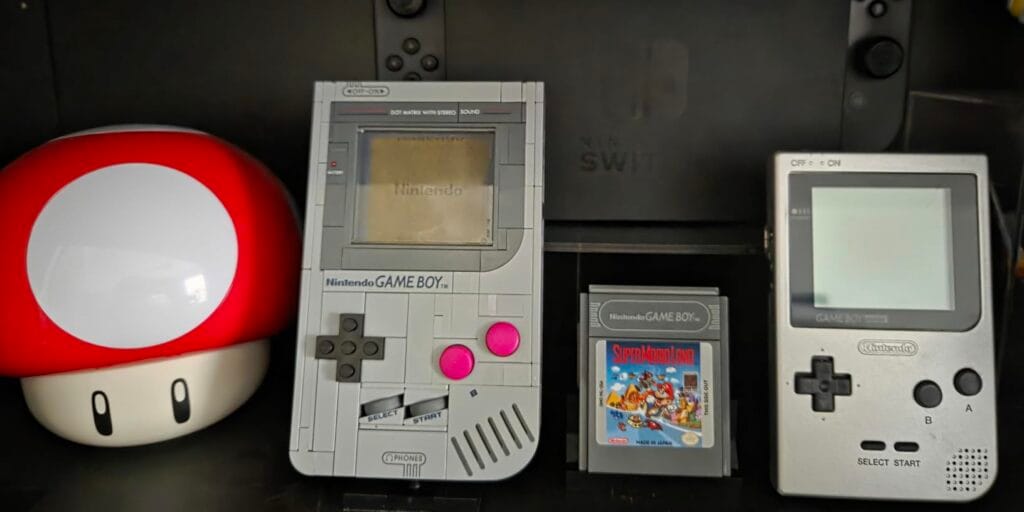
Before we dive into the nitty-gritty, let’s break down what you’re actually getting for your sixty bucks. The LEGO Game Boy isn’t just a static display model—it’s a surprisingly faithful recreation of the 1989 gaming icon that revolutionized handheld gaming and gave us all repetitive strain injuries from playing Tetris for eight hours straight.
The set contains 421 pieces and comes with functional buttons, interchangeable lenticular screens, and brick-built cartridges for two legendary titles: Super Mario Land and The Legend of Zelda: Link’s Awakening. Yeah, you read that right—those screens actually change when you tilt them, creating the illusion that the games are actually running. It’s the kind of clever wizardry that makes you wonder if LEGO designers are actually just magicians with engineering degrees.
The set is marketed for ages 18+, but let’s be real—this is squarely aimed at us millennials who spent our childhood years glued to that iconic grey brick of gaming goodness. At a near 1:1 scale, it’s close enough to the original that you’ll do a double-take when you put them side by side.
Ready to buy? — see it on Amazon
The Build Experience: More Fun Than We Expected
Alright, let’s talk about putting this thing together. Our team dove into this build on a lazy Saturday afternoon, and what we thought would be a quick two-hour project turned into something way more engaging.
The build took approximately 1 hour and 15 minutes for most reviewers, though some completed it in under an hour. But here’s the thing—you won’t want to rush through it. The instruction manual is incredibly smart, starting you off with the Super Mario Land cartridge and the screen storage stand before moving on to the main console.
What really blew our minds was how the designers managed to cram so much functionality into such a compact build. We’re talking pressable buttons that actually click, a d-pad that moves like the real thing, and even those tiny contrast and volume dials that you can turn. Sure, they don’t actually do anything, but the tactile satisfaction is absolutely there.
The build includes approximately 12 pieces unique to this set, including custom corner molds with speaker slots and pre-printed panels that save you from sticker hell. As someone who’s cursed at crooked stickers on countless LEGO sets, this was a massive relief.
The construction techniques are surprisingly advanced for a set this size. You’ll be building in multiple directions, using clever SNOT (Studs Not On Top) techniques, and discovering little engineering tricks that make you appreciate the design genius behind it. One minute you’re building a circuit board inside a Game Pak cartridge, the next you’re creating a working button mechanism with rubber bands. It’s like a masterclass in LEGO engineering condensed into an afternoon.
The only slight hiccup? Some instructions occasionally make it tricky to see piece placement underneath already-built sections, particularly with L-shaped pieces. But honestly, that’s a minor nitpick in what is otherwise a brilliantly structured build experience.
Design Accuracy: Shockingly Close to the Original
Now, let’s get into the details that really matter. How accurate is this thing?
We pulled out our original Game Boys from storage (yes, they still work, and yes, we’re keeping them forever) and did a thorough side-by-side comparison. The results? LEGO absolutely nailed it.
The LEGO Game Boy isn’t exactly 1:1 scale, being slightly smaller in some dimensions and slightly larger in others, but it’s very close. Unless you’re putting them directly next to each other with a ruler, you honestly won’t notice the difference. The proportions feel right, the weight distribution is satisfying, and when you hold it in your hands, you get that same tactile memory of gripping an original Game Boy.
The color choice deserves some discussion. LEGO went with their standard light grey brick color, which is pretty much spot-on for a pristine Game Boy fresh out of the box. Our original console, after 35+ years of storage and UV exposure, has yellowed to a warmer tone—but that’s just the natural aging process of old plastic. If anything, the LEGO version looks like what our Game Boys looked like when we first got them, which honestly makes the nostalgia hit even harder.
The attention to detail is absolutely insane. Every little element is accounted for:
- The “Dot Matrix with Stereo Sound” label above the screen
- The ext connector port on the side with its protective cover
- The contrast adjustment wheel
- The volume dial
- The headphone jack
- Even the serial number sticker on the back
The buttons use a rubber band mechanism that makes them actually functional and pressable, just like the real thing. The d-pad rocks back and forth, the A and B buttons have that satisfying spongy feel, and the power switch? Oh man, that power switch. It slides with a hefty, satisfying “CLICK” that immediately transports you back to 1989.
The Game Cartridges: Brick-Built Brilliance
Let’s talk about those Game Paks for a second, because they deserve their own spotlight. You get two cartridges in the set: Super Mario Land and The Legend of Zelda: Link’s Awakening, and they’re both little masterpieces of LEGO engineering.
Here’s where LEGO made a brilliant choice: The cartridges use stickers for the game labels, which actually makes sense since original Game Boy cartridges used stickers. It’s one of those rare occasions where stickers feel authentic rather than like a cost-cutting measure.
But the real magic is inside. The Super Mario Land cartridge features green and black plates representing the circuit board, with pearl gold grilles adding that authentic tech look. The Link’s Awakening cartridge goes even further, including a printed 2×2 round tile representing the internal battery that was used to save game data. This is the kind of deep-cut detail that gaming nerds will absolutely lose their minds over.
Both cartridges slot into the back of the Game Boy with that same satisfying “clunk” you remember from inserting real Game Paks. It’s these little touches that elevate this from a good set to a great one.
The Lenticular Screens: Surprisingly Magical
Okay, this is where things get really cool. Instead of just a static printed screen, LEGO included three lenticular screen inserts that you can swap out:
- Super Mario Land gameplay
- The Legend of Zelda: Link’s Awakening gameplay
- The iconic Nintendo boot-up screen
The lenticular screens feature moving action that creates the illusion of the games actually running. When you tilt the Game Boy, the characters actually move on screen. Mario runs, Link slashes his sword, and the Nintendo logo scrolls down during the boot sequence. It’s such a clever solution for adding life to what could have been a static display piece.
Sure, there are no lights or sounds (which would have pushed the price way up), but honestly? The lenticular screens are way cooler than we expected. They add a layer of interactivity and visual interest that makes this feel more like a premium collectible than a simple building set.
Value Proposition: Is $60 Fair?
Let’s address the elephant in the room: Is this set worth sixty dollars?
In our opinion, absolutely. Here’s why:
For the quality and pleasure gained from both the build and finished result, $60 feels like a fantastic price. Consider what you’re getting:
- 421 pieces, including multiple unique, specially-molded elements
- Extensive printed details (minimal stickers)
- Functional interactive elements
- Three lenticular screens
- Two detailed game cartridges
- A display stand
- Instructions that guide you through an enjoyable 1-3 hour build
Compare that to other LEGO sets in the same price range, and the Game Boy holds up incredibly well. The NES set was over $400 with 2,646 pieces. The Atari 2600 came in at $240 with 2,532 pieces. At just $60, this is one of the best-selling LEGO sets of this year, especially with its release timing so close to the holiday season.
Could you buy an actual working Game Boy or a modern emulation handheld for the same price? Sure. But those don’t give you the joy of building something with your own hands, the satisfaction of that perfectly organized instruction manual, or the conversation piece that this thing becomes on your desk or shelf.
Frequently Asked Questions
How long does it take to build?
Most builders complete the set in 1 to 3 hours. Our team averaged around 1.5 hours, but we were taking our time and savoring the experience. If you’re an experienced builder going at full speed, you could probably knock it out in under an hour.
Do the buttons actually work?
Yes! The d-pad, A and B buttons, Start and Select buttons, and even the power switch all have working mechanisms. The buttons press and spring back, the d-pad rocks in all directions, and the power switch slides with a satisfying click. They don’t control anything, obviously, but the tactile feedback is surprisingly authentic.
Can you play games on it?
No, it’s not a functioning gaming device. However, the lenticular screens create the illusion of gameplay when you tilt the console, which is a clever touch that adds visual interest without requiring electronics.
Is it the same size as a real Game Boy?
It’s very close—near 1:1 scale. There are minor size differences in some dimensions, but unless you’re measuring with calipers, you won’t notice. It feels right when you hold it, which is what matters most.
Are there stickers?
Only two—one for each game cartridge label. Everything else is pre-printed, which is a huge win. The stickers actually make sense here since original Game Boy cartridges used stickers for their labels.
Will LEGO make other Nintendo handhelds?
Nothing has been officially announced, but given how well this set has been received, it wouldn’t be surprising to see a Game Boy Color or Game Boy Advance in the future. Fingers crossed!
Is it sturdy enough to display?
Yes, it’s surprisingly robust for a display piece. The construction techniques create a solid structure that won’t fall apart if you carefully pick it up or move it around. That said, it’s not meant to be played with like a toy—this is definitely a display model.
Display Options and Shelf Presence
Once built, the LEGO Game Boy measures approximately 5 inches high, 11.5 inches wide, and 1 inch deep on its display stand. It’s the perfect size for a desk, bookshelf, or entertainment center display. The included stand holds the console upright, showing off the screen, while the second cartridge can be displayed alongside it.
The set also comes with a separate stand for storing the lenticular screens you’re not currently using, which is a thoughtful touch that prevents you from losing them in a drawer somewhere. Everything is designed to be a cohesive display piece, not just the console itself.
We’ve had ours on display for weeks now, and it consistently gets comments from visitors. Even people who aren’t into LEGO or gaming recognize it immediately and get hit with that wave of nostalgia. It’s a fantastic icebreaker and conversation starter.