Advertiser Disclosure
We independently review everything we recommend. When you buy through our links, we may earn a commission.
LEGO UCS Millennium Falcon 75192 Review: Is the Ultimate Star Wars Set Worth?
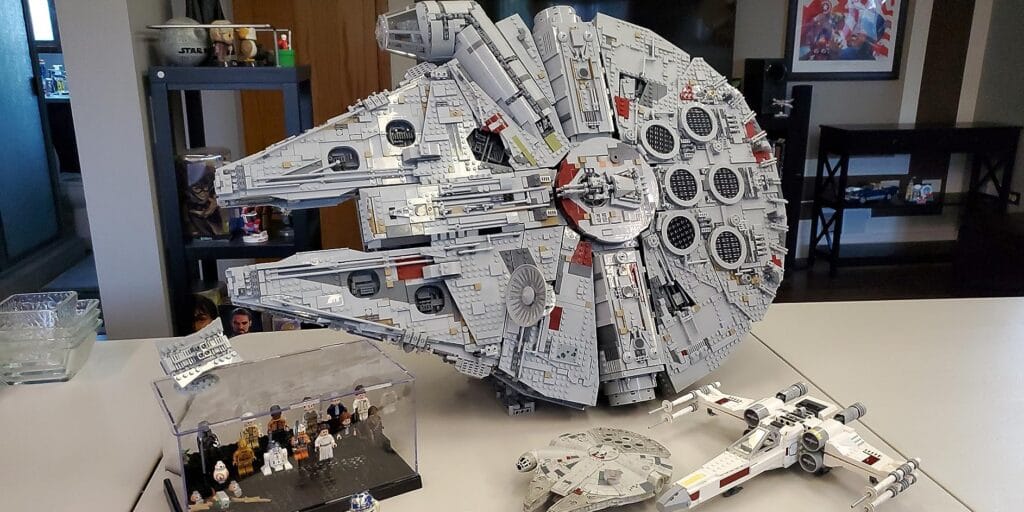
When I first saw the price tag on the LEGO Ultimate Collector Series (UCS) Millennium Falcon—a whopping $850—I did what any reasonable person would do: I laughed, closed the browser tab, and went about my day. But here’s the thing about obsession: it doesn’t go away that easily.
Three months later, after countless YouTube videos, forum debates, and late-night “window shopping” sessions, I finally pulled the trigger. Now, after spending over 30 hours building this 7,541-piece beast and living with it for six months, I’m ready to give you the brutal truth about whether this set is worth more than most people’s monthly rent.
This isn’t just another review that lists specifications and says “it’s great if you can afford it.” Instead, I’m going to walk you through every aspect of this iconic set—from the moment you open that massive box to the day you display it proudly (or sheepishly, depending on your significant other’s reaction). Whether you’re a hardcore LEGO collector, a Star Wars superfan, or someone considering this as an investment piece, I’ve got you covered.
Ready to buy? View offers — see it on Amazon
What Exactly Are You Getting for $850?
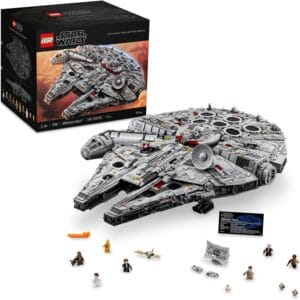
Before we dive into whether this set justifies its premium price, let’s establish what we’re actually dealing with here. The LEGO UCS Millennium Falcon (set number 75192) isn’t just another LEGO set—it’s a monument to building brick engineering.
Released in October 2017, this set shattered records by becoming the largest commercially available LEGO set ever produced. We’re talking about 7,541 pieces that, when assembled, create a model measuring over 33 inches long and 22 inches wide. To put that in perspective, it’s roughly the size of a large pizza box, but about ten times heavier.
What really blew my mind during the build was the attention to detail. This isn’t some simplified version of Han Solo’s ship—it’s a meticulously crafted replica featuring everything from the iconic dish antenna (with the option to display either the original or the Episode VII version) to the intricate interior corridors. You get a removable hull that reveals detailed rooms, including the main hold where Obi-Wan Kenobi trained Luke, the hyperdrive, the secret smuggling compartments, and even tiny details like the Dejarik holochess table.
The set also includes eight minifigures: Han Solo, Chewbacca, Princess Leia, C-3PO, Rey, Finn, BB-8, and an older Han Solo. Honestly? The minifigures are nice, but they’re not why you’re buying this set. They’re like the free toy in a cereal box—a pleasant bonus, but not the main attraction.
The Build Experience: 30+ Hours of Pure Joy (and Occasional Frustration)
Let me paint you a picture of what building the UCS Millennium Falcon is really like. First, when the package arrives, you’ll need help carrying it. At 31 pounds, this isn’t a “I’ll grab it on my way in” situation. My delivery driver gave me a look that said, “What did you buy, a small engine block?”
Inside the massive box, you’ll find 17 numbered bags, four instruction manuals (yes, four), and a sheet of stickers. Now, I need to address something controversial in the LEGO community: this set uses stickers instead of printed pieces for many details. For an $850 set, this rubbed some collectors the wrong way, and honestly, I get it. However, the stickers are high-quality and, if applied carefully, look fantastic.
The building process itself is an adventure that took me approximately 32 hours spread across three weeks. Here’s what that journey was like:
Hours 1-8: The Foundation. The first several bags focus on building the internal framework. This part is surprisingly technical and geometric. You’re essentially creating a skeleton that will support the entire ship. It’s not the most exciting phase visually, but watching the structural engineering come together is fascinating. This is where you truly appreciate how LEGO designers planned this build.
Hours 9-20: The Magic Happens. This is where things get exciting. You start building the recognizable sections—the cockpit, the main hold, the distinctive mandibles. The techniques used here are brilliant. You’ll encounter SNOT (Studs Not On Top) building techniques, sideways construction, and clever uses of pieces you’ve probably never seen before. I found myself regularly pausing to appreciate the ingenuity of the design.
Hours 21-30: The Details and Assembly. The final phase involves adding all the greebling (those little technical details on the exterior), installing the interior elements, and bringing all the major sections together. Fair warning: connecting the main hull sections requires patience and sometimes feels like you need three hands. I definitely recommend having a large, sturdy workspace for this.
Hours 30-32: The Finishing Touches. Adding the panels, installing the radar dish, placing the minifigures, and stepping back to admire what you’ve created. This moment—when you finally complete it—is genuinely emotional. You’ve invested real time, energy, and money into this, and seeing it finished is incredibly rewarding.
Throughout the build, I experienced moments of frustration (usually when I dropped a tiny piece under my desk for the third time), satisfaction (when a complex section clicked into place perfectly), and awe (at the sheer creativity of the designers). It’s not just a building experience; it’s a journey.
Display and Practicality: The Elephant in Every Room
Let’s address the practical concerns, because they’re significant. This completed model weighs about 31 pounds and takes up a tremendous amount of space. You can’t just plop this on your bookshelf next to your paperbacks and call it a day.
I initially planned to display mine on my office desk. That lasted approximately three hours before I realized my desk was now completely unusable for actual work. Currently, it sits on a custom-built shelf unit in my entertainment room, and it’s become the centerpiece of that space.
Here are the display realities you need to consider:
The Space Factor: You need approximately 33 x 22 inches of completely free, flat surface. And that’s just for the set itself—you’ll want some clearance around it so it doesn’t look cramped. Many owners opt for wall-mounted shelves, custom display cases, or dedicated furniture pieces. Some even build custom stands that angle the ship, making it look like it’s in flight.
The Dust Factor: This is the part nobody tells you about until it’s too late: this set is a dust magnet. All those intricate details and exposed studs collect dust like it’s their job. I spend about 15 minutes every two weeks gently cleaning it with a soft brush and compressed air. Some collectors go the extra mile and build display cases with glass enclosures. That’s not a bad idea if you’re serious about long-term preservation.
The Stability Factor. Despite its size, the completed model is surprisingly sturdy thanks to that internal framework I mentioned earlier. However, it’s not something you want to move frequently. Once you find a home for it, commit to that location. I learned this the hard way when I decided to rearrange my room—transporting it to a temporary location while I reorganized was nerve-wracking.
The “Conversation Starter” Factor. Without exception, every single person who has visited my home since I built this has commented on it. It’s impossible to ignore. About 80% of reactions are positive amazement, 15% are “Why would you spend that much on LEGO?”, and 5% are my mom asking if I’ve reconsidered grad school. Your mileage may vary.
The Investment Angle: More Than Just a Toy?
Here’s where things get interesting for those thinking beyond just the building experience. LEGO sets, particularly UCS Star Wars sets, have a history of appreciating after retirement. Let’s examine the numbers, as they’re compelling.
The previous UCS Millennium Falcon (set 10179), released in 2007 and retired in 2010, originally retailed for $500. Today, sealed copies regularly sell for $5,000 to $8,000 on the secondary market. That’s a 1,000% to 1,500% return over roughly 14 years. Even opened, built sets in good condition fetch $3,000 to $4,000.
Now, will the current UCS Millennium Falcon (75192) follow the same trajectory? That’s the million-dollar question—or in this case, the several-thousand-dollar question. Here’s what we know:
Production Run: Unlike the 2007 version, which had a limited production run, set 75192 has been in production since 2017 and remains available through LEGO and authorized retailers as of 2024. The longer it stays in production, the more units exist, which theoretically impacts future rarity and value.
Market Demand Star Wars continues to be one of the most valuable intellectual properties in entertainment, and the Millennium Falcon remains its most iconic ship. This sustained cultural relevance bodes well for long-term collectibility.
Historical Precedent Major UCS sets have consistently appreciated post-retirement. The UCS Star Destroyer, Death Star II, and others have all seen significant value increases. While past performance doesn’t guarantee future results, the pattern is encouraging.
My take? If you’re buying this purely as an investment, you’re playing a long game that requires patience and proper storage. The set would need to be kept sealed, in a climate-controlled environment, protected from sunlight and moisture. You’d also need to wait for retirement (which hasn’t been announced yet) and then several additional years for scarcity to drive prices up.
However, if you plan to build and enjoy it while also appreciating that it might be worth something substantial down the road, that’s a more realistic approach. I built mine because I wanted the experience and the display piece, but I’m not upset that I’m essentially storing $850+ in assets in my entertainment room.
Breaking Down the Value Proposition
So here’s where we get to the heart of the matter: is this thing actually worth $850? To answer that, we need to break down the value proposition into tangible and intangible components.
Cost Per Piece Analysis: At $850 for 7,541 pieces, you’re paying approximately $0.11 per piece. In the LEGO world, this is actually reasonable. Standard LEGO sets typically range from $0.10 to $0.15 per piece, with licensed sets (like Star Wars) often trending toward the higher end. From a pure piece-count perspective, the UCS Millennium Falcon isn’t overpriced—it’s competitively priced.
The Experience Factor. This is highly subjective, but let me frame it this way: I spent 32 hours building this set. That’s $26.56 per hour if we’re treating it like entertainment. Compare that to:
- A movie ticket: $15-20 for 2 hours ($7.50-10 per hour)
- A video game: $60-70 for potentially hundreds of hours ($0.10-1 per hour)
- A nice dinner out: $100-150 for 2 hours ($50-75 per hour)
When viewed as an entertainment experience, it’s pricier than a video game but cheaper than many other leisure activities. Plus, unlike that fancy dinner, you have something tangible and permanent when you’re done.
The Display Value. This is where things get even more subjective. What’s it worth to have a conversation piece and display item that you’ll see and appreciate every single day? For me, walking into my entertainment room and seeing the Falcon displayed beautifully brings me genuine joy. That’s not something you can easily quantify, but it’s a real value nonetheless.
The Nostalgia and Fandom Factor: If you’re a Star Wars fan, the emotional connection to this ship cannot be overstated. This is the vessel that made the Kessel Run in less than 12 parsecs (yes, I know that doesn’t make sense—don’t @ me). It’s the ship that helped destroy two Death Stars. It’s woven into the fabric of modern cinema history. For fans, that connection adds intangible value that justifies a premium.
The Quality Factor: Having built dozens of LEGO sets over the years, I can confidently say that the engineering and design quality of this set is exceptional. The clutch power (how tightly pieces hold together) is perfect, the instruction manuals are clear and well-organized, and the final product is structurally sound and impressively detailed.
Who Should Actually Buy This?
After six months of living with this set, here’s my honest assessment of who should and shouldn’t consider this purchase:
You Should Buy If:
You’re a serious Star Wars fan with the display space and budget. This is the ultimate expression of fandom, and if the Millennium Falcon holds special meaning for you, the emotional value justifies the cost. Every time I see mine, I remember watching the original trilogy as a kid, and that connection is priceless.
You’re a dedicated LEGO collector who wants the flagship set. This is LEGO’s statement piece—their Sistine Chapel, if you will. Not owning it as a serious collector feels like a significant gap in your collection.
You value the building experience as much as the final product. If you find the act of building LEGO relaxing, meditative, and enjoyable, 30+ hours with this set is a gift, not a chore. The journey is as valuable as the destination.
You have adequate display space and won’t regret the real estate it consumes. If you’ve already planned where it will live and you’re excited about that, go for it.
You’re thinking long-term and can afford to have $850 invested in a display piece. If this won’t strain your finances and you can appreciate it for years to come, the cost per year of ownership becomes quite reasonable.
You Probably Shouldn’t Buy If:
You’re looking for a quick flip investment. Yes, it might appreciate, but that’s a long-term play requiring patience and proper storage. If you need that $850 to be liquid, this isn’t the right move.
You don’t have a dedicated display space planned. Impulse buying this without a display plan is a recipe for regret. You’ll end up with an expensive problem taking up valuable space.
You’re not particularly into Star Wars or LEGO. There are better ways to spend $850 if this doesn’t align with your interests. Don’t buy it because it’s famous or because you feel like you should—buy it because you genuinely want it.
Your budget is tight, or this purchase would be financially stressful. LEGO should be fun, not financially burdensome. If buying this means a sacrifice in other important areas, wait until you’re in a better financial position.
You’re buying for a child who might not appreciate its value or complexity. This is an adult collector set, period. There are amazing Star Wars sets designed for younger builders that cost a fraction of the price.
Alternative Options Worth Considering
If you’re on the fence about the UCS Falcon, here are some alternatives worth exploring:
The LEGO Star Wars AT-AT (set 75313) is similarly priced but offers a completely different aesthetic and building experience. It’s equally impressive and might resonate more if you prefer the Imperial side of Star Wars.
The LEGO Titanic (set 10294) is actually larger at 9,090 pieces, offering better value per piece and an equally impressive display.
The LEGO UCS Imperial Star Destroyer (set 75252), while retired, can sometimes be found for $800-1,500 and offers a different style of Star Wars magnificence.
For those who want Falcon representation without the massive commitment, the LEGO Star Wars Millennium Falcon (set 75257) is a $260 minifig-scale version that’s actually quite impressive for its size and infinitely more manageable.
Frequently Asked Questions
Is it really that hard to build? Not particularly, but it’s time-consuming and requires patience. The complexity isn’t about difficult techniques—LEGO provides clear instructions. The challenge is the repetitive nature of some sections and the sheer scale. If you can build a standard LEGO set, you can build this. You just need dedication and a good workspace.
Where do people typically display it? Based on my research in LEGO communities, popular display locations include: dedicated wall-mounted shelves in offices or entertainment rooms, custom display tables, IKEA Kallax units (with reinforcement), and custom-built display cases. Some creative builders even suspend them from ceilings using fishing line to create a “flying” effect.
How long does it take to build? Most builders report 20-40 hours depending on pace and experience. Speed builders have done it in 12-15 hours, while others who build casually over several months might stretch it to 50+ hours. My 32-hour build time over three weeks felt comfortable and enjoyable.
Will LEGO retire this set soon? As of late 2024, there’s been no official announcement about retirement. However, major UCS sets typically stay in production for 3-7 years. Given that this set launched in 2017, speculation suggests it could retire within the next 1-2 years, though LEGO’s retirement schedule is notoriously unpredictable.
Can you actually move it once it’s built? Technically, yes, but it requires extreme care. The set is sturdy but not designed for frequent transport. If you need to move it, I recommend supporting it from underneath with both hands and moving slowly. Some builders actually build certain sections to be detachable for easier transport, though this requires planning during the build.
Is it worth it if I’m not a huge Star Wars fan? This is tough. If you’re purely a LEGO enthusiast who appreciates complex builds and impressive displays, there’s still value here. However, much of the set’s appeal is tied to its Star Wars connection. If you’re ambivalent about the franchise, you might find better value in other large sets like the Titanic, Colosseum, or Eiffel Tower.
What about lighting kits? Many owners invest in aftermarket LED lighting kits ($60-150) that illuminate the interior and exterior. Having seen several lit-up versions at LEGO conventions, I can confirm they look spectacular. It’s not essential, but it definitely enhances the display appeal, especially if showcased in a dim room.
How does it compare to the 2007 version? The current version is significantly larger (7,541 vs. 5,195 pieces), more detailed, and more expensive. However, the 2007 version has historical significance as the first UCS Falcon and is now a holy grail for collectors. If you own the 2007 version, congratulations on your retirement fund. If you’re choosing between hunting for a 2007 version versus buying the current one, buy the current one—it’s objectively better in almost every way and actually obtainable at a reasonable price.
My Personal Conclusion
Six months ago, I was the person reading reviews just like this one, trying to justify an $850 purchase to myself (and my partner). Now, having built it, displayed it, and lived with it, here’s my takeaway:
The LEGO UCS Millennium Falcon is worth every penny—if you’re the right buyer. This isn’t a value judgment on whether people should prioritize LEGO over other expenditures. It’s simply acknowledging that for the target audience (serious LEGO collectors and passionate Star Wars fans with disposable income and display space), this set delivers extraordinary value.
The build experience alone—those 30+ hours of focused, meditative construction—was worth several hundred dollars to me. The final product, which I see and appreciate daily, justifies the rest. Add in the potential long-term appreciation once the set retires, and suddenly that $850 doesn’t seem so outrageous.
However, I’d be lying if I said everyone should rush out and buy this. It’s a premium product with a premium price tag, designed for a specific audience. If you’re outside that audience, the value proposition falls apart quickly.
My advice? If you’re seriously considering this purchase, think about how you’ll feel about it in five years. If you can envision yourself looking at it on display, remembering the building experience fondly, and feeling good about the purchase, then pull the trigger. If you have doubts, those doubts will likely grow over time.
For me? Best $850 I’ve spent on LEGO, and I’ve spent a lot on LEGO. Your mileage may vary, but for this Star Wars fan and LEGO enthusiast, the UCS Millennium Falcon was worth every stud.