Advertiser Disclosure
We independently review everything we recommend. When you buy through our links, we may earn a commission.
Do Jigsaw Puzzles Help with ADHD?
Look, we’ve spent months digging into this question because it keeps coming up in our community. Parents email us, adults with ADHD reach out, and educators want to know: can something as simple as a jigsaw puzzle actually make a difference for ADHD symptoms?
Before we dive in, here’s our disclaimer: we’re not medical professionals, and nothing we share here replaces professional medical advice. What we are is a dedicated assessment team that’s passionate about understanding how everyday activities can support brain health. We’ve analyzed the research, talked to experts, and looked at what actually works in real-world situations.
ADHD: More Than Just Distraction
According to the CDC, approximately 7.1 million children in the United States have been diagnosed with ADHD as of 2022. That’s about one in nine kids. Meanwhile, around 15.5 million adults are living with this condition. These numbers have been climbing, partly because we’re getting better at recognizing ADHD in different populations, including women and adults who went undiagnosed as children.
ADHD stands for Attention Deficit Hyperactivity Disorder, and it presents in three main ways. Some people are predominantly hyperactive and impulsive—they fidget constantly, struggle to sit still, and might interrupt conversations or grab things impulsively. Others are predominantly inattentive, finding it tough to focus on tasks, getting easily distracted, and forgetting daily routines. Then there’s the combined presentation, where someone deals with both sets of challenges simultaneously.
The symptoms can look different for everyone, but the core struggles typically include making careless mistakes, having difficulty resisting temptation, forgetting or losing things frequently, talking excessively, and sometimes struggling in social situations. It’s exhausting, frankly, for the person experiencing it and their loved ones.
What Causes ADHD?
Research points to several primary triggers. Traumatic brain injuries like concussions or brain bleeds can contribute. Toxic exposure during pregnancy, along with alcohol, tobacco, or drug use during pregnancy, also plays a role. Premature birth or low birth weight increases risk as well. The point is, ADHD has real neurological roots—it’s not about laziness or poor discipline.
The Science Behind Puzzles and ADHD: What Actually Works
Here’s where things get interesting. We’ve reviewed multiple studies published in peer-reviewed journals, and the connection between puzzles and cognitive benefits is stronger than we initially expected.
A comprehensive study published in PMC’s Frontiers in Aging Neuroscience found that jigsaw puzzling taps into multiple cognitive abilities simultaneously. The researchers discovered that puzzle solving recruits visuospatial cognition, perception, mental rotation, working memory, reasoning, and episodic memory all at once. That’s a pretty significant cognitive workout.
But here’s the thing about ADHD specifically: the brain’s executive function system struggles. Executive function is like your brain’s project manager—it helps you plan, focus attention, remember instructions, and juggle multiple tasks. People with ADHD often have lower levels of dopamine, a neurotransmitter crucial for motivation, focus, and reward processing.
How Puzzles Engage the ADHD Brain
When you work on a jigsaw puzzle, something remarkable happens neurologically. Both hemispheres of your brain activate simultaneously. The left brain handles the logical, analytical aspects—sorting pieces by color, identifying edges, and working methodically. Meanwhile, the right brain engages with the creative, visual-spatial elements—recognizing patterns, imagining how pieces fit together, seeing the big picture.
This bilateral brain engagement is huge for ADHD. According to research from Harvard Health, puzzle activities can actually reduce brain shrinkage and improve cognitive function in people with mild cognitive impairment. While that study focused on crossword puzzles, the principle applies: engaging cognitive activities strengthens neural pathways.
Each time you successfully match a puzzle piece, your brain releases dopamine. Remember, dopamine is exactly what many ADHD brains need more of. This creates a natural reward cycle: you search for a piece, find it, experience a small dopamine hit, and feel motivated to continue. It’s like creating your own internal reward system without medication.
The Neuroplasticity Factor
What really excites us about puzzles is their potential to support neuroplasticity—the brain’s ability to form new neural connections and reorganize itself. A study we found in NEJM Evidence showed that participants who engaged in regular puzzle activities demonstrated measurable cognitive improvement and actually experienced less brain shrinkage compared to those who played digital brain games.
Think about what this means for ADHD. If puzzles can help strengthen neural pathways and improve working memory, they’re essentially providing cognitive training that addresses core ADHD challenges. You’re not just passing time—you’re actively rewiring your brain’s response patterns.
Practical Benefits: What We've Observed
Through our research and community feedback, we’ve identified several concrete ways puzzles help with ADHD symptoms:
Improved Focus and Attention Span
Puzzles provide what experts call “structured open-endedness.” There’s a clear goal (complete the picture), but multiple pathways to get there. This structure helps ADHD brains stay engaged without feeling constrained. We’ve heard from parents whose kids can’t sit through homework for five minutes but will work on puzzles for 45 minutes straight.
The key is finding that sweet spot of challenge. Too easy, and the ADHD brain gets bored and disengages. Too difficult and frustration takes over. But when the difficulty is just right, puzzles create what psychologists call “flow state”—that feeling of being completely absorbed in an activity.
Enhanced Working Memory
Working memory is often significantly impaired in people with ADHD. It’s why you might forget what someone just said or lose track of multi-step instructions. Puzzles naturally exercise working memory because you need to remember where pieces are located, what patterns you’ve seen, and which sections you’ve already completed.
According to research published in the Journal of Clinical Child & Adolescent Psychology, nearly 78% of children with ADHD have at least one co-occurring condition, often affecting memory and learning. Activities that strengthen working memory, like puzzles, can have ripple effects across multiple areas of functioning.
Better Visual-Spatial Skills
People with ADHD sometimes struggle with spatial awareness and visual processing. Jigsaw puzzles directly train these skills. You’re constantly analyzing shapes, rotating pieces mentally, and understanding how parts relate to the whole. These are transferable skills that help with everything from reading maps to organizing physical spaces.
Reduced Hyperactivity and Restlessness
Here’s something we found particularly interesting: puzzles provide a productive outlet for that constant need for stimulation that characterizes ADHD hyperactivity. Your hands stay busy, your brain stays engaged, but you’re in a calm, controlled activity rather than bouncing off walls or compulsively checking your phone.
Mindfulness and Stress Reduction
Multiple studies we reviewed highlighted puzzles’ meditative qualities. When you’re focused on finding the right piece, your mind isn’t racing through anxious thoughts or jumping from worry to worry. It’s a form of active meditation that works particularly well for ADHD brains that struggle with traditional sit-still-and-clear-your-mind meditation.
Choosing the Right Puzzles for ADHD
Not all puzzles are created equal when it comes to ADHD support. Here’s what we’ve learned works best:
Start with Appropriate Complexity
For younger children or those just starting, begin with 100-piece puzzles. The sense of achievement from completing a puzzle in one sitting is valuable positive reinforcement. You can gradually increase difficulty as attention span and skills improve.
For teenagers and adults, 300-500-piece puzzles often hit that sweet spot. They’re challenging enough to maintain interest but not so overwhelming that frustration derails the experience. Once someone builds confidence, moving up to 1000-piece puzzles can provide extended engagement.
Choose Engaging Images
This matters more than you might think. Pick images that genuinely interest the person working on the puzzle. Love animals? Get nature scenes. Into Marvel superheroes? There are amazing comic-themed puzzles. The visual appeal keeps the ADHD brain motivated to continue.
Avoid puzzles that are too monochromatic or have large sections of similar colors, especially when starting. These create unnecessary frustration. Clear color differentiation and distinct patterns work better for maintaining engagement.
Consider Texture and Quality
High-quality puzzle pieces with a satisfying “snap” when they connect provide tactile feedback that’s rewarding for ADHD brains. The sensory component shouldn’t be overlooked—it’s part of what makes the experience engaging and dopamine-producing.
Creating an ADHD-Friendly Puzzle Environment
The environment where you puzzle matters just as much as the puzzle itself. Here’s what we recommend based on feedback from our ADHD community:
Designate a Puzzle Space
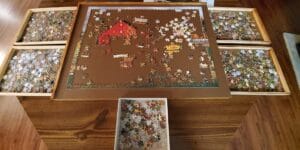
Set up a dedicated area where the puzzle can stay out between sessions. Having to constantly set up and put away creates friction that kills momentum. A puzzle board, table, or even a piece of cardboard can work. The point is making it easy to jump in whenever the mood strikes.
Minimize Distractions
Turn off the TV. Put phones on silent. For people with ADHD, environmental distractions derail focus faster than anything else. Some people find that instrumental music or white noise helps maintain concentration, while others need complete silence. Experiment to find what works.
Make It Social (Sometimes)
While puzzles can be wonderful solo activities, they also work beautifully as family or group activities. Working on puzzles together provides natural conversation opportunities and turns it into quality time rather than isolation. For kids with ADHD, having a parent nearby (even if they’re doing their own thing) can provide the external structure that helps maintain focus.
Combine with Healthy Snacks
We’re big believers in pairing puzzle time with nutritious snacks. Keep cut vegetables, hummus, fruit, or nuts nearby. Your brain needs fuel to function optimally, and having healthy snacks readily available prevents the blood sugar crashes that worsen ADHD symptoms. Skip the processed sugars and refined carbs—they create energy spikes and crashes that make focus harder.
Other Complementary Strategies for ADHD Support
Puzzles work best as part of a comprehensive approach. Here are other evidence-based strategies that pair well with puzzle activities:
Limit Screen Time
This one’s huge. Research from Harvard Medical School documents how artificial blue light disrupts sleep patterns and can exacerbate ADHD symptoms. Even kids without ADHD can display ADHD-like symptoms after excessive screen exposure.
Puzzles offer a screen-free alternative that still provides stimulation and engagement. The contrast is striking—instead of passive consumption of rapidly changing images, you get active problem-solving at a natural pace.
Build Community Support
Everyone needs people cheering them on, but this is especially true for people with ADHD who often face criticism for symptoms they can’t fully control. When introducing puzzles to younger people with ADHD, patience is crucial. Explain the process, work alongside them initially, and celebrate small victories. You’re not just teaching puzzle skills—you’re helping another human being develop coping strategies and confidence.
Maintain Consistent Routines
ADHD brains thrive on external structure, even though creating that structure internally is difficult. Try incorporating puzzle time into daily routines—maybe 20 minutes after dinner or during weekend mornings. The predictability helps establish habits that become easier over time.
Consider Professional Treatment
Let’s be clear: puzzles are a supportive tool, not a cure. According to the National Institute of Mental Health, medication remains the most effective single treatment for reducing ADHD symptoms. However, behavioral therapy, lifestyle modifications, and cognitive activities like puzzles can enhance treatment outcomes significantly.
About 53.6% of children with current ADHD receive medication, and 44.4% receive behavioral treatment. The most effective approach often combines multiple strategies. Puzzles fit into this bigger picture as a supplementary tool that’s accessible, affordable, and free of side effects.
Real-World Applications: Making It Work
Theory is one thing, but how do you actually implement this? Here’s what we’ve seen work in practice:
For Parents of Children with ADHD
Start small. Don’t expect your child to sit down and complete a 500-piece puzzle on day one. Begin with 20-50 pieces and build up gradually. Make it a special time together rather than another task they have to complete. Let them choose the puzzle image—ownership matters for engagement.
Use puzzle time as a calm-down activity rather than a reward to be earned. When you notice hyperactivity increasing, suggest working on the puzzle together. This reframes it as a regulation tool rather than a privilege that can be taken away.
For Adults with ADHD
Many adults with ADHD report that puzzles become their go-to stress management tool. Keep a puzzle set up in your living space where you can work on it for five minutes or two hours, whatever your focus allows. There’s no pressure, no deadline, no performance evaluation.
Some people find that starting their day with 15 minutes of puzzle time helps transition their brain into focus mode before tackling work tasks. Others use puzzles as a wind-down activity in the evening, creating separation between work stress and sleep.
For Educators and Therapists
Consider incorporating puzzles into classroom break areas or therapy spaces. They provide a constructive activity for students who need movement breaks or struggle with unstructured downtime. Puzzles also work well for small group social skills activities, teaching cooperation and communication.
Getting Started Today
Ready to give puzzles a try? Here’s our recommended approach:
Choose one puzzle that appeals to you or your family member. Start with a comfortable difficulty level—you can always increase complexity later. Set up a dedicated space where the puzzle can stay out. Commit to spending at least 10-15 minutes working on it, ideally at a consistent time each day.
Pay attention to how it feels. Does focus improve? Does the time pass quickly (a sign of engagement)? Does the person seem calmer afterward? These observations help you assess whether puzzles are a good fit.
If traditional jigsaw puzzles don’t click, try other puzzle types. Crosswords, Sudoku, logic puzzles, and 3D puzzles all engage different cognitive skills. The key is finding what holds attention and provides that satisfying sense of accomplishment.
We started this investigation asking whether jigsaw puzzles help with ADHD, and what we discovered exceeded our expectations. The research supports meaningful cognitive benefits. The neurological mechanisms make sense. The community experiences validate the science.
More importantly, puzzles represent something our fast-paced, screen-dominated world desperately needs more of: slow, focused, rewarding activities that let our brains work the way they’re designed to work. For ADHD brains that constantly crave stimulation but struggle with sustained attention, puzzles hit a sweet spot that few activities manage.
So yeah, we’re convinced. Give it a shot. Start a puzzle today. See what happens when you create space for your brain to slow down, focus, and experience the satisfaction of fitting pieces together one at a time. Your brain might just thank you for it.