Advertiser Disclosure
We independently review everything we recommend. When you buy through our links, we may earn a commission.
LEGO NINJAGO City Gardens 71741 Review: Is This the Ultimate Ninjago City Set?

After spending nearly 16 hours building this beast and several weeks displaying it in our studio, I can tell you this: the 5,685-piece NINJAGO City Gardens isn’t just another LEGO set. It’s a towering monument to one of LEGO’s most successful themes, celebrating a full decade of ninja adventures with the kind of detail and craftsmanship that makes you stop and stare.
But is it actually the ultimate Ninjago City set? That’s what we’re here to find out. Throughout this review, we’ll dive deep into every aspect of this incredible build, from the value proposition to the building experience, from the minifigures to how it stacks up against its legendary predecessors. Whether you’re a hardcore Ninjago collector, a LEGO architecture enthusiast, or someone considering their first big LEGO purchase, we’ve got you covered.
Ready to buy? View offers — see it on Amazon
What Makes LEGO NINJAGO City Gardens 71741 So Special?
First things first, let’s talk about the sheer scale of this build. The NINJAGO City Gardens measures approximately 74cm in height, which translates to about 29 inches of vertical LEGO goodness. To put that in perspective, it actually surpasses the original Ninjago City set that everyone raves about.
When we first opened the box, we were honestly blown away by the packaging. It’s clear LEGO knew they had something special here. The box itself requires portrait orientation just to properly showcase this towering masterpiece. Inside, you’ll find what can only be described as a treasure trove of bricks organized into numbered bags, along with three hefty sticker sheets containing 66 stickers.
Now, I know what you’re thinking—66 stickers sounds like a lot of work. And yeah, it is. Our team had mixed feelings about this. On one hand, the stickers add incredible detail to the cyberpunk signage throughout the city. On the other hand, we would’ve loved to see more printed pieces at this price point. But we’ll get into that later.
Breaking Down the Value Proposition
Here’s where things get really interesting. At approximately $0.053 per piece, this set represents phenomenal value for money. Let me put that into context for you. The iconic UCS Millennium Falcon costs about $0.12 per part—literally double what you’re paying per piece here.
During our assessment, we timed the build and found it took us just under 16 hours to complete. That works out to roughly $0.42 per minute of build time. Compared to the average LEGO set in this price range, that’s exceptional entertainment value. Think about it—for the same money as a few nights out at the movies, you get a building experience that spans multiple evenings plus a stunning display piece that’ll wow visitors for years.
The Building Experience: A Journey Through Ninjago's History
Starting From the Ground Up
The build starts exactly where you’d expect—with the baseplate work. And honestly? This is probably the least exciting part of the entire experience. Covering the 32×32 plate to delimit the constructible spaces isn’t anyone’s idea of a thrilling Saturday afternoon. But stick with it, because what comes next makes it all worthwhile.
Our team really appreciated how the construction is divided into distinct sections. You’re not just mindlessly following instructions—you’re actually building different neighborhoods and businesses that each have their own character and story. The modular nature means you can take breaks between sections without losing momentum, which is perfect for busy people who can’t dedicate an entire weekend to building.
Innovation in Every Corner
One thing that consistently impressed us throughout the build was the clever use of building techniques. LEGO designer Markus Rollbühler clearly approached this project with a fan’s passion. The introduction of the new escalator element (Technic Link Chain with Panel and Center Divider) was a brilliant addition. It’s functional, it looks great, and it’s something we’d never seen in a LEGO set before.
The way different walls connect at angles throughout the structure demonstrates some seriously advanced building techniques. We particularly loved the diagonal 45-degree walls in the NINJAGO Museum of History, which use a combination of studs-on-top assembly, hollow bricks, and clever plate work to achieve that perfect angle. It’s the kind of stuff that makes you appreciate LEGO as an art form.
The Tree That Holds It All Together
Speaking of impressive techniques, let’s talk about the massive tree that grows through multiple levels of the structure. This isn’t just decorative—it actually provides crucial structural support for the upper levels. The design incorporates Technic elements hidden beneath twisted vines and flexible cables, creating both stability and visual interest. It’s similar to techniques used in the LEGO Bonsai Tree set, but implemented in a completely different way that suits the cyberpunk aesthetic perfectly.
The Minifigures: 19 Characters to Populate Your City
Quality Over Quantity? Not This Time—You Get Both
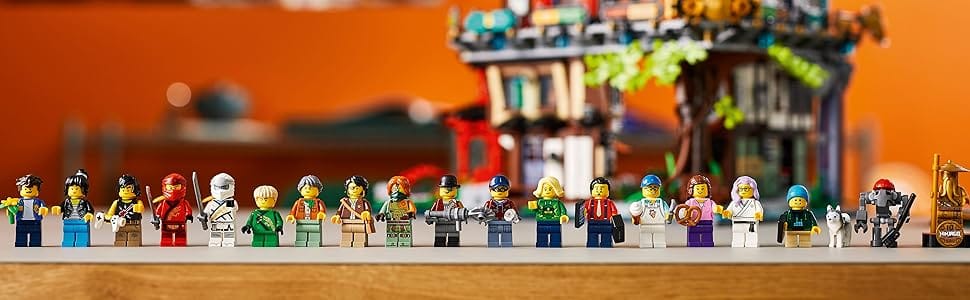
One of the absolute highlights of this set is the minifigure selection. With 19 minifigures included—more than any other NINJAGO set —you’re getting an incredible cast to bring your city to life. But it’s not just about the numbers. The variety here is genuinely impressive.
You get key characters from the Ninjago series, including a golden Sensei Wu that alone makes collectors weak in the knees. But what really sets this apart is the inclusion of civilian characters that most sets skip. Characters like Hai, the ice cream seller, Christina the fan, and Tito with Sensei Wu’s husky add so much life to the display. These aren’t just filler figures—each one has personality and purpose.
The Clutch Powers Surprise
One minifigure that had our team particularly excited was the inclusion of Clutch Powers. For those who don’t know, Clutch Powers was introduced in February 2010 as the protagonist in LEGO: The Adventures of Clutch Powers, and seeing him make an appearance in this set felt like a deep-cut Easter egg for longtime LEGO fans. It’s these thoughtful inclusions that show LEGO wasn’t just phoning it in with this anniversary set.
You also get Misako (Lloyd’s mother), The Mechanic, various ninjas in different outfits, and even a cleaning robot named Scoop. The diversity of characters means you can create all sorts of scenarios and stories with this set.
Exploring the Architecture: A Cyberpunk Wonderland
Multiple Levels, Multiple Stories
The structure is organized across three main tiers, each with its own distinct personality and function. At ground level, you’ll find tranquil spaces including a tea pavilion, koi ponds, and landscaped gardens. This provides a nice contrast to the bustling, neon-soaked upper levels.
As you move up, you’ll discover restaurants (including a noodle house and takeaway shop), a museum, an arcade, a dojo, and various apartments. Each space is carefully detailed with furniture, decorations, and accessories that make it feel lived-in and real. There’s even a separate temple built on its own 16×32 baseplate that can be positioned adjacent to the main structure.
Easter Eggs and References Everywhere
One of the absolute joys of building and displaying this set is discovering all the hidden references scattered throughout. Our team spent hours finding Easter eggs referencing other LEGO themes and Ninjago lore. Billboards are advertising the competing crab restaurant from the original Ninjago City, references to the defunct Znap theme, complete with connector emblems, Time Cruisers fonts and colors, and Prime Empire branding.
There’s even a printed 2×2 round tile on the tree celebrating the tenth anniversary of NINJAGO. And if you look carefully, you’ll spot a pink frog—a signature calling card of Nick Vás, who designed the original Ninjago City set and who included frogs in many of his designs, including the Bonsai Tree set.
The Good, The Bad, and The Stickery
What We Absolutely Loved
Let me start with what had our entire assessment team enthusiastic. The value is simply undeniable. Getting nearly 6,000 pieces, 19 minifigures, and advanced building techniques at this price point is remarkable in today’s LEGO market, where prices seem to climb every year.
The modular design is brilliant. Each section removes easily, making it simple to access interiors or rearrange floors if you want to customize your display. The variety of building techniques kept the construction engaging for the entire 16-hour build—we never felt bored or like we were just repeating the same steps over and over.
The color palette is vibrant and eye-catching without being garish. The mix of traditional Asian architectural elements with cyberpunk neon creates a unique aesthetic that photographs beautifully. And the sheer vertical presence of this set when displayed, is absolutely commanding. It becomes an instant conversation piece.
Areas Where It Falls Short
Now for the honest criticism, because no set is perfect. The biggest complaint across our team was those 66 stickers. At this price point and piece count, we really expected more printed elements. Applying stickers to curved or textured surfaces is frustrating, and they’ll never look quite as clean as printed pieces. Plus, if you ever want to disassemble and rebuild, those stickers won’t survive the process well.
Some areas of the build are surprisingly fragile, with loose bits that can come apart if you’re not careful when handling the model. This isn’t a set you can rough-house with, despite LEGO marketing it with playability in mind. Our team felt it’s more of a display piece than a true playset for younger builders.
The museum section received mixed reviews from our team. While it’s conceptually interesting, the execution feels a bit underwhelming compared to some of the other areas. The space doesn’t offer as much visual interest or detail as, say, the arcade or the noodle house.
Additionally, while the set includes detailed interiors, accessing them can be challenging, and there’s limited space for actually playing with minifigures inside. If you’re someone who likes to pose and photograph minifigures in action scenes, you might find yourself frustrated by the cramped quarters.
Frequently Asked Questions
Is the LEGO NINJAGO City Gardens worth $300?
Based on our assessment, absolutely yes—with caveats. If you appreciate complex building techniques, value detailed display pieces, or collect the Ninjago City line, this is a no-brainer. The price-per-piece ratio is excellent, and the building experience justifies the cost. However, if you’re primarily interested in playability for younger kids, there might be better options. This is really designed for ages 14+ and serious collectors.
How long does it take to build LEGO set 71741?
Our team completed the build in approximately 15 hours and 54 minutes. However, this will vary significantly based on your experience level. First-time builders of sets this large should probably budget 18-20 hours. Experienced LEGO builders might knock it out in 12-14 hours. We recommend spreading the build over several sessions rather than trying to power through in one sitting.
Does it connect to other Ninjago City sets?
Yes! The set is specifically designed to display alongside 70620 NINJAGO City and 70657 NINJAGO City Docks. The sidewalks align perfectly, and the architectural style complements the other sets beautifully. The baseplates match the grid system used in the previous sets, making combination displays straightforward.
Are the interiors accessible for play?
Technically, yes, but practically speaking, it’s limited. The modular design allows you to remove levels and access interiors, but the spaces are quite cramped with furniture and decorations. This is much more of a display piece than a hands-on playset. Younger children might struggle with the delicate construction and limited playability.
Will this set increase in value?
While we can’t predict the future, previous Ninjago City sets have appreciated significantly on the secondary market. The original Ninjago City, which retailed for $299.99, now regularly sells for $600-800 or more. Given that this set has already retired from production, similar appreciation seems likely over time, especially among collectors who want to complete the trio.
What’s the most challenging part of the build?
Our team found the angled walls and intricate connection points in the museum section to be the most technically demanding. The escalator mechanism requires careful attention to get it right. However, nothing in this build is impossibly difficult—it’s just detailed and requires patience. The instructions are clear and well-organized.
How stable is the completed model?
The overall structure is quite stable thanks to the tree providing internal support and the modular sections locking together well. However, individual details and decorative elements can be somewhat fragile. You’ll want to handle it carefully and display it somewhere it won’t get bumped. This isn’t a set you’ll want to move around frequently once built.