Advertiser Disclosure
We independently review everything we recommend. When you buy through our links, we may earn a commission.
The Best Murder Mystery Board Games for Every Type of Sleuth
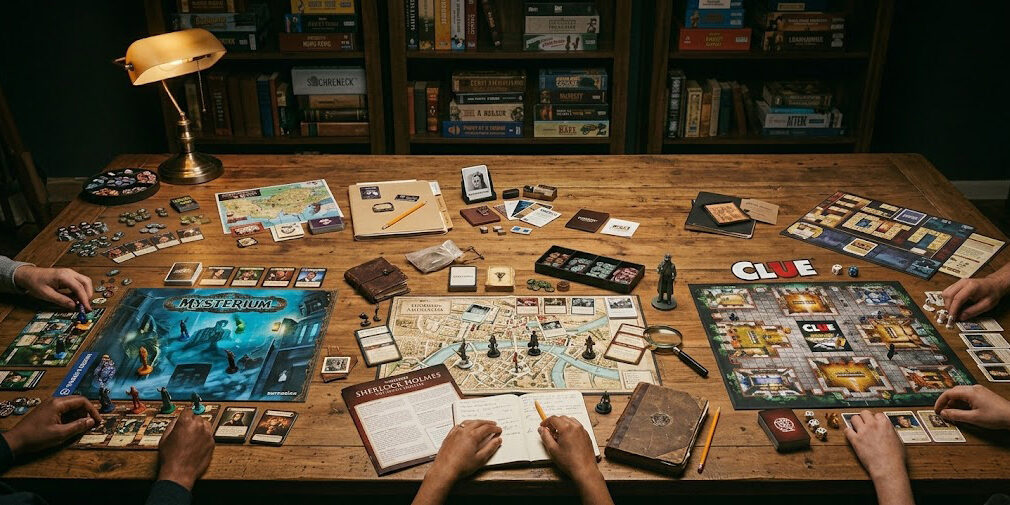
If you only read one recommendation from this entire article, make it this one: Sherlock Holmes Consulting Detective: The Thames Murders & Other Cases is the murder mystery board game most worth your money if you genuinely enjoy being challenged. It doesn’t hold your hand, it doesn’t rely on luck, and it doesn’t get stale after a couple of plays. For serious puzzle-lovers who want a rich, immersive detective experience, it stands apart from nearly everything else on the market.
That said, the “right” murder mystery game depends enormously on your group size, your appetite for complexity, and whether you’re planning a casual game night or a full-blown detective evening. That’s exactly why this guide exists — to walk you through the real differences between these games, including the frustrating ones, so you can spend your money confidently.
Which Game Should You Actually Buy?
Choosing between eleven solid options can feel paralyzing, so here’s how we’d break it down by player type.
If you’re a serious puzzle enthusiast who wants genuine intellectual challenge and replayability across multiple sessions, go with Sherlock Holmes Consulting Detective. It’s the game most likely to change how you think about what a board game can be.
If you’re hosting a party and need something that works for a big, mixed-ability group with minimal setup, One Night Ultimate Werewolf or Murder in Hong Kong will serve you best. Both are fast, loud, and reliably entertaining.
If you’re planning a special dinner party and want the game to be the evening rather than just part of it, Murder Mystery Party: Underwood Cellars is your best option. Commit to the format, and it’ll be an evening people talk about.
If you’re a true crime fan who wants the most immersive, evidence-heavy solo or small-group experience, Hunt A Killer: Death at the Dive Bar and Cryptic Killers: Murder of a Millionaire are both excellent, with Hunt A Killer being slightly more accessible and Cryptic Killers offering more complexity.
If you want something for families with kids or for groups where not everyone is a committed gamer, Clue remains the most reliable entry point — and Mysterium is an excellent step up once they’re ready for something more creative.
If you’re shopping for a couple’s game night or a small group of two to three players, Rear Window and Dead Man on the Orient Express are both compact, focused experiences that work beautifully at low player counts.
If you want something genuinely different from the standard mystery format, Perspectives (Orange Box) rewards groups willing to give it a patient first play.
Our Top Picks for Murder Mystery Board Games
✅ We recommend these products based on an intensive research process that’s designed to cut through the noise and find the top products in this space. Guided by experts, we spend hours looking into the factors that matter to bring you these selections.
⭐ 2.5 million+ people assisted in the last 30 days ⭐
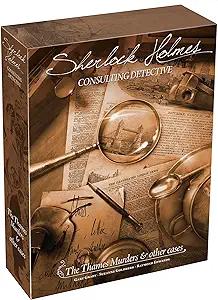
Best for: Serious puzzle enthusiasts and literary mystery fans
Players: 1–8 | Play Time: 2–3 hours per case | Age: 14+
There’s a particular kind of quiet satisfaction that comes from cracking a case in Sherlock Holmes Consulting Detective — the kind that feels genuinely earned, not handed to you. This isn’t a game that coddles you. You receive a casebook, a Victorian London newspaper, an illustrated map of the city, and a list of directories, and from there you’re on your own. No dice, no board in the traditional sense, no turn structure telling you what to do next. You decide where to go, who to interview, and which leads are worth chasing. When we first sat down with the Thames Murders case, our team spent nearly 20 minutes debating whether a specific witness statement was a red herring or a genuine lead — and that argument, it turned out, was exactly the point. The game creates genuine investigative tension in a way that very few tabletop experiences manage. The trade-off is that it’s firmly in the camp of games that take effort to love. First-timers often feel lost, and the scoring system — which compares your solution efficiency to Holmes’s — can feel harsh if you expected a gentler ride. But for groups willing to commit, it’s remarkably replayable across its ten included cases and several expansion packs. It pairs particularly well with a quiet evening and something warm to drink.
Pros: Deeply immersive narrative, outstanding replayability, no app dependency, scales well from 1 to 8 players
Cons: Steep learning curve, no tutorial mode, can feel punishing for casual players
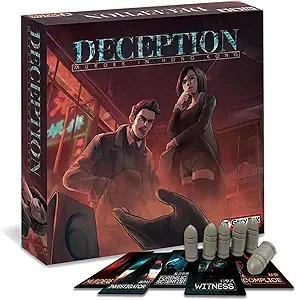
Best for: Larger groups who enjoy social deduction with a clever twist
Players: 4–12 | Play Time: 20–30 minutes | Age: 13+
Murder in Hong Kong deserves more attention than it tends to get. It borrows the hidden-role DNA of games like Avalon and Mafia but wraps it inside a genuinely smart forensic mechanic that makes the deduction feel purposeful rather than arbitrary. One player acts as the Forensic Scientist, who knows the truth of the crime but can only communicate through a limited set of scene tiles — they can point to what matters without ever directly naming the killer. Everyone else is either an investigator trying to figure it out or the murderer trying to stay hidden. What surprised us most when testing this was how effectively the scene tile system creates those “oh wait — that’s it!” moments without the game ever having to say a word. The Forensic Scientist’s frustration at not being able to just blurt out the answer, and the investigators’ frantic rereading of the clues, produce a dynamic energy that fills a room fast. It’s not a game for two players — it really does need a crowd to hum — and the single-use nature of each scenario means dedicated groups will burn through the content within a few sessions. But as a party centerpiece for mixed-ability groups, it punches well above its price.
Pros: Fast-moving, accessible to newcomers, excellent group energy, smart forensic mechanic
Cons: Needs 6+ players to really shine, limited replay scenarios, single-use mystery narratives
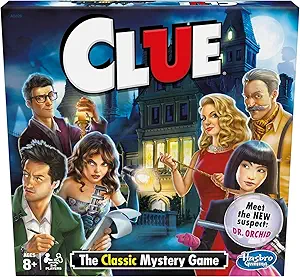
Best for: Families, casual players, and anyone introducing kids to mystery games
Players: 2–6 | Play Time: 45–60 minutes | Age: 8+
Clue has been around since 1949, and it’s still in print for a reason — it works. It’s not the most sophisticated game on this list, and it won’t challenge a seasoned gamer’s deductive skills the way Sherlock Holmes Consulting Detective will. But it does something important that a lot of modern mystery games fail at: it’s genuinely easy to teach, quick to set up, and produces winners and losers in under an hour. When we brought Clue to a mixed group that included a ten-year-old and a seventy-two-year-old, both were fully engaged and playing correctly within five minutes. That’s remarkable. The mechanics rely more on elimination logic than complex narrative deduction, which critics rightly note makes it feel more like a process of elimination than true detective work. But as a gateway drug into the murder mystery genre — or as a reliable fallback for a casual family evening — it holds up better than most of its imitators. Just be aware that experienced gamers will likely solve it before the newer players get comfortable, and the “gotcha” moments can occasionally deflate the ending if someone makes an early, lucky guess.
Pros: Instantly recognizable, genuinely accessible across all ages, fast to set up, multiple editions available
Cons: Relies too much on elimination guessing rather than deduction, experienced players gain a significant advantage, can feel thin for adults
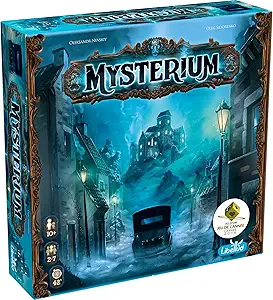
Best for: Creative thinkers, art lovers, and groups who enjoy cooperative play
Players: 2–7 | Play Time: 42 minutes | Age: 10+
Mysterium is one of those games that tends to produce specific, vivid memories. Not “we solved the murder,” but “remember when Jamie gave us that ghost card with the lighthouse, and somehow none of us connected it to the artist with the red scarf?” The ghost player communicates exclusively through surreal, heavily illustrated vision cards — no words, no pointing, just imagery — and the living players have to interpret those visions to identify the correct suspect, location, and weapon. When we tested this, the ghost player’s silent anguish as the group misread a clear clue was genuinely funny, and the moment of collective understanding when everything clicks into place is legitimately satisfying. Mysterium tends to work better with groups that lean into the creative and interpretive aspects rather than treating it as a pure logic puzzle. It’s cooperative throughout, which makes it a friendlier social experience than games where someone wins at everyone else’s expense. The only meaningful frustration is the seven-turn time limit — it can cut an evening short just as things are heating up, and losing because of time rather than because of a wrong answer feels deflating. The artwork, however, is consistently stunning and deserves mention as a selling point in itself.
Pros: Cooperative, visually gorgeous, highly creative, accessible to non-gamers, good for mixed groups
Cons: Time limit can feel arbitrary, the ghost player has very limited agency, and groups with poor spatial imagination may struggle
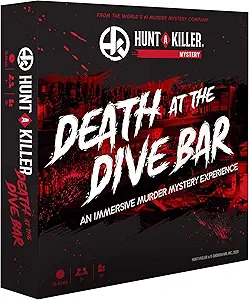
Best for: True crime fans, couples, and small groups looking for an immersive one-night experience
Players: 1–5 | Play Time: 45–60 minutes | Age: 14+
Death at the Dive Bar is less a board game and more a mystery in a box — and that distinction matters for setting expectations correctly. When you open it, you’re greeted with a collection of physical evidence: handwritten notes, police reports, photographs, receipts, and documents, each printed on different paper stock to feel authentic. The premise follows the suspicious death of bar owner Nick Webster, whose fall from a cliff behind his roadside tavern is officially called an accident — but one of his employees isn’t buying it. What genuinely surprised us during testing was how quickly the “this is just props” feeling disappeared. Within fifteen minutes, two of our testers had spontaneously set up a timeline on the table and were arguing about an alibi. The evidence feels like it was actually gathered, not manufactured for a game, and that tactile authenticity is Hunt A Killer’s greatest strength. The downsides are real, though: it’s a one-and-done experience with essentially no replay value, and puzzle difficulty leans toward the easier side, meaning experienced mystery players might crack the case faster than expected. But as a date-night activity or a novel way to spend an evening with close friends, it’s a standout value.
Pros: Exceptionally immersive physical evidence, great for true crime fans, hint system available online, epilogue unlocks after completion
Cons: No replay value whatsoever, puzzles may feel easy for experienced players, not suitable for large groups

Best for: Large party groups who want fast, chaotic fun with social deduction
Players: 3–10 | Play Time: 10 minutes | Age: 8+
One Night Ultimate Werewolf strips the traditional Werewolf/Mafia format down to its most efficient, adrenaline-producing form. There are no multi-night elimination rounds, no long stretches of waiting while other players deliberate. Every player gets a secret role — Werewolf, Seer, Troublemaker, Drunk, or one of several others — and over the course of a single accelerated “night” phase, roles are secretly swapped around by certain characters. Then everyone wakes up, nobody is quite sure what happened, and you have five minutes to argue your way to a vote before the round ends. The first time we played this with a group of eight, the Troublemaker had swapped two people’s roles without anyone knowing, leading to a frenzy of false accusations and increasingly confident-sounding bluffing that had the whole table in stitches. At ten minutes per round, you can easily squeeze in five or six games in an evening, which means the social dynamics evolve and shift in interesting ways as people learn each other’s tells. The companion app handles the narrated night phase cleanly, removing the need for one person to run the game. If you’re after a slow-burn investigation, look elsewhere. But for a party opener or a chaotic late-night game, it’s close to perfect.
Pros: Extremely fast rounds, huge replayability, companion app eliminates the need for a moderator, scales well for large groups
Cons: Very little actual “mystery” solving, can feel chaotic and random for players who prefer structured deduction

Best for: Groups who enjoy collaborative storytelling and non-linear mysteries
Players: 2–6 | Play Time: 60–90 minutes | Age: 12+
Perspectives is one of the more quietly inventive games on this list, and it tends to be underrated simply because it doesn’t fit neatly into existing genre categories. The central mechanic is that players experience the same story from different characters’ points of view — simultaneously, using a soundtrack played through phones or a speaker to synchronize the action — and must piece together a complete picture of events by sharing what each perspective reveals. Our team found the first playthrough a little disorienting, which is actually by design. You’re meant to feel the confusion of incomplete information, and the moment when details from different perspectives click together into a coherent timeline produces a genuine sense of discovery. It’s a game that rewards communication and patience, and it works particularly well with smaller groups where everyone can be fully engaged. The synchronized audio element is clever but can become a logistical wrinkle if phones have different volume levels or someone misses a cue. Still, for players who want something genuinely different from the standard mystery format, Perspectives offers an experience that’s hard to find elsewhere.
Pros: Genuinely innovative multi-perspective mechanic, deeply cooperative, produces memorable “aha” moments, compact and travel-friendly
Cons: Audio synchronization can be finicky, the first scenario may feel confusing until the mechanic clicks, limited scenarios per box
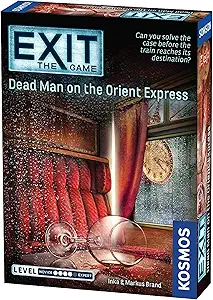
Best for: Fans of Agatha Christie, escape-room enthusiasts, and one-night game groups
Players: 1–4 | Play Time: 60–120 minutes | Age: 12+
The Exit series from Thames & Kosmos consistently delivers tight, well-crafted puzzle experiences, and Dead Man on the Orient Express is one of its stronger entries. The setting leans directly into the Christie-esque appeal of a murder on a luxury train — the urgency, the confined suspects, the ticking clock — and the puzzles are smartly integrated into the thematic setting rather than feeling bolted on. During our playthrough, one team member noticed a detail hidden in the corner of a prop card that the rest of us had completely overlooked, and that moment of discovery felt authentically earned. The game ranges between medium and challenging in difficulty, which makes it appropriate for groups with some puzzle experience without being inaccessible to newcomers. The key trade-off, as with all Exit games, is that you destructively alter components as you play — you’ll write on cards, cut them up, fold them — which means this is a one-and-done experience. That’s not a flaw so much as a design philosophy, but it’s worth knowing before you buy. As a gift for mystery fans or a special-occasion game night, it offers excellent value for the price.
Pros: Beautifully thematic, cleverly integrated puzzles, good difficulty calibration, compact, and affordable
Cons: Destroyed after one play, not suitable for players who prefer reusable games, and no cooperative app support
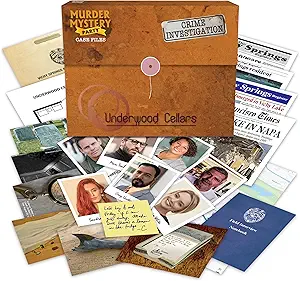
Best for: Dinner party hosts, role-play enthusiasts, and groups of 6–8 who enjoy theatrical experiences
Players: 1–8 | Play Time: 3–4 hours | Age: 14+
Underwood Cellars sits in a different category than most games on this list — it’s designed specifically around a hosted dinner party format, and it commits to that premise fully. Players receive character dossiers in advance, costume suggestions are included, and the evening unfolds in structured rounds that blend socializing with investigation. When we ran a playthrough, the host spent about an hour preparing beforehand, but the payoff was an evening that felt genuinely theatrical — part game, part improv comedy, part dinner party. The character writing is stronger than many competitors in the dinner mystery space, with motives that feel coherent and backstories that give even quieter players something to work with. The format does require some buy-in from participants; players who refuse to commit to a character tend to pull everyone else out of the immersion. It also works best with the right crowd — a group of friends comfortable with lighthearted roleplay will get far more from this than people who prefer silent deduction over conversation. Think of it less as a board game and more as a structured social experience that happens to end with a solution.
Pros: Perfect for dinner party settings, character writing is genuinely solid, inclusive for non-gamers, and memorable as a social event
Cons: Requires advanced host preparation, doesn’t suit introverted or non-roleplay-inclined groups, and replay value is limited

Best for: Film fans, couples, and small groups who enjoy deduction with a voyeuristic twist
Players: 3–5 | Play Time: 30–60 minutes | Age: 13+
The Rear Window game is an interesting case of a licensed product that actually earns its intellectual property rather than simply borrowing it. Inspired by Hitchcock’s classic film, it places players in the position of observing neighbors through windows across a courtyard, concluding limited, fragmentary evidence rather than direct investigation. One player sets up the scene — hidden behind a screen — while others observe and deduce what actually happened. When we tested this with two players, it felt surprisingly intimate and tense, with the observer genuinely uncertain whether what they were seeing constituted evidence of something sinister or an innocent misread of mundane events. The thematic fidelity to the film is strong, and it brings that specific sensation of suspicion-from-a-distance to life in a way that’s hard to replicate with a more conventional mystery format. It’s not a particularly long game, and it doesn’t carry the same narrative depth as some of our other picks — but for a date-night game or a tightly-focused evening with a small group, it offers something genuinely distinctive and well-produced.
Pros: Unique voyeuristic mechanic, strong thematic identity, good for small groups and two-player sessions, affordable price point
Cons: Lighter on narrative depth, limited replay variety, best enjoyed by fans of the source material

Best for: True crime fans who want an immersive cold-case experience with physical evidence
Players: 1–6 | Play Time: 90–180 minutes | Age: 13+
Murder of a Millionaire from Cryptic Killers takes the evidence-in-a-box concept and executes it at a notably high production level. The case centres around the death of a wealthy businessman, and the physical evidence — which includes forged documents, photographs, handwritten letters, and forensic reports — is produced with a level of detail that makes it easy to forget you’re handling game components rather than actual case files. During our testing, the group spread everything across a large table and spent the first twenty minutes simply cataloguing what was there, which felt exactly like what a real investigation team might do. The mystery itself is layered with enough red herrings and misdirection to keep experienced mystery players genuinely uncertain until close to the end, which is a harder balance to strike than it sounds. The age recommendation reflects some mature themes — financial crime, complicated family dynamics, morally ambiguous characters — but nothing gratuitously dark. For groups who want an evening-length investigation that feels substantial and well-crafted, this is one of the stronger offerings in the physical-evidence mystery category.
Pros: High-quality physical evidence, satisfying narrative complexity, good for groups who enjoy collaborative investigation, strong production values
Cons: Long play time requires a committed group, mature themes are not suitable for younger players, and one-time use
How We Tested These Games
We spent several weeks working through more than 20 murder mystery games as a team, rotating between groups of two, four, and eight players to stress-test each one under real conditions. We played games with self-described board game veterans and with people who hadn’t touched a board game since childhood. We paid attention to setup friction, how long it took to teach newcomers the rules, where arguments broke out, which games sparked genuine excitement, and which ones quietly lost the room by the 45-minute mark.
From that pool, we eliminated games that felt gimmicky, had components that fell apart or printed poorly, relied too heavily on luck rather than deduction, or simply weren’t worth their price tag given the competition. What remained is the list you’re reading now — eleven games that each do something meaningfully well.
Games We Eliminated and Why
Before we get to the recommendations, it’s worth being transparent about what didn’t make the cut. A few popular titles were dropped for specific reasons.
Betrayal at House on the Hill has a passionate following, but we found the haunt phase — where one player secretly becomes the traitor — creates wildly unbalanced scenarios depending on which haunt is triggered. The randomness felt more frustrating than fun in repeated plays.
Chronicles of Crime impressed us with its QR-code and app integration, but the reliance on a companion app meant that any device battery problems or software updates could derail an evening entirely. Games that depend on a third-party app have a durability problem that ages them poorly.
Several party-oriented “dinner theater” kits were eliminated because they leaned entirely on scripted roleplay rather than actual deduction, making them feel closer to amateur dramatics than board games.
What to Look for When Buying a Murder Mystery Game
Before committing to any purchase, it helps to think through a few key questions.
Group size matters more than most people realize. Social deduction games like Werewolf and Murder in Hong Kong genuinely break down to below six players. Investigation games like Sherlock Holmes and Hunt A Killer actually work better in smaller, more focused groups. Always check the player count on the box and take it seriously.
Replayability is a spectrum. Some games on this list — Clue, Mysterium, Sherlock Holmes — can be played repeatedly. Others, like the Exit series and Hunt A Killer, are designed as one-time experiences. Neither is inherently better, but they represent fundamentally different value propositions. A single-play game at $30 that delivers a four-hour immersive evening may be a better value than a $60 game that gets played twice.
Know your group’s tolerance for complexity. A game with a 30-minute setup and a 20-page rulebook will kill the energy in most casual settings. If your group trends toward casual, prioritize games with fast starts and clear mechanics. If your group skews experienced, choose games that offer genuine depth.
Consider the physical quality of components. Games that include physical evidence — documents, photographs, cards — vary enormously in production quality. Thin card stock and fuzzy printing will undercut immersion faster than almost anything else.