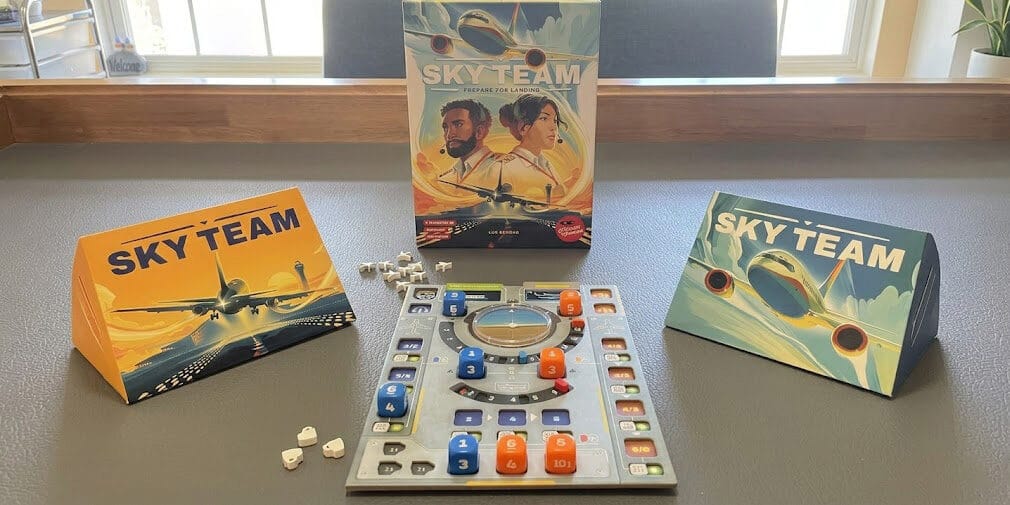

Sky Team won the 2024 Spiel des Jahres — the board gaming equivalent of a Michelin star — and after playing it more sessions than we can count, we understand exactly why. Designed by Luc Rémond and published by Scorpion Masqué, this cooperative game puts two players in the cockpit of a commercial airliner as pilot and co-pilot. Your shared goal is to safely land the plane. The twist — the one that makes this game genuinely brilliant — is that once you’ve rolled your dice, you can no longer talk to each other. You can plan between rounds, yes, but the moment those dice hit the table, all verbal communication stops. Every placement is a silent bet that your partner is thinking what you’re thinking. The first time your co-pilot slots a die somewhere completely unexpected and you watch your carefully planned descent begin to unravel, you’ll feel a jolt of real panic that almost no other game delivers. Between the Axis dial, the speed gauge, landing gear, flaps, and radio communications that all need to land just right, the cockpit control board becomes a kind of shared puzzle that gets harder with every new airport module you add. It plays in about 20 minutes flat, which means you’ll almost always play twice. The only genuine knock is that the no-communication rule can occasionally feel arbitrary — thematically, it’s a little hard to justify — but it’s so central to what makes the experience work that we came to appreciate it quickly.
Players: 2 only | Playtime: ~20 minutes | Age: 14+ | Complexity: Medium-light
Winner of the 2024 Spiel des Jahres — and one of the most tension-packed 20 minutes you’ll spend at a table.
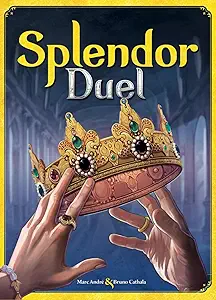
Asmodee Splendor Duel Board Game
Splendor Duel takes everything that made the original Splendor comfortable and familiar, then quietly tightens every bolt until the experience becomes something far more engaging. Designed by Marc André and Bruno Cathala, it casts both players as rival Renaissance jewelers competing for gem tokens on a 5×5 spatial grid — and that spatial element immediately changes the feel. You can’t just grab what you want; you need to take tokens in a consecutive line, which means your opponent’s choices directly shape your options. Privilege scrolls add another layer of meaningful tension: take gems aggressively and you hand your opponent a free pick from anywhere on the board. Our testers found themselves genuinely deliberating over moves that would have been automatic in the original game. There are three different ways to win — reach 20 prestige points, collect 10 crowns, or earn 10 points in a single gem color — and the card abilities that let you steal gems, chain turns, or claim extra actions give the mid-game a constant sense of back-and-forth momentum. The components are excellent, sessions run about 30 minutes, and the box is compact enough to bring anywhere. It does trend slightly confrontational, so if your play partner prefers low-conflict games, this one may occasionally generate friction. But for duos who enjoy the strategic sting of out-maneuvering each other, Splendor Duel tends to become a regular rotation.
Players: 2 only | Playtime: ~30 minutes | Age: 10+ | Complexity: Light-medium
A sharper, more combative version of a classic — and in many ways, a better game.
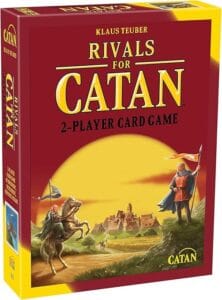
CATAN Rivals for CATAN Card Game
If you’ve ever played CATAN at a table of four and thought, “I wish this were just me and one other person,” Rivals for CATAN is the game that was waiting for you. This card-based version of the classic civilization-building game rebuilds the Catan experience from the ground up for two players, replacing the hex board with a tableau of settlements, cities, roads, and resource cards that each player builds in front of them. The clever part is how it handles production: both players produce resources on every die roll, depending on the numbers on their settlements, so you’re never just sitting there waiting for your turn. There’s a genuine rhythm to it — roll, collect, develop, and steadily nudge your principality toward victory. Our testers appreciated that it preserved Catan’s satisfying resource management loop while cutting the waiting time and player-count dependency that can make the board game frustrating. The various theme sets add meaningful variety, changing which cards are available and shifting the strategic focus across different plays. It does take a few sessions to internalize the card interactions, and the game runs a bit longer than lighter picks in this list — usually 45–75 minutes — which places it firmly in “dedicated game night” territory rather than quick filler. But for Catan fans who often play as a pair, this remains one of the most thoughtfully designed adaptations in that universe.
Players: 2 only | Playtime: 45–75 minutes | Age: 10+ | Complexity: Medium
All the Catan flavour you know, stripped down to its competitive core.
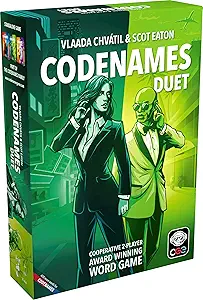
CGE Codenames Duet Board Game (2nd Edition)
Codenames Duet takes the brilliant word-association engine of the original Codenames and redesigns it specifically for two cooperative players — and the result is one of the most accessible, repeatedly playable games on this list. Where the original pits two teams against each other, Duet asks both players to work together to identify all fifteen agents on the grid before the timer runs out or they contact too many assassins. The catch — and what makes this genuinely challenging — is that each player holds a key card that only they can see, so you’re both clue-givers and guessers simultaneously. You might know that “crane” refers to two cards from your side; your partner might know it connects to one from theirs. That shared, overlapping information creates some of the most satisfying moments of collaborative deduction we experienced in our testing. The 2nd Edition adds new cards and refines the components, making it a clear upgrade over the original release. It’s light enough to introduce to non-gamers, plays in under 30 minutes, and can be played almost anywhere with its compact format. The main caveat is that it leans heavily on language and pop-culture associations, so it may not travel as well across language barriers or large age gaps. But for a quick, cheerful game that two people can genuinely enjoy equally? It’s hard to beat.
Players: 2 (or 2+ cooperative) | Playtime: 15–30 minutes | Age: 11+ | Complexity: Light
The rare party game that works just as well with two.
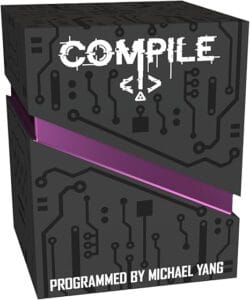
Compile is a newer entry in the two-player card game space from Synapses Games, and it earned a spot in our rotation by doing something that not many games manage: making you feel smart. The game asks both players to draft and play cards representing software modules, building stacks that score in unexpected combinations. Every card you take is a card your opponent doesn’t get, so the drafting phase carries real weight. Our testers found that early games felt exploratory and occasionally chaotic, but by the third or fourth play, a genuine strategic layer emerged — one about reading your opponent’s intentions and disrupting their engine as efficiently as possible. The tech theme is light enough not to alienate anyone unfamiliar with programming concepts, and the iconography, once learned, keeps turning quickly. It’s a strong pick for duos who enjoy card-drafting games like Sushi Go! but want something with a bit more bite to it. As a caveat, because Compile Main 1 is the first set in what appears to be an expandable line, some players may find the base game feels slightly limited after extended play — worth keeping in mind if you’re drawn to games with a large card pool.
Players: 2 | Playtime: 30–45 minutes | Age: 10+ | Complexity: Light-medium
A clever card-drafting duel with a tech theme that rewards planning.
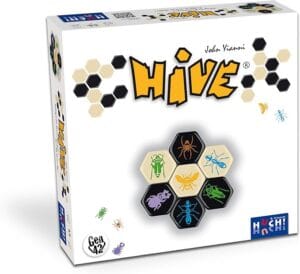
Hive is the kind of game that feels immediately intuitive and then, about three plays in, reveals itself to be genuinely deep. Published in this edition by HUCH!, it’s an abstract strategy game played entirely with large, chunky Bakelite-like tiles — no board, no dice, no cards. Each tile represents an insect with its own movement rules, and your goal is to surround your opponent’s Queen Bee while protecting your own. The hive itself shifts and grows with every placement, which means the board state changes constantly and in ways that reward spatial thinking. Our team found that Hive occupies a satisfying middle ground between chess (which can be intimidating for newer players) and simpler abstracts (which can feel solved too quickly). The game travels beautifully — the tiles live in a small bag and can be played on any flat surface — making it a strong pick for cafés, travel, or anywhere you want a game you can set up in 30 seconds. The trade-off is that it’s a pure abstract with no narrative or thematic hook, so players who need a story to stay engaged may find it dry. But for those who enjoy a clean strategic puzzle played directly against a single opponent, Hive tends to generate the kind of deep respect that keeps it on shelves for years.
Players: 2 | Playtime: 20–30 minutes | Age: 9+ | Complexity: Medium
Chess-like depth in a game with no board, no luck, and a gorgeous tactile weight.
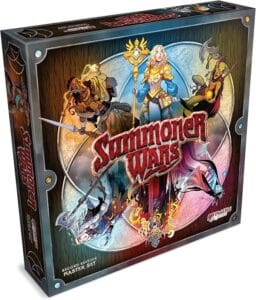
Plaid Hat Games Summoner Wars Second Edition Master Set
Summoner Wars occupies a space between a miniatures game and a card game, and the Second Edition Master Set from Plaid Hat Games is the definitive way to experience it. Each player controls a unique faction — drawing units, casting spells, managing resources, and maneuvering across a grid-based battlefield toward their opponent’s Summoner. The factions feel genuinely different from each other, which gives the game exceptional replayability. Our testers found early games required some patience with the rules, but by the second or third session, the mechanics clicked, and matches became genuinely tense strategic exercises. What sets Summoner Wars apart from similar games is how well it handles asymmetry: the Phoenix Elves play nothing like the Cave Goblins, so every new faction matchup feels like a different game. The Master Set includes multiple factions and enough content to play for months without feeling like you’re repeating yourself. The main caveat is setup time and complexity — this isn’t a game you can reasonably pull out mid-evening without commitment. But for duos who enjoy deeper combat games and are willing to invest a few sessions in learning, Summoner Wars tends to become a genuine fixture.
Players: 2 | Playtime: 45–90 minutes | Age: 9+ | Complexity: Medium-heavy
A card-and-miniature combat game with a surprisingly accessible core loop.
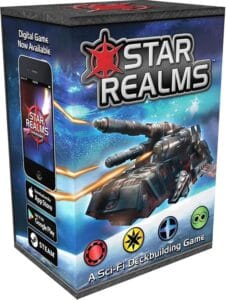
Star Realms is, in our view, one of the cleanest and most replayable deck-builders ever made for two players, and the version from Wise Wizard Games delivers all of that in a pocket-sized package that costs a fraction of what most games in this genre demand. The premise is straightforward: both players start with identical small decks, purchase cards from a shared trade row to improve their deck, and use those cards to deal damage to the opponent’s authority (essentially their health total). The four factions — Star Empire, Trade Federation, Machine Cult, and Blob — create synergies that make every game feel different depending on which cards cycle through the trade row. What consistently impressed our team was the game’s pace. Turns are fast, the catch-up mechanic built into the authority system keeps games from feeling decided early, and the moment when your deck finally “goes off” — chaining a sequence of synergistic cards for massive damage — remains satisfying across dozens of plays. The trade-off is that the game is fairly aggressive and direct, which can feel relentless to players who prefer building engines quietly. It also doesn’t have a strong thematic narrative. But as a quick, clever, deeply replayable head-to-head deck-builder, Star Realms is hard to argue with.
Players: 2 | Playtime: 20–30 minutes | Age: 12+ | Complexity: Light-medium
The deck-builder that gets straight to the point — and keeps every game feeling different.
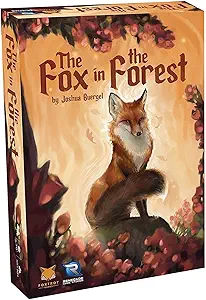
Renegade Game Studios Fox in the Forest
Trick-taking games are one of the oldest game formats in existence, but Fox in the Forest, published by Renegade Game Studios, manages to do something genuinely original with the structure. You’re playing standard trick-taking across a series of rounds — lead a card, your opponent plays a card, the higher card wins — but the scoring completely subverts expectations. Winning too many tricks actually hurts you. Score between zero and three tricks, and you earn points for being “humble”; score four to six, and you get the standard points; but win seven or more, and the game labels you “greedy” and you score nothing. That single rule inversion creates a game about deliberate underperformance and careful counting that we found endlessly fascinating. The odd-numbered cards carry special abilities — like reversing lead player advantage or swapping trump suit — that add decisions to a format that can otherwise feel purely mechanical. Fox in the Forest is a brilliant entry point for people who have never tried trick-taking games, and it’s quick enough to play three rounds in an evening. The main limitation is that the format inherently involves some luck in what you’re dealt, which means a bad hand can make for a frustrating round on occasion. But the game is forgiving enough that the sessions stay fun even when one hand goes sideways.
Players: 2 only | Playtime: 25 minutes | Age: 10+ | Complexity: Light
A trick-taking card game with a brilliant twist that rewards restraint.
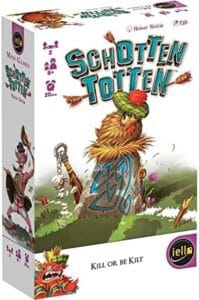
Schotten Totten is a Reiner Knizia classic published here by IELLO, and it belongs in the conversation whenever people ask about the best small-box two-player games ever made. The concept is simple: nine stones sit in a line between two players, and you’re each playing cards (numbered 1–9 in six colors) to claim stones by building three-card poker-like combinations on your side. The player who claims five stones, or any three adjacent stones, wins. It sounds modest, but the game generates extraordinary tension because every card you play is a card you’re not playing elsewhere, and with a small deck, both players are constantly tracking what combinations are still possible. Our testers repeatedly found themselves making agonizing calls — hold this card for the stone I really want, or block the one my opponent is obviously building toward? Schotten Totten is one of the few games where we found ourselves genuinely analyzing the mathematics of what’s left in the deck late in the game. It’s fast, it fits in a pocket, and it ages remarkably well. The knock against it is that analysis paralysis can occasionally slow things down for players who want to think deeply about every move, but even then, the session rarely exceeds 30 minutes.
Players: 2 only | Playtime: 20–30 minutes | Age: 8+ | Complexity: Light-medium
A deceptively elegant battle of wits wrapped in a tartan package.
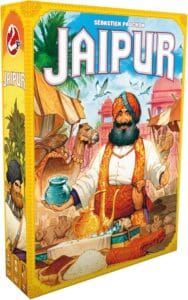
Asmodee Jaipur Board Game (New Edition)
Jaipur is the game we’ve recommended most often to couples and friends who are new to hobby gaming, and the New Edition from Asmodee only makes that easier by polishing the components and streamlining the presentation. You and your opponent are merchants in a bustling Indian marketplace, taking and selling goods — camels, spices, leather, cloth, gems, gold, and silver — to earn rupees and prestige. The central decision is always the same: sell now for smaller tokens, or wait to accumulate more goods and sell for larger bonuses? But your opponent is doing the same math, which means waiting carries real risk. The camel mechanic — a shared herd that both players can take but only one uses — adds a persistent tactical texture that makes the game feel alive rather than formulaic. Our team consistently found Jaipur sessions hitting the 30-minute mark comfortably, with enough variability from the token draw and bonus tiles to keep individual games feeling distinct. It’s arguably one of the gentlest entry points on this entire list, and it genuinely rewards repeat play as you start to read your opponent’s intentions through their camel movements and selling patterns. For duos new to hobby gaming, it’s among the most reliable gateway games available.
Players: 2 only | Playtime: 30 minutes | Age: 10+ | Complexity: Light
One of the most satisfying trading card games for two — quick to learn, hard to master.
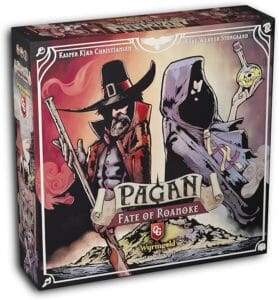
Capstone Games Pagan: Fate of Roanoke Strategy Card Game
Pagan: Fate of Roanoke from Capstone Games takes a genuinely surprising approach to two-player card games by grounding its mechanics in the mystery of the lost Roanoke Colony of 1587. One player controls the colonists; the other plays as the mysterious pagan forces of the New World. The asymmetric design means each side plays entirely differently, with the colonists trying to survive and gather resources while the pagan player presses supernatural advantages and disrupts their efforts. Our testers found this asymmetry to be one of the game’s genuine strengths — learning both sides doubles your understanding of what the game is doing and makes rematches feel strategically fresh. The historical and folkloric theme carries real atmosphere; the card art and flavor text do a lot of work to make the experience feel narratively cohesive rather than purely mechanical. Sessions run 45–75 minutes, which places it firmly in the heavier-filler range, and the asymmetric rules do require patience in the learning phase. But for players who want a two-player card game with genuine narrative flavor and meaningful strategic decisions on both sides of the table, Pagan is a distinctive and rewarding choice.
Players: 2 only | Playtime: 45–75 minutes | Age: 12+ | Complexity: Medium
A haunting, story-rich strategy card game built around one of history’s greatest mysteries.
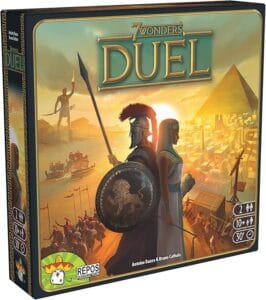
Asmodee 7 Wonders Duel Board Game
7 Wonders Duel is the game that convinced a large portion of the hobby that two-player spinoffs could genuinely surpass their originals, and after returning to it repeatedly during our testing, we’d agree with that assessment. Designed by Antoine Bauza and Bruno Cathala, it compresses the sweeping arc of civilizational development — science, military, commerce, culture — into a 30-minute head-to-head card drafting game. Cards are arranged in a shared display, and the spatial arrangement determines which cards are accessible on any given turn, creating a constant tension between what you want and what you can safely let your opponent take. The three separate victory conditions — a military breakthrough, a science breakthrough, or the most points at game end — mean the game can end suddenly and unexpectedly, keeping both players alert even when they feel they’re ahead. Progress cards give you permanent resource discounts that compound across the game, making early card decisions matter significantly. Our team consistently found 7 Wonders Duel rewarding to both teach and replay. The caveat is that the military track can create runaway momentum if one player advances aggressively without the other responding, which new players may find frustrating until they understand the counter-play options.
Players: 2 only | Playtime: 30 minutes | Age: 10+ | Complexity: Medium
One of the most celebrated two-player games ever made — and it holds up completely.
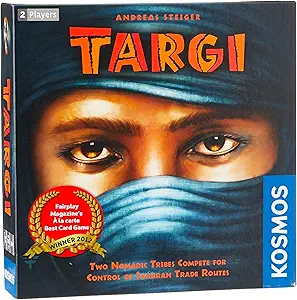
Targi, published by Thames & Kosmos, is one of those games that earns its reputation over time. On the surface, it looks modest — a 5×5 grid of cards, some tribe cards in the center, and a set of goods tokens. But the worker placement mechanism here is unlike anything else in the category: you place your markers on the outer border of the grid, and your claimed card is determined by the intersection of your two marker positions. That spatial logic creates a game where blocking your opponent is central, where positions you choose purely for their border card simultaneously claim a central card, and where your opponent might force you into an impossible position with a single clever marker placement. Our testers found that early games felt slightly slow as the system became familiar, but by the second session, Targi revealed itself as a precise and deeply satisfying puzzle. It plays in 60–75 minutes and has just enough variability in its tribe cards to feel different across sessions. The main trade-off is that the game is strictly for two and doesn’t offer the dramatic swings that heavier strategy games do — it’s a quiet, cerebral experience. For players who enjoy thinking-forward, patient strategic games, Targi regularly earns comparisons to Hive and Jaipur as an essential two-player design.
Players: 2 only | Playtime: 60–75 minutes | Age: 12+ | Complexity: Medium
A worker-placement gem that’s uniquely and brilliantly designed for two.
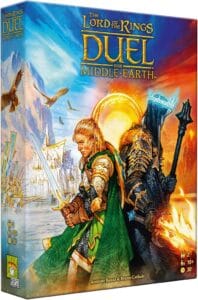
Asmodee The Lord of the Rings: Duel for Middle-Earth Board Game
The Lord of the Rings: Duel for Middle-Earth captures the scope of Tolkien’s conflict without asking you to spend an evening on it. One player controls the Fellowship, working to destroy the One Ring and bring light to the regions of Middle-earth; the other leads Sauron’s forces, trying to control enough territory to claim victory before the Ring is destroyed. The game is built around a card-playing area-control system: both players draw cards representing locations, characters, and events from the books, playing them to claim or contest regions on a central game board. Our testers found the thematic integration impressive — the character cards feel grounded in the story, and the push-pull of light versus shadow gives the game a narrative momentum that purely abstract designs can’t replicate. It plays in 30–45 minutes, which is the sweet spot for an evening game, and the asymmetric sides ensure that each player’s turn feels genuinely distinct. The caveat is that, like most licensed games, it’s most rewarding for players who have some emotional connection to the source material. Players unfamiliar with Tolkien will find a solid area-control card game, but they’ll miss some of the thematic resonance that makes this design special.
Players: 2 only | Playtime: 30–45 minutes | Age: 10+ | Complexity: Light-medium
Middle-earth’s greatest conflict, distilled into a clever card-and-area-control duel.
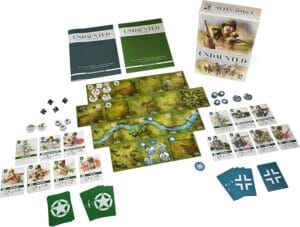
Undaunted: Normandy is the game we’d recommend to anyone who’s always been curious about wargames but felt intimidated by the rules-heavy reputation of the genre. Designed by David Thompson and Trevor Benjamin, it’s built on a deck-building foundation rather than the usual hex-and-counter system, which dramatically lowers the barrier to entry. Each player controls one side of a WWII squad battle — Americans or Germans — and uses their hand of cards to activate soldiers, maneuver units across a modular terrain board, and execute tactical actions. The clever innovation is how casualties work: when a soldier is eliminated, their card is removed from your deck, permanently weakening your options going forward. That mechanic creates a visceral sense of attrition that most lighter wargames struggle to replicate. Our testers found the campaign structure — a series of linked scenarios that evolve across sessions — particularly compelling, as losses from one mission carry consequences into the next. The game does favor players with some prior wargaming instincts, and the American and German sides play asymmetrically, so the first few scenarios may favor whoever picks up the game’s rhythms faster. But as an entry point into the wargame genre, Undaunted: Normandy is genuinely excellent.
Players: 2 | Playtime: 45–75 minutes | Age: 14+ | Complexity: Medium
A squad-level WWII wargame that strips away the complexity without losing the tension.
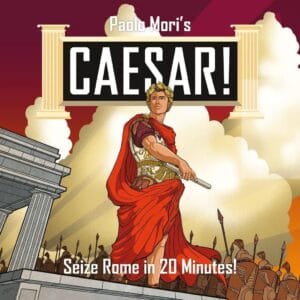
PSC Games Caesar: Rome vs. Gaul
Caesar: Rome vs. Gaul from PSC Games belongs to a family of sub-30-minute wargames that prioritize tight decision-making over exhaustive simulation, and it’s our favorite of that group. One player commands Caesar’s Roman legions; the other leads Vercingetorix’s Gauls through the pivotal conflict of the Gallic Wars. The game uses an area-control mechanic layered over a card-driven action system, where both sides draw resource cards and allocate them across the map to advance, fortify, or strike. What distinguishes Caesar from other compact wargames is how well it conveys historical asymmetry: the Romans tend toward methodical, disciplined advancement, while the Gauls reward opportunistic raiding and holding strategic chokepoints. Our team found that the short play time worked strongly in the game’s favor — a 25-minute session felt complete rather than truncated, and the replayability came from the variability of card draws rather than session length. Related games Blitzkrieg and Dogfight cover WWII and WWI themes, respectively, in the same format, but Caesar’s cleaner historical scenario and tighter map design make it our preferred pick of the three. If you have a partner who’s been curious about wargaming but doesn’t want to commit to a two-hour ruleset, Caesar is a reliable and genuinely satisfying first step.
Players: 2 | Playtime: 20–30 minutes | Age: 14+ | Complexity: Light-medium
A fast, focused wargame about the Gallic Wars that fits in a coat pocket.