Advertiser Disclosure
We independently review everything we recommend. When you buy through our links, we may earn a commission.
The Best Organic Tampons

Conventional tampons are typically made from a blend of cotton and rayon, processed with chlorine-based bleaching agents, and sometimes treated with fragrances or synthetic additives. The concern isn’t that these ingredients are definitely dangerous at the doses involved — the research on that is still evolving — but rather that the vaginal mucosa is highly absorptive tissue, and what goes near it matters more than most people realize.
Organic tampons are generally made from 100% organic cotton that hasn’t been treated with synthetic pesticides, herbicides, or fertilizers. They’re also typically free from chlorine bleaching, artificial fragrances, dyes, and rayon. As OB-GYN Dr. Erica Montes has noted in several consumer health guides, organic options “tend to reduce irritation as well as risk of allergic reactions” — particularly for people with sensitive skin or hormonal conditions that make vulvar tissue more reactive.
Ready to buy? Rael Tampon Organic is our #1 pick — see it on Amazon
Everything We Recommend
✅ We recommend these products based on an intensive research process that’s designed to cut through the noise and find the top products in this space. Guided by experts, we spend hours looking into the factors that matter to bring you these selections.
⭐ 2.5 million+ people assisted in the last 30 days ⭐
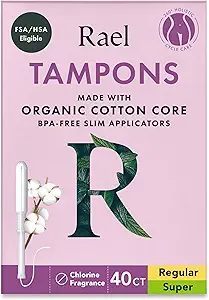
Ultra slim BPA-free plastic applicator features a rounded tip and an anti-slip grip for easy insertion.
Comfort-fit design expands in all directions, ensuring faster absorption and a secure, comfortable fit.
Leak Locker technology locks fluids in the core, protecting for up to eight hours.
Made with clean ingredients suitable for all skin types and menstrual conditions, safe for everyone.
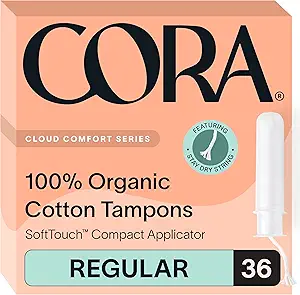
Cora tampons are 100% organic cotton, providing ultra-confident leak protection for all flows.
Made without pesticides, rayon, chlorine, fragrance, or dyes, FSA/HSA eligible for safe use.
Sleek BPA-free applicator allows smooth, comfortable insertion, expanding to absorb from all angles.
Each pack contains 36 regular tampons, supporting comfort and period care for everyone in need.
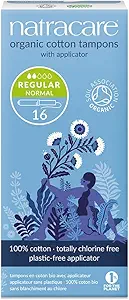
Natracare tampons use GOTS certified 100% organic cotton for safe, natural period care.
Plastic-free and vegan design ensures environmentally friendly, gentle protection for sensitive bodies.
Regular absorbency tampons are GMO-free, chlorine-free, and made without perfumes or dyes.
No rayon, plastics, or artificial additives, providing a comfortable and worry-free period experience.
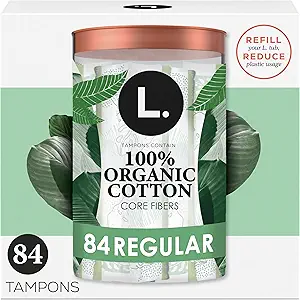
L. tampons feature an organic cotton core, providing gentle, reliable protection for daily use.
Made without synthetic pesticides, rayon, or fragrances, ensuring safe and hypoallergenic period care.
Full-size BPA-free applicator with easy-open wrapper and grip prevents slips for comfortable insertion.
Regular absorbency tampons cost under $5 monthly and are FSA/HSA eligible for convenience.
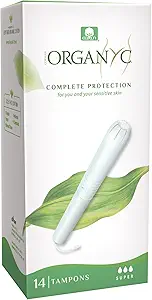
Organyc tampons are made from 100% certified organic cotton for gentle, reliable absorbency.
Hypoallergenic design contains no chlorine, rayon, perfumes, dyes, or chemicals, safe for sensitive skin.
Ultra-absorbent cotton is textured for strength, providing complete protection even on heavy flow days.
Cardboard applicator reduces plastic waste while respecting sensitive skin and protecting the environment.
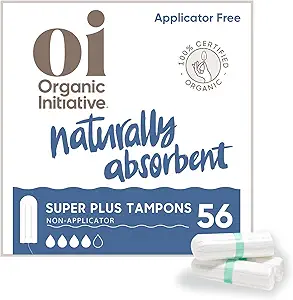
Oi tampons are made from 100% certified organic cotton, avoiding plastic, SAP, and synthetic veils.
Slender, non-applicator design with rounded tip and secure finger grip ensures easy, discreet insertion.
Free from toxic chemicals, perfumes, dyes, chlorine, and allergens, safe for sensitive skin daily.
GOTS and BioGro certified cotton expands naturally for 360° absorbency, providing reliable, comfortable protection.
What to Look for Before You Buy
Third-Party Certifications Matter Most
Marketing language on period care packaging can be slippery. Words like “natural” and “pure” aren’t regulated, so they mean whatever the brand wants them to mean. What actually carries weight is third-party certification. The two most credible ones to look for:
GOTS (Global Organic Textile Standard) — This is the gold standard for organic textiles. It covers the entire supply chain, from farming to processing, and prohibits toxic inputs at every stage. If a tampon carries GOTS certification, you can reasonably trust the organic claim.
OEKO-TEX Standard 100 — This certification tests the final product for harmful substances, even if the inputs weren’t organically certified. It’s a useful second layer of confidence, particularly for products that don’t lead with GOTS.
You can verify certifications through the GOTS public database and the OEKO-TEX certification search. We’d encourage you to do this — not out of distrust, but because verification is a healthy habit with personal care products.
Full Ingredient Transparency
Here’s something most people don’t know: tampon brands in the United States are not legally required to disclose their full ingredient list. That’s changing slowly thanks to consumer advocacy, but for now, ingredient transparency is a feature — not a given. Brands that voluntarily list every component, including the string, applicator material, and wrapper, tend to be more trustworthy across the board. If a brand is vague about what’s in the product, that tells you something.
Absorbency Matching
Using a tampon with a higher absorbency than your flow requires isn’t just wasteful — it increases your theoretical risk of Toxic Shock Syndrome (TSS), a rare but serious condition. The FDA advises using the lowest absorbency that effectively manages your flow. Most quality organic brands offer a range from Light through Super Plus, so there’s no need to compromise. If you’re not sure where your flow falls, start with Regular and adjust from there.
A Note on Certifications vs. Claims
One thing we noticed during our testing and research: some brands prominently feature language like “100% organic cotton” without linking that claim to a specific third-party certifier. In some cases, this is legitimate — the product may use certified organic cotton but simply not display the certification logo on the front-of-pack. In other cases, it’s marketing. Our picks below either carry GOTS certification or have transparent ingredient disclosures that give us sufficient confidence. We’ve noted the certification status for each.
Our Top Picks for Organic Tampons
If you’ve been hesitant to switch to organic tampons because you’re worried about giving up performance, Rael is the place to start. What immediately stood out to us during testing was how thoroughly the brand had thought through every component — not just the cotton, but the entire system. The tampon uses 100% certified organic cotton for both the core and the outer veil, which means there’s no synthetic layer between you and the absorbent material, a detail many competing brands quietly skip. The BPA-free plastic applicator glides smoothly without the stiff, scratchy feel that puts so many people off applicator tampons in the first place, and the brand also offers a cardboard applicator option and a compact version for those who prefer something more pocket-friendly. The standout feature is Rael’s proprietary Leak Locker Technology, which encourages the tampon to expand widthwise rather than just lengthwise — and during heavier days, that lateral expansion genuinely made a difference in protection without having to size up in absorbency. Available in Regular and Super, with up to 8 hours of wear time and no chlorine bleaching or added fragrances, Rael is a strong all-rounder that works just as well for the office as it does for an active day. It’s the pick we’d give to someone switching from a conventional brand who wants the transition to feel completely seamless.
Best for: First-time switchers to organic; active lifestyles; those with sensitive skin who still want applicator convenience.
Cora occupies an interesting space in the organic tampon market: it’s simultaneously one of the most ethically driven brands and one of the most practically designed. The tampons themselves are made from 100% certified organic cotton — GOTS-certified, biodegradable, and free from dioxins, pesticides, rayon, fragrance, and chlorine. What makes Cora distinctive, though, is the body-centric expansion design. Rather than simply soaking up fluid from a fixed shape, Cora tampons are engineered to gently expand to your individual anatomy, which during our testing translated into noticeably fewer leaks on medium-flow days without needing to wear backup protection. The compact, BPA-free applicator is genuinely compact — it fits comfortably in a small pocket or tucked into a wallet — and insertion was smooth across multiple testers, including those who typically find plastic applicators uncomfortable. Cora is also a B Corp, which means its social and environmental commitments are independently verified, not just stated on a website. The brand donates period products and health education to people who would otherwise go without, so every box you buy contributes to that mission. If you want a tampon that works well and aligns with your values, Cora is one of the more complete packages on this list.
Best for: Values-driven shoppers; those with irregular flow shapes; people who want verified environmental and social responsibility.
There’s a reason Natracare has been around since 1989 and still turns up on nearly every credible organic tampon list: the product does exactly what it says, and the brand has decades of consistency behind it. Natracare holds the distinction of creating the world’s first certified organic cotton tampon, and that legacy shows in how uncompromising the formulation is. The tampons are made from 100% pure, GOTS-certified organic cotton — no rayon, no synthetic veil, no synthetic anything — and the cotton itself interlocks in a way that prevents fiber shedding, which matters more than most people realize. Conventional tampons can leave behind synthetic fibers in vaginal tissue; Natracare’s construction is specifically designed to avoid that. During our testing, the Regular size performed well for light-to-moderate flow days, and the expansion pattern (widthwise, which aligns with anatomy more naturally than purely length-based expansion) meant they felt more comfortable on lighter days when over-absorbency can cause dryness. The packaging is made from recycled card, the tampons are biodegradable and compostable, and nothing about the product contains plastic. The non-applicator versions come paper-wrapped, making them genuinely zero-plastic. For anyone who has dealt with recurring vaginal irritation and suspected their tampons might be part of the problem, Natracare is one of the cleanest options available and well worth the switch.
Best for: People prone to vaginal irritation or allergic reactions; zero-waste priorities; those who want the simplest possible formulation.
L. is one of those brands that’s easy to walk past at Target because the packaging is understated — but the product earned a permanent spot in our rotation. The tampons are made with GOTS-certified organic cotton and are free from chlorine bleaching, rayon, synthetic pesticides, fragrances, and dyes. What distinguishes L. from similarly clean competitors is the combination of accessibility and impact: the compact BPA-free applicator inserts smoothly, the leak-stopping design held up well across different flow levels during our testing, and the brand’s 1-for-1 giving model means every pack you purchase results in period products being made accessible to someone in need. That’s not a vague charitable pledge — it’s a verified, ongoing commitment. On a practical level, L. tampons tend to be one of the more widely available organic options in drugstores and big-box retailers, which matters on a Wednesday evening when you’re running low. The Regular absorbency worked well for our moderate-flow testers, and the compact applicator made the product legitimately discreet — something that sounds trivial until you’re fishing for a tampon in a work bag during a meeting. For people who want a reliable, certifiably clean tampon that they can grab at Target without special-ordering online, L. is a genuinely practical choice that doesn’t compromise on ingredients.
Best for: Everyday reliability; shoppers who prioritize retail accessibility; people who want their purchase to have a direct social impact.
Organyc takes the “nothing but cotton” principle further than almost any other brand on the market, and for some bodies, that’s exactly what’s needed. The tampons are made with 100% certified organic cotton inside and out — no synthetic veil, no latex, no parabens, no super-absorbent polymers, no perfumes, no wood pulp, and no man-made materials of any kind. The organic certification is independently verified (certified to Global Organic Textile Standards), and the brand has published clinical study data showing that Organyc products not only protected against skin irritation in testing but actually resolved existing irritative vulvitis in a subset of participants. That’s an uncommon level of evidence to bring to a tampon brand, and it meant a lot to our testers who’ve dealt with chronic sensitivity. The patented twisted construction increases both fiber strength and absorbency, so despite the stripped-down formulation, these tampons perform comparably to mainstream brands in absorbency testing. The cardboard applicator version is fully biodegradable, and the brand has committed to manufacturing using geothermal, solar, and natural energy — a level of environmental accountability that’s rare in this category. If you have highly sensitive skin, a history of allergic reactions to period products, or simply want the most chemical-free tampon currently available, Organyc is the obvious choice.
Best for: Highly sensitive skin; people with recurring irritation or allergic reactions; zero-compromise formulation seekers.
Oi comes from New Zealand and brings a refreshingly straightforward philosophy to period care: the tampon should contain organic cotton and nothing else, and the entire product — from the cotton to the packaging — should be biodegradable. The non-applicator tampons carry both GOTS certification and BioGro certification (New Zealand’s independent organic standard), making them among the most rigorously certified options on this list. For applicator-free tampons, insertion can feel daunting if you’ve never tried it, but Oi’s design genuinely helps: the tampon is slender and discreet with a rounded tip and a recessed finger grip at the base that gives you real control during placement. Once you get the hang of it — and it typically takes one or two cycles — you start to appreciate the freedom. No applicator waste, no plastic, no bulk in your bag. Just a paper-wrapped tampon that you can slip into a pocket and forget about. Our testers who made the switch to Oi noted that the lack of applicator actually made them more body-aware in a way they found positive, and several didn’t go back. The entire product, including packaging and wrappers, is designed to biodegrade within five years under the right conditions, making this the closest to a truly zero-waste tampon currently available at scale. If reducing your environmental footprint during your period is a genuine priority — not just a purchasing factor — Oi is the product that actually delivers on it.
Best for: Eco-minimalists; experienced tampon users open to applicator-free options; people who want the most biodegradable option available.
Comparing Applicator Types
One of the most common sources of confusion when switching to organic is navigating applicator options. Here’s a quick breakdown of what you’ll encounter:
Plastic (BPA-free) — Smooth insertion, widely familiar, but adds plastic waste. Most brands now use BPA-free plastic; some use bio-based plastic derived from sugarcane, which is a meaningful step up.
Cardboard — Biodegradable and compostable, but historically prone to stiffness. Newer cardboard applicators have improved significantly in terms of smooth insertion — brands like Natracare and Organyc have worked on rounded tips and better slide coatings.
Non-Applicator — Zero waste, no cost overhead for the applicator, and generally the most compact form. Requires clean hands and some comfort with self-insertion. For people who’ve never tried it, Cora and Oi both make the learning curve easier than most.
Organic Tampons and TSS: What You Need to Know
Toxic Shock Syndrome remains one of the most important safety considerations with tampon use, regardless of whether the product is organic. TSS is caused by toxin-producing bacteria — primarily Staphylococcus aureus — and while it’s rare, it can be serious. The FDA’s guidance on tampon safety is clear: always use the lowest absorbency appropriate for your flow, change tampons every 4–8 hours, and alternate with pads or period underwear when possible. Organic cotton doesn’t eliminate TSS risk, but some researchers suggest that the absence of synthetic fibers may reduce the optimal growth environment for toxin-producing bacteria — though this remains an area of ongoing study rather than settled science.
How Often Should You Change Organic Tampons?
The general guidance — every 4 to 8 hours — applies to organic tampons just as it does to conventional ones. Don’t leave a tampon in for longer than 8 hours. If your flow is heavy, you may need to change more frequently, and that’s a good reason to have both Regular and Super absorbencies on hand. Many of our picks, including Rael and Cora, offer mixed absorbency packs specifically for this reason.
The Cost Question
Organic tampons typically cost more than conventional options — sometimes significantly more on a per-unit basis. However, several factors tend to close that gap in practice. Many brands sell larger bulk packs online that bring the per-tampon cost down, subscription services add additional savings, and because organic tampons are now classified as FSA/HSA-eligible qualified medical expenses (as of 2020), you may be able to purchase them with pre-tax dollars. If you spend any time on period products each month, it’s worth checking whether your FSA or HSA covers them — it’s a meaningful discount for what is, after all, a recurring healthcare expense.
Frequently Asked Questions
Are organic tampons safer than conventional ones?
The scientific literature doesn’t yet draw a definitive line between conventional tampon use and specific health outcomes, but organic tampons do generally contain fewer synthetic chemicals and potential irritants. For people with sensitive skin, endocrine concerns, or recurring irritation, the precautionary case is reasonable. Choosing organic is about reducing known exposures where you can — not about certainty.
Do organic tampons work as well as conventional ones?
In our testing, yes — with some variation by brand and absorbency level. Absorption performance across our picks was comparable to well-known conventional brands, and in a few cases, the widthwise expansion design of organic options actually outperformed conventional ones on leak protection.
Can I flush organic tampons?
No. Even biodegradable and compostable tampons should be wrapped and disposed of in a bin. Flushing any tampon — organic or otherwise — can cause plumbing and wastewater treatment problems.
Are organic tampons better for the environment?
Generally, yes — particularly those with biodegradable applicators or no applicator at all, and those packaged in recycled or recyclable materials. Organic cotton farming also has a lower environmental footprint than conventional cotton in terms of water usage, soil health, and chemical runoff.