Advertiser Disclosure
We independently review everything we recommend. When you buy through our links, we may earn a commission.
The Best Party Board Games
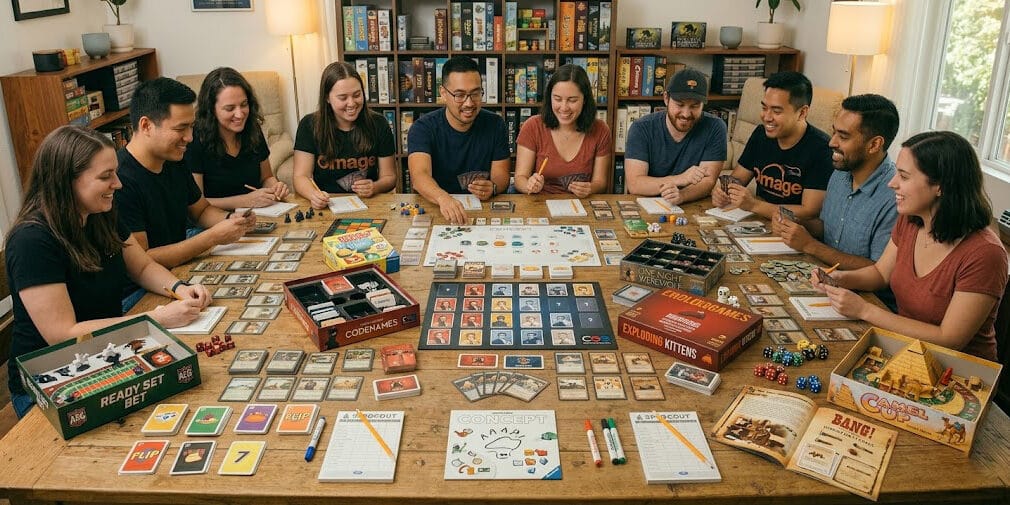
If you only buy one party board game this year, make it Just One. It’s cooperative, lightning-fast to explain, scales beautifully from 3 to 7 players, and — this is the part that’s harder to find than it sounds — it generates genuine laughter every single round without anyone needing to be clever or dramatic. It’s the rare game that works with your competitive coworkers on Friday, your wine-and-cheese friends on Saturday, and your parents on Sunday. That versatility alone puts it ahead of almost everything else we tested.
Which Party Board Game Should You Buy?
Choosing the right party board game comes down to three things: the size of your group, the experience level of your players, and the kind of evening you want to have. Here’s how we break it down.
If you want one game that works for almost any group, get Just One. It’s cooperative, quick, and generates laughs without requiring anyone to be funny, skilled, or competitive. We’ve never seen it fail with a mixed group.
If your group loves word games and teamwork, start with Codenames for the strategic experience or Wavelength if you want something faster and more conversation-driven. Both reward lateral thinking without punishing new players.
If you want maximum chaos and energy, look at Telestrations for drawing-based pandemonium, Monikers for escalating acting silliness, or Cash ‘N Guns for theatrical standoffs. These three games tend to produce the loudest rooms.
If your group skews toward social deduction and bluffing, The Resistance: Avalon, One Night Ultimate Werewolf, and Spyfall 2 are all strong picks, though they require some experience with the genre to fully click. Avalon rewards patient groups; Spyfall 2 and One Night are better for quick, high-turnover rounds.
If you want something with more mechanical substance without losing the party feel, Decrypto, Camel Up, Ready Set Bet, and Bang! all deliver. These games have enough structure that experienced gamers will find something to think about, while remaining accessible enough that newcomers aren’t left behind.
For large groups (10+), your best options from this list are Codenames, Dixit Odyssey, Concept, Cash ‘N Guns, and Spyfall 2. Most games cap out comfortably at 8 players, so having one of these in reserve for bigger gatherings is worth the investment.
For families with mixed ages, Dixit Odyssey, Camel Up, That’s Not a Hat, and Flip 7 tend to cross age gaps most naturally. They rely less on pop culture knowledge and more on universal instincts — memory, odds, and shared humor.
If you’re buying on a budget, Flip 7, That’s Not a Hat, and Hot Streak offer strong value for their price. They may not have the longevity of Codenames or Wavelength, but they’re excellent for the cost and travel well.
Everything We Recommend
✅ We recommend these products based on an intensive research process that’s designed to cut through the noise and find the top products in this space. Guided by experts, we spend hours looking into the factors that matter to bring you these selections.
⭐ 2.5 million+ people assisted in the last 30 days ⭐
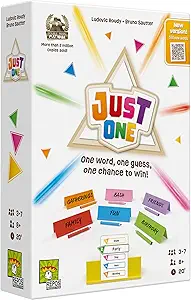
Just One is the kind of game that makes you wonder why more games aren’t designed this way. Players work together to help one person guess a mystery word — everyone writes a one-word clue on their mini whiteboard, but here’s the twist: if two people write the same clue, both get erased before the guesser ever sees them. That single rule transforms the entire experience. Suddenly, you’re thinking hard about whether “ocean” is too obvious, whether “Poseidon” is too obscure, and whether your friend across the table is about to write the exact word you chose. We watched a group of seven quietly deliberate for 45 seconds and then burst into chaos when three people had written “big” as a clue for whale. The cooperative format means nobody is eliminated, nobody is embarrassed, and the joy is shared across the table. It won the Spiel des Jahres — the Nobel Prize of board games — in 2019 for good reason. Best for 3–7 players, plays in about 20 minutes, and genuinely works for ages 8 and up.
Pros: Immediately understandable rules; cooperative, so no one feels like a loser; generates consistent, natural laughter; excellent with mixed-experience groups
Cons: Upper player limit of 7 can feel restrictive at larger gatherings; some groups want more competition
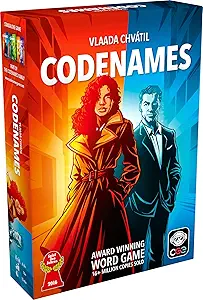
Codenames has been on the table at more gatherings than probably any other game in this list, and after nearly a decade on shelves, it has earned that reputation honestly. The setup is simple: a 5×5 grid of word cards sits in the middle of the table, and one spymaster from each team gives single-word clues to guide their team toward their assigned words while avoiding the opposing team’s words and — critically — the assassin card that ends the game instantly. What makes it work is the tension between ambition and caution. A bold spymaster who links four words with a single clue earns enormous respect; a bold spymaster who accidentally leads their team to the assassin earns something else entirely. We found it works best with six or more players, and it benefits from having at least one player on each team who’s comfortable thinking laterally. Newer players tend to give safe, obvious clues, which is fine — but when someone lands a clue that connects three seemingly unrelated words and the team figures it out, the table loses its mind. Few games reward that kind of creative thinking as cleanly.
Pros: Deep replay value; works well for 4–8 players; builds teamwork and creative thinking; multiple themed editions available
Cons: Can create passive players if teams are unbalanced; requires a spymaster willing to lead
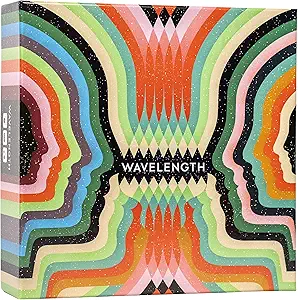
Wavelength is the rare party game that generates actual philosophical debate, and somehow that makes it funnier, not more serious. Each round, a clue giver secretly spins a dial to land on a hidden target zone somewhere along a spectrum — say, “Cold ↔ Hot” or “Useless ↔ Useful” — and then gives a single-word clue that represents where on that spectrum the target sits. Their teammates then have to position a needle based on that clue, while the opposing team tries to guess which side of the needle the target is on. The debates that follow are genuinely unpredictable. Is a microwave closer to “useless” or “useful”? Depends entirely on how your team thinks. We had one session where the clue “elevator music” for a Chill ↔ Intense spectrum split the room completely and sparked a five-minute argument that had nothing to do with winning points. That’s Wavelength doing exactly what it’s designed to do: revealing how differently people’s minds work, then letting everyone delight in the gap. Plays 2–12+ players and scales well.
Pros: Works with nearly any group size; sparks genuine conversation; no wrong answers means lower-stakes fun; replayable almost indefinitely
Cons: Scoring can feel secondary to the discussion; first-time players sometimes need a round to understand the target positioning
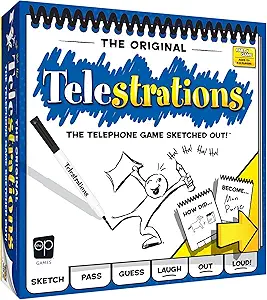
Telestrations is essentially Telephone played with drawings, and it is relentlessly, dependably funny in a way that holds up across dozens of plays. Each player starts with a word, sketches it, passes the sketchbook to the next person who guesses what they drew, who then draws their guess, who passes it on — and by the end of the chain, “lighthouse” has become “angry snowman with a torch.” The reason it works where similar games sometimes don’t is that Telestrations doesn’t punish bad drawing — it celebrates it. The worse the sketch, the more spectacular the misinterpretation, the bigger the laugh. We played with a group that included a professional illustrator and someone who admitted she “can’t draw a straight line,” and both had an equal amount of fun. The physical sketchbooks and dry-erase markers hold up well through repeated use, and the game is portable enough to bring to a restaurant or vacation rental without a second thought. Best at 6–8 players, though the 12-player version handles larger groups well.
Pros: Works for all ages and artistic abilities; generates consistent, organic laughter; zero downtime; low barrier to entry
Cons: Can feel slightly repetitive after many consecutive plays; the 8-player base version runs out of room at larger parties

Monikers is charades evolved into something smarter and substantially more chaotic. Teams take turns getting their partner to guess names from a shared deck — celebrities, historical figures, fictional characters — and the deck carries over across three progressively restrictive rounds. In Round 1, you can say anything except the name. In Round 2, you get one word. In Round 3, no words at all — just acting. The genius of the design is that the same cards show up in all three rounds, which means by Round 3, everyone at the table has context for the cards, and the guessing becomes lightning fast and absolutely absurd. When someone flails their arms for eight seconds, and their teammate screams “Mikhail Gorbachev!” correctly, the table erupts — and that moment is only possible because the card was explained with an elaborate story in Round 1. Monikers has a slight adult skew given some of the names on the cards, but the base set is surprisingly inclusive, and the game never feels mean-spirited. It’s especially strong with groups who know each other well.
Pros: Three-round structure builds momentum brilliantly; very high energy; works beautifully for pop culture enthusiasts; easy to teach
Cons: Some card references may land unevenly with certain age groups; requires enough players to form reasonable teams (best at 6+)
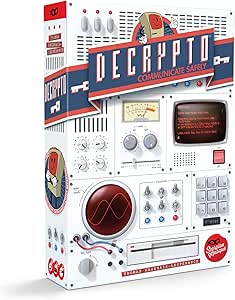
Decrypto fills a specific and valuable niche: it’s the game for groups who like Codenames but want something with more tension and strategic depth. Each team has a screen with four code words that only they can see. Each round, one team member receives a secret sequence of numbers (like 3-1-4) and must give clues to lead their team to the right words in the right order — without giving the opposing team enough information to crack their code. The twist is that both teams are building “intercept sheets” to decode the other team’s clue patterns over multiple rounds. So the pressure compounds: your clues need to be clear enough for your team but vague enough that the other team can’t use them against you. The first time a team successfully intercepts the opposing code, the room goes electric. We found Decrypto particularly strong with groups of four to six who enjoy the feeling of outsmarting each other, and it tends to generate more strategy-focused conversation than most party games. Sessions generally run 15–30 minutes with experienced players.
Pros: Deep, satisfying strategic layer; every round raises the stakes; excellent for groups who like thinking under pressure; high replay value
Cons: Steeper learning curve than most party games; less ideal for large groups or casual mixed-experience gatherings
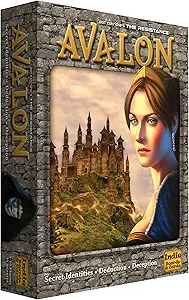
The Resistance: Avalon is, without question, the most socially intense game on this list. Set in a loose Arthurian framework, players are secretly divided into the forces of good (loyal knights) and evil (Mordred’s minions). Good players are trying to successfully complete quests; evil players are trying to sabotage them — while blending in and avoiding detection. Every conversation, every vote, every hesitation becomes potential evidence. We watched friendships tested (briefly and good-naturedly) over a single game of Avalon. The game shines because even the Merlin mechanic — one good player who knows who the evil players are but can’t reveal themselves — adds a layer of meta-deception that creates fascinating table dynamics. The physical components are modest, but that’s genuinely not the point; the game lives in the conversation. It scales best from 5–10 players and works best when at least a few people at the table are comfortable with social deduction games. Not ideal for first-time-gamer gatherings, but deeply rewarding for the right group.
Pros: Intensely engaging social deduction; scales well up to 10 players; high replay value because no two sessions unfold the same way
Cons: Not for casual or sensitive groups; requires buy-in from all players; setup requires careful role distribution

One Night Ultimate Werewolf takes the sprawling, sometimes hours-long social deduction experience of traditional Werewolf and compresses it into a single, tense, five-minute round. Everyone receives a role at night — werewolf, villager, seer, troublemaker — performs a secret action in the dark guided by the companion app’s narration, and then spends three minutes arguing before the village votes someone out. Because there’s only one round, the pressure is immediate, and the paranoia kicks in fast. We found it particularly useful as an opener or closer for a game night — it’s self-contained enough that one bad round doesn’t derail the evening. The app narration is genuinely well designed and removes the need for a moderator, which addresses one of the friction points that makes traditional Werewolf hard to run. Best for 3–10 players. The roles in the box offer enough variety that groups tend to play multiple rounds back to back.
Pros: Plays in 10 minutes, including setup; app-narrated for smooth play; no player elimination; huge variety in roles
Cons: Requires a smartphone app; can feel chaotic for players unfamiliar with social deduction games; the very short round length leaves less time to pick up on genuine tells
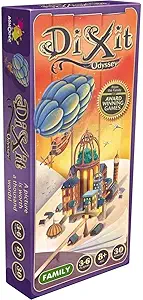
Dixit is one of those games that slows a room down in the best possible way. Each player holds a hand of gorgeously illustrated, surrealist cards — dreamy, slightly strange images that suggest a mood more than a scene. On your turn, you choose one card and give a clue — a word, a phrase, a sound, a song lyric — then every other player submits a card from their own hand that could plausibly match your clue. The cards are shuffled and laid out, and everyone votes on which one is the original. The catch: if everyone guesses correctly, you score nothing. So your clue needs to be just evocative enough to reach a few people, but not so obvious that it reaches everyone. That balance turns each round into a tiny performance piece. We found Dixit Odyssey specifically valuable because it accommodates up to 12 players — significantly more than the base game — which makes it a reliable option for larger gatherings. The artwork is genuinely beautiful, and the game consistently draws comments from first-time players who want to examine the cards closely.
Pros: Stunning artwork that doubles as a conversation starter; accommodates up to 12 players; gentle and creative atmosphere; suitable for ages 8+
Cons: Competitive or fast-paced players sometimes find the pace too meandering; the guessing mechanic can occasionally frustrate new players

Ready Set Bet is a horse racing game that somehow manages to feel like you’ve been transported to a raucous trackside betting window — without any of the actual gambling. One player acts as the House, rolling dice to advance horses along the track in real time, while everyone else simultaneously places their betting tokens on outcomes across the board. The real-time element is what separates it from traditional betting games: there’s no taking turns, no waiting — you’re constantly watching the board, reassessing, grabbing your limited tokens and slapping them down before someone else claims the best odds. We had sessions where the game hit a fever pitch in the final three rolls, with three horses neck-and-neck and people actually standing up from their chairs. For groups who enjoy energy and light chaos over deep strategy, Ready Set Bet tends to be a highlight of the night. It scales excellently from 2 to 9 players and plays in about 45 minutes.
Pros: Real-time betting creates genuine excitement; intuitive once you see it in action; plays well with 2–9 players; high energy, and great for sports fans
Cons: The House role requires one player to focus on dice rather than betting; setup takes a few minutes to explain token placement; it can feel frantic rather than strategic for some players
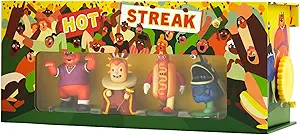
Hot Streak is one of those games that looks almost too simple — until someone starts betting their entire stack on a guess that should be obvious and suddenly isn’t. Players take turns naming items that fit a category, and the rest of the table bets on whether the active player can name a certain number of them before they stall. The betting element is what elevates this above a straightforward trivia game. Do you bet everything that your friend can name eight dog breeds? Do you bet against them? That push-and-pull creates hilarious pressure moments that belong purely to your specific group — your friend’s confidence, your read on their knowledge, the category they drew. We found Hot Streak particularly strong at parties with a wide range of ages because the categories tend to be accessible without being dumbed down. It’s quick to pick up, faster to play, and consistently generates the kind of spirited table talk that keeps a room energized.
Pros: Easy to teach in under two minutes; betting mechanic adds excitement without complexity; works well across age ranges; compact and portable
Cons: Category knowledge can still create small gaps between players; betting decisions occasionally stall the table in larger groups
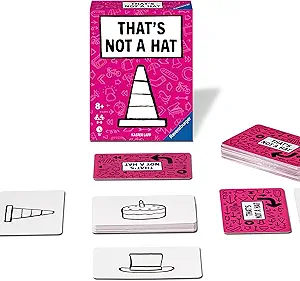
That’s Not a Hat is a memory game, and it is quietly, deliciously mean. Players draw gift cards, silently memorize them, and then pass them face-down around the table, verbally describing what’s being passed while trying to remember — and convincingly misrepresent — what they’ve received. The catch: players can call “That’s Not a Hat!” if they think the person passing to them is wrong about what they’re handing over. Get it wrong, and you collect penalty cards. Get it right, and the bluffer does. It sounds simple, and the first round is genuinely gentle. Then the table fills with face-down cards that nobody is quite sure about anymore, and the lies start compounding on each other. We had rounds where nobody, including the person originally holding a card, was sure what it was anymore. It plays in about 20 minutes, handles 3–8 players well, and has an extremely low barrier to entry — most groups grasp the rules within two minutes.
Pros: Fast and easy to learn; builds escalating confusion hilariously; compact box travels easily; low price point for the experience
Cons: Memory demands can frustrate some players after a long evening; the bluffing element occasionally feels accidental rather than strategic
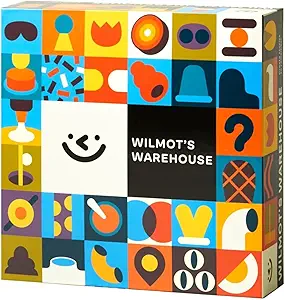
Wilmot’s Warehouse is the outlier on this list — it’s cooperative, it’s spatial, and it rewards organizational instincts in a way that almost no other party game does. Players work together to arrange a warehouse full of product tiles, develop their own internal logic for where things go, and then race to retrieve customer orders by remembering what they put where and why. The twist: only the person who stored a tile knows exactly where it is and what their personal categorization logic was. So if your warehouse partner stored “socks” under “things that come in pairs,” you need to quickly reverse-engineer their thinking under time pressure. The result is a game that feels different from anything else on this list — quieter, more collaborative, occasionally maddening — but deeply satisfying when a team is clicking. It works best with 2–6 players who enjoy slightly more cerebral fun and don’t mind some productive frustration.
Pros: Genuinely unique gameplay loop; excellent for creative, spatially-minded players; co-op format means no one is “losing”; surprisingly replayable
Cons: Not suited for large groups; the organizational nature can feel stressful rather than fun for certain players; best enjoyed with patient, engaged groups
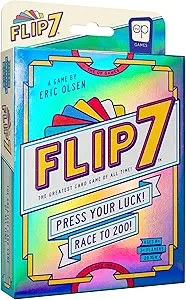
Flip 7 is a push-your-luck card game that distills the genre down to its most satisfying form. On your turn, you flip cards from the deck and collect numbers — but if you flip a duplicate number you already have, your entire turn score is wiped. The question every round is: do you stop now and bank what you have, or do you risk one more flip? That calculation sounds simple until you’ve flipped six cards without a duplicate and there are grins and groans around the table, and suddenly walking away feels cowardly and staying feels reckless in equal measure. We found Flip 7 works as an excellent opener or closer — it’s short, requires no strategy overhead, and generates genuine tension per round. Games typically finish in 20–30 minutes for 2–5 players. It travels easily in a bag pocket, which makes it one of the most practical picks on this list for impromptu occasions.
Pros: Extremely easy to learn; creates genuine tension with simple mechanics; portable and affordable; fun across age groups
Cons: Limited player count (best at 2–5); experienced push-your-luck fans may find it too light; randomness can occasionally feel frustrating rather than exciting

Camel Up is a camel racing game where the camels stack on each other, move unpredictably, and occasionally carry their rivals along for the ride — and somehow that description doesn’t do justice to how genuinely funny the outcomes are. Players place bets on which camel will win or lose the leg and the overall race, collect action tiles, and watch as a pyramid die-dispenser releases one random camel movement per round. The stacking mechanic is the heart of it: when a camel lands on another, it rides on top, and wherever the bottom camel goes, all its passengers go too. An underdog camel can sprint to the front in seconds by riding a piggyback chain that nobody predicted. We played Camel Up with groups that included people who claimed to hate board games, and by round two everyone was invested in the fate of a particular camel. It plays 3–8 players in about 30–45 minutes and has a visual playfulness that draws people in even before the rules are explained.
Pros: Visually charming and immediately engaging; unpredictable outcomes keep every game fresh; works with non-gamers; excellent for families
Cons: Some experienced gamers find the luck-to-strategy ratio leans too heavily on luck; betting can occasionally feel like it matters less than the dice
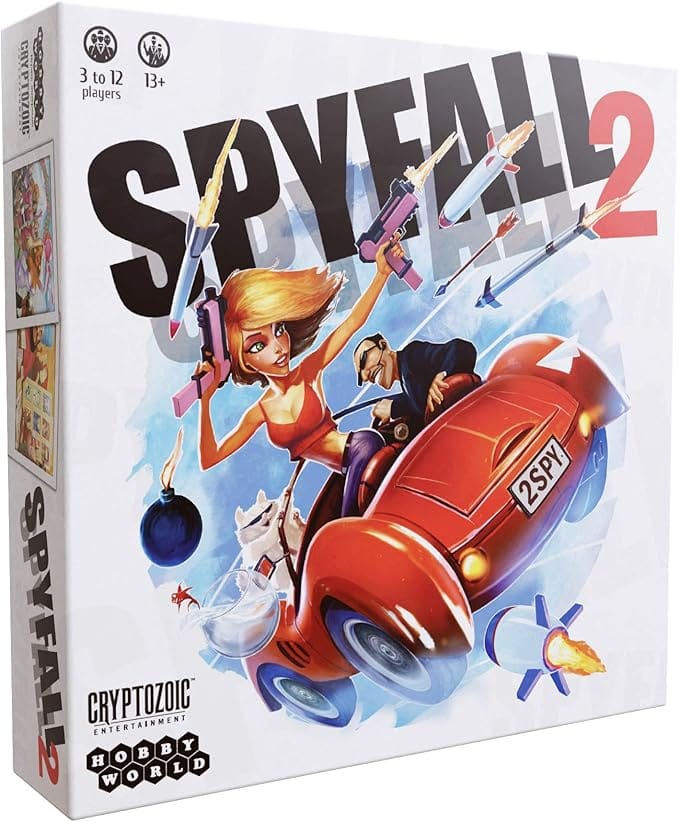
Spyfall 2 is a social deduction game with an elegant central premise: everyone at the table knows the same secret location — except one (or two) players who are the spies. Players take turns asking each other questions to reveal who knows the location and who doesn’t, while the spy desperately tries to pick up enough context clues to guess where they are before they’re outed. The spy wins by guessing the location; everyone else wins by identifying the spy. What makes Spyfall 2 consistently exciting is how much personality players bring to it. The questions can be probing or abstract, accusatory or innocent, and the spy’s answers sit in a delicious middle ground — too specific and they give themselves away, too vague and everyone becomes suspicious. The second edition adds more location cards and a two-spy option that raises the tension considerably. It plays 3–12 players in about 15 minutes, which makes it one of the fastest-playing games on this list.
Pros: Fast-playing; excellent for large groups; creates immediate social tension; high variability with 30+ location cards
Cons: Experienced players sometimes find it easier to stay under the radar; early questions occasionally feel awkward before the room settles into it
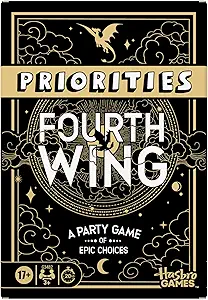
Priorities: Fourth Wing Edition takes the satisfying framework of the original Priorities — secretly ranking a set of options from most to least important — and layers it with the world, lore, and characters from Rebecca Yarros’ fantasy series. If your group contains at least a few Fourth Wing readers, the themed categories (which rider would you trust with your dragon? Which quadrant would you choose?) create a much richer conversation than the generic version of the game. That said, the core mechanic works independently of the IP: each player arranges their cards privately, then everyone reveals at once and scores points for matches with the majority. It’s a quick, accessible game that tends to generate more conversation than it does competition — which is exactly the right register for a casual gathering. Plays in about 20–30 minutes with 3+ players. Particularly strong as an icebreaker or transition game between longer sessions.
Pros: Fast and accessible; sparks genuine conversation and debate; themed version rewards fans with richer discussions; low price point
Cons: Non-fans of the IP may feel excluded by some category prompts; competitive players may find the scoring too low-stakes
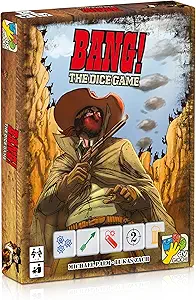
Bang! is a western-themed hidden role game that has been a staple of European gaming cafés for decades, and it earns its longevity. One player is secretly the Sheriff — the only role that’s publicly revealed. Hidden among the others are Deputies who protect the Sheriff, Outlaws who want to eliminate them, and a Renegade pursuing their own agenda. Players use a hand of cards to attack, defend, and use special abilities, all while trying to figure out who is on which side. The western aesthetic is laid on thick in the best way: Gatling guns, Missed! cards, Jail tiles, and character abilities named after spaghetti western archetypes. We found Bang! particularly satisfying with groups who enjoy a slightly longer, more involved experience than most party games — a full session runs 20–40 minutes depending on player count. It plays 3–8 players and scales well, though the sweet spot is around 5–6 where the role distribution creates the most interesting social dynamics.
Pros: Rich thematic flavor; rewarding hidden role dynamics; high replayability with different character combinations; beloved across many gaming communities
Cons: Longer setup and rules explanation than many party games; eliminated players can sit out for stretches; requires a group willing to commit to a slightly more complex experience
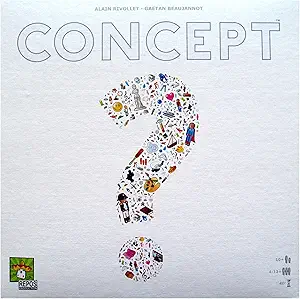
Concept is one of the most underrated games on this list. Players work together to guess words and phrases that a clue giver communicates entirely through a shared board of universal symbols — no words, no drawing, no sounds. Instead, you place pawns on icons (living thing? small? moves fast? associated with water?) and the table races to guess what you’re indicating. The result is a game that manages to be simultaneously frustrating and illuminating, because the symbols are just ambiguous enough that two people pointing to the same icon can mean completely different things. We found it particularly strong with multilingual groups or gatherings with significant age range, because it sidesteps language barriers and pop culture gaps in a way few other party games manage. It plays 4–12 players with no defined turn length, which makes it feel more like a shared social activity than a structured game — and that quality makes it uniquely low-pressure.
Pros: Works across language barriers and age ranges; deeply social and collaborative atmosphere; board is visually intuitive; no elimination, no pressure
Cons: Without strict turn structure, some groups find the format unfocused; harder to track scores, which some competitive players dislike
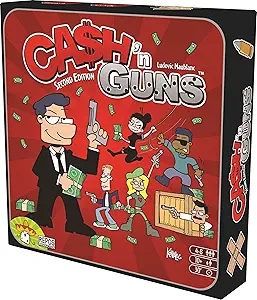
Cash ‘N Guns turns everyone at the table into a gangster arguing over loot, and it is significantly more fun than that sentence might suggest. Players simultaneously point foam guns at each other in a Mexican standoff, then secretly choose to either bluff (playing a click card) or actually shoot (playing a bang card). After everyone commits, those who get shot drop out of the round; those who stay claim their share of the loot pile. The physical act of pointing foam guns across the table generates an immediate, theatrical energy that is unlike any other game in this list. It scales excellently from 4–8 players, plays in about 30 minutes, and manages to feel fresh round after round because the social reading — who’s going to actually shoot me? who’s bluffing? — changes depending on the room. The second edition adds roles and special abilities that give each player a small mechanical twist, which keeps experienced players engaged over multiple plays.
Pros: Unique physical component (foam guns) creates immediate fun; excellent social reading and bluffing; fast-playing; generates memorable moments
Cons: The foam guns can wear down with heavy use; player counts below 4 feel thin; bluffing-averse players may find the standoff mechanic uncomfortable
How We Tested
We tested more than 30 party board games over six months with groups ranging from 3 to 14 players. Our testing team included casual players who hadn’t touched a board game since Scrabble was their family’s weekend staple, experienced hobby gamers who could teach Twilight Imperium without notes, and everyone in between. We played each game multiple times — often with completely different groups — to understand how each one held up under different social dynamics, energy levels, and experience gaps. We paid attention to setup time, rule confusion, first-game engagement, and whether people asked to play again. Games that generated excitement only once, or that consistently left quieter players disengaged, didn’t make the cut.
What We Eliminated and Why
We started with a wide field and cut aggressively. Several trivia-heavy games were eliminated early because they tend to skew toward one or two players who dominate through knowledge alone, leaving others feeling left out rather than included. A handful of games that looked promising on paper had rulebooks that took 20-plus minutes to get through — which kills the energy of a gathering before it starts.
We also cut games that leaned too hard on a single gimmick. One bluffing game generated strong first impressions but felt hollow by the third play, once everyone understood the lone mechanic at its center. Similarly, games that required a smartphone app were deprioritized — not because the apps were bad, but because they added a friction point (someone always has to update the app, someone always has low battery) that slowed things down. We wanted games that could be pulled off a shelf and running within five minutes.
Price was also a factor. A few games were genuinely good but priced at a premium that simply wasn’t justified by what was in the box.
You can also check out our list of the best family board games if you’re looking for something for all ages.