Advertiser Disclosure
We independently review everything we recommend. When you buy through our links, we may earn a commission.
The Best Deck-Building Board Games

If you only buy one deck-building game this year, make it Slay the Spire: The Board Game by Contention Games. It consistently delivers what most deck-builders only promise — a genuinely tense, deeply strategic cooperative experience that keeps you thinking between sessions, not just during them. Whether you play solo or with three friends, it scales exceptionally well, and its roguelike structure means almost no two runs ever feel the same. This isn’t a game you’ll play twice and shelve. It’s a game you’ll plan your next run while commuting home from work.
Which Deck-Building Board Games Should You Get?
Making the right call here depends less on which game is “objectively best” and more on who’s sitting at your table. Here’s how we’d break it down:
If you want the most complete overall package, go with Slay the Spire: The Board Game. It handles solo and cooperative play at the same high level, delivers excellent replay value, and justifies its price more decisively than anything else we tested.
If your group includes non-gamers or casual players, start with The Quest for El Dorado or HEAT: Pedal to the Metal. Both have accessible entry points without feeling patronizing, and HEAT specifically works for up to six players with minimal downtime.
If you want a two-player experience: Undaunted: Normandy for something strategic and grounded, Star Wars: The Deckbuilding Game for something accessible and thematic, or Aeon’s End: War Eternal if you want cooperative challenge.
If you have a mixed group with a wide age range, Quacks of Quedlinburg is reliably entertaining across age groups and experience levels. Tag Team works well for families with younger children.
If you’re a serious hobbyist, Dune: Imperium offers the deepest strategic experience on this list, combining worker placement with deck-building in a way that reveals new layers over multiple plays.
If you’re new to deck-builders entirely, Dominion (2nd Edition) remains the clearest introduction to the core mechanics of the genre. Play it a few times, understand why it works, and then use the rest of this list as a roadmap for where to go next.
If you want something thematic and unique, Mistborn Deckbuilding Game is a standout for fans of Brandon Sanderson’s novels, and Clank! Catacombs is the pick if you want a competitive dungeon crawl with strong narrative energy.
Best Deck-Building Board Games We Recommend
✅ We recommend these products based on an intensive research process that’s designed to cut through the noise and find the top products in this space. Guided by experts, we spend hours looking into the factors that matter to bring you these selections.
⭐ 2.5 million+ people assisted in the last 30 days ⭐
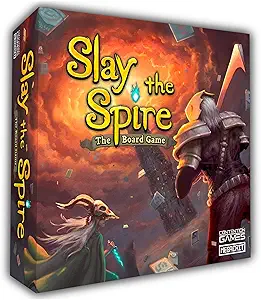
Players: 1–4 | Time: 30–150 min | Age: 12+ | Complexity: Moderate
Slay the Spire: The Board Game is genuinely one of the most impressive tabletop adaptations we’ve ever put on the table. Developed by Contention Games following a Kickstarter campaign that raised nearly $4 million, this cooperative deck-builder follows four asymmetric characters — the hard-hitting Ironclad, the poisonous Silent, the orb-wielding Defect, and the mode-switching Watcher — as they climb a monster-filled tower across three acts. What surprised us most wasn’t how faithful it is to the video game (it is, remarkably so), but how it creates its own identity through the physical components. Upgrading a card by flipping it in its sleeve, arranging relics on your player mat, debating route choices with your teammates — these tactile moments slow the game down in the best possible way. The roguelike Ascension system adds 20 progressive difficulty tiers for groups that want a long-term challenge, and the solo mode is among the strongest we tested in any genre. It won the 2024 Golden Geek Best Solo Board Game award for good reason.
Pros:
- Exceptional solo and cooperative modes that scale well
- Enormous replay value through roguelike structure and asymmetric characters
- Outstanding component quality, including pre-sleeved cards
- Deep card synergies reward thoughtful play over multiple sessions
- Faithful to the video game while creating its own tabletop identity
Cons:
- Full runs can stretch to 150 minutes — not ideal for casual nights
- The rulebook has a learning curve; the first game benefits from a tutorial read
- A completed run requires commitment; it’s not easy to pause mid-Act

Players: 1–4 | Time: 30–60 min | Age: 10+ | Complexity: Low–Medium
HEAT: Pedal to the Metal doesn’t feel like a deck-builder at first — it feels like a racing game, which is exactly the point. Designed by Asger Harding Granerud and Daniel Skjold Pedersen and published by Days of Wonder (under Asmodee), this 2022 release won the Golden Geek Medium Game of the Year award and hasn’t slowed down since. The core loop is deceptively elegant: you select a gear, play speed cards from your hand, and navigate corners without overheating your engine. Push too hard, and heat cards flood your deck, clogging your hand at the worst possible moments. We loved how the risk-reward tension never lets up — the temptation to slam fourth gear on a straight is real, and so is the pain of spinning out on the next corner. The Championship module, where you carry upgraded car cards across multiple races, genuinely elevated the experience into something that felt like a full F1 season at the kitchen table. With up to six players, races stay surprisingly tight.
Pros:
- Accessible enough for non-gamers, satisfying enough for hobbyists
- Races genuinely feel close — catch-up mechanics are well-balanced
- Modular design lets you add complexity (Garage, Weather, Championship) at your own pace
- Plays well at all counts from 1 to 4; the solo AI mode works better than expected
- Exceptional production quality from Days of Wonder
Cons:
- The base game can feel slightly formulaic after many plays without modules
- Push-your-luck element means bad luck can occasionally override good decisions
- At higher player counts, downtime between turns becomes noticeable
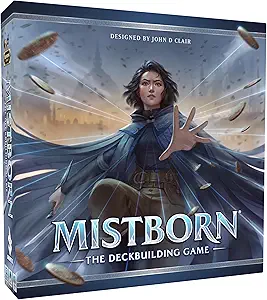
Players: 1–4 | Time: 45–75 min | Age: 13+ | Complexity: Medium
Based on Brandon Sanderson’s beloved fantasy series, the Mistborn Deckbuilding Game from Brotherwise Games serves two audiences exceptionally well: fans of the books who want to live inside Sanderson’s world, and deck-builder enthusiasts looking for a theme that actually feels integrated rather than pasted on. We were struck by how well the Allomancy metal system — the power-based magic from the novels — maps onto card mechanics. Each metal you “burn” corresponds to a distinct card effect, so if you’ve read the books, the game clicks into place with a satisfying thematic logic. For players unfamiliar with the source material, the asymmetric faction play and dynamic combat still hold up as standalone mechanics. The game handles two players particularly cleanly, with a tight, confrontational feel that keeps both sides engaged. Component quality is solid throughout, and Brotherwise has included enough variety in the starting configurations to keep sessions feeling different across multiple plays. This is one of those licensed games that actually respects both the IP and the players.
Pros:
- Outstanding theme integration — Allomancy mechanics feel authentic to the novels
- Plays very well at two players, with a competitive edge that stays engaging
- Accessible enough for fans of the book series who are new to deck-builders
- Solid production quality from a reliable indie publisher
- Multiple asymmetric factions offer good replayability
Cons:
- Less compelling if you have no connection to the Mistborn universe
- Lighter than some hobbyist deck-builders, experienced players may want more depth
- Expansion support is still developing compared to more established titles

Players: 2–8 | Time: 20–30 min | Age: 10+ | Complexity: Low
Hot Streak occupies a genuinely underserved niche in the deck-builder space: it’s a party game that actually uses deck-building mechanics rather than just slapping the label on a trivia box. Published by CMYK, this is the game we reached for when the guest list included people who’d never touched a card game in their lives. The core challenge involves predicting which categories your group will agree on, which sounds simple until you’re three rounds in and realize you completely misjudged the room. What makes it work as a party game is that the deck-building layer adds a strategic element of escalation — you’re not just answering questions; you’re managing which tools you’ll have available later. It plays up to eight people without dragging, which alone earns it a spot on this list. We found it particularly effective at bridging the gap between hardcore gamers and casual guests at mixed-experience game nights. Don’t mistake its accessible entry point for shallowness — the scoring system rewards genuine strategic thinking across the whole game.
Pros:
- Works at large player counts (up to 9) without significant downtime
- Bridges the gap between party games and deck-builders remarkably well
- Quick to teach — most groups are playing within five minutes
- High energy, naturally funny moments emerge from group dynamics
- A compact box makes it easy to bring anywhere
Cons:
- May feel too light for dedicated deck-builder fans expecting mechanical depth
- Performance varies based on group chemistry — not every crowd responds equally
- Replayability depends on how often you play with the same group

Players: 2 | Time: 15–20 min | Age: 10+ | Complexity: Low
Tag Team from Scorpion Masqué is one of the more underrated picks on this list, and we suspect it gets overlooked because its casual appearance undersells what’s happening underneath. This is a fast-playing cooperative deck-builder where two-person teams work in tandem, and the coordination mechanic — where you must align your plays with your partner’s without over-communicating — creates a surprisingly tense and funny dynamic. We played this at a game night with couples, and it turned into one of the evening’s highlights: the near-misses and unexpected synergies generated more laughter than most “party” games we’d tested. For families with children on the younger end of the hobby, Tag Team hits a sweet spot — it’s not so simple that adults feel patronized, but it’s not so complex that kids disengage. The short play time means multiple rounds in a single session are the norm, and rounds tend to improve as partners develop an unspoken rhythm. It’s a genuinely charming, well-designed game that deserves more shelf space.
Pros:
- Cooperative two-vs-two format creates unique communication dynamics
- Short playtime (20–40 minutes) supports multiple sessions in a row
- Age-appropriate for families with children 8 and up
- Light rules overhead; easy to introduce to non-gamers
- Cooperative tension generates natural laughs and memorable moments
Cons:
- May feel too light for hobbyist deck-builder fans
- Best at exactly two teams of two; other player counts feel less balanced
- Limited complexity ceiling means experienced players may outgrow it quickly
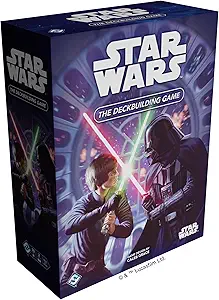
Players: 2 | Time: 30–45 min | Age: 12+ | Complexity: Low–Medium
We had modest expectations going into Star Wars: The Deckbuilding Game — licensed games don’t always earn their price tag — but this one genuinely surprised us. Published by Asmodee, it’s a two-player head-to-head game where one player controls the Rebel Alliance and the other commands the Galactic Empire, and both sides feel meaningfully different. The Galaxy Row mechanic, where a shared row of cards sits between players and can be acquired or targeted for destruction, creates constant tension over a shared resource that neither player controls outright. We appreciated how the asymmetric faction design forces both players to think differently — the Empire tends toward direct firepower, while the Rebels lean into flexibility and tempo. For Star Wars fans who want to share the hobby with a partner or friend who isn’t a dedicated gamer, this is probably the most accessible entry point on this entire list. The theme is clear, the stakes feel authentic, and the play time is short enough that a rematch is almost always on the table.
Pros:
- Strong two-player head-to-head design with meaningful asymmetry
- Galaxy Row mechanic adds a shared-board tension that most two-player games lack
- IP integration feels authentic, not superficial
- Short, punchy play time makes it easy to squeeze in on a weeknight
- Accessible entry point for Star Wars fans new to deck-builders
Cons:
- Limited to exactly two players — no options for larger groups
- Lighter depth compared to other competitive deck-builders
- Expansion content is still relatively sparse compared to similar games
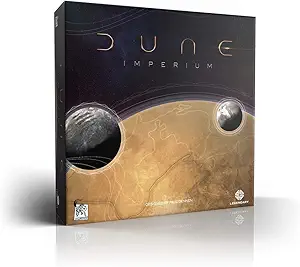
Players: 1–4 | Time: 60–120 min | Age: 14+ | Complexity: Medium–High
Dune: Imperium is arguably the most complete deck-builder on this list — and we say that having tested games across every complexity tier. Designed by Paul Dennen and published by Dire Wolf, it blends deck-building with worker placement in a way that feels genuinely seamless rather than mechanical. You’re not just building a deck; you’re using that deck to fuel a worker placement engine that drives political intrigue, military conflict, and resource management simultaneously. Every card you acquire is a decision about which spaces on the board you’ll be able to access later, and that interconnection between deck and board creates a strategic depth that most pure deck-builders can’t match. We found it equally strong in solo mode — the Hagal House AI opponent is surprisingly robust — and at four players, where the political layer becomes genuinely cutthroat. The Dune license is treated with real respect here; the thematic texture of Herbert’s world is woven through every mechanism, not just the artwork. This is a game that rewards returning players significantly.
Pros:
- Brilliant fusion of deck-building and worker placement — best in class for the hybrid mechanic
- Strong solo mode with a capable AI opponent
- Outstanding theme integration; the political tension of Dune is present in every decision
- Scales well across all player counts
- High replayability through variable card availability and faction compositions
Cons:
- Setup and rules explanation takes meaningful time; not ideal for quick sessions
- The iconography has a learning curve in the first game
- The full strategic depth only reveals itself after two or three plays
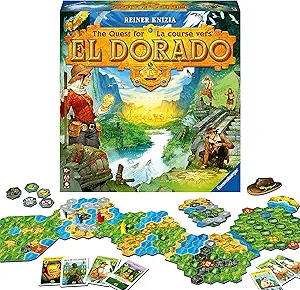
Players: 2–4 | Time: 30–60 min | Age: 10+ | Complexity: Low–Medium
The Quest for El Dorado is a game we kept coming back to when we wanted something with genuine strategic texture that wouldn’t require an hour of rules explanation. Designed by the legendary Reiner Knizia and published by Ravensburger, it threads a needle between racing game and deck-builder with unusual elegance. Players build card decks to move their explorer tokens through modular jungle hex tiles toward the fabled city of El Dorado, and the key tension lies in balancing cheap, fast cards for movement against powerful, expensive cards that unlock special terrain. We consistently found that newer players could participate meaningfully in their first game, while experienced players discovered real optimization depth within the card economy. The modular board means the map changes every session, which helps sustain long-term replay value. It plays in a tight 30–60 minutes, even at four players, and is easy to pack up. For families or game night hosts who want a deck-builder that won’t intimidate anyone at the table, this is one of our most reliable suggestions.
Pros:
- Elegant design from a legendary game designer
- Accessible to beginners while still offering real strategic decisions
- A modular board means no two games look the same
- Quick setup and relatively short play time
- Works particularly well as a first deck-builder for mixed-experience groups
Cons:
- Lighter than many hobbyist deck-builders, experienced players may feel constrained
- Racing mechanic means a strong early lead can sometimes feel decisive
- The theme, while charming, doesn’t carry the same depth as heavier titles
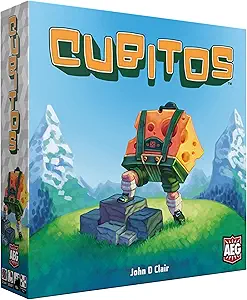
Players: 2–4 | Time: 30–45 min | Age: 10+ | Complexity: Medium
Cubitos from AEG is one of those games that sounds weird on paper — you’re rolling dice to race cartoon creatures — and then you play it and can’t stop laughing. It’s technically a “dice pool builder” rather than a strict deck-builder, but the core loop of acquiring new dice to improve your pool functions identically to deck-building and belongs in any honest survey of the genre. The real hook is the push-your-luck rolling mechanic: you roll your dice pool on each turn, collecting resources when dice succeed, but if too many dice bust, your turn ends immediately. The escalating tension of one more roll — especially with a table full of people urging you forward — creates some of the most naturally joyful moments we experienced in testing. The colorful production and accessible theme mean it brings in players who’d normally glaze over at card games. With two to four players, games stay tight and fast. We’d recommend Cubitos to anyone who wants their deck-builder to also double as a guaranteed crowd-pleaser.
Pros:
- Push-your-luck dice mechanics create inherently fun, social moments
- Visually approachable and easy to explain to newcomers
- Solid strategic depth in pool-building decisions beneath the accessible surface
- Plays well across all player counts with minimal downtime
- Replay value supported by varied dice types and track layouts
Cons:
- Luck factor is higher than most traditional card deck-builders
- The theme’s lightness may put off hobbyists looking for something more serious
- Loses some steam after many plays without expansion content
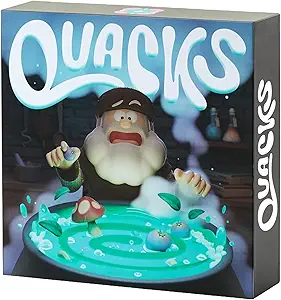
Players: 2–4 | Time: 45 min | Age: 10+ | Complexity: Low–Medium
The Quacks of Quedlinburg — or just Quacks, as our group started calling it by the second session — is a bag-building game (another close relative of deck-building) that hits a rare sweet spot: it’s instantly fun for new players and still strategically interesting for experienced ones. Each turn, you’re pulling ingredient tokens from your personal bag, trying to brew a powerful potion without drawing the dreaded white “rat tails” that blow up your cauldron. The catch is that you set the bag contents yourself, choosing which ingredients to add after each round, and that incremental optimization is where the real game lives. We found that the push-your-luck element generates spontaneous table energy — there’s always a moment where someone keeps pulling when they probably shouldn’t — while the strategic layer in ingredient selection keeps the game honest. It’s one of the most reliably fun games we tested at any player count. If someone at your table has never tried a bag-builder or deck-builder, Quacks is as good a starting point as we can recommend.
Pros:
- Push-your-luck bag-building creates genuine excitement every turn
- Balances luck and strategy in a way that feels fair rather than arbitrary
- Consistently fun across a wide range of player experience levels
- Quick to learn and fast to play — most games finish under an hour
- High replayability through varied ingredient books and player powers
Cons:
- Luck can occasionally feel punishing in the final rounds
- At two players, the magic of group reactions is somewhat reduced
- Some expansion ingredients can feel imbalanced without careful pairing
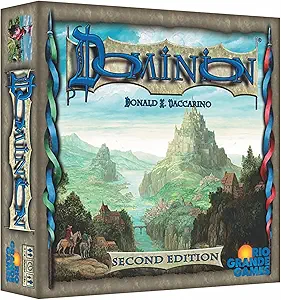
Players: 2–4 | Time: 30 min | Age: 13+ | Complexity: Low–Medium
We’d be doing a disservice to the genre if we didn’t include Dominion, the game that more or less invented competitive deck-building as we know it. Donald X. Vaccarino’s 2008 design still holds up remarkably well, and the second edition cleaned up some rough edges in the original card text while adding two previously-expansion-only kingdom cards. You start with a hand of basic coppers and estates, gradually acquiring more powerful kingdom cards to build an economic engine that hopefully outpaces your opponents. What Dominion does better than almost everything that followed it is turn management — a well-constructed Dominion deck has a flowing rhythm that feels genuinely satisfying to execute. It lacks the tactical board interaction of newer titles, but that purity of focus is also its strength. We still recommend Dominion for new players precisely because it teaches the core loop of deck-building without competing mechanics getting in the way. It’s the clearest expression of the genre’s central idea, and that’s worth something even 17 years later.
Pros:
- Defined the genre; the clearest pure expression of deck-building mechanics
- Second edition updated rules and added value over the original
- Faster to learn than most modern deck-builders
- Enormous expansion library for groups that want long-term depth
- Short play time (around 30 minutes) makes it easy to fit in
Cons:
- Minimal player interaction — games can feel parallel rather than competitive
- Less thematic texture than newer titles; it’s fairly abstract
- Requires expansions to sustain long-term interest for experienced players
Players: 1–4 | Time: 60–90 min | Age: 14+ | Complexity: Medium–High
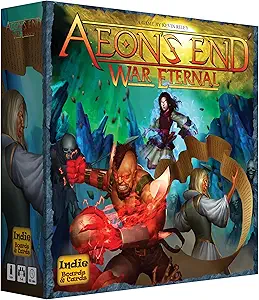
Aeon’s End: War Eternal is the standalone expansion to the original Aeon’s End, and in our testing, it consistently performed as the more complete of the two experiences. The premise is cooperative: players are mages defending Gravehold, humanity’s last stronghold, against increasingly powerful Nemesis creatures. What separates Aeon’s End from most cooperative deck-builders — and what immediately hooked our testing group — is the non-shuffling discard rule. Your discard pile is simply flipped over to become your new deck, which means you can plan your draws with actual foresight. Pair that with the randomized turn order deck (no one knows who goes next), and you get a game that demands continuous strategic communication. We found it one of the more discussion-rich games in our entire testing pool — every turn generated table conversation. War Eternal introduces new mages and Nemesis bosses that raise the strategic ceiling over the base game. If you enjoy cooperative games with genuine difficulty and long-term optimization potential, this belongs in your collection.
Pros:
- Non-shuffling discard mechanic enables real long-term planning
- Random turn order creates constant uncertainty and strategic adaptation
- Strong cooperative communication — genuinely team-focused design
- Multiple mages and Nemesis bosses offer excellent replay variety
- Works well in solo mode with a single mage
Cons:
- The thematic setting is somewhat generic despite strong mechanics
- Asymmetric mage powers create a learning gap between the first and second games
- Higher complexity ceiling means the first games can be overwhelming
Players: 2–4 | Time: 45–90 min | Age: 13+ | Complexity: Medium
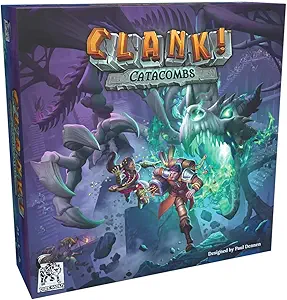
Clank! Catacombs is the culmination of everything the Clank! The series has learned, and it’s noticeably stronger than the original for one central reason: the dungeon builds itself as you explore it. Rather than a fixed board, players lay dungeon tiles as they venture deeper, meaning no map is ever the same twice. You’re playing thieves sneaking into a dragon’s lair, building a personal card deck to navigate deeper, fight monsters, and haul out increasingly valuable loot — all while trying not to make too much noise (clank). When you do make noise, Clank cubes go into the bag, and periodic dragon attacks draw from that bag. Your cubes in the bag are bad. Your opponents’ cubes in the bag are fine. This creates a natural tension between diving deeper for richer treasure and getting out before the dragon wakes up fully. In our testing, Clank! Catacombs produced the most narratively memorable moments of any competitive deck-builder we played — the kind of session-defining events that get retold at future game nights. It’s the title in the line we’d recommend without hesitation.
Pros:
- The modular dungeon tile system ensures high replay variety
- Competitive deck-building with natural dramatic tension throughout
- Press-your-luck depth-vs-escape decisions create genuinely tense moments
- Accessible enough for players new to deck-builders
- Session stories emerge naturally — this game generates memorable moments
Cons:
- The lack of the dragon bag can occasionally feel punishing rather than tense
- Games can run long with four players, particularly in the early exploration phase
- Players eliminated early (by the dragon) must wait for others to finish

Players: 2 | Time: 45–75 min | Age: 14+ | Complexity: Medium
Undaunted: Normandy is a two-player wargame that uses deck-building as its core tactical engine, and the combination is more compelling than it has any right to be. One player commands U.S. forces, the other German, and each side builds their deck from unit cards that correspond to actual soldiers on a modular battlefield board. The key insight of designer David Thompson and Trevor Benjamin is that your deck represents the morale and effectiveness of your force — lose soldiers, and you lose cards, which weakens your future options in a deeply thematic way. We found that this mechanic produced genuine emotional investment in the little cardboard tiles representing your squad. The asymmetric scenarios (drawn from historical Normandy engagements) provide enough variety to sustain many sessions, and the game is fast enough that a rematch the same evening is common. For players who want a deck-builder with a serious, grounded theme and real strategic decisions around force composition and positioning, Undaunted: Normandy hits a niche that nothing else on this list occupies.
Pros:
- Exceptional integration of deck-building with wargame tactical positioning
- Attrition mechanic — losing soldiers weakens your deck — is deeply thematic
- Asymmetric U.S. vs. German forces feel meaningfully different to play
- Modular scenario design offers strong replayability
- Compact ruleset compared to traditional wargames; accessible to hobbyists
Cons:
- Strictly two players only — no option for larger groups
- Theme and tone are more serious than most deck-builders; not a casual game night pick
- Tactical complexity may require a second session before a full strategy emerges
How We Tested
We spent several months playing through more than 20 deck-building games across a range of player counts, experience levels, and game nights. Our team includes players who grew up on Dominion and Magic: The Gathering, casual gamers who’d never touched a deck-builder before, and one person who had sunk 400+ hours into the Slay the Spire video game. We tracked setup time, average session length, rules-learning curve, replay value, and — most importantly — whether people actually wanted to play again after the first session. Games that caused table groaning during setup, produced runaway leaders, or stopped being interesting after three plays didn’t make the cut.
What We Eliminated and Why
The field of deck-builders is crowded, and honestly, a fair amount of what’s out there doesn’t hold up past the novelty phase. Here’s what we cut and why:
Star Realms — a solid two-player game, but too light for the price of admission if you want anything beyond a quick filler. It didn’t offer enough strategic depth to warrant long-term investment.
Legendary: A Marvel Deck Building Game — thematically exciting but mechanically inconsistent. Cooperative play feels uneven, and player elimination left newer players sitting idle far too long.
Thunderstone Quest — we genuinely wanted to love this one, but setup time and rulebook density made it feel more like homework than a game night. The payoff didn’t match the investment.
Ascension — still playable, still fun, but it felt too dated next to the newer titles. Newer games have refined the shared market mechanism significantly without adding Ascension’s randomness swings.
Paperback — interesting concept (word game meets deck-builder), but too niche to earn a general recommendation. Great for a specific group, irrelevant for most others.
What remained after our testing were 14 games that each do something genuinely well — whether that’s theme integration, mechanical depth, accessibility, or sheer staying power.
Frequently Asked Questions
What is a deck-building game? A deck-building game is one where players begin with a small starting deck of cards and acquire new, more powerful cards over the course of the game — usually from a shared market — improving their engine as play progresses. It’s different from collectible card games (like Magic: The Gathering), where you build your deck before the game begins.
How long do deck-building games usually take? It varies significantly. Light games like Hot Streak or Tag Team can run 20–40 minutes. Mid-weight titles like HEAT or Quest for El Dorado typically run 30–60 minutes. Heavier games like Dune: Imperium or Slay the Spire can run 60–150 minutes depending on player count and experience.
Are deck-builders good for beginners? Many are, yes — but the entry point matters. We’d recommend Dominion (2nd Edition), Quest for El Dorado, or HEAT as starting points. Avoid starting with Dune: Imperium or Aeon’s End: War Eternal if the group is completely new to the genre.
What’s the best deck-builder to play solo? Slay the Spire: The Board Game is our top solo pick by a meaningful margin. Aeon’s End: War Eternal and Dune: Imperium are also strong solo options with dedicated AI systems.