Advertiser Disclosure
We independently review everything we recommend. When you buy through our links, we may earn a commission.
The Best Long Board Games Worth Clearing Your Schedule
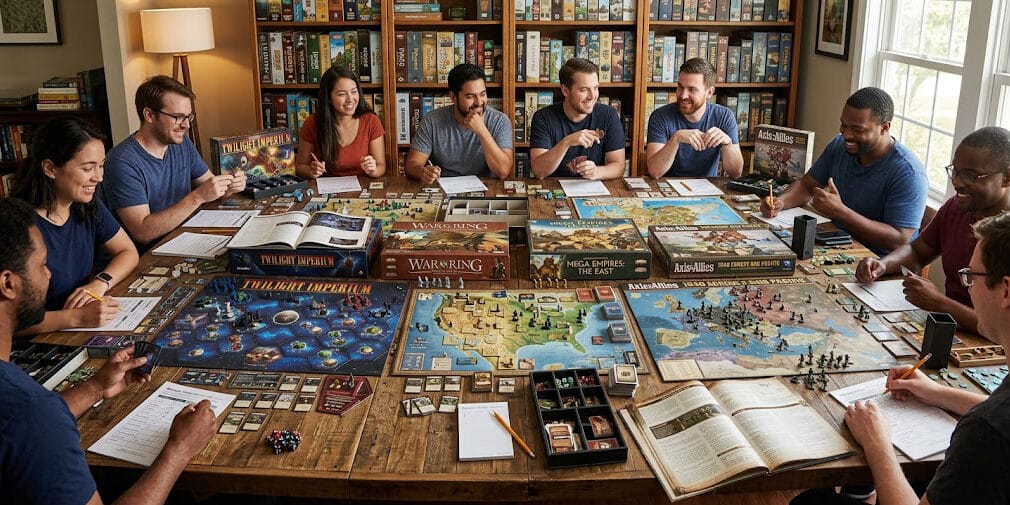
If you’ve got six or more hours to spare and a group of people willing to commit, there’s one long board game that tends to pull ahead of the field: Asmodee Twilight Imperium 4th Edition. It’s not short, it’s not light, and the rulebook alone might give you pause — but nothing else on this list produces the kind of sprawling, negotiation-heavy, story-generating chaos that TI4 does. We’ll explain what makes it stand out, why it isn’t for everyone, and — just as importantly — which of the other games on this list might be a better fit for you.
Our Top Picks for Long Board Games
✅ We recommend these products based on an intensive research process that’s designed to cut through the noise and find the top products in this space. Guided by experts, we spend hours looking into the factors that matter to bring you these selections.
⭐ 2.5 million+ people assisted in the last 30 days ⭐
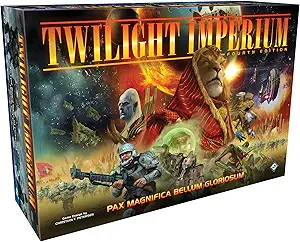
Players: 3–6 | Playtime: 4–8 hours | Ages: 14+
Twilight Imperium 4th Edition is the kind of game that sounds unreasonable on paper and then somehow becomes the most memorable thing you did all year. When we sat down to our first full six-player session, nobody quite believed it would work — you’re asked to manage fleets, negotiate trade deals, vote on galactic law, fight wars, and chase victory points simultaneously, all while quietly trying not to be the person everyone gangs up on. What surprised us wasn’t the complexity. It was that, somewhere around hour four, nobody wanted it to stop. The faction asymmetry is where TI4 genuinely earns its reputation. Each of the seventeen civilizations plays differently enough that the same group can run three sessions and barely overlap in strategy. The political system, where players vote on laws that reshape the game mid-session, consistently generates moments that your table will still be talking about weeks later. At the same time, TI4 demands an honest group. If even one player is disengaged, the whole thing sags. Setup takes close to an hour. The rulebook is a commitment. And if your group can’t field at least three experienced players, expect to spend a chunk of the session confused. Still, nothing else on this list replicates the feeling of TI4 at its best — when the politics, the warfare, and the backroom dealing all collide in the final two rounds, it’s genuinely unlike anything else in the hobby.
Pros: Extraordinary depth and replayability; every faction plays differently; generates unique stories every session; streamlined compared to third edition
Cons: Setup and teardown are time-consuming; requires committed, engaged players; steep learning curve for newcomers; not suitable for two players
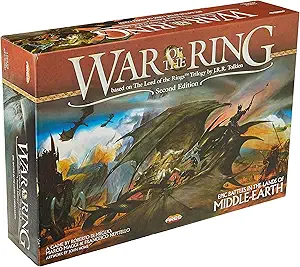
Players: 2–4 | Playtime: 120–360 minutes | Ages: 14+
If Twilight Imperium is the game for a group looking to lose a Saturday, War of the Ring is the game for two people who want to disappear into Middle-earth for an afternoon and come out the other side feeling like they actually lived through something. We tested it across both two-player and four-player configurations, and we’ll be honest: the two-player experience is where this game finds its best self. The asymmetry between the Shadow forces and the Free Peoples is genuinely brilliant — one side is racing the clock, the other is grinding toward an overwhelming military conquest, and the tension between those two objectives makes every dice roll feel meaningful. What struck our team first was how faithful the design is to Tolkien’s actual story. Gandalf can ride ahead to alert Rohan. Aragorn can step up and reveal himself as the true heir to Gondor’s throne. The Fellowship moves hidden across the board while Sauron’s hunt closes in around them. Even if you know how the books end, you’ll find yourself making desperate tactical calls that the story never required. The dice-action system is clever and flexible, and the Event Cards layer in just enough narrative flavor to keep both players emotionally invested. The component quality has drawn some fair criticism — the miniatures aren’t as crisp as premium alternatives — but once the game is moving, that barely registers. We consistently found ourselves locked in until the very last action.
Pros: Deeply thematic and faithful to Tolkien; highly asymmetric gameplay rewards both sides; tense from start to finish; two paths to victory for each faction
Cons: Four-player mode adds complexity without much benefit; miniature quality is uneven; the first game tends to run significantly longer as rules are absorbed; it can be tough to find opponents willing to commit to the runtime
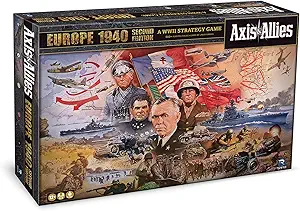
Players: 2–5 | Playtime: ~6 hours | Ages: 12+
Of all the games on this list, Axis and Allies 1940 Europe is the one that most rewards strategic patience over theatrical moves. The European theater of World War II is already gripping on its own terms, and this edition captures it with a level of mechanical honesty that surprised us. We were testing a group that included a dedicated wargame enthusiast and two players who’d never touched anything heavier than Ticket to Ride. The wargamer was engaged immediately. The two newcomers took about forty-five minutes to find their footing — and then they didn’t want to stop either. The 35-by-32-inch gameboard is a table presence unto itself. Six playable nations — Germany, Italy, the United Kingdom, France, the Soviet Union, and the United States — give players meaningfully distinct strategic positions, and the economic management layer adds real depth to what could otherwise be a simple minis-pushing exercise. Production values from Renegade Game Studios are solid: detailed military miniatures, clear iconography, and a rulebook that’s much more digestible than the game’s reputation suggests. The standalone nature matters here too — you can play this game on its own and have a complete, satisfying experience, or you can combine it with Axis and Allies 1940 Pacific to create a global campaign that genuinely earns the word “epic.” The six-hour runtime is honest for experienced players. New groups should plan for longer.
Pros: Historically grounded with meaningful nation asymmetry; excellent production quality; expandable with Pacific edition for global play; accessible enough for strategy newcomers
Cons: Six-hour sessions require planning; slower early turns as players build economies; works best with five players, which requires coordination; can feel repetitive across multiple plays of the same theater
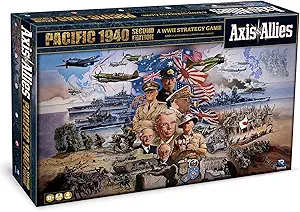
Players: 2–4 | Playtime: ~6 hours | Ages: 14+
Where the Europe edition opens with Europe on the brink of collapse, the Pacific edition drops you into a world already at war — Japan is pushing through China, the United States is watching with growing alarm, and the geopolitical tension of the Pacific theater in 1940 is already crackling before you move a single unit. That setting energy carries through the whole game. We found the Pacific edition slightly sharper in moment-to-moment decision-making than its European counterpart, largely because the geography of the Pacific island chains, vast stretches of ocean, and contested naval lanes creates a different kind of strategic puzzle. Controlling sea lanes feels genuinely important in a way that European land corridors sometimes don’t. The playable factions — Japan, China, the United States, the United Kingdom, and ANZAC forces — each have recognizable strategic identities, and the naval warfare mechanics are satisfying and tactically interesting. It’s worth emphasizing again that this game integrates directly with Axis and Allies 1940 Europe: when you combine both games, you’re running a nine-power global conflict on a board that spans nearly six feet in width. That combined experience is ambitious to the point of being its own event. But the Pacific edition holds up strongly as a standalone, and for groups who prefer maritime strategy to continental warfare, it tends to be the preferred edition.
Pros: Compelling Pacific theater geography with strong naval mechanics; plays well as a standalone or combined with the Europe edition; leaner player count works well at four; historically rich faction design
Cons: Recommended age of 14+ reflects genuine complexity; naval focus may not appeal to players who prefer land-based strategy; global combination requires a serious time investment; lower player count limits some social dynamics
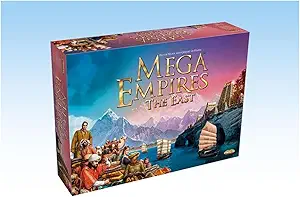
Players: 3–9 | Playtime: Up to 12 hours | Ages: 14+
Mega Empires: The East is a game that requires some honest self-reflection before you buy it. The playtime of up to twelve hours is not marketing hyperbole. Across our testing sessions — which averaged about an hour per player — we found that a full nine-player run is genuinely an all-day commitment. But here’s what surprised us: the mechanics that sustain that runtime are far more accessible than you’d expect. The trading phase, where players scramble around the table trying to assemble commodity sets by shouting offers at each other, is energetic and genuinely funny. Civilizations rise and collapse across 8,000 years of history, from the Stone Age through the Bronze Age to the Iron Age, along a map stretching from the Middle East to India. The game focuses on the great empires along the Silk Road — the Babylonians, the Persians, the Nubians, and the Indus Valley civilization, among others — and gives each player meaningful decisions around territorial expansion, calamity management, and civilization advancement. What makes Mega Empires: The East particularly well-suited to its occasion is how well it scales. Shorter scenarios can be completed in three to four hours. The full experience is designed for groups who specifically want to fill a day with something ambitious. It integrates with Mega Empires: The West for an even larger experience, supporting up to eighteen players. If your gaming group ever had a “big day” event in mind, this is one of the very few games designed explicitly for that format.
Pros: Supports up to nine players as a standalone; chaotic, engaging trading phase; surprising depth for such accessible mechanics; Short Game variant reduces playtime significantly; integrates with The West for massive sessions
Cons: Full-game runtime demands serious scheduling commitment; not suitable for casual play; calamity system can feel punishing; requires players who accept both cooperation and cutthroat competition
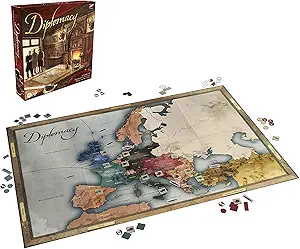
Players: 2–7 | Playtime: ~6 hours | Ages: 12+
There are games where strategy determines the outcome, and then there is Diplomacy — a game where the outcome is determined almost entirely by what you can get other people to believe. No dice. No random events. No card draws. Every move you make depends on the promises you extracted from your neighbors during the negotiation phase, and whether they intend to keep them. That design, first released in 1959 and unchanged in its essentials since, produces a social experience that no other game on this list can replicate. We played multiple sessions with a range of groups, and the most consistent observation was that Diplomacy doesn’t feel like playing a board game — it feels like a pressure test of every relationship at the table. The Hasbro Avalon Hill edition includes 315 playing pieces covering all seven European powers (England, France, Germany, Italy, Austria-Hungary, Russia, and Turkey), a well-produced map, and a rulebook whose simplicity is almost deceptive. The mechanics themselves take about twenty minutes to learn. The art of playing the game well takes considerably longer. Seven players is the right count — the game was designed around that configuration, and with fewer players, the strategic balance shifts noticeably. Sessions typically run four to six hours, though committed groups often break across two evenings. The biggest caveat here is temperamental: Diplomacy works brilliantly in groups that can separate in-game betrayal from personal offense. In groups that can’t, it tends to end badly.
Pros: Genuinely unique pure-negotiation experience with no randomness; accessible rules with enormous strategic depth; a genuine classic with decades of competitive play behind it; strong at a full seven players
Cons: Requires exactly the right group temperament; not well-suited to fewer than five players; betrayal mechanics can strain friendships; no catch-up mechanism for players in poor positions
Why We're Qualified to Weigh In
We put these six games through their paces across multiple sessions and player groups before settling on our recommendations. Our assessment team is a mix of long-time hobbyists and strategy game skeptics, ranging from people who treat a game of Risk as a warm-up to players who hadn’t touched a war game before we started testing. We evaluated each game on setup burden, rules accessibility, table presence, player engagement over a long session, and — honestly — how badly anyone wanted to quit before it was over.
What We Cut and Why
Before we arrived at our six final recommendations, we worked through a considerably longer shortlist. Here’s why some didn’t make it.
Several popular titles were eliminated for failing to hold player attention over their full runtime. A game that loses half the table in the third hour isn’t doing its job, regardless of how impressive the box looks on a shelf. We also cut games where the theme felt bolted onto generic mechanics — if you could swap out the art and change nothing meaningful, we weren’t interested. A couple of contenders had component quality issues serious enough to hurt the experience: miniatures that snapped during normal handling, tokens too small to distinguish mid-game, or boards that warped out of the box.
We also set aside games that promised a “long” experience but topped out around ninety minutes in practice. The games on this list typically run three hours minimum, with most pushing toward six to twelve. That’s the honest category we’re operating in.
Which Long Board Game Is Right for You?
Choosing between these games comes down to your group’s size, patience, and appetite for complexity — and being honest about all three.
If you want the single richest long-game experience and can field five or six committed players who enjoy negotiation, politics, and deep strategy, Twilight Imperium 4th Edition is the game to buy. Nothing else produces sessions quite like it, and it tends to convert skeptics once they’ve lived through a tense final round.
If you mainly play with one other person and you want deep, thematic, asymmetric strategy, War of the Ring 2nd Edition is the stronger choice. It’s the most narratively immersive game on this list, and its dual-path victory conditions keep both sides engaged until the end. Tolkien fans specifically should consider this a near-essential purchase.
If your group is drawn to WWII history and enjoys economic management layered into combat strategy, the Axis and Allies 1940 Europe edition is the more complete standalone experience. The Pacific edition is worth adding if your group wants the naval-focused theater or plans to eventually run the combined global game.
If you regularly host large groups — six, seven, eight, or nine people — and you’re planning around an event day rather than a regular game night, Mega Empires: The East is essentially purpose-built for that occasion. It’s accessible enough for mixed-experience groups and delivers an experience that genuinely fills a day.
Finally, if your group wants a social and psychological challenge more than a mechanical one — and can handle what happens when someone breaks a promise in the final act — Diplomacy is its own category. It’s been pulling friends apart and back together since 1959 for good reason.
The common thread across all six picks: these are games that reward investment. They’re not for a quiet Tuesday evening. They’re for the days you’ve cleared your schedule and gathered people who are ready to commit — and that’s precisely what makes them worth it.