Advertiser Disclosure
We independently review everything we recommend. When you buy through our links, we may earn a commission.
The Best Worker Placement Board Games
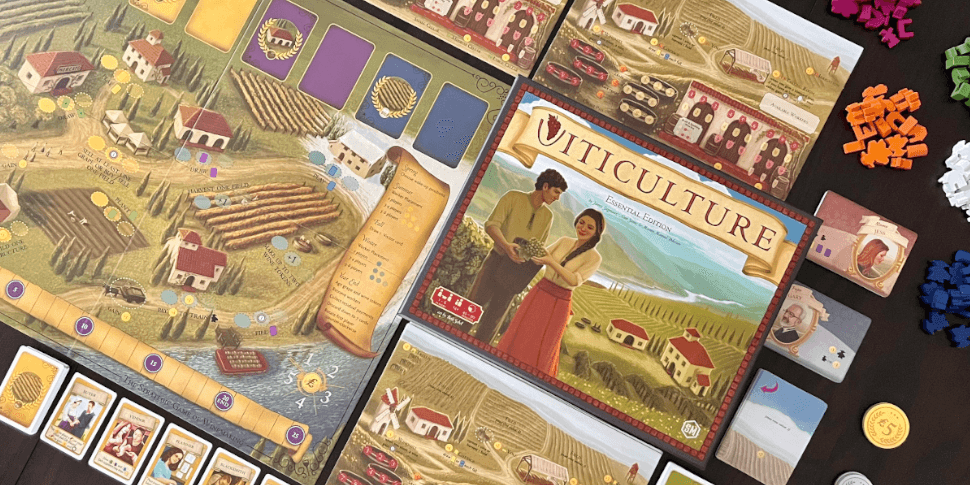
Worker placement games have this way of grabbing you from the very first turn. You sit down, scan the board, and suddenly realize that everyone wants the same spots you do — and the race is on. We’ve spent a good deal of time at our table working through a wide range of titles in this genre, and the ones we’re highlighting here genuinely stood out for different reasons. Some surprised us with their creativity; others reminded us why certain mechanics never get old.
Whether you’re brand new to the genre or already deep in the hobby with a shelf full of euros, this guide is built to help you figure out which game actually fits what you’re looking for. We cover everything from light, quick-playing options to heavier brain-burners, and we walk through exactly what makes each one tick — and where it falls short.
Ready to buy? Stonemaier Games Viticulture Essential Edition is our #1 pick — see it on Amazon
Which Worker Placement Game Should You Get?
We get asked this question a lot, so here’s a direct breakdown based on who’s asking.
If you’re new to worker placement games and want the most welcoming entry point, start with Viticulture: Essential Edition. It teaches the core mechanic cleanly, plays in under 90 minutes, handles a wide range of player counts, and the theme is charming enough that non-gamers get pulled in easily. It’s the game our team most often recommends to someone buying their first “serious” board game.
If your group plays regularly and wants something fresh in under an hour, Fromage is the pick. The rotating board and simultaneous play make it feel genuinely different from other worker placement games on the market, and the 40-minute runtime means you can play twice in an evening. It works well as a warm-up for a longer game night or as the main event for a shorter session.
If you’re a dedicated Euro gamer who wants mechanical depth and replayability, look at Yokohama (for a clean, refined experience) or Unconscious Mind (for something more complex and visually stunning). Both reward repeated plays with increasing strategic clarity.
If you want a heavy, thematic euro that will occupy your group for a full evening, Darwin’s Journey is the standout. It’s demanding, it takes time to learn, and the first game will be messy — but the second game reveals one of the most satisfying worker progression systems in the genre. It suits groups that love games like Teotihuacan, Tzolk’in, or Architects of the West Kingdom.
If you want a game that a non-gamer group will enjoy as much as an experienced one, Rock Hard 1977 is the table crowd-pleaser. The theme is immediately accessible, the player boards are playful, and the game generates more laughter and storytelling than any other title on this list. It’s also genuinely competitive, so experienced players won’t feel like they’re slumming it.
If your group enjoys dice-driven strategy with a strong sense of exploration and engine-building, Wayfarers of the South Tigris is the game that keeps getting better. It’s not for a first play with casual players, but for a regular gaming group willing to invest two or three sessions, it delivers a uniquely deep strategic experience.
Our Top Picks for Worker Placement Board Games
✅ We recommend these products based on an intensive research process that’s designed to cut through the noise and find the top products in this space. Guided by experts, we spend hours looking into the factors that matter to bring you these selections.
⭐ 2.5 million+ people assisted in the last 30 days ⭐
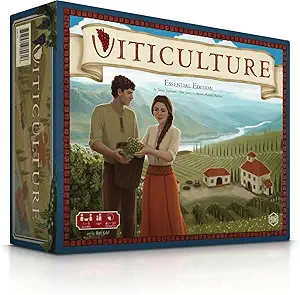
If there’s a single worker placement game that our team keeps coming back to recommend as a starting point for the genre, Viticulture: Essential Edition is the one. Designed by Jamey Stegmaier and Alan Stone and published by Stonemaier Games, it puts players in rustic, pre-modern Tuscany where they’ve inherited a small vineyard and need to turn it into a thriving wine business. What struck us immediately was how well the theme and mechanics work together — you’re literally planting vines, crushing grapes, aging wine in your cellar, and fulfilling orders, and every action feels like it belongs. The Mama and Papa card system gives each player an asymmetric starting condition without adding confusion, and the Grande Worker is a clever safety valve that keeps the “I got blocked” frustration from ever becoming too sharp. It plays just as well at two as it does at five, which isn’t something many worker placement games can claim. The visitor cards in the Essential Edition are notably improved over the original game, and every single one feels meaningful — not filler. Our testers consistently described the experience as “relaxing but tense,” which might sound like a contradiction until you actually play it. Trade-offs: it does lean into luck via cards, and some will find the strategy shallower than heavier euros. But as an introduction to the genre, or just a beautiful game to have in your collection, it’s hard to beat.
Pros: Elegant theme integration, low learning curve, scales well with player count, outstanding production quality
Cons: Luck factor from cards can frustrate optimization-focused players, relatively shallow compared to heavier titles
Players: 1–4 | Playtime: 40 min | Weight: Medium | Ages: 14+
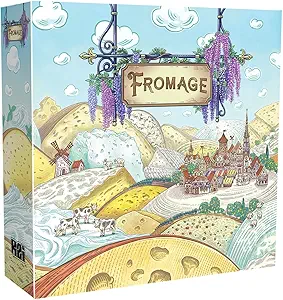
We’ll be honest — when we heard “worker placement game about making cheese,” some of us were skeptical. Then we actually sat down with Fromage from Road to Infamy Games, and within a single rotation of the board, every ounce of skepticism evaporated. This game is doing something genuinely new. Instead of a static board with fixed action spaces, Fromage uses a circular, rotating board divided into four quadrants, each hosting its own mini-game with distinct scoring logic. All players place workers simultaneously — you’re never waiting around — and when everyone has placed, the board rotates a quarter turn, aging whatever cheese tokens you’ve committed and presenting you with a completely new puzzle. The worker aging system (bronze workers return quickly, silver takes two rotations, gold takes three) creates this brilliant tension where every placement decision is also a question of tempo: do you commit a powerful, slow-returning worker now, or do you play nimble and stay flexible? Our testers who tend to dislike downtime in euros fell in love with the simultaneous play. The game wraps up in around 40 minutes, which makes it extraordinary for the strategic depth on offer. It’s not a walk in the park for complete newcomers — the four different quadrant scoring systems take a game or two to internalize — but once it clicks, the replayability is excellent thanks to modular quadrant tiles. Think of it as the Euro game that plays like a tight puzzle sprint.
Pros: Innovative rotating board mechanic, simultaneous play eliminates downtime, fits in 40 minutes, strong replayability
Cons: Multiple scoring mini-games can feel overwhelming to first-timers, limited cross-quadrant interaction
Players: 2–4 | Playtime: 90 min | Weight: Medium-Heavy | Ages: 14+
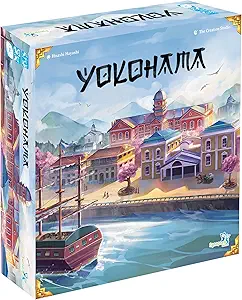
Yokohama, designed by Hisashi Hayashi and recently republished in a gorgeous 2024 edition by Synapses Games, is set during Japan’s Meiji era — a moment when the fishing village of Yokohama was becoming a premier international trading hub. Players take on the roles of merchants trying to earn fame through smart business ventures: collecting trade goods, building shops and trading houses, learning new technologies, and fulfilling orders from abroad. What sets this game apart mechanically is its twist on how worker placement actually works. Rather than placing your workers and then taking the action at that same location, in Yokohama, you deploy assistant cubes to position them around the board, and then your President pawn moves to a location to activate based on how many of your assistants are there. The more assistants crowded around a spot, the more powerful the action. It demands genuine planning — not just for your current turn, but two or three rounds ahead — which creates the deeply satisfying feeling of executing a well-laid plan. The 2024 edition brings dual-layer player boards, refreshed artwork from The Creation Studio, and a much-improved insert, making this the definitive way to experience the game. New players may find the initial setup and rules somewhat dense, but experienced Euro gamers will find the learning curve entirely worthwhile.
Pros: Unique assistant-deployment twist on worker placement, strong replayability via modular board, improved 2024 edition production
Cons: Steeper learning curve, can feel overwhelming at first, not ideal for complete beginners
Players: 1–4 | Playtime: 60–90 min | Weight: Medium-Heavy | Ages: 14+
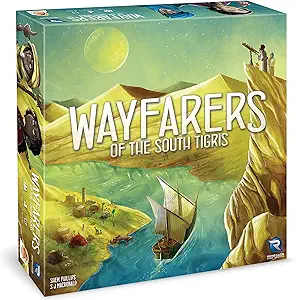
Wayfarers of the South Tigris, designed by Shem Phillips and S J MacDonald for Garphill Games and Renegade Game Studios, takes the worker placement genre and runs it through a dice-as-workers engine with spectacular results. Set during the Abbasid Caliphate circa 820 AD, players are explorers, cartographers, and astronomers setting out from Baghdad to map the surrounding lands, waterways, and skies. The headline innovation is that your workers are dice — but the values of those dice don’t constrain which spaces you can use them in the way you might expect. Instead, they determine the rewards and interactions you trigger, which completely changes how you think about dice placement. Your tableau grows outward as you add land, sea, and sky cards, each unlocking new actions and abilities, and there’s a central Journal track that rewards you for periodically resting and reporting your findings. The game wants you to chain actions together cleverly, and pulling off those multi-step turns where resources cascade into each other is genuinely satisfying. Our testing team found that Wayfarers really opens up after a second play — the first game can feel like you’re discovering the rules as much as playing — but it rewards patience generously. The solo mode is also worth singling out as one of the better implementations of the format in the genre. Trade-offs include a significant table footprint and real potential for analysis paralysis given the sheer number of options available.
Pros: Innovative dice-as-workers system, satisfying tableau-building, excellent solo mode, grows with repeated plays
Cons: Large table footprint, prone to analysis paralysis, first game can feel disorienting

Players: 2–5 | Playtime: 90 min | Weight: Medium | Ages: 16+
Rock Hard 1977, designed by Jackie Fox — bassist for The Runaways and four-time Jeopardy champion — and published by Devir Games, was genuinely one of the most talked-about games at Gen Con 2024, and it earns that attention almost entirely through sheer personality. The game drops players into the scrappy, sweaty world of 1977 rock music, where you’re an up-and-coming musician trying to build fame before the year is out. Over a maximum of nine rounds — each representing a month from April to December — players navigate Day, Night, and Evening phases, hitting different locations to rehearse, write songs, play gigs, promote their band, and network at after-hours clubs. Worker placement here is single-worker-per-phase, which keeps turns moving briskly. The amp-shaped player boards are a delight, with stat dials that go up to eleven (naturally). The currency — physical bills that look and feel genuinely distressed and worn — drew more table commentary during our playtesting sessions than any other component we’ve handled this year. What Rock Hard 1977 does exceptionally well is make you feel the story. Every decision is wrapped in flavor: your band’s manager, your day job, your vices (the “Candy” mechanic lets you trade future efficiency for extra actions now, with all the thematic implications that implies). It’s not the tightest euro design you’ll find — some job cards are imbalanced, and a few public milestones feel underpowered — but for groups who like their strategy games to come with some storytelling energy and a great soundtrack in their heads, this is a standout.
Pros: Exceptional theme immersion, outstanding production (especially the currency), accessible worker placement, strong social experience
Cons: Some job card imbalance, not the most strategically precise design, luck elements can frustrate competitive players
Players: 1–4 | Playtime: 60–120 min | Weight: Medium-Heavy | Ages: 12+
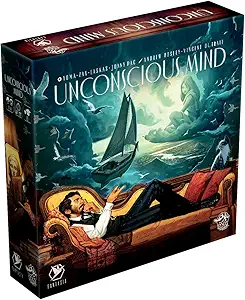
Unconscious Mind, published by Lucky Duck Games, is one of the more intellectually ambitious worker placement games we’ve reviewed. Set in early 1900s Vienna at the dawn of psychoanalysis, players join Freud’s Wednesday Psychological Society as rival thought leaders — competing to become the most distinguished colleague of Freud himself, who is constantly racing toward his own endgame trigger. The thematic frame is genuinely unusual for the genre, and it pulls off the conceit with style. The game’s central board — the Meeting Table — is where you place your Idea tokens (your workers), and unlike most games in the genre, where you place and activate at the same location, here your placement also advances an inkpot on your personal rondel, triggering cascading tile effects on your player board. That layered system creates the engine-building depth that experienced Euro players tend to seek out. Clients are the core of your scoring: Routine clients deliver ongoing powers while Case-Study clients deliver conditional end-game bonuses, and managing that balance is a puzzle that stays interesting across multiple plays. The artwork from Andrew Bosley (Everdell) and Vincent Dutrait is simply stunning — genuinely among the best we’ve seen in a euro-style game in recent years. One honest note: this game has limited direct player interaction, which suits some groups well and frustrates others. It also rewards players who enjoy thinking two or three moves ahead, so groups prone to analysis paralysis may want to keep session lengths in mind.
Pros: Stunning artwork and production, deep engine-building mechanics, genuinely unique theme, rondel system creates satisfying combos
Cons: Limited player-to-player interaction, can feel overwhelming during first play, higher price point
Players: 1–4 | Playtime: 30 – 120 min | Weight: Heavy | Ages: 14+
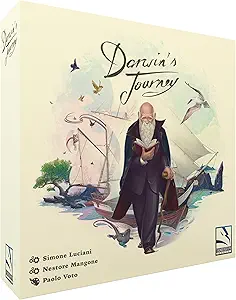
Darwin’s Journey from Thundergryph Games, designed by Simone Luciani and Nestore Mangone, is the most ambitious game on this list, and probably the one with the longest runway before it fully reveals itself. Players retrace Charles Darwin’s famous voyage through the Galápagos Islands over five rounds, exploring islands, collecting specimens, corresponding with scientists in Europe, and contributing to the Museum in a race to advance the Theory of Evolution. The headline mechanic — and the one that hooked our most experienced testers hardest — is the worker progression system. Your workers don’t simply place and take actions; they need to earn wax seals through training at the Academy before they can access many of the game’s more powerful actions. A worker with the right seal combination doesn’t just unlock the action — it performs an enhanced version of it. That creates a long-term planning dimension that most worker placement games simply don’t have. Every game session involves a cascading web of chain reactions: navigating your ship might let you explore an island, which lets you place a tent, which unlocks a bonus, which completes an objective, which earns you coins and progression on the Evolution track. When you pull off one of those long-chain turns, the table erupts. The learning curve is real — the rulebook is dense, and a video tutorial is genuinely helpful before your first session — but for players who want a rich, thematic heavy euro, Darwin’s Journey delivers an experience that few games in the genre can match.
Pros: Innovative worker progression system, deep strategic planning, rich thematic integration, high replayability via variable setup
Cons: Very long teach time, heavy rulebook, 120-minute runtime not ideal for casual game nights
What Is Worker Placement Board Games?
Before diving into the recommendations, it’s worth grounding ourselves in what the mechanic actually means. According to our research, worker placement is a stylized form of action drafting in which players place tokens — typically the iconic person-shaped meeple — on action spaces to trigger effects. The key tension comes from the fact that most spaces are limited: once someone takes an action, it may become unavailable or more expensive for everyone else that round.
That scarcity is the heartbeat of the genre. Every time you place a worker, you’re not just choosing what you want to do — you’re also choosing what your opponents can’t. This creates a layer of interaction even in games where players are otherwise racing along their own paths.
The genre has roots going back to titles like Bus (1999) and Agricola (2007), but modern designers have found endlessly inventive ways to build on the foundation. Today you’ll find worker placement woven into exploration games, rock music simulators, cheese-making adventures, and scientific epics. The variety is genuinely remarkable.
What We Looked For in Our Picks
Our assessment team tested each of these games over multiple sessions with different group compositions — experienced strategy gamers, casual players, and everyone in between. We evaluated each game on several dimensions: thematic integration (does the mechanic feel connected to the story?), decision quality (are the choices interesting?), table presence and production value, learning curve, and how well the game scales across different player counts. We also paid close attention to which types of players each game tends to suit best, since “good game” means very different things depending on who’s sitting at your table.
Understanding Worker Placement Sub-Genres
Not all worker placement games feel the same, and that’s worth understanding before you buy. At a high level, you can usually group them into a few categories.
Pure worker placement games — like the classic Agricola — keep the mechanic front and center with little else layered on top. Your workers go out, take action, and come home. The competition for spaces is the entire game. These tend to be tighter and more direct.
Hybrid worker placement games blend the core mechanic with other systems: deck-building (as in Lost Ruins of Arnak), dice-as-workers (as in Wayfarers of the South Tigris), rotating boards (as in Fromage or Tzolk’in: The Mayan Calendar), or rondel-driven engines (as in Unconscious Mind). These tend to feel fresher and more complex.
Thematic worker placement games prioritize the narrative experience alongside mechanical depth. Rock Hard 1977 and Darwin’s Journey both lean heavily into their themes, using the worker placement framework as a vehicle for storytelling rather than as an end in itself.
Knowing which category you’re shopping in helps you set the right expectations. An experienced euro gamer looking for something mechanically novel will probably gravitate toward the hybrids. A group that plays occasionally and wants to feel a story will likely enjoy the thematic options more.
How to Choose the Right Game for Your Group
Group composition matters enormously. A game like Darwin’s Journey or Unconscious Mind requires a table of patient, experienced players willing to commit to a full learning game before the depth reveals itself. Fromage, by contrast, is genuinely approachable for anyone who’s played a handful of modern titles, and its 40-minute runtime makes it easy to fit in a second game immediately.
Player count shapes the experience. Viticulture plays well at a wide range of counts, which is unusual. Most worker placement games are at their best with 3–4 players, where competition for spaces is real but not punishing. At two players, some games add clever adjustments (Yokohama does this well) to maintain tension. Always check the sweet spot for the specific title before purchasing.
Think about your group’s tolerance for complexity. BoardGameGeek’s weight ratings — which use a 1–5 scale — are a useful reference point. Fromage sits around 2.5, Viticulture around 2.9, and Darwin’s Journey closer to 4.0. The higher the weight, the more time you’ll spend teaching and learning before the fun fully kicks in.