Advertiser Disclosure
We independently review everything we recommend. When you buy through our links, we may earn a commission.
The Best Galison 1000 Piece Jigsaw Puzzles
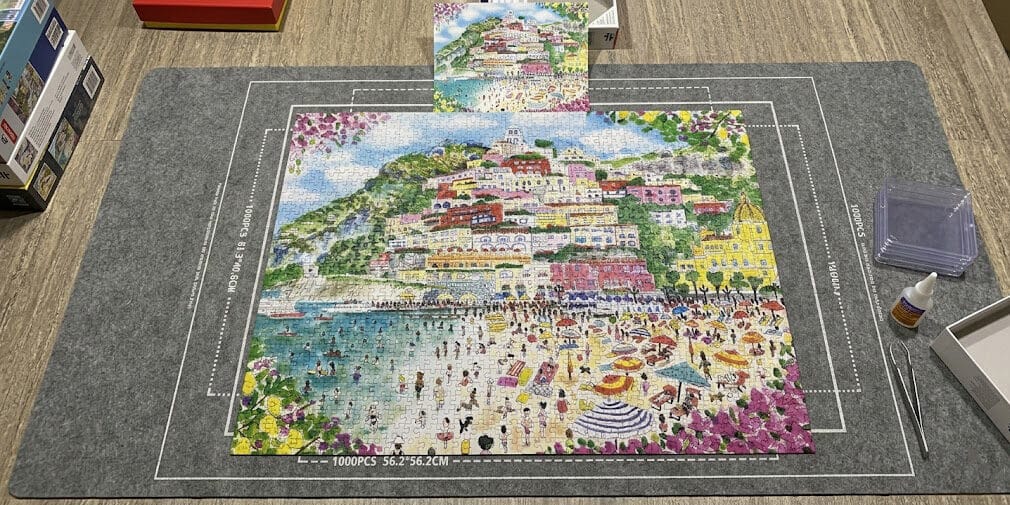
There’s a particular kind of quiet that settles over a room when someone’s working on a jigsaw puzzle. The soft click of a piece sliding into place, the slow emergence of something beautiful from a scattered pile — it’s meditative in a way that’s hard to replicate. Over the past few years, our team has spent a fair amount of weekend time at the puzzle table, and we keep coming back to Galison as one of the more reliable names in the space.
Founded in 1979, Galison has built its reputation around collaborating with working artists — illustrators, designers, and estates like Andy Warhol and Frank Lloyd Wright — to produce puzzles that genuinely feel like art objects rather than just a box of cardboard. The 1000-piece format tends to be their sweet spot: challenging enough to feel satisfying over several sessions, but achievable for a wide range of skill levels. Most adults complete one in roughly 8 to 12 hours spread across a few sittings, though that varies considerably depending on the complexity of the image.
Our Top Galison 1000-Piece Puzzle Picks
✅ We recommend these products based on an intensive research process that’s designed to cut through the noise and find the top products in this space. Guided by experts, we spend hours looking into the factors that matter to bring you these selections.
⭐ 2.5 million+ people assisted in the last 30 days ⭐
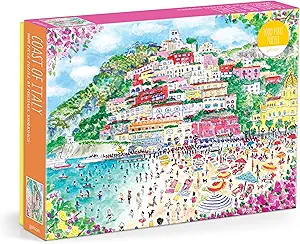
Best for: Travel enthusiasts, Mediterranean dreamers, fans of Michael Storrings
If you’ve ever flipped through travel photos of Positano and felt that particular ache — the one that says why am I not there — then this puzzle is going to hit differently. The Coast of Italy puzzle features original artwork by Michael Storrings, one of Galison’s most beloved collaborators, depicting a sun-drenched day along the Amalfi Coast. The scene is packed with the kind of layered, narrative detail that makes long puzzle sessions feel genuinely absorbing: vivid beach umbrellas, bustling beachgoers, the iconic stacked hillside village climbing up behind the shoreline, and that particular shade of turquoise water that makes the Mediterranean so immediately recognizable. What struck our team during testing was how naturally the image breaks into workable sections — the azure sea, the terracotta rooftops, the sandy beach — giving you clear anchor points without making the process feel mechanical. Storrings’ warm, slightly impressionistic brushwork means each piece carries enough color variation to stay distinguishable, which keeps the assembly moving at a satisfying pace. Finished, it measures 27″ x 20″, and we think it’s genuinely beautiful enough to frame. For anyone who uses puzzles as a form of armchair travel, this one tends to feel like a small vacation in itself.
Trade-offs: The sky and upper hillside sections can slow things down — there’s less tonal variety there than in the beach scene below. Also worth noting: this puzzle is frequently backordered, which suggests strong demand but can mean some wait time if you’re ordering as a gift.
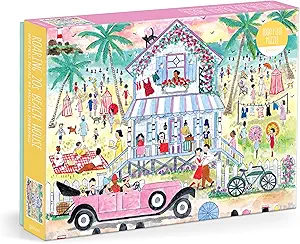
Best for: History buffs, vintage art lovers, and anyone who enjoys a richly populated scene
This puzzle earned some of the most enthusiastic reactions from our team, and honestly, it’s easy to see why. Michael Storrings takes on the glamour of 1920s coastal life here, and the result is one of the most detail-packed images in Galison’s lineup. At the center stands a charming two-story pale blue beach cottage with a striped awning and a black cat perched on the rooftop peak — already a lot to love. But the real joy is in the surrounding scene: a pink vintage convertible pulling up to a white picket fence, elegantly dressed partygoers mingling on the porch, a couple dancing out front, a picnic on a red-and-white checkered blanket, and dozens of beachgoers in period-perfect swimwear scattered across the shoreline. The sky glows in warm pinks and golds at the horizon. During testing, we found the sheer number of distinct vignettes made this puzzle unusually engaging to build — there was always something new to discover in a corner we hadn’t yet looked at closely. Storrings’ soft watercolor style gives the finished piece a dreamy, almost nostalgic quality that genuinely looks stunning displayed on a wall. It’s the kind of puzzle that prompts visitors to stop and look more closely, which is its own kind of compliment.
Trade-offs: The level of detail, while delightful, does make this a moderately challenging build. The turquoise water and sandy beach areas share relatively similar tones and may require patience. This is probably not the right starting point for someone new to 1000-piece puzzles.
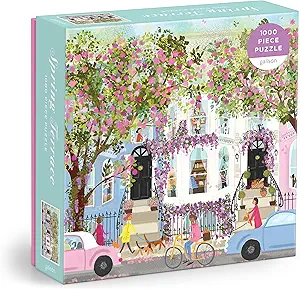
Best for: Fans of Joy Laforme, springtime scenes, those who enjoy architectural detail
Joy Laforme is one of the puzzle world’s more distinctive voices, and the Spring Terrace puzzle shows exactly why. Her signature style — bold, layered color, a sense of slightly stylized charm — translates exceptionally well into the puzzle format, and the magnolia-filled residential block she’s painted here is exactly the kind of image that makes you want to sit down and spend an afternoon with it. The scene captures the particular magic of a city street in early spring: flowering trees arching overhead, brownstone facades in warm tones, and the kind of quiet, neighborhood energy that feels genuinely restorative to look at. What works especially well from a puzzling perspective is how Laforme’s technique creates natural color zones that give you a clear strategy from the start. The blooms read differently from the brickwork, the sky shifts from the foliage, and the architectural details provide reliable landmarks throughout. Our team found the middle stretch of this puzzle — after the border is placed but before the larger sections come together — to be particularly satisfying, with regular moments of pieces clicking into place in pleasing clusters. It’s also a puzzle that tends to look prettier and prettier as you progress, which keeps morale high.
Trade-offs: The floral sections, while beautiful, involve a fair amount of similar pink and white tones that can slow things down in spots. If you prefer puzzles with stronger contrast across the entire image, you may find a few sections more tedious than others.
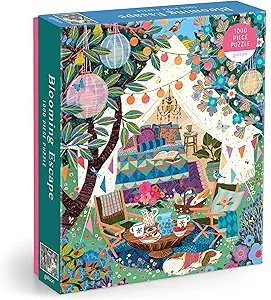
Best for: Nature lovers, cottagecore enthusiasts, anyone craving a sense of peaceful retreat
This is the puzzle we kept returning to when the week had been long, and the idea of something genuinely calming was appealing. Victoria Ball’s Blooming Escape depicts a dreamy glamping setup — an elegantly appointed white bell tent nestled in a wildflower field, with a tea party table set outside, bohemian lanterns strung overhead, and a sleeping dog completing the scene with characteristic ease. The artwork is extraordinarily rich in layered detail: patterned quilts in teals and golds spill out of the tent, colorful bunting flags flutter between trees, butterflies drift through the botanical border that frames the entire composition in pink, lavender, and coral. What made this puzzle a standout during testing was how the distinct zones — tent interior, outdoor tea setup, and lush floral border — created natural sorting categories that made assembly feel both organized and satisfying. The textile patterns inside the tent provide particularly absorbing work: each quilt is different, each pillow distinct, and finding the right piece feels like solving a small puzzle within the larger one. It’s a genuinely soothing build, and the finished image is the kind of thing you might actually consider framing. At 20″ x 27″, it makes a lovely display piece.
Trade-offs: The botanical border, while gorgeous, involves a high concentration of similar greens and pinks that can feel repetitive to sort through. We’d suggest tackling it after establishing the tent and table sections, rather than starting there.
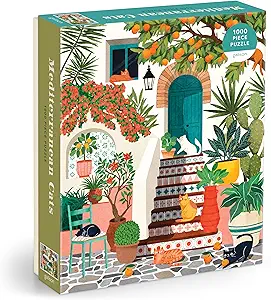
Best for: Cat lovers, anyone drawn to warm coastal aesthetics, and fans of illustrated domestic scenes
Few puzzle images inspire as much immediate affection as this one. Tania Garcia’s Mediterranean Cats depicts a charming coastal home with contented cats arranged across a sunny stoop, surrounded by lush orange trees, terracotta pots, and the kind of casually beautiful Mediterranean domestic life that makes you want to book a flight immediately. The illustration has a warm, almost folk-art quality that feels immediately inviting — and it’s genuinely one of those puzzles where the finished image is as much the point as the process of building it. From a puzzling standpoint, the design works well: the citrus-heavy foreground offers rich, distinct color work; the cats themselves provide recognizable anchor shapes; and the architectural details give you solid structural landmarks to build around. Our team noted that this puzzle tends to generate conversation — people passing by the puzzle table regularly stopped to comment on the illustration, which is something that doesn’t happen with every design. It also photographs beautifully when assembled, which matters more than it might sound if you’re the kind of person who shares finished puzzle photos. It’s a genuinely joyful image to spend time with.
Trade-offs: The orange tree sections can involve some repetition of similar warm tones, which may slow progress in those areas. Also, cat-heavy imagery tends to have a lot of similarly shaped curved pieces, so patience is helpful when sorting the feline sections.
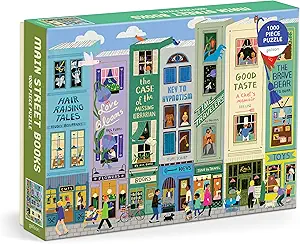
Best for: Book lovers, design-forward puzzle fans, those who appreciate clever visual concepts
This one earns its place as our most conceptually inventive pick. Created by illustrator Anne Bentley, Main Street Books reimagines a neighborhood street where every building is shaped like a book spine — mystery novels become moody dark storefronts, romance titles bloom into flower-fronted shops, science fiction volumes glow with neon signage. The concept is clever enough to feel genuinely fresh in a crowded market, and Bentley executes it with enough detail and wit that the image rewards close inspection at every stage of the build. Worth noting: this is a foil puzzle, meaning select elements carry a subtle metallic sheen that adds a layer of visual interest both during assembly and in the finished piece. The foil tends to catch light differently depending on your angle, which makes the building signage and certain architectural details feel almost three-dimensional. Seven distinct buildings, each themed around a different reading genre, give you clear structural sections to work through, which makes assembly feel logically satisfying rather than chaotic. Our team found this particularly well-suited to book clubs or literary-minded households where the image itself becomes a conversation starter.
Trade-offs: The foil finish can occasionally make it slightly harder to read piece edges under certain lighting conditions — a bright, directional light source works better here than diffuse overhead lighting. The design’s strong vertical structure also means the sky and ground areas can feel like filler compared to the richly detailed building facades.
What We Looked For
Image Complexity and “Puzzlability”
A beautiful image doesn’t automatically make a good puzzle. Large swaths of uniform color — a pale sky, a flat sea — can grind progress to a halt. We looked for designs that offer distinct color zones, varied textures, and enough visual landmarks to keep the assembly feeling rewarding rather than frustrating. Galison itself refers to this quality as “puzzlability,” and it’s genuinely something their design team appears to think carefully about.
Piece Quality and Cut
Galison uses what they call a ribbon cut — a style where each piece has a slightly irregular, interlocking shape that tends to hold together reasonably well once assembled. The greyboard they use contains 90% recycled paper, and while pieces are somewhat thinner than some premium European brands, they’re sturdy enough for most purposes and don’t show excessive puzzle dust during assembly. The matte, non-glare finish on the front makes them comfortable to work with under various lighting conditions.
Box and Presentation
Each Galison puzzle comes packaged in a matte-finish sturdy box made from 70% recycled paper and FSC-certified material, printed with non-toxic inks. The boxes are compact and tidy — about 8 x 8 x 2.5 inches — which makes them genuinely practical for gifting or storage. A puzzle insert with the full image is included, so you have a reference guide handy without needing to prop up the box lid.
Value
Galison puzzles generally land in the $18–$25 range, which puts them in a reasonable middle ground — more than a budget supermarket puzzle, but considerably less than some specialty brands. For the quality of the artwork and the consistency of the construction, we think the pricing is generally fair.
How Galison Compares to Other Puzzle Brands
It’s worth taking a moment to put Galison in context, because they occupy a specific and somewhat distinctive position in the puzzle market.
Compared to brands like Ravensburger, which tend to produce thicker, more precisely cut pieces with a wider international distribution, Galison generally trades some of that mechanical precision for a stronger artistic identity. Ravensburger puzzles often feel sturdier piece-by-piece; Galison puzzles tend to feel more like owning a piece of art. Neither approach is wrong — they’re just different priorities.
Against specialty brands like Liberty Puzzles or Artifact Puzzles, Galison is considerably more affordable and widely available, though those brands offer laser-cut wooden pieces and a tactile experience that’s genuinely different from cardboard puzzles. If budget is a primary consideration and you want reliable artistic quality, Galison lands in an appealing middle ground.
One area where Galison genuinely distinguishes itself is in the breadth of its artist collaborations. Working with everyone from Joy Laforme to Andy Warhol to Frank Lloyd Wright means that even within the 1000-piece format, the visual variety across their catalog is considerable. You’re not choosing between twelve slightly different landscapes — you’re choosing between genuinely distinct artistic visions.
Tips for Getting the Most Out of Your Galison Puzzle
Set up proper lighting. Puzzle pieces under warm incandescent light can look subtly different in color from the same pieces under cool daylight-spectrum light. If you’re struggling to match tones, try moving your work surface or changing your light source before assuming pieces are in the wrong pile.
Sort before you start. Galison’s ribbon-cut pieces tend to sort well by color and approximate shape. Taking 20 to 30 minutes at the start to organize your pile by major color region generally saves time overall, particularly in the middle stages when progress can otherwise slow considerably.
Use the insert, not just the box. The included image insert is easier to prop up at a useful angle than the box lid, and referring back to it regularly — especially in sections with similar tones — will save you from second-guessing pieces unnecessarily.
Consider framing the finished puzzle. Several of the puzzles in this guide are genuinely beautiful enough to display. Puzzle-specific glue pens and foam boards are widely available and relatively inexpensive, and a framed Galison puzzle can read as a legitimate piece of wall art rather than just a completed activity. Framing has become increasingly popular as puzzle imagery has improved in artistic quality, which tracks with our own experience.
Take breaks between sessions. One underrated aspect of multi-session puzzles is the fresh-eyes effect — returning after a night’s sleep often lets you see matches you couldn’t find the evening before. Don’t push through frustration; stepping away tends to be more productive than forcing it.
Who Should — and Shouldn't — Buy a Galison Puzzle
Galison 1000-piece puzzles tend to work particularly well for adults who want a screen-free activity that still feels creative and visually rewarding. They’re a reliable gift choice for puzzle enthusiasts, art lovers, and travelers who connect with certain regions or aesthetics. The price point and packaging also make them solid gifting options for occasions where you want to give something thoughtful but not overly expensive.
They’re generally less suitable for very young children — the 1000-piece format requires patience and fine motor control that most kids under 12 or 13 haven’t fully developed. And if you’re looking for the absolute sturdiest, most precisely cut pieces available, some European brands may suit you better. But for the combination of artistic quality, consistent construction, and accessible pricing, Galison is a brand we return to with regularity — and the six puzzles above represent what we think are some of their strongest offerings.
Frequently Asked Questions
How difficult are Galison 1000-piece puzzles? They tend to fall in the moderate range. Most adults with some puzzle experience will find them achievable over several sessions. Beginners may want to start with one of the more visually varied designs — the Coast of Italy or the Mediterranean Cats, for instance — rather than something with large areas of similar tones.
Are Galison puzzles eco-friendly? Reasonably so. The greyboard used for pieces contains 90% recycled paper, packaging is made from 70% recycled paper and FSC-certified materials, and the inks are non-toxic. It’s not a perfect environmental footprint, but it’s notably better than many mass-market puzzle brands.
Can I buy replacement pieces if I lose one? Galison’s customer service team can sometimes help with missing pieces, though it’s not a guaranteed service. The general recommendation is to keep your puzzle box and the included image insert, and to count your pieces before and after assembly if you’re in a household with pets or young children who might carry pieces off.
Do Galison puzzles hold together without glue? The ribbon-cut pieces interlock reasonably well, but they’re not designed to hold together permanently without adhesive. If you plan to display a finished puzzle, a dedicated puzzle glue or puzzle-saver sheets are worth the modest extra cost.