Advertiser Disclosure
We independently review everything we recommend. When you buy through our links, we may earn a commission.
Christmas Jigsaw Puzzle Brands Adults and Kids Will Actually Love
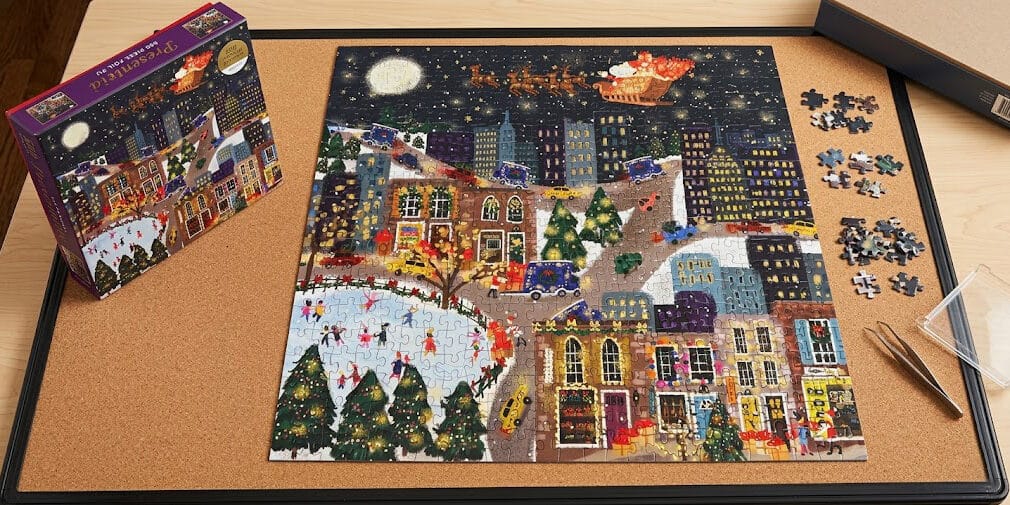
We’ve spent the better part of the holiday season testing, assembling, and genuinely wrestling with puzzles from dozens of brands, and what we found surprised us. Not all Christmas puzzles are created equal — and the difference between a puzzle that sparks joy and one that sparks frustration often comes down to things you’d never notice on the box: the precision of the cut, the coating on the image, the way the pieces feel in your hand. Those details matter, especially when you’re three hours into a 1,000-piece snowy village and the light is fading.
So whether you’re shopping for a grandparent who prefers cozy cabin scenes, a teenager who’d enjoy a challenging 1,500-piece winter landscape, or a six-year-old who wants to put together a puzzle of Santa’s reindeer, this guide covers the seven Christmas puzzle brands our team has come to trust. We’ll walk you through what makes each one stand out, who it suits best, and where it falls a little short — because no puzzle brand is flawless, and you deserve an honest read before you spend your money.
7 Best Christmas Jigsaw Puzzle Brands
✅ We recommend these products based on an intensive research process that’s designed to cut through the noise and find the top products in this space. Guided by experts, we spend hours looking into the factors that matter to bring you these selections.
⭐ 2.5 million+ people assisted in the last 30 days ⭐
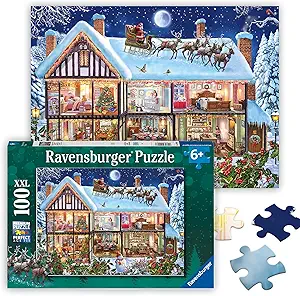
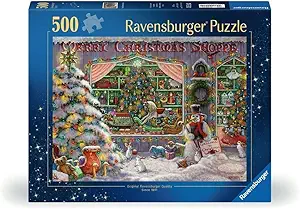
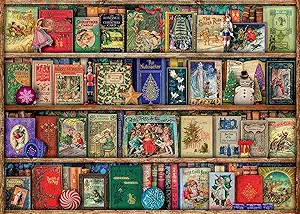
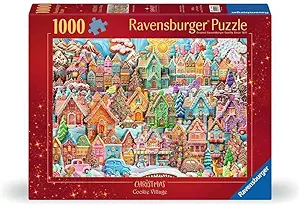
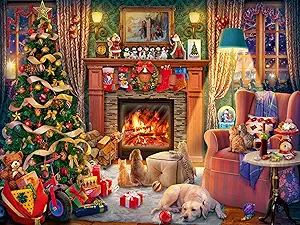
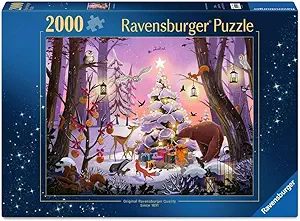
When our team sits down for a long puzzling session, Ravensburger is the brand we reach for without much debate. Founded in Germany in 1883, the company has spent over a century refining what a jigsaw puzzle can and should be — and it shows in every single piece. What struck us most during testing wasn’t any one feature in isolation, but the way everything worked together: the Softclick technology that makes pieces fit with a quiet, precise snap, the thick linen-textured surface that eliminates glare under lamp light, and the near-total absence of puzzle dust even after extended handling. Ravensburger’s Christmas collection tends toward beautifully illustrated scenes — festive village streetscapes, snow-draped forests, warmly lit kitchens on Christmas morning — and the print quality is consistently sharp enough that we found ourselves stopping mid-assembly just to admire a corner of the image. These puzzles run from 500 to 40,000 pieces, so they genuinely scale with your skill and ambition. The one honest caveat: Ravensburger puzzles sit at the higher end of the price range, which can feel steep for casual buyers. But for anyone who puzzles regularly or wants to give a gift that will last through multiple holiday seasons without warping or shedding, the investment is hard to argue with.
Best for: Dedicated adult puzzlers, families who puzzle regularly, and anyone who wants to frame the finished image.
Click here to view Ravensburger’s full Christmas product lineup and choose your favorites.
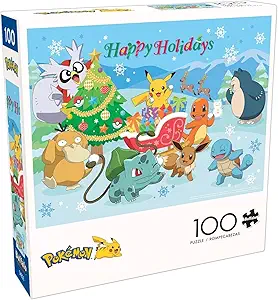
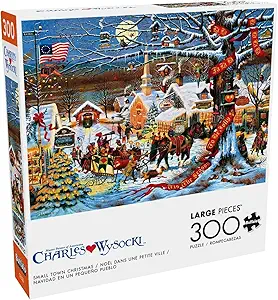
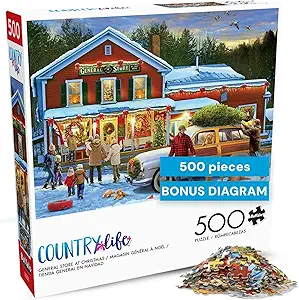
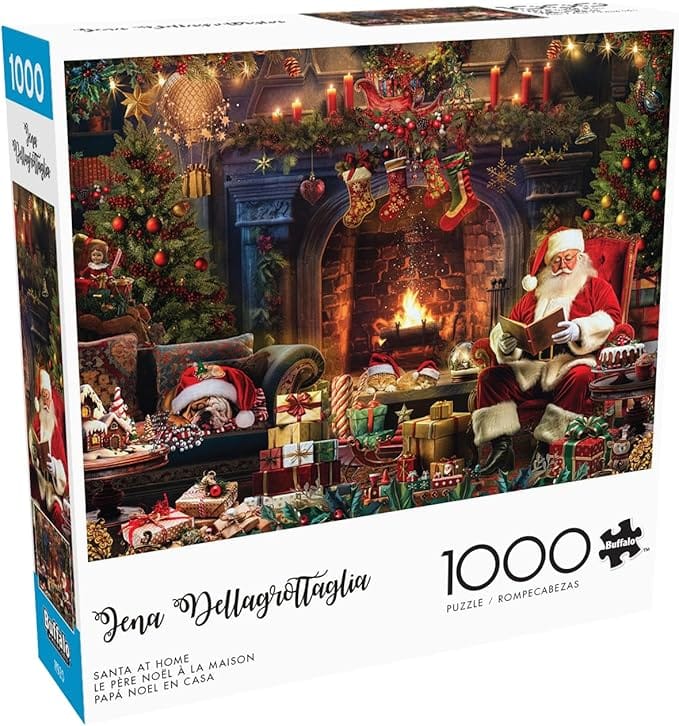
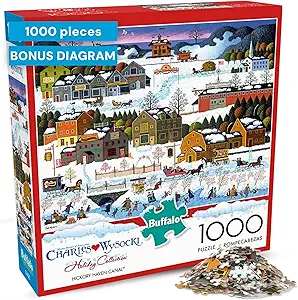
Buffalo Games sits in that genuinely useful middle ground between “budget” and “premium,” and for a lot of holiday gift-givers, that’s exactly where the sweet spot is. What our team appreciated most during testing was the brand’s consistency — across every Buffalo Games Christmas puzzle we assembled, the piece fit was reliable, the image printing was crisp, and the whole experience felt more polished than the price tag suggested. The brand is particularly well known for its Linen finish technology, a matte coating that diffuses light across the surface and makes sorting pieces by color significantly easier. We noticed this during our first assembly of their Holiday Village puzzle and mentioned it to each other almost immediately — sorting by color under overhead light is genuinely more pleasant than with glossy-surface competitors. Buffalo Games also does something smart with their Christmas lineup: they collaborate with popular illustrators and photographers to produce images that feel fresh and specific rather than generic clip-art holiday scenes. The trade-off is that pieces can occasionally run slightly thinner than Ravensburger or White Mountain, and the boxes don’t always include sorting trays, which matters if you’re working on a 1,500-piece puzzle on a table that needs to be cleared for dinner. But at their price point, these are minor notes, not dealbreakers.
Best for: Families who puzzle a few times a year, adults looking for quality without the premium price, gift-givers on a moderate budget.
Click here to view Buffalo’s full Christmas product lineup and choose your favorites.
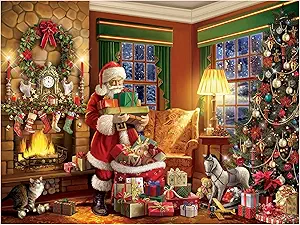
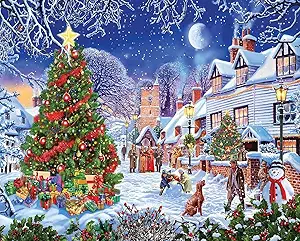
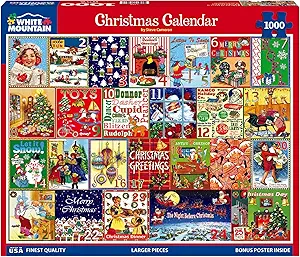
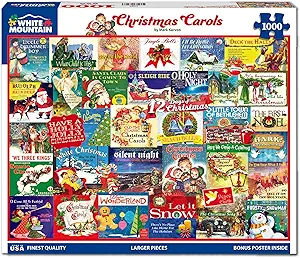
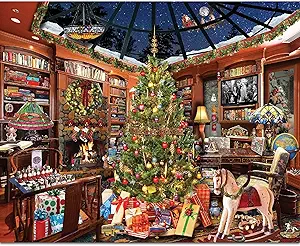
There is a very specific kind of Christmas puzzle warmth that White Mountain does better than anyone else, and it comes from the brand’s commitment to a particular aesthetic: densely illustrated, vintage-influenced scenes packed with dozens of tiny, story-rich details. When we opened their Christmas Memories puzzle during testing, the room genuinely warmed up a little — or at least it felt that way. The illustration style leans heavily into mid-century Americana, the kind of scene that makes you think of old holiday issues of The Saturday Evening Post, full of kids sledding, storefronts decorated with tinsel, and families gathered around tables with too much food. Beyond the aesthetic, White Mountain puzzles are reliably well-constructed: the pieces are thick, the cut is random and varied, and the image-to-box-art accuracy is among the best we tested. One thing that consistently impressed our team was the brand’s commitment to Made-in-USA manufacturing, which shows up not just as a label but as a tangible quality signal in the piece density and finish. The one genuine limitation is that the detailed, busy illustration style — while charming — can make sorting and assembly genuinely challenging, particularly in the lower-contrast center sections of a large scene. That’s not necessarily a flaw, but it’s worth knowing before you hand a 1,000-piece White Mountain puzzle to someone relatively new to the hobby.
Best for: Adults who love detailed, nostalgic imagery; puzzlers who enjoy a real challenge; families with older children (12+).
Click here to view White Mountain’s full Christmas product lineup and choose your favorites.
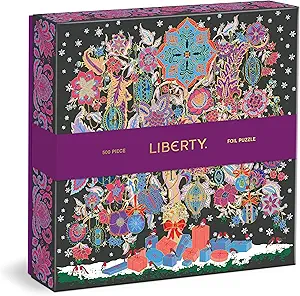
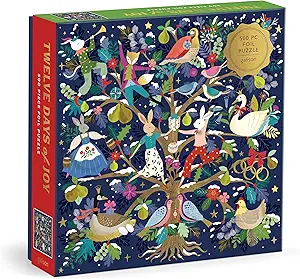
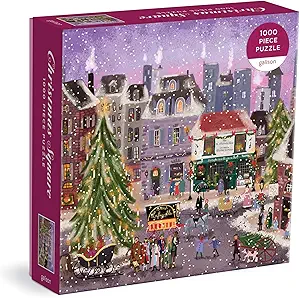
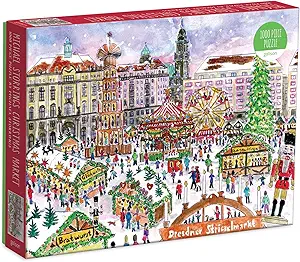
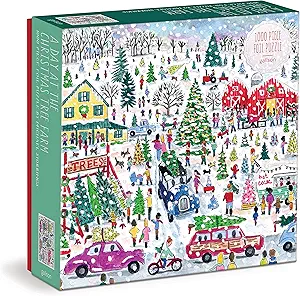
Galison occupies a fascinating niche in the puzzle world: it’s a brand built as much around art and design as it is around the puzzle-assembly experience itself. If you’ve ever wanted a Christmas puzzle that doubles as a conversation piece — something you’d actually want to display on a shelf in its box — Galison is worth a close look. The brand collaborates with independent artists, illustrators, and designers to produce images that feel genuinely distinctive: think modern botanical prints with holly and mistletoe, abstract geometric snowflake patterns, or richly layered Art Deco–inspired holiday scenes. During our testing, we noticed that Galison puzzles tend to attract comments from people in the room who aren’t even puzzling — the imagery is that visually interesting. The puzzle packaging itself is considered intentional, with sturdy boxes and a tactile quality that makes them feel gift-ready straight off the shelf. On the construction side, pieces are generally thick and solid, with a matte finish that photographs beautifully if you’re the type to post finished puzzles online. The caveat we’d flag honestly: because the imagery is often abstract or graphically bold, some Galison Christmas puzzles can be more frustrating to assemble than the box difficulty rating suggests. If the visual challenge sounds appealing rather than off-putting, that’s your answer right there.
Best for: Art and design enthusiasts, adults looking for a stylish gift, and anyone who appreciates independent illustration and modern aesthetics.
Click here to view Galison’s full Christmas product lineup and choose your favorites.
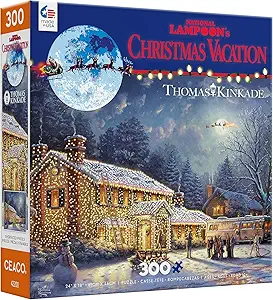
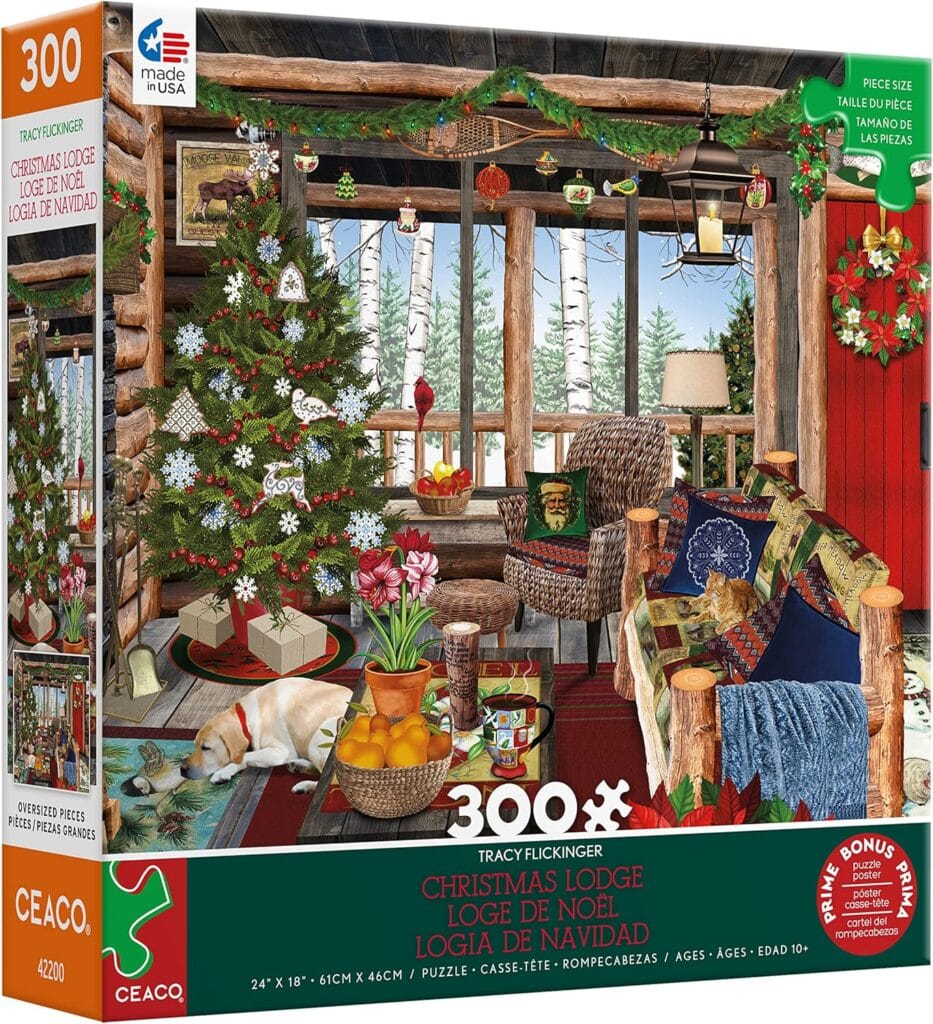
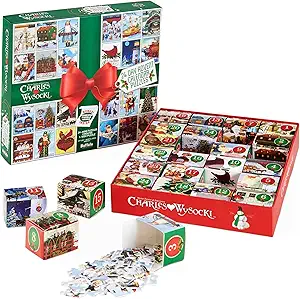
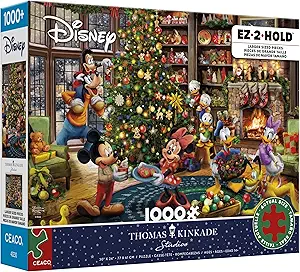
CEACO earns its place on this list specifically for what it does well: bold, colorful, high-energy Christmas puzzles that are genuinely fun for kids and families without feeling dumbed-down or cheap. The brand has carved out a reputation for licensed and character-driven imagery — think beloved holiday characters, playful Santa and reindeer illustrations, and vibrant winter wonderland scenes that practically glow on the table. When our team tested their holiday puzzles with younger family members (ages 5 through 12), the reaction was uniformly enthusiastic. The images are bright enough to hold a child’s attention for the full duration of assembly, and the piece sizes in their kids’ range are thoughtfully scaled for smaller hands. CEACO also produces a solid range of family-sized puzzles in the 300–750 piece range, which hits the sweet spot for a group that includes adults and children working together — complex enough to be engaging for older participants, approachable enough that younger ones contribute meaningfully rather than just watching. The trade-offs are modest but real: CEACO pieces tend to run slightly thinner than premium brands, and the image printing, while bright and appealing, doesn’t quite reach the fine-detail sharpness of Ravensburger or White Mountain. For a family Christmas puzzle session, though, those limitations rarely come up. The fun is front and center, and that’s the point.
Best for: Families with young children, holiday gift-giving for kids ages 4–12, group puzzle nights with mixed age ranges.
Click here to view CEACO’s full Christmas product lineup and choose your favorites.
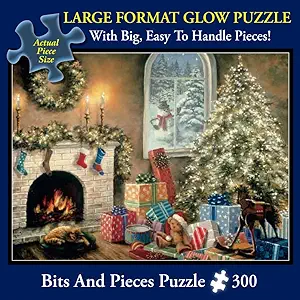
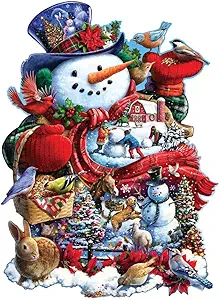
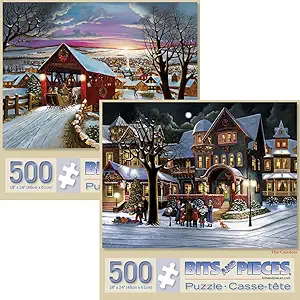
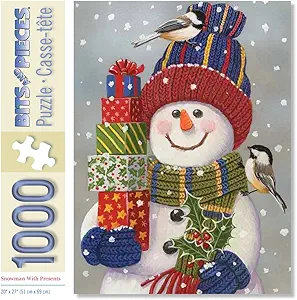
Bits and Pieces has built a devoted following among puzzle enthusiasts by doing something that most mainstream brands don’t bother with: genuinely experimenting with format, shape, and assembly experience. The brand is perhaps best known in the puzzle community for its shaped and die-cut puzzles — Christmas trees assembled in the shape of a Christmas tree, snowflakes that actually look like snowflakes when complete, and wreath-shaped puzzles that sit beautifully on a wall or mantel after assembly. Our team found these especially appealing as gifts because they offer something different — the novelty factor is real, and it translates into a more memorable unwrapping experience than a standard rectangular box. Beyond the novelty formats, Bits and Pieces also produces more traditional Christmas puzzles in the 300–2,000-piece range, and the quality here is solid: thick pieces, good image clarity, and a reliable random cut that keeps the challenge honest. The brand also has a strong tradition of working with wildlife and nature artists, so if your recipient loves imagery of snowy forests, winter birds, or reindeer in their natural habitat rather than pulling Santa’s sleigh, the selection here is particularly good. The honest note: shaped puzzles can be more challenging to store and transport, and the piece counts can be irregular, which occasionally throws off casual estimates of difficulty.
Best for: Experienced puzzlers looking for something different, enthusiasts who appreciate unique formats, gift-givers who want something memorable and unexpected.
Click here to view Bits and Pieces’ full Christmas product lineup and choose your favorites.
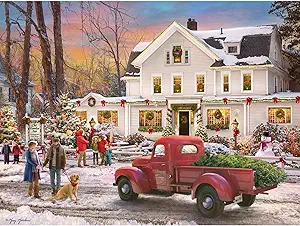
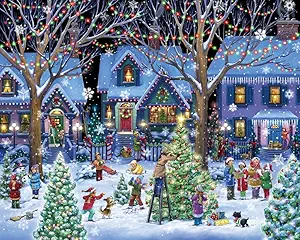
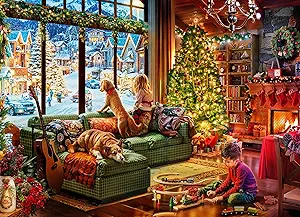
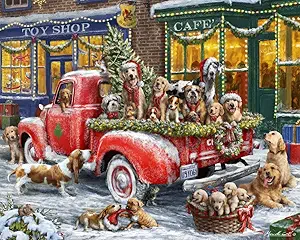
Vermont Christmas Company holds a special place in the Christmas puzzle world partly because of what it isn’t: it’s not a major corporate toy brand with a hundred product lines, a licensing strategy, and a marketing budget. It’s a company that does one thing — holiday puzzles — and does it with the kind of focused attention that shows up in the work. The imagery that Vermont Christmas Company produces is consistently warm, detailed, and deeply seasonal: crackling fireplaces, snow-globe villages, bookshelves stuffed with holiday reads, toy stores with steamed-up windows on winter evenings. When our team assembled their Cozy Christmas Cottage puzzle, the conversation at the table turned almost immediately to childhood holiday memories. That’s the brand’s real gift — not just a puzzle but a mood, a sensory trigger, a reason to slow down. On the construction side, the pieces are thick and satisfying, the random cut ensures that even similar-looking sky and snow sections have enough shape variety to keep you honest, and the image printing is warm and accurate. There’s a reason this brand gets passed down in families, with the same puzzles reassembled year after year. The main trade-off is limited availability outside the brand’s own website and a handful of specialty retailers — these puzzles occasionally sell out by mid-November, so if you’re shopping for the holidays, earlier is genuinely smarter than later.
Best for: Adults and families who love cozy, nostalgic holiday imagery; puzzlers who want something deeply seasonal rather than broadly thematic; anyone who already loves the brand and returns to it annually.
Click here to view Vermont Christmas Company’s full Christmas product lineup and choose your favorites.
What Makes a Great Christmas Jigsaw Puzzle? (The Criteria We Used)
Before we get to the brands, it’s worth understanding how we evaluated them. After assembling more than forty individual puzzles across this season, our team settled on five key criteria that consistently separated the great from the merely okay.
Image quality and print clarity topped the list. A Christmas puzzle is, at its heart, a piece of seasonal décor as much as it is an activity. The image should be sharp, the colors vivid and accurate to the box art, and the details rich enough to make the experience genuinely rewarding. Muddy prints or washed-out colors kill the mood fast.
Piece fit and cut precision came in a close second. Pieces should click together with a satisfying firmness — not so tight that you’re forcing them, not so loose that the assembled image shifts and separates. Random-cut puzzles (where no two pieces are identical in shape) tend to be harder and more satisfying than grid-cut puzzles, which can feel repetitive.
Piece thickness and durability matter more than people expect. Thicker chipboard pieces hold up better across multiple assemblies, resist warping, and feel substantial in your hand. This is especially relevant if you’re buying for kids or plan to frame the finished product.
Puzzle dust and coating are the unglamorous details that puzzle enthusiasts care about deeply. Lower-quality puzzles shed a noticeable amount of cardboard dust, which settles on the image surface and can be mildly irritating. A good satin or linen finish on the image side also reduces glare and makes finding matching pieces easier.
Age-appropriate challenge rounds out the criteria. A great children’s Christmas puzzle should be engaging without being defeating. A great adult puzzle should offer genuine challenge without resorting to the cheap trick of printing an entirely monochromatic image (yes, some brands do this).
How to Choose the Right Christmas Puzzle for Your Household
With seven strong options on the table, the question becomes: how do you match the right brand to the right person or occasion? Here’s how our team thinks about it.
Start with piece count, not brand. Piece count is the single biggest determinant of how long a puzzle will take and how challenging it will be. A general rule of thumb our team uses: 300 pieces for kids under 10 or for a casual 1–2 hour family session; 500–750 pieces for mixed groups or moderate adult difficulty; 1,000 pieces for a dedicated adult puzzle session over an evening or two; 1,500+ pieces for experienced puzzlers who want a multi-day challenge.
Consider the image before the brand. The best puzzle is one that the assembler will actually want to look at for 5–10 hours while building. Take the image seriously. A puzzle with a stunning image and slightly thinner pieces will generally be more enjoyed than a premium-construction puzzle with an image that doesn’t excite anyone.
Think about the assembly environment. If you’re puzzling at a table that gets reclaimed for meals, look for brands that offer sorting trays or consider buying a puzzle mat separately. If you’re puzzling in a room with strong overhead light, a matte or linen finish (Ravensburger, Buffalo Games) will be noticeably more comfortable than a glossy surface.
Gift-giving versus personal use changes the calculus. When buying for yourself, you can factor in your specific preferences. When buying as a gift, a slightly more well-known brand — Ravensburger, Buffalo Games, or White Mountain — is often a safer choice because the quality is reliably consistent and the brand recognition adds a layer of gift confidence.
The seven brands in this guide each bring something genuinely different to the Christmas puzzle landscape. Ravensburger is the right call when quality is the priority and budget is flexible. Buffalo Games delivers real value without meaningful compromise. White Mountain brings warmth and nostalgia that’s hard to replicate. Galison turns puzzling into an artistic experience. CEACO makes the holidays bright and accessible for younger puzzlers. Bits and Pieces delights with formats you won’t find anywhere else. And Vermont Christmas Company does something rare — it makes a product that feels truly, specifically made for this time of year.
Frequently Asked Questions About Christmas Jigsaw Puzzles
What piece count is appropriate for adults who are new to puzzling? We generally recommend starting in the 500-piece range. It’s enough pieces to make the experience feel substantial and rewarding without becoming overwhelming or discouraging. Once you’ve completed two or three 500-piece puzzles comfortably, stepping up to 1,000 pieces feels natural rather than daunting.
Are expensive puzzles worth the money? In most cases, yes — with caveats. The premium you pay for brands like Ravensburger or White Mountain over a budget brand translates directly into thicker pieces, more precise cuts, better image quality, and significantly less puzzle dust. Whether those improvements matter depends on how often you puzzle and how bothered you are by minor quality inconsistencies. Casual holiday puzzlers may not notice much difference. Dedicated puzzlers almost certainly will.
Can Christmas puzzles be framed after assembly? Absolutely, and many people do. You’ll need puzzle glue (applied to the back side for a cleaner finish) and a frame sized to the puzzle’s dimensions, which are usually printed on the box. Ravensburger and White Mountain puzzles tend to frame particularly well because of their image clarity and relatively stable piece construction. Shaped puzzles from Bits and Pieces can also be framed as seasonal wall art.
What’s the best way to store a partially assembled Christmas puzzle? A puzzle mat is the most flexible option — you roll the mat with the assembled portion on top, secure it with the included strap, and unroll it when you’re ready to continue. Alternatively, a large, shallow tray or even a piece of foam core board works well. The key is keeping the assembled section flat enough that pieces don’t pop apart when you move it.
Are Christmas puzzles good gifts for seniors? Yes, with some considerations. Many seniors find puzzling to be a genuinely enjoyable and cognitively stimulating activity, and several studies have suggested that regular puzzle-solving may support working memory and attention. For older adults with any vision challenges, look for puzzles with high contrast imagery and larger piece sizes (300-piece puzzles with larger individual pieces rather than 1,000-piece puzzles with small, intricate pieces). White Mountain and Ravensburger both offer large-piece formats worth exploring.
When should I start shopping to ensure availability? This is genuinely important, especially for specialty brands like Vermont Christmas Company or specific Galison artist editions. Our team recommends completing holiday puzzle shopping by mid-October if you have specific titles in mind. By mid-November, popular Christmas puzzle titles from premium brands frequently sell out at major retailers.
A Few Tips From Our Testing Season
After forty-plus puzzle assemblies across two months, we picked up a handful of practical insights that don’t always make it into standard puzzle advice.
Sort by edge pieces first, always — but then sort interior pieces by color and texture, not just color. On highly detailed images like White Mountain’s scenes, two areas with similar colors can often be distinguished by the texture or linework in the print. This sounds minor but saves real time.
Lighting matters more than most people acknowledge. Natural daylight is ideal. If you’re puzzling at night, a warm-toned desk lamp positioned to eliminate glare across the puzzle surface makes a noticeable difference, particularly with glossy-finished puzzles.
Don’t underestimate the role of the box image. Keep it propped up and visible throughout your session, and refer to it regularly. Even experienced puzzlers sometimes get so focused on a small section that they lose context for where it sits in the full image.
Finally — and this might be the most important piece of advice we can offer — choose a puzzle image you actually love looking at. The assembly experience, however well-constructed the puzzle, is inseparable from the hours you spend staring at the image. Pick something that makes December feel like December.