Advertiser Disclosure
We independently review everything we recommend. When you buy through our links, we may earn a commission.
Best New York Puzzle Company 1000-Piece Jigsaw Puzzles
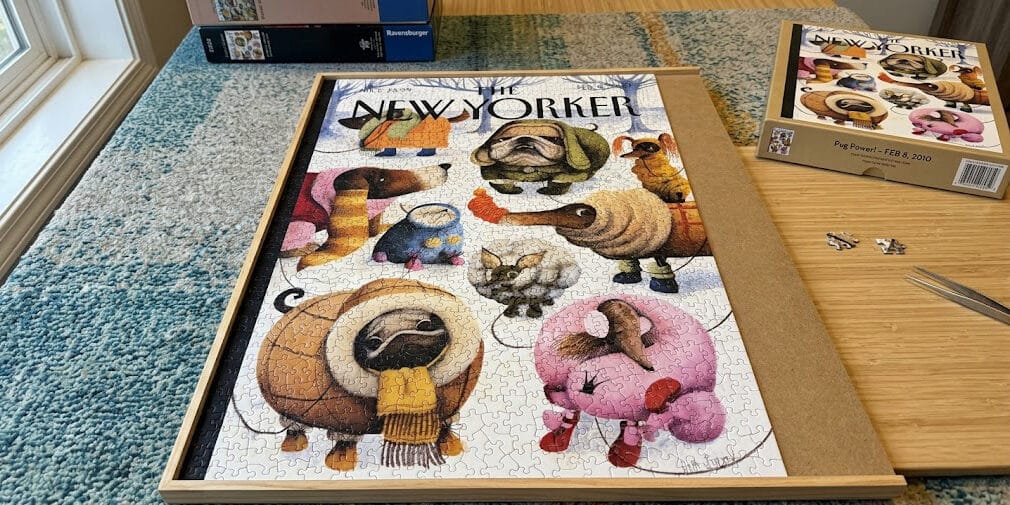
We’ve spent more evenings than we’d like to admit hunched over puzzle boards, sorting edge pieces under lamp light, and debating whether that particular shade of grey belongs to a cobblestone street or a winter coat. After working through dozens of New York Puzzle Company (NYPC) releases — including their iconic New Yorker magazine editions, fine art collaborations, and vintage illustration titles — we’ve put together this guide to help you figure out which 1000-piece puzzles are genuinely worth your time, and which ones might frustrate more than they reward.
See all New York Puzzle Company 1000-piece puzzles on Amazon
Why New York Puzzle Company Tends to Stand Apart
Before we get into individual picks, it helps to understand what makes NYPC puzzles feel different from the sea of mass-market options out there.
For starters, the company makes all of its puzzles right here in the USA — printed, cut, and boxed domestically, which matters both for quality control and for those who prefer to support American manufacturing. According to NYPC’s own product page, their pieces are made from 100% recycled 80-point chipboard — a thickness that’s roughly 20% higher than most industry-standard puzzles. That extra density translates to pieces that feel substantial in your hand and hold their shape through repeated use.
Since 2014, they’ve also applied a linen-style paper finish to all puzzles, which does two things most puzzlers genuinely appreciate: it cuts down on glare under artificial lighting, and it gives the pieces a soft, almost matte texture that feels satisfying to handle. On top of that, NYPC is a proud member of 1% for the Planet, donating 1% of every sale to environmental nonprofits. It’s a small thing, maybe, but it’s the kind of detail that makes buying a puzzle feel a little less frivolous.
The artwork is, of course, the main draw. NYPC’s New Yorker collection pulls from nearly a century of magazine covers — images that carry genuine wit, cultural weight, and visual complexity. These aren’t random stock illustrations. They’re works of art by celebrated illustrators, and that tends to show in how engaging the puzzling experience actually is.
New York Puzzle Company 1000-Piece Jigsaw Puzzles We Recommend
✅ We recommend these products based on an intensive research process that’s designed to cut through the noise and find the top products in this space. Guided by experts, we spend hours looking into the factors that matter to bring you these selections.
⭐ 2.5 million+ people assisted in the last 30 days ⭐
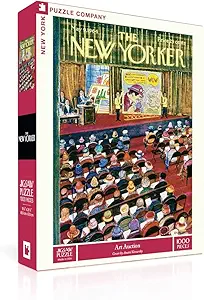
If there’s one puzzle in this lineup that genuinely surprised our team, it was the Art Auction. On the surface, it reads as a classic New Yorker scene: a crowded auction room populated with well-dressed figures, dramatic lighting, and the kind of deadpan social observation the magazine has always done so well. But the moment you tip the pieces out of the box and start to sort, you realize just how cleverly the image works as a puzzle. The dense crowd means almost every piece contains a fragment of a figure — a jacket lapel here, a bidding hand there — and the varied lighting across the room creates natural zones that guide your progress without making things too easy. Our testers found the mid-section genuinely absorbing, with just enough visual complexity to keep you thinking but enough structure to keep you from getting lost. The linen finish holds up beautifully under warm lamp light, and the piece fit is satisfying and snug throughout. This one suits puzzlers who enjoy figural scenes with lots of subtle storytelling buried in the details — and who don’t mind spending a few focused evenings on a single image.
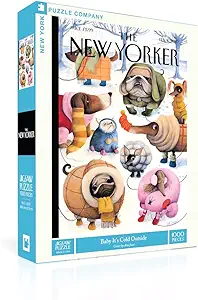
There’s something deeply comforting about this puzzle — and that’s probably the point. The Baby It’s Cold Outside cover captures that particular New York winter feeling: bundled-up pedestrians, the icy blue-grey of a city street in December, and a warmth that somehow radiates despite all the cold tones in the image. What struck our team most was how well this puzzle works as a seasonal ritual. Several of our testers mentioned that they’d brought this one out specifically to do over a few winter evenings with family, and that the image itself — festive without being overwrought — made it genuinely enjoyable to live with on the table for a week or more. Difficulty-wise, it sits solidly in the intermediate range. The cool color palette means the sky and street sections require patience, but the figures and storefronts provide enough variety to keep the process moving. It also happens to be one of the more giftable options in this list — the kind of puzzle that looks handsome under a tree and holds genuine appeal for a wide range of ages and skill levels.
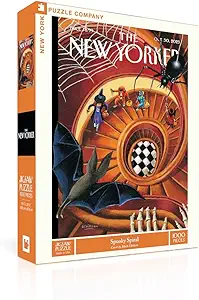
This one is a genuinely clever puzzle — and not just thematically. The Spooky Spiral cover wraps a Halloween scene into a swirling, circular composition that plays tricks on your spatial perception even before you’ve sorted a single piece. When our team first opened the box, there was a collective pause as everyone tried to figure out where to begin. That’s actually a sign of a well-chosen puzzle image: it creates just enough disorientation to make the solving process feel like a real puzzle, not just a matching exercise. The Halloween motifs — bats, jack-o-lanterns, costumed figures — are rendered in NYPC’s characteristically rich print quality, and the deep oranges and purples hold their saturation beautifully on the linen-finish paper. This is a puzzle we’d specifically recommend for October, ideally with some atmospheric lighting and a hot drink nearby. It’s also a strong pick for intermediate puzzlers who want to push themselves a little — the spiral composition breaks most standard sorting strategies, which makes it more engaging than a conventionally composed image of similar complexity.
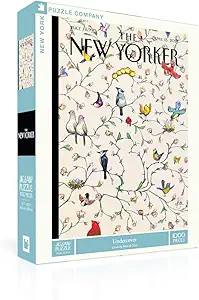
The Undercover puzzle is one of those images that rewards close attention — and it keeps rewarding you the longer you work on it. At first glance, it reads as a bookshop or library scene, but the longer you look, the more details emerge: hidden figures, layered visual jokes, and the kind of illustrative density that makes New Yorker covers so satisfying to spend time with. Our testing team found this one particularly strong for solo sessions. Unlike some of the more socially oriented puzzles in this lineup, Undercover has a quiet, immersive quality that suits an evening alone with a podcast or some background music. The varied color palette — warm wood tones, jewel-toned book spines, pockets of light and shadow — means there are clear visual anchors throughout, which keeps the solve from feeling stalled even in the denser sections. Piece quality is consistent with NYPC’s standard: firm chipboard, clean cuts, and a snug interlocking fit that lets you build with confidence. For anyone who loves books, libraries, or the pleasures of a well-stocked independent bookshop, this puzzle has a kind of soulful quality that’s hard to quantify but easy to feel.
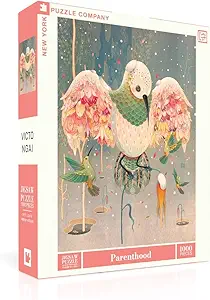
This is probably the most visually striking puzzle in this entire roundup — and possibly the most emotionally resonant. Victo Ngai is one of contemporary illustration’s most celebrated voices, known for her intricate, layered compositions that blend Eastern and Western visual traditions into something entirely her own. The Parenthood image is a tour de force: densely packed with symbolic imagery, rich color, and a level of detail that reveals new elements even after the puzzle is complete. Our team found this one genuinely challenging in the best possible way. Because the image is so complex and the color palette so varied, conventional sorting strategies — by color, by edge, by major element — all need to be used in combination. You can’t just work your way through it methodically; you have to stay curious and flexible. The payoff, though, is substantial. When the puzzle is finished, and you step back to take it in, the full composition lands with real emotional weight. This is the one in our lineup that our testers most wanted to frame and keep. It suits experienced puzzlers with an appreciation for contemporary illustration and a willingness to sit with something complex and gradually beautiful.
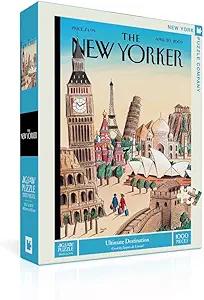
The Ultimate Destination is a puzzle that earns its name through sheer visual ambition. The image — a sprawling, bird’s-eye view of a city teeming with activity — gives you a lot to work with and a lot to navigate. It’s the kind of image that initially feels overwhelming but quickly reveals an internal logic as you sort and build. What we noticed most during testing was how naturally this puzzle facilitates conversation. It’s genuinely fun to do in a group, partly because the busy scene gives everyone something to hunt for, and partly because the image itself is so layered with detail that two people can look at the same section and notice completely different things. The NYPC linen finish performs particularly well here — the reduction in glare makes it easier to distinguish subtle tonal shifts in a busy composition when you’re working under indoor lighting. For couples, families, or small groups who want a puzzle that holds up over multiple sessions without becoming repetitive, this is a strong choice. It also photographs beautifully when complete, if that’s relevant to you.
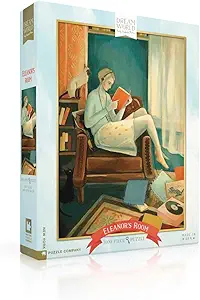
Eleanor’s Room is a bit of a departure from the New Yorker covers, and it’s all the better for it. Part of NYPC’s Dream World collection, this puzzle features an impossibly detailed, whimsical interior scene — the kind of room that seems to exist just outside the edges of reality, filled with fantastical objects, warm light, and a deeply cozy atmosphere. The moment we tipped this one out on the table, the reaction from our team was immediate and unanimous: everyone wanted to find their piece and place it. That quality — the puzzle that makes you want to sit down and work on it — is harder to achieve than it sounds, and Eleanor’s Room has it in abundance. The image rewards methodical puzzlers (there are distinct zones to work through) while also offering enough interconnection between sections to keep things interesting. The color palette leans warm — golds, deep reds, soft greens — and the print quality captures the painterly quality of the original illustration beautifully. This is an ideal pick for anyone who loves illustrated interior scenes, maximalist art, or simply wants a puzzle that feels like stepping into a story.
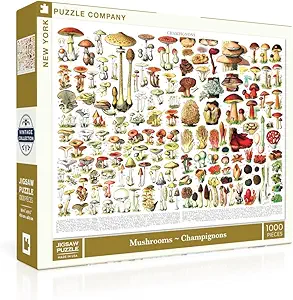
This is the puzzle for the nature lovers, the foragers, the cottagecore enthusiasts, and anyone who has ever found themselves genuinely delighted by a beautifully rendered botanical illustration. The Mushrooms ~ Champignons puzzle draws from the rich tradition of vintage natural history illustration — the kind of meticulous, scientific-meets-artistic imagery that graced 19th-century field guides and still looks stunning today. Our team found this one particularly satisfying from a purely tactile standpoint. Because the image is organized around distinct mushroom specimens set against a cream background, there’s a wonderful clarity to the sorting process — each specimen becomes its own small sub-puzzle, and assembling them individually before connecting them to the whole creates a genuinely rewarding rhythm. It’s also a puzzle that holds up beautifully once completed: the vintage illustration style lends it a timeless quality, making it an excellent candidate for framing. If you’re shopping for someone who loves nature, illustration history, or simply appreciates a quieter, more contemplative puzzle experience, this one consistently earns our team’s highest marks.
What to Know Before Buying a 1000-Piece Puzzle
Difficulty Isn’t Always About Piece Count
A 1000-piece puzzle can range from manageable to genuinely humbling, depending on the image. Color variety, contrast, and the number of distinct visual zones all affect difficulty far more than piece count alone. Puzzles with large areas of a single color — a grey winter sky, say, or a dense crowd of similarly-dressed figures — will take considerably longer than a busy, colorful scene with lots of visual anchors.
If you’re newer to 1000-piece puzzles, look for images with strong contrast and a variety of distinct sections. Experienced puzzlers who want a real challenge should lean toward images with subtle tonal shifts and complex patterns.
Piece Cut Matters More Than You’d Think
NYPC uses a random die-cut technique, meaning pieces don’t follow a uniform grid pattern. This is generally a plus — it reduces the likelihood of false fits and makes the solving process feel more organic. That said, it also means you can’t rely on shape alone to confirm a placement. You’ll need the image to guide you, which keeps you engaged with the artwork throughout.
Finished Size and Storage
Most NYPC 1000-piece puzzles assemble to approximately 19.25 x 26.625 inches. That’s a standard finished size that fits comfortably on most dining tables or dedicated puzzle boards. If you plan to frame your completed puzzle, this is also a size that many standard poster frames can accommodate — a nice bonus for the puzzles with particularly striking artwork.
How These Puzzles Compare to the Competition
NYPC occupies a specific, well-defined niche in the puzzle market — and it’s worth being clear about what that niche is. These are art-forward puzzles that prioritize image quality and cultural relevance over pure difficulty or gimmickry. If you’re after an extremely challenging puzzle experience with intentionally tricky cut patterns, companies like Ravensburger might suit you better. If you want a photorealistic landscape puzzle with hyper-detailed imagery, that’s not really NYPC’s territory.
But if you want a puzzle that feels like spending time with a piece of art — something that’s engaging without being punishing, and that leaves you with something genuinely beautiful when it’s done — NYPC tends to deliver consistently.
The price point for most 1000-piece NYPC puzzles runs roughly in the $20–$35 range, depending on retailer and current availability, which positions them comfortably in the mid-premium tier. That’s more than a basic mass-market puzzle, but generally less than boutique wooden puzzle options. For the material quality and the caliber of the artwork, we find that pricing is fair.
Things to Consider Before You Buy
Difficulty level: As mentioned above, NYPC puzzles vary considerably in difficulty based on image composition rather than piece count. The Victo Ngai Parenthood and Spooky Spiral puzzles tend to run harder; Baby It’s Cold Outside and Mushrooms ~ Champignons tend to be more manageable, though still genuinely engaging.
Audience: Most of these puzzles are designed with adult puzzlers in mind. The suggested age on NYPC’s 1000-piece range is generally 12 and up, though many of these images — particularly the more detailed New Yorker covers — are really at their best when enjoyed by adults who can appreciate the illustrative wit and cultural references embedded in the artwork.
Gifting: Nearly every puzzle in this list makes a strong gift, particularly for people who appreciate art, culture, or the simple pleasure of a quiet hobby. The New Yorker covers in particular tend to land well with people who already have a connection to the magazine.
Sustainability: If environmental impact factors into your purchasing decisions, NYPC’s commitment to recycled chipboard, soy-based inks, and 1% for the Planet giving makes them one of the more conscientious options in the mainstream puzzle market.
Tips for Getting the Most Out of a NYPC 1000-Piece Puzzle
Start with the edges, but don’t stop there. The random die-cut means edge pieces can sometimes look deceptively like interior pieces. Sort carefully, and don’t assume a straight edge on one side automatically means it’s a border piece.
Use good lighting. The linen finish significantly reduces glare, but a warm, directional light source — a desk lamp or an angled floor lamp — still makes color distinction much easier than overhead fluorescents.
Take your time with the image. NYPC puzzles reward puzzlers who study the reference image before and during the solve. Many of the most satisfying placements come from recognizing a specific detail in the artwork, not just matching shapes.
Consider a puzzle mat or board. If you’re working on a puzzle over multiple sessions, a roll-up mat or dedicated puzzle board lets you store and transport the in-progress puzzle without disturbing your work. This is especially useful for the more ambitious images in this list. Our puzzle accessories guide (internal link) covers several options at different price points.
The Bottom Line
New York Puzzle Company makes puzzles that tend to be genuinely worth the time you invest in them — and that’s not a given in a market full of mediocre options. The combination of high-quality materials, American manufacturing, thoughtful artwork curation, and environmental responsibility gives NYPC a meaningful edge over many competitors in a similar price range.
From the visual storytelling of the New Yorker Art Auction to the intricate beauty of Victo Ngai’s Parenthood, and from the cozy immersion of Eleanor’s Room to the quiet satisfaction of the Mushrooms ~ Champignons botanical prints, there’s enough variety in this lineup to suit a wide range of tastes and skill levels. None of these puzzles is perfect for every puzzler — the right choice really does depend on your personal taste, your experience level, and the kind of puzzling experience you’re after. But all of them are worth your consideration.