Advertiser Disclosure
We independently review everything we recommend. When you buy through our links, we may earn a commission.
Rravensburger 5000 Piece Jigsaw Puzzles: Extreme Challenge
Ravensburger is one of our favorite brands for high-quality jigsaw puzzles. We’ve spent considerable time on our team working through Ravensburger’s 5,000-piece lineup, and we’ll be upfront about something right away: these puzzles are genuinely hard. Not impossible, not gimmicky hard — legitimately challenging in the way that a long hiking trail is challenging. You’ll probably want to quit somewhere around piece 1,200. You likely won’t. And when you finish, the feeling is unlike anything a smaller puzzle can give you.
Ravensburger has been making puzzles since 1883, and the German manufacturer’s reputation for print quality and piece precision is well-earned. Their 5,000-piece puzzles specifically use what they call “linen-finish” printing, which reduces glare and makes extended sorting sessions easier on the eyes. The pieces are thick, they fit together with a satisfying firmness, and the images are reproduced with a clarity that holds up even when you’re staring at a 4.5-square-foot finished image from a foot away.
What Makes Ravensburger 5,000-Piece Puzzles Different?
Before we get into specific picks, it helps to understand what separates this tier from a standard puzzle purchase.
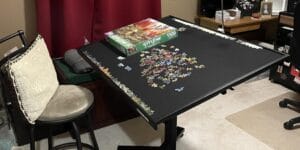
Scale alone changes everything. A finished Ravensburger 5,000-piece puzzle measures approximately 153 × 101 cm (about 60 × 40 inches). You need a dedicated surface — most standard dining tables won’t accommodate the full footprint. Many serious puzzlers work in sections on multiple boards or invest in a puzzle mat that can be rolled up between sessions.
Print quality becomes more important at this size. Ravensburger prints its 5,000-piece images at a resolution that holds detail across the full assembled image. You’ll notice this particularly in subjects like maps, paintings, and collages where fine text or intricate line work needs to remain legible even at puzzle-piece scale.
Piece variation is noticeably more nuanced. Ravensburger uses a wider variety of piece shapes at this count, which reduces the frustration of pieces that look like they should fit together but don’t. That said, 5,000-piece puzzles still present significant challenges in sections with low color variation — and that’s genuinely part of the appeal.
Assembly time is significant. Depending on experience level and daily session length, most puzzlers in our team found these take anywhere from 3 to 8 weeks to complete when working in regular, focused sessions. Budget your table time accordingly.
Ravensburger 5,000-Piece Puzzles We Recommend
✅ We recommend these products based on an intensive research process that’s designed to cut through the noise and find the top products in this space. Guided by experts, we spend hours looking into the factors that matter to bring you these selections.
⭐ 2.5 million+ people assisted in the last 30 days ⭐
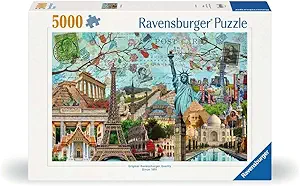
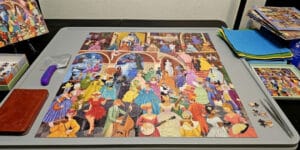
If you’ve ever wanted a puzzle that genuinely rewards your attention to detail, the Big City Collage delivers in a way that surprised even our most experienced tester. The image is a densely layered collage of iconic city photography — skyscrapers, street scenes, famous landmarks, and architectural details all compressed into a vibrant, high-energy mosaic. What makes this one so engaging is that no single section of the puzzle looks like another. You get sharp blacks and cool greys in the steel-and-glass sections, warm ochres and terracottas in the older European streetscapes, and vivid pops of color scattered throughout in neon signage and taxi cabs. Our tester, who has completed more than a dozen large-format puzzles, said the Big City Collage felt like “working on five puzzles at once in the best possible way.” The variety of visual textures genuinely keeps boredom at bay through the long middle stretch, and the finished image is striking enough to display. This one tends to suit puzzlers who enjoy visual busyness and strong contrasts — if you like puzzles where you can always find a foothold in a new section, this is an excellent choice. The only trade-off is that the sheer density of imagery can make the final 200–300 pieces feel surprisingly tricky, since almost any piece could plausibly fit in several spots at first glance.
Best for: Experienced puzzlers who enjoy busy, collage-style images and want a puzzle they can genuinely display afterward.
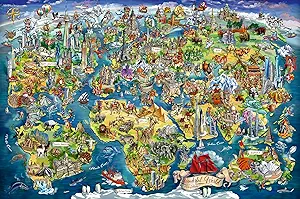
Few puzzles in our experience have the educational appeal and visual richness of the Ravensburger World Map. This is not your standard classroom map — it’s a richly illustrated antique-style cartographic image packed with illustrated sea creatures, compass roses, ship drawings, and decorative borders that make assembly feel like a kind of slow-motion geographical exploration. We spent a full afternoon just on the Atlantic Ocean section, which sounds tedious but was genuinely absorbing. The color palette is warm and varied — deep navy oceans that shift to teal near coastlines, golden landmasses, and the kind of illustrated detail that made old maps feel like art. What particularly impressed us was how Ravensburger handles the text on this puzzle: country names, city labels, and cartographic notations all remain legible in the finished image, which speaks to the print quality at this scale. The map layout also provides a natural organizational framework — you can work continent by continent, border by border, ocean by ocean — which many puzzlers find psychologically helpful for managing a project this size. The challenge level is significant in the open ocean sections, where color variation drops sharply. But honestly, working through that section slowly is part of the meditative appeal of a puzzle like this.
Best for: Geography enthusiasts, history buffs, and puzzlers who appreciate a natural organizational structure that makes the project feel manageable.
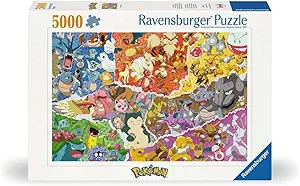
We’ll admit our team had some gentle skepticism about this one going in — and we were wrong to have it. The Ravensburger Pokémon 5,000-piece puzzle is a legitimately impressive product that appeals well beyond the obvious demographic of younger puzzlers. The image packs hundreds of Pokémon characters into a dense, colorful composition that reads almost like a “Where’s Waldo” experience. Every sorting session turns into a mini treasure hunt: spotting Pikachu near the upper right, finding the Legendary birds tucked near the corners, tracking down the original 151 alongside newer generations. Our youngest tester (a 16-year-old with growing puzzle experience) worked through this one with noticeably more sustained enthusiasm than any other puzzle we tested — the recognizability of the characters acted as a kind of constant positive feedback during assembly, rewarding each piece placed with a small moment of identification. That said, the color density is genuinely challenging in sections where similar-hued Pokémon cluster together. The image is busy in a way that demands good lighting and patience. For a family project, though, this may actually be the most fun option on this list — multiple people can work simultaneously on recognizable characters without much coordination needed.
Best for: Pokémon fans of any age, family puzzle projects, and anyone who benefits from recognizable imagery to stay motivated through a long build.
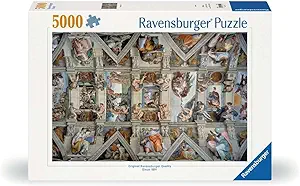
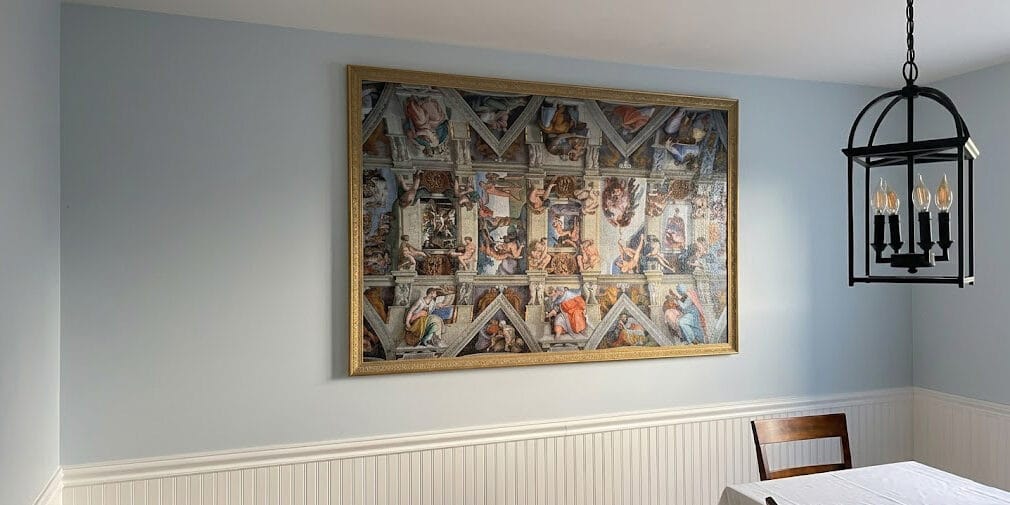
Of all the puzzles we tested, the Ravensburger Sistine Chapel generated the most consistent awe when finished — and the most intense frustration during assembly. Michelangelo’s ceiling is reproduced with extraordinary fidelity here: the deep umbers and terracottas of the architectural framing, the luminous skin tones of the figures, the complex foreshortening in the central panels. Working on this puzzle genuinely feels like spending time inside one of the world’s great works of art, which sounds grandiose but is honestly accurate. What makes it uniquely challenging, though, is that large sections of the ceiling share very similar tonal values — the architectural framework, in particular, presents long stretches of warm grey-brown that require careful attention to piece shape rather than color matching. Our most experienced tester found the ceiling spandrels and the lunettes nearly as difficult as any puzzle section he’d encountered. He also found them the most satisfying to complete. The finished puzzle, once assembled and (ideally) mounted, is genuinely gallery-worthy. If you’re buying this for someone, it’s worth pairing it with a puzzle mat or dedicated table — this is a commitment, and it deserves the right conditions.
Best for: Art lovers, serious puzzle hobbyists, and anyone looking for a long-term project that produces a display-worthy result.
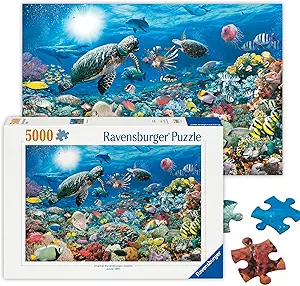
The Beneath the Sea puzzle earns a quiet kind of admiration that sneaks up on you. The image is a sweeping underwater scene — coral reefs in vivid oranges and pinks, schools of tropical fish in blues and yellows, rays gliding through the mid-water column, and the deep indigo fade of open ocean in the background. Ravensburger’s color printing genuinely shines here: the gradation from sunlit shallow reef to darker depths is smooth and nuanced in a way that rewards careful assembly. What we found particularly interesting during testing was how this puzzle changes difficulty as you progress. The reef sections are busy and colorful, giving you strong visual anchors early on. The open water and deep-sea sections — which make up roughly a third of the image — are substantially more challenging, with subtle blue-green gradients that require close attention. One tester described it as “learning a new language halfway through,” which is a good description of the experience. The finished image has a serene, almost meditative quality that sets it apart from the busier options on this list. If you’re someone who finds calmness in puzzles rather than stimulation, this one tends to deliver that in abundance.
Best for: Nature lovers, ocean enthusiasts, and puzzlers who prefer a calmer, more meditative assembly experience with beautiful, organic imagery.
Frequently Asked Questions About Ravensburger 5,000-Piece Puzzles
How long does it actually take to complete a 5,000-piece puzzle?
Honestly, this varies more than most guides admit. In our experience, a dedicated solo puzzler working one to two hours a day can generally expect to spend four to eight weeks on a Ravensburger 5,000-piece puzzle. Factors that significantly affect this include the image’s color diversity (more variety = faster progress), the number of people working simultaneously, and whether you work in concentrated sessions or scattered, short ones. We’ve found that longer, focused sessions tend to produce better progress per hour — there’s a meaningful warm-up period when you’re re-familiarizing yourself with which section you’re working on.
Do I need a special table for a 5,000-piece puzzle?
In most cases, yes. The finished dimensions of approximately 153 × 101 cm exceed standard dining table sizes. Your options include a dedicated puzzle board (several manufacturers make large-format foam boards with sorting trays), a portable folding table set up specifically for the project, or a puzzle mat that rolls up for storage. The puzzle mat approach works well if you’re limited on permanent space — you sort and build on the mat, roll it carefully when you need the surface, and unroll to continue. Just be aware that rolling and unrolling consistently does add some wear risk for pieces near the edges.
Are Ravensburger 5,000-piece puzzles suitable for beginners?
We’d generally suggest building up to this size. If you’ve completed several 1,000-piece puzzles with reasonable comfort, you can likely tackle a 5,000-piece puzzle with patience and the right organizational approach. The jump from 1,000 to 5,000 is substantial — this is roughly five times as many pieces, which multiplies the sorting time significantly. Edge pieces alone on a 5,000-piece puzzle number around 280–300. Starting with a 2,000-piece or 3,000-piece puzzle first tends to build the spatial reasoning and sorting habits that make a 5,000-piece assembly feel more manageable.
What’s the best way to organize and sort 5,000 pieces?
Most experienced puzzlers use a multi-stage sorting approach. First, separate edge pieces from interior pieces. Then sort interior pieces by color family or image section — this works best when you have a good reference copy of the box image nearby. Some puzzlers use sorting trays (available from most puzzle suppliers); others use shallow plates or bowls from the kitchen. The key habit we’ve found most valuable is sorting by section rather than by color alone — identifying which part of the image you’re going to build next and pulling only those pieces out, which keeps the visual field manageable.
How should I store or preserve a completed 5,000-piece puzzle?
If you plan to display the finished puzzle, puzzle glue (applied in thin coats, allowing full drying between layers) provides a solid mount that can then be framed or attached to a backing board. If you want to preserve it without permanently committing, leave it assembled on a board and store it flat. Attempting to break it apart and re-box it generally works for the first two or three completions, but pieces inevitably show wear at the interlocking points over repeated disassembly.
Is there a meaningful difference in difficulty between these five puzzles?
Yes, and it’s worth thinking about before you buy. In our assessment, the Sistine Chapel and Beneath the Sea present the greatest challenge due to large tonal sections with limited color variation. The Big City Collage and Pokémon puzzles are comparatively more accessible thanks to high visual variety across the image. The World Map falls somewhere in the middle — the illustrated oceans are moderately challenging, but the overall geographic structure gives you reliable organizational anchors throughout.
Quick Comparison: Which Puzzle Is Right for You?
| Puzzle | Difficulty | Best Audience | Visual Complexity |
|---|---|---|---|
| Big City Collage | ★★★★☆ | Experienced puzzlers | Very high |
| World Map | ★★★☆☆ | Geography/history fans | High |
| Pokémon | ★★★☆☆ | Fans, families | Very high |
| Sistine Chapel | ★★★★★ | Art lovers, serious hobbyists | High (tonally challenging) |
| Beneath the Sea | ★★★★☆ | Nature lovers, meditative puzzlers | Medium-high |
Tips Our Team Actually Uses for Large-Format Puzzle Assembly
Work section by section, not piece by piece. On a puzzle this size, trying to place individual pieces across the whole image quickly becomes exhausting. Identify a target section — a specific building, a single continent, a school of fish — and work only within that area until it’s substantially complete.
Good lighting is not optional. Under poor lighting, similar-colored pieces blur together in ways that slow assembly dramatically and cause placement errors you only discover later. A dedicated work lamp positioned to minimize glare makes a measurable difference.
Take photographs of your progress. This sounds like a minor habit, but it’s genuinely useful — both as a motivational record and as a reference if pieces get disturbed between sessions. Several of our team members now photograph before every roll-up or table clear.
Sort on paper, not directly on the work surface. Keeping your working space limited to the section you’re actively building — with sorted pieces on separate paper nearby — prevents the overwhelming feeling of 5,000 loose pieces spread across a table.
Expect the middle to feel slow. Almost every puzzler we’ve spoken to hits a psychological wall between roughly 20% and 60% completion on a 5,000-piece puzzle. It’s entirely normal. The finishing stretch, by contrast, tends to move surprisingly quickly.