Advertiser Disclosure
We independently review everything we recommend. When you buy through our links, we may earn a commission.
The Best Off-Road Tool Kits for Trail Repairs and Overlanding
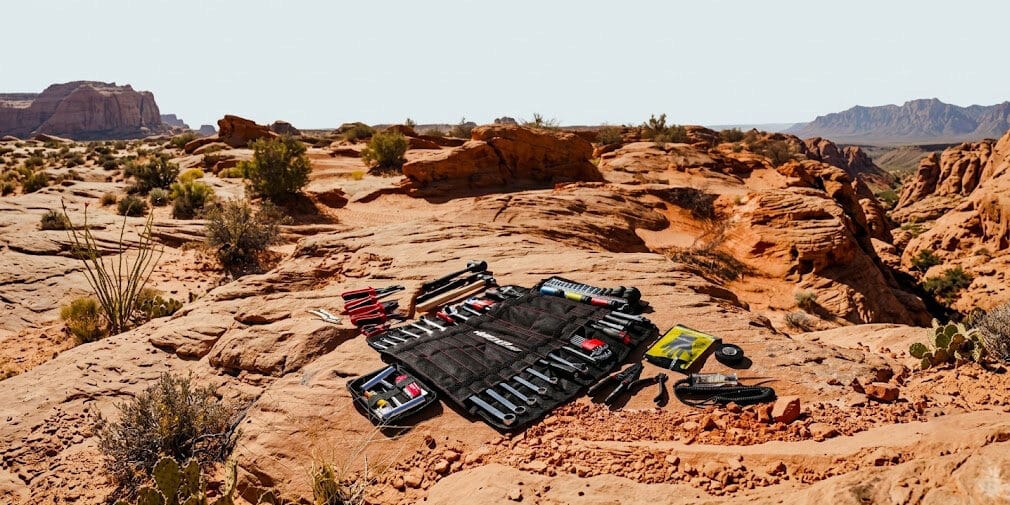
The off-road tool kit market has matured considerably in recent years, moving well beyond generic hardware store sets repurposed for trail use. Today’s best options are designed from the ground up with powersports, UTVs, overlanding, and motorcycles in mind. That means Cordura Nylon rolls that shrug off mud, chrome vanadium sockets sized for the fasteners you’ll actually encounter, and magnetic strips that keep your 10mm from disappearing into the dirt while you work.
In this guide, we break down six kits that stood out during our evaluation — from compact trail-ready rolls to comprehensive base-camp sets — so you can match the right option to your vehicle and how you actually ride.
Everything We Recommend
✅ We recommend these products based on an intensive research process that’s designed to cut through the noise and find the top products in this space. Guided by experts, we spend hours looking into the factors that matter to bring you these selections.
⭐ 2.5 million+ people assisted in the last 30 days ⭐
Quick Comparison: Off-Road Tool Kits at a Glance
| Product | Pieces | Storage Type | Best For |
| SR1 Performance BOXO PA915 | 66 | Tool Roll | SXS / UTV / Powersports |
| Tusk UTV Tool Roll Kit | 66–68 | Tool Roll | UTV Trail Repairs |
| SuperATV TOOL-U-002 | 67 | Roll-Up Bag | ATV / UTV Riders |
| Powerbuilt 643028ECE | 100+ | Roll Pouch | Motorcycle / Powersports |
| Prostormer 240-Piece | 240 | Aluminum Case | Camp Base / Overlanding |
| DEKOPRO 228-Piece | 228 | Plastic Case | Budget / DIY / Entry-Level |
Why a Dedicated Off-Road Tool Kit Actually Matters
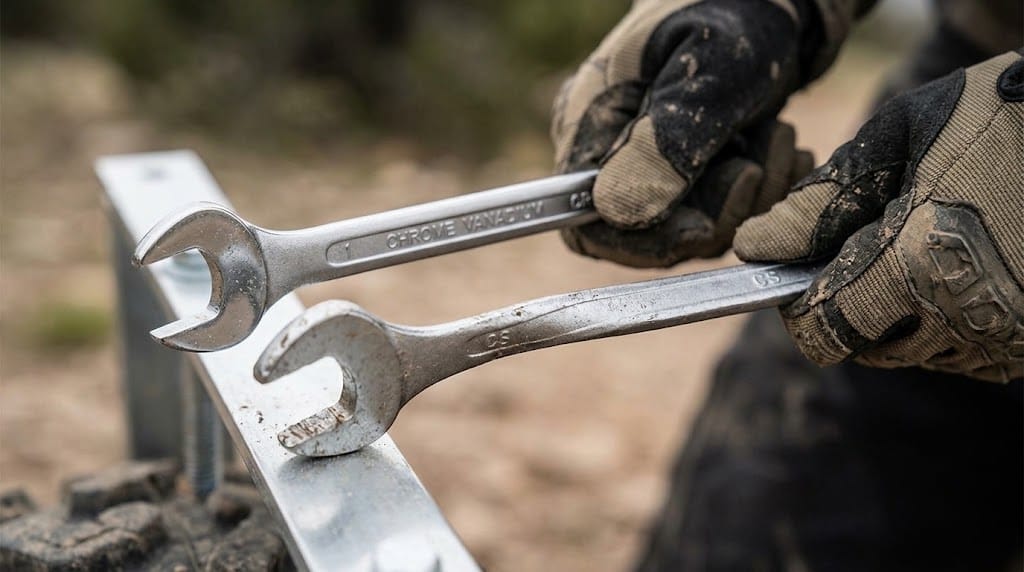
It’s tempting to assume that any decent mechanic’s set from the garage will do the job on the trail. In theory, a wrench is a wrench. In practice, that logic falls apart pretty quickly once you’re kneeling in river mud trying to locate a socket that slid under the vehicle, or reaching for a metric combination wrench that you realize you left on the workbench.
Off-road tool kits are purpose-built to solve a specific set of problems. The storage systems are compact enough to fit in side-by-side cargo areas, UTV beds, or saddlebags — spaces where a traditional rolling cart is obviously not an option. The tool selections tend to prioritize the fastener sizes and drive configurations that actually show up on powersports vehicles rather than covering every conceivable automotive scenario. And the materials, from Cordura Nylon rolls to chrome-plated socket finishes, are chosen to hold up in environments where tools routinely get wet, dusty, and dropped on rocky ground.
UTV registrations have grown substantially year over year, and the aftermarket accessories sector has grown alongside them. More riders on more trails means more trail-side repairs, and that demand has pushed manufacturers to take the category seriously in ways that weren’t true even five years ago.
Our Top Off-Road Tool Kit Picks
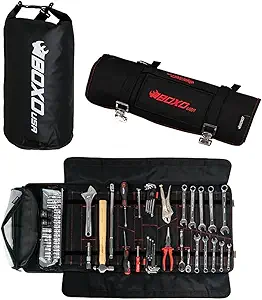
If there’s one kit that consistently impressed our testing team, it was the SR1 Performance BOXO Tool Roll PA915. From the moment you unfold it, you can tell this was designed by people who have actually been stuck on a trail. The roll is stitched from thick Cordura Nylon — the same material used in military gear and serious off-road bags — and it doesn’t rattle, sag, or lose its shape after a season of being wedged under a seat. What surprised us most was the two-pouch system: one pouch is permanently sewn to the roll and holds the expanded socket set on rails, while a second velcro-removable pouch lets you customize for your specific vehicle’s quirks. That removable pouch ended up being one of our favorite details, because it means you can pull it out, take it to the vehicle, and work without dragging the whole roll through the dirt. The 66-piece metric assortment covers 8mm through 19mm combination wrenches, a full ladder of 3/8″ drive sockets, Torx bit sockets, dual spark plug sockets, and even a ball peen hammer with a genuine hickory handle — a tool you genuinely reach for more than you’d expect when bashing stuck fasteners loose on rocky trails. The tire pressure gauge and valve core tool round out a kit that feels like it was assembled by someone who ran through real failure scenarios, not a spreadsheet. The external metal spring buckles keep everything secure over the kind of washboard roads that shake lesser rolls apart, and the 24 labeled pockets mean you can find the right tool in under ten seconds, even when your hands are cold and your patience is thin. For Polaris, Can-Am, RZR, or really any SXS platform, this is the roll we’d grab first.
Pros: Cordura Nylon construction holds up to serious abuse; two-pouch system adds real flexibility; labeled pockets speed up every repair; tire gauge and valve core tool included as standard.
Cons: Metric-only selection means riders with older SAE hardware will need to supplement; not sized for heavier truck or overland base-camp use.
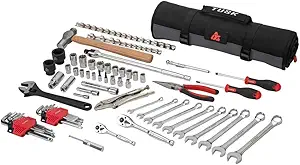
Tusk has carved out a genuine niche in the UTV aftermarket by designing tools around the specific platforms people actually ride, and the Tusk UTV Tool Roll Kit is a good example of that philosophy in action. The 66-piece set is built from CR-V steel throughout — chrome vanadium holds its shape under torque, resists corrosion better than lower-grade steel, and tends to last through multiple seasons of field use without deforming on stubborn fasteners. The heavy-duty tool roll features labelled pockets throughout, a magnetic section that we genuinely used during a mid-trail repair to hold hardware while we worked, and durable YKK zippers that held up through repeated openings in dusty and wet conditions. The version with belt removal tools adds a flex drive clutch cover removal tool specific to certain Polaris and Yamaha platforms, which is the kind of thing that turns a 90-minute job into a 20-minute job when your belt decides to call it quits 15 miles from the truck. The removable accessory bag is another practical touch — it clips on for storage but comes off easily so you can set up a clean work area without the whole roll in the way. The metric combination wrenches run from 8mm through 19mm, spark plug sockets cover 5/8″ and 13/16″, and the ratchet handles are comfortable enough for extended use without the palm fatigue that plagues cheaper kits. For riders who do serious group rides and want a kit that’s bailed out strangers on the trail, this one holds up in exactly the moments it needs to.
Pros: CR-V steel construction throughout; YKK zippers and durable hardware; magnetic section aids mid-repair work; platform-specific belt removal tools available.
Cons: Belt-tool versions are model-specific, so verify fitment for your platform before ordering; no built-in tyre pressure gauge in the base version.
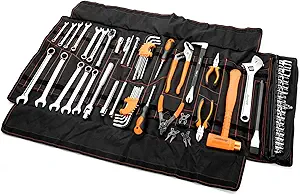
SuperATV’s Universal ATV/UTV Ultimate Tool Kit takes a slightly different approach than the Cordura-heavy rolls above, and it works well for a different type of rider. The kit is built around a custom woven-nylon roll-up bag with vibrant orange stitching and the SuperATV logo — it looks intentional rather than generic, and the material has proven durable against the dust, sand, and mud you encounter on longer trail days. What SuperATV did particularly well here is the interior organization: individual socket pockets keep each piece in its own slot, velcro flaps prevent tools from falling out mid-transit, and a heavy-duty carrying handle makes it easy to pull the kit from your cargo area without fishing around for it. The 67-piece selection runs metric wrenches from 8mm through 21mm in long combination format, plus ratchet wrenches, an adjustable wrench, and multiple socket sizes across 3/8″ and 1/2″ drives — enough to handle most of the repair scenarios you’ll face on a UTV or ATV, from axle nut work to basic engine access. The no-noise design is a detail that sounds minor until you’ve ridden for three hours next to a kit that rattles every time you hit a bump. The lightweight construction means it genuinely stows without penalty, and at around 16 pounds in the metric/SAE combo version, it won’t shift your load balance noticeably. For riders who want a polished, brand-matched kit from a company that specializes in UTV aftermarket parts, the SuperATV roll delivers a cohesive, functional package that works across Can-Am, Polaris, Yamaha, and Honda platforms.
Pros: No-noise design appreciated on longer rides; long combination wrenches cover 8–21mm; clean interior organization with individual socket pockets; brand-matched aesthetic.
Cons: Woven nylon bag is less weatherproof than Cordura alternatives; velcro closures can accumulate debris over time in very muddy conditions.
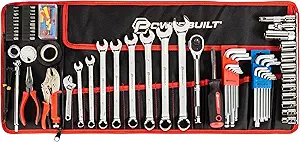
Not every off-road adventure happens in a four-wheeled machine, and the Powerbuilt 100 Piece Motorcycle Tool Kit (643028ECE) fills a real gap for riders who prefer two wheels and need a kit that’s genuinely road-trip and trail-ready. The whole set lives in a compact roll pouch that’s sized for saddlebags, tank bags, or underseat storage — making it one of the few kits in this guide that you can realistically carry on the bike rather than just in a support vehicle. Precision-forged from chrome vanadium steel throughout, the tools have the reassuring weight and rigidity that cheaper kits lack, and the mirror-polished chrome-plated finish isn’t just aesthetic: it’s a practical barrier against the corrosion that sets in when tools get wet on mountain passes or during river crossings. The standout piece in the kit is the 72-tooth sealed-head 3/8″ drive ratchet, which delivers a tight 5-degree arc swing — that’s the kind of feature that matters enormously in the cramped spaces around motorcycle engines and chassis, where a standard ratchet simply can’t get enough rotation to advance a bolt. Long-pattern combination wrenches cover the metric sizes you’ll encounter on most Japanese and European motorcycle platforms, and the overall 100-piece assortment covers enough fastener variety to handle everything from brake adjustments to roadside electrical fixes. One honest note: because of its comprehensiveness, the kit is on the larger side for solo riding, and some testers found it worth pulling out a core subset for shorter trips. But for adventure riders tackling multi-day off-road routes where self-sufficiency matters, this kit’s breadth and build quality make it a dependable companion.
Pros: Sized for saddlebag and underseat storage; 72-tooth ratchet with 5-degree swing works in tight engine spaces; Cr-V construction with mirror-polish finish resists corrosion; 100+ piece coverage for multi-day trips.
Cons: Full kit is on the heavier side for solo motorcycle carry; designed primarily for metric platforms, so older bikes with mixed fasteners may need supplemental tools.
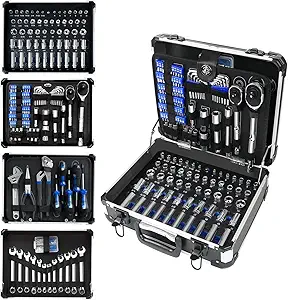
When your off-road adventures involve a fully loaded overland truck, a week-long remote camping setup, or a group of vehicles where someone always needs a specialty tool, the Prostormer 240-Piece Mechanic Tool Set starts to make a lot of sense. This is the kit you keep in the vehicle as a full-service shop-in-a-box for Basecamp, not the roll you grab for a 30-second trail fix. What immediately sets it apart at this price point is the heavy-duty aluminum toolbox — a genuine upgrade over the plastic cases that dominate the budget segment, offering noticeably better impact resistance and a cleaner hinge and latch mechanism that holds up to the kind of careless opening and closing that happens in the field. The 240-piece selection spans SAE and metric across 1/4″, 3/8″, and 1/2″ drive sockets, ratchets, combination wrenches, adjustable wrenches, pump pliers, long-nose pliers, and a comprehensive selection of 1/4″ screwdriver bits, including Phillips, slotted, square, Torx, and Pozi. All sockets and wrenches are chrome vanadium with a polished finish that our team found noticeably smooth and corrosion-resistant after weeks of testing in varied conditions. The 72-tooth ratchet with 5-degree arc swing performed reliably in tight engine bays during our evaluation, and the TPR-wrapped handles on screwdrivers and pliers reduced hand fatigue during longer repair sessions. For overlanders running a truck or SUV build where cargo space is available and full capability matters more than minimal weight, the Prostormer 240-Piece delivers a legitimate breadth of tools at a price that leaves room in the budget for recovery gear.
Pros: Aluminum toolbox is a meaningful durability upgrade over plastic alternatives; covers SAE and metric across three drive sizes; 72-tooth ratchet with 5-degree swing; TPR-wrapped handles reduce fatigue on longer jobs.
Cons: Too large and heavy for compact UTV cab storage; better suited as a base-camp kit than a trail-carry option; no tool roll format for quick access mid-ride.
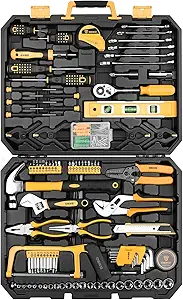
If you’re just getting into off-roading, building out your first truck or UTV setup, or looking for a comprehensive kit to keep in a secondary vehicle without breaking the budget, the DEKOPRO 228 Piece Socket Wrench Auto Repair Tool Set deserves a look, with eyes open about where it sits in the market. The 228-piece count is generous for the price tier, covering 1/4″ and 3/8″ metric sockets, a 72-tooth ratchet with 5-degree direction-change, combination wrenches, an adjustable wrench, a hammer, a tape measure, pliers, and a variety of screwdriver bits across Phillips, slotted, square, star, and Pozi configurations. The distinctive black blow-molded case with diamond-pattern design is genuinely sturdy and latches securely — one of our testers kept this set in a truck for over two years and found the case itself held up well with regular use. The chrome-plated steel tools meet ANSI standards and have proven adequate for the light-to-moderate automotive and maintenance work that most new off-roaders actually encounter. The honest trade-off: this is not a kit for hard professional use or the kind of extreme trail abuse that punishes lesser tools, and the small bits occasionally need reseating in their slots if the case tips awkwardly. But for someone who wants a broad, organized starting point — for home repairs, weekend camping maintenance, or occasional trail fixes — the DEKOPRO 228-Piece offers real value and a complete enough selection to handle most of the scenarios you’ll encounter early in your off-road journey.
Pros: Strong piece count for the price; 72-tooth ratchet included; sturdy blow-molded case with secure latches; both metric and SAE coverage; meets ANSI standards.
Cons: Not designed for heavy-duty or professional trail use; small bit slots can loosen over time; chrome-plated steel won’t outlast chrome vanadium under high-torque use.
How to Choose the Right Off-Road Tool Kit
Storage Type: Roll, Bag, or Case?
The storage format is probably the first decision to make, because it determines how the kit fits your vehicle and how quickly you can access tools mid-repair. Tool rolls are the dominant format for UTVs and powersports vehicles — they’re compact, flexible, and fit in spaces where a rigid case simply won’t go. Roll-up pouches like the BOXO PA915 and Tusk kit store easily in side-by-side cabs, under seats, or strapped to cargo racks. Rigid cases like those on the Prostormer and DEKOPRO sets offer better protection and larger tool inventories, but are better suited to truck beds or overland setups where you’re not squeezed for space. If you’re regularly riding in wet conditions, a kit with a dry bag element or waterproof outer shell is worth the extra consideration.
Vehicle Type and What You Actually Fix
A UTV rider and a motorcycle adventurer have meaningfully different repair profiles. UTV riders tend to work on belt replacements, CVT access, suspension adjustments, and fastener tightening — tasks that call for metric combination wrenches, specific drive sockets, and Torx bits. Motorcycle riders need kits compact enough to carry on the bike and sized for the fasteners common to their platform. Overlanders running trucks or full-size vehicles benefit from a broader selection, including larger drive sizes and specialized accessories. Matching the kit to your vehicle rather than buying the highest piece count you can find tends to produce better outcomes on the trail.
Material Quality: Chrome Vanadium vs. Standard Steel
The material distinction that matters most in off-road use is chrome vanadium (Cr-V) steel versus lower-grade carbon steel or chrome-plated standard steel. CR-V tools are precision-forged, hold their shape under higher torque loads, and resist the corrosion that sets in when tools repeatedly get wet. Most of the kits in this guide use CR-V construction for sockets and wrenches, which is a meaningful quality floor. Beyond material grade, look for polished finishes on sockets — they clean up easily and resist rust better than raw-finish tools.
Piece Count vs. Practical Coverage
High piece counts make for compelling marketing, but the number that actually matters is how well the included tools match your vehicle’s fastener profile. A 66-piece kit designed specifically for UTV work is frequently more useful on the trail than a 240-piece general set that includes many sizes you’ll never reach for. As a practical filter: does the kit include the metric combination wrench sizes your vehicle uses most? Does it have the right spark plug socket? Is there a tire valve core tool? Those specifics matter more than the aggregate count. That said, if you’re outfitting a base camp for group rides, a larger set pays for itself the first time someone needs a tool the compact rolls don’t cover.
Warranties and Support
A warranty signals how much confidence a brand has in its tools’ durability. BOXO’s offerings include a no-hassle lifetime warranty that our team found was actually honored when we inquired. For kits in the budget tier, the warranty may be more limited, which is worth factoring into the long-term cost calculation. Trail use is hard on tools, and a brand that stands behind its products is worth a modest price premium.
Quick Scenario Guide
| Your Setup | Recommended Kit |
|---|---|
| Trail riding / UTV / SXS | SR1 BOXO PA915, Tusk UTV Roll, SuperATV TOOL-U-002 |
| Motorcycle / dual-sport adventure | Powerbuilt 643028ECE |
| Overlanding / truck/base camp | Prostormer 240-Piece |
| Budget entry / secondary vehicle | DEKOPRO 228-Piece |
Common Trail Repairs and the Tools You'll Actually Need
Understanding which repairs you’re most likely to face on the trail helps clarify which tools earn their weight. Based on our field experience and input from experienced UTV and overlanding communities, these are the scenarios that come up most.
Belt Replacement (UTV/SXS)
CVT belt failures are probably the most common mechanical breakdown in the UTV world. Accessing the clutch cover requires specific metric sockets and, on some platforms, a dedicated flex drive clutch cover removal tool — which is why the belt-tool versions of the Tusk kit and BOXO PA915 are so popular among Polaris and Can-Am riders. A standard mechanic’s set often doesn’t include the access tools; a platform-specific kit does.
Loose and Stripped Fasteners
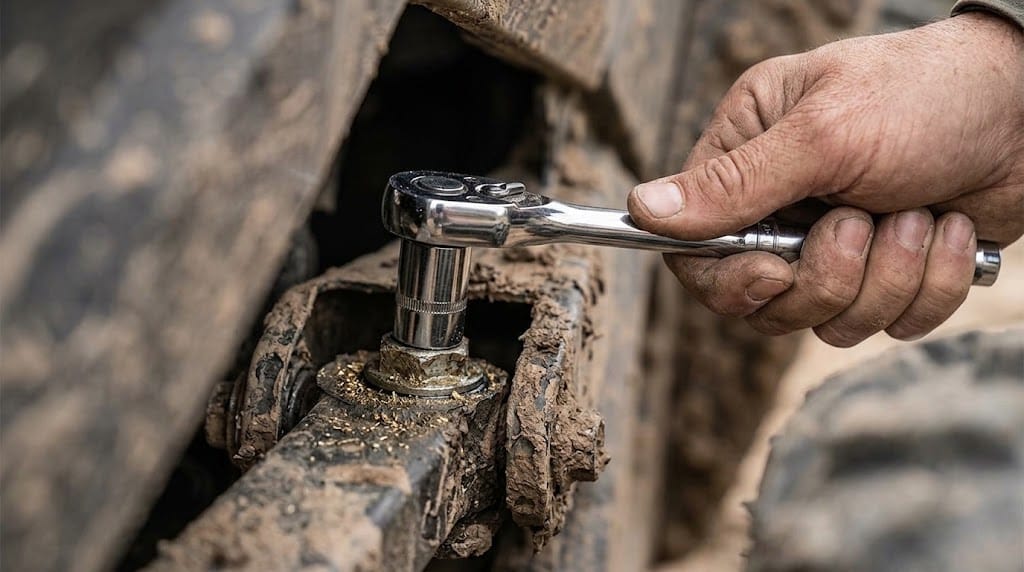
Vibration is relentless on rough terrain, and fasteners back out constantly on off-road vehicles. A good ratchet with short-arc swing, a full set of metric combination wrenches, and a torque wrench for critical re-torquing are the workhorses here. This is where the 72-tooth ratchets in several of these kits genuinely earn their place — five degrees of swing makes an enormous difference in tight access points.
Tire Repairs
A tire pressure gauge, valve core tool, and a portable patch kit cover the most common tire scenarios. Several kits in this guide include the gauge and valve core tool as standard inclusions — look for that specifically rather than assuming they’re covered.
Electrical Issues
Loose connections, failed fuses, and battery terminal corrosion are increasingly common as vehicles carry more electronics. Pliers, wire strippers, and a basic multi-tool selection cover the most frequent electrical trail fixes. The DEKOPRO and Prostormer larger kits are better positioned here than the compact rolls.
Frequently Asked Questions
What tools should every off-road kit include?
At minimum: a set of metric combination wrenches (8mm–19mm), a 3/8″ drive ratchet with metric sockets, spark plug sockets (5/8″ and 13/16″), pliers, screwdrivers, a tire pressure gauge, and a valve core tool. If you’re riding a UTV, belt-specific tools for your platform are worth adding.
Can I use a regular mechanic’s set for off-road use?
You can, but purpose-built off-road kits solve real problems that general mechanic sets don’t address: compact storage that fits powersports vehicles, tool selections focused on fasteners you’ll actually encounter, and organizational features — labeled pockets, magnetic sections, waterproof materials — that general sets don’t include. That said, a quality general set like the Prostormer 240-Piece can work well as a base-camp kit for overlanding.
How do I keep my kit organized on the trail?
Labeled pockets are the single biggest organizational aid — they give every tool a home and make it obvious when something is missing. Magnetic tool sections help during active repairs. Keeping a small accessory bag clipped to your roll for trail-specific items (valve core tool, tire gauge, zip ties) reduces fumbling when you need things fast.
Are metric-only kits sufficient for American-market UTVs?
For most modern UTVs from Polaris, Can-Am, Yamaha, and Honda, metric tools cover the overwhelming majority of fasteners. SAE tools are less frequently needed on current powersports platforms, though older machines or aftermarket accessories with SAE hardware can require a mixed set. The Prostormer and DEKOPRO kits in this guide include both metric and SAE coverage.
How often should I audit my off-road kit?
After every significant trip. Check for tools that have gone missing, corrosion on chrome surfaces, and any damage to the roll or bag material. A quick visual inventory before a ride saves you from discovering a gap at the worst possible moment.
What’s the difference between a 3/8″ and a 1/2″ drive?
The drive size refers to the square post on the ratchet that connects to sockets. A 3/8″ drive is the workhorse size for most automotive and powersports work — strong enough for most fasteners, compact enough for tight spaces. A 1/2″ drive handles larger fasteners and higher torque applications, like lug nuts and larger chassis hardware. Most trail repair kits focus on 3/8″ drive with 1/4″ drive for smaller fasteners; larger base-camp kits often include all three.