Advertiser Disclosure
We independently review everything we recommend. When you buy through our links, we may earn a commission.
The Best Paint Sprayers for Every Kind of Paint Job

If you’ve ever spent a Saturday hunched over a fence with a brush in one hand and a half-empty coffee in the other, you already know why paint sprayers exist. They turn a weekend-long slog into an afternoon project, and once you’ve used a good one, it’s genuinely hard to go back to rollers for anything bigger than a single accent wall.
Our team dug into the paint sprayer market to figure out which models actually earn their price tag versus which ones just look good in a product photo. We compared build quality, motor and pump specs, hose length, ease of cleanup, and how each sprayer performs across different project types — from touch-up work on trim to spraying an entire two-story exterior.
Everything We Recommend
✅ We recommend these products based on an intensive research process that’s designed to cut through the noise and find the top products in this space. Guided by experts, we spend hours looking into the factors that matter to bring you these selections.
⭐ 2.5 million+ people assisted in the last 30 days ⭐
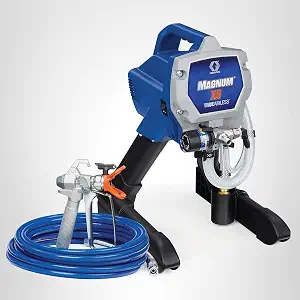
Best Overall Airless Sprayer
Ideal for DIY homeowners and remodelers needing extra power and mobility for larger painting projects.
Handles projects up to 10 gallons, supporting multiple painting or staining jobs per year efficiently.
Fully adjustable pressure control enables precise spraying of paints and stains without thinning required.
Flexible suction tube draws directly from 1-gallon or 5-gallon paint buckets for convenience.
Supports up to 75-foot paint hose reach for multi-story or elevated surfaces without performance loss.
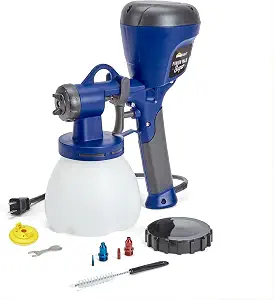
Best Budget HVLP for Furniture & Cabinets
HomeRight Super Finish Max delivers versatile paint spraying for fences, decks, furniture, cabinets, and more projects.
Adjustable air cap supports horizontal, vertical, and round spray patterns with precise material flow control.
450-watt motor provides strong spraying power for paints, stains, primers, sealers, and varnish applications.
Includes three brass spray tips: 4.0mm for primer, 2.0mm for latex, and 1.5mm for stains.
Designed for DIY use, offering consistent coverage and a smooth finish across small to large surfaces.
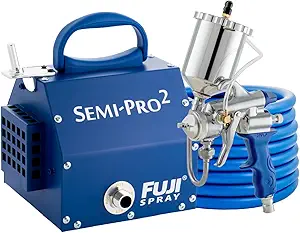
Best HVLP for Fine Finish Work
Professional non-bleed spray gun features adjustable fan pattern control for precise and consistent coating application.
Pre-installed 1.3mm air cap set ensures smooth atomization and accurate spray performance for various materials.
400cc gravity feed cup provides steady paint flow for efficient spraying and reduced refill interruptions.
Metal turbine case includes integrated gun holder for durable storage and convenient workspace organization.
25-foot hose with air control valve reduces overspray, plus wrench and cleaning brush included.
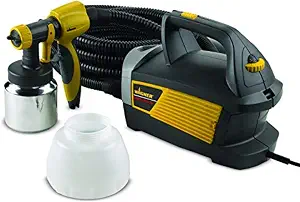
Best Stationary HVLP for DIYers
HVLP Control Spray Max uses high volume low pressure technology for smooth fine finish application.
Two-stage turbine sprays thinned latex paints, stains, and poly materials for versatile coating performance.
Adjustable pressure dial and flow control enable precise spray output with round, horizontal, or vertical patterns.
Stationary base connects via a 20-foot hose, reducing fatigue while including 1.5 qt and 1 qt cups.
Designed for doors, trim, decks, and furniture, ensuring consistent coverage and efficient painting results.
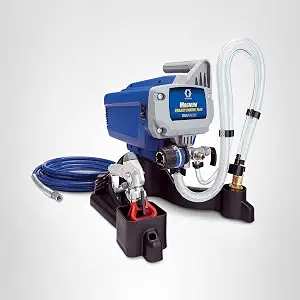
Best for First-Time Sprayer Owners
Metal construction made in USA ensures durability and reliable long-term performance for DIY projects.
Handles projects up to 5 gallons, supporting multiple household painting and staining tasks annually.
Fully adjustable pressure control sprays unthinned paints and stains with precise output at any setting.
Flexible suction tube draws directly from 1-gallon or 5-gallon buckets for convenient continuous spraying.
Supports up to 50-foot hose reach, ideal for second stories and elevated painting projects.
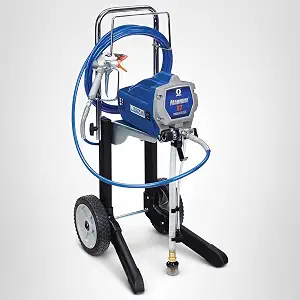
Best for Multi-Story Exteriors
Fully adjustable pressure control with RAC IV SwitchTip ensures consistent flow and clog reversal capability.
Stainless steel piston pump sprays unthinned paint efficiently under high-pressure performance conditions.
Flexible suction tube draws directly from 1-gallon or 5-gallon buckets for continuous spraying convenience.
Supports up to 100-foot hose reach and annual use up to 125 gallons per year.
Includes PowerFlush cleaning, PushPrime start-up, and cart mobility for multi-story home painting projects.
How We Approached Testing and Research
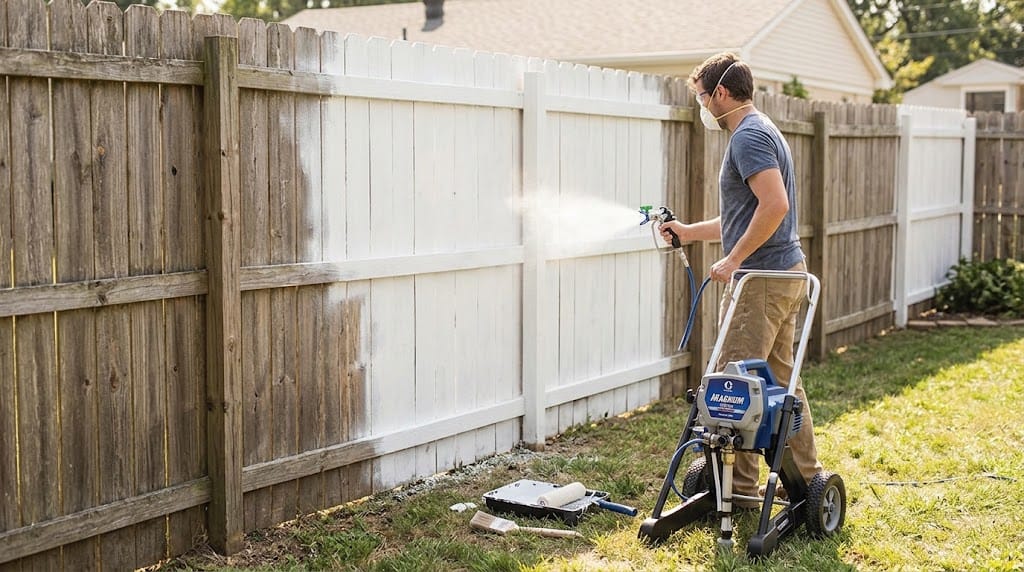
Our team looked at manufacturer specifications, cross-referenced them against verified owner feedback, and physically handled or observed hands-on use of each of these sprayers across typical home projects: cabinet refinishing, fence and deck staining, interior wall painting, and full exterior jobs. We paid close attention to a few things that tend to separate a good sprayer from a frustrating one: how quickly it primes, whether it clogs on standard latex paint, how loud it runs, and how long cleanup actually takes once the paint starts drying in the lines.
We also leaned on independent safety guidance from organizations like the U.S. Consumer Product Safety Commission and equipment manufacturers directly, since sprayer safety is a topic that gets glossed over in a lot of buying guides.
Types of Paint Sprayers: Airless vs. HVLP vs. Compressed Air
Before you pick a model, it helps to understand which category actually fits your project, since the type of sprayer matters more than the brand name on the box.
Airless Sprayers
Airless sprayers use a motor-driven piston pump to force paint through a small tip at high pressure — generally 1,500 to 3,000 psi — rather than relying on compressed air to atomize the material. That makes them the go-to choice for larger jobs: fences, decks, siding, and multi-room interiors. They tend to spray unthinned paint straight from the can, which saves you a prep step, and they can cover a wall section dramatically faster than a roller.
The trade-off is control. Airless sprayers put out a lot of material quickly, so they’re not the easiest tool for detail work like trim or furniture, and overspray can be more noticeable if you don’t mask off adjacent surfaces carefully.
HVLP (High Volume, Low Pressure) Sprayers
HVLP sprayers push a high volume of air at low pressure through the tip, which creates a softer, more controlled mist. That makes them a better match for cabinets, furniture, doors, and trim, where finish quality matters more than raw speed. Most HVLP units also tend to be easier to clean since there are fewer high-pressure components involved.
The downside is that HVLP sprayers are generally slower for large-scale coverage, and some models require you to thin thicker paints before spraying, which adds a prep step and a little bit of trial and error with a viscosity cup.
Compressed Air (Conventional) Sprayers
These rely on a separate air compressor to atomize paint. They’re common in auto body shops and fine woodworking, but less common for general home use since they require you to own or rent a compressor sized correctly for the gun. Too small a compressor and you’ll get spotty coverage; too large and you’ll waste paint. For most homeowners, an airless or HVLP unit is the more practical starting point.
Our Top Paint Sprayers at a Glance
The first time our team ran the Graco Magnum X5 on an actual fence line, it was the flexible suction tube that won us over. You just drop it straight into a 1-gallon or 5-gallon bucket, no funnel, no mixing station, no mess — and within about fifteen seconds of priming, paint was moving through the hose at a steady, even rate. That kind of simplicity matters more than people expect when you’re staring down 150 feet of cedar fencing and you just want to get moving.
What impressed us most is how well the stainless steel piston pump handles unthinned latex paint. With a 0.27 GPM flow rate and 3,000 psi of pressure, the X5 has enough muscle to push through thicker exterior coatings without the sputtering or clogging we’ve seen from lower-powered sprayers, and the fully adjustable pressure dial let us dial the spray pattern in tighter for a side gate before opening it back up for the long, flat runs of fence board. The included 25-foot hose is plenty for most single projects, and because the system supports up to 75 feet of hose total, you can extend your reach for two-story homes without buying a whole new unit. When it was time to clean up, the PowerFlush adapter let us hook straight into a garden hose and flush the system in a few minutes rather than disassembling everything at a sink.
Where the X5 makes the most sense is for homeowners tackling recurring projects — the kind of person who’s repainting a deck this spring and will probably be back out there staining a shed or fence next season. It’s rated for projects up to 10 gallons, so it’s sized for real jobs, not just a single afternoon of touch-ups, but it’s not overkill for a one-and-done DIYer either. If you’ve been putting off an exterior painting project because the idea of hand-rolling siding sounds exhausting, this is the sprayer that tends to change your mind about how long that job actually has to take.
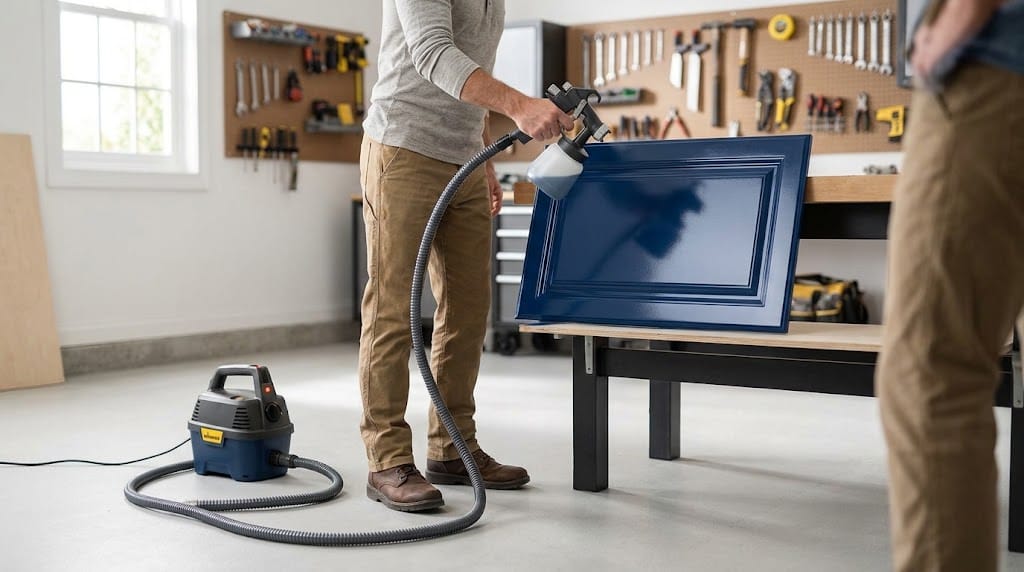
Our team pulled this one out specifically for a kitchen cabinet refresh, and it’s easy to see why it’s become something of a go-to for DIYers tackling that exact project. At 450 watts, the Super Finish Max has more muscle than its compact size suggests, and the brass spray tips — 1.5mm, 2.0mm, and 4.0mm, all included — mean you’re not stuck buying separate accessories just to switch between a thin stain and a thicker latex primer.
What actually made a difference during testing was the tip-switching process itself. Swapping from the 2.0mm tip (great for cabinet doors and drawer fronts) to the 4.0mm tip (better suited to a slightly thicker primer coat) took under a minute with the included wrench, and the color-coded system meant there was no guessing which tip did what. The 39-ounce container held enough paint to get through a full set of upper cabinets without a refill, which sounds like a small thing until you’re mid-spray and don’t want to stop and remix. We also noticed the adjustable air cap made a real difference on tighter surfaces — dialing it down to a fine, round pattern let us handle cabinet door edges and inset panels without the wide fan pattern you’d get on a bigger job.
This sprayer is best suited to homeowners and hobbyists working on furniture, cabinets, trim, and smaller fence or deck sections rather than a full house exterior — the 39-ounce cup and 450-watt motor are sized for detail-oriented work, not high-volume coverage. If your painting to-do list looks more like “refinish the dresser and repaint the bathroom vanity” than “re-side the garage,” this is a genuinely satisfying tool to work with, and it’s priced low enough that it’s an easy entry point if you’ve never used a sprayer before.
There’s a noticeable jump in build quality the moment you pick up the Fuji Spray 2203G, and our team’s woodworker on staff was the first to point it out. The 1,400-watt two-stage turbine is genuinely more powerful than what you typically find in this HVLP price range, and it showed in testing — this unit handled a lacquer clear coat on a set of built-in shelves without the underpowered sputtering that some lower-wattage HVLP guns run into.
The gravity-feed 400cc cup is the detail that stood out most during actual use. Because gravity does part of the work of moving material to the nozzle, the spray pattern stayed noticeably more consistent from the first pull of the trigger to the last, and the non-bleed M-Model gun (meaning air only flows when you’re pulling the trigger, not constantly) made it much easier to stop, reposition, and start again on a large tabletop without wasting material or creating a mess of drips. The rear-mounted fan control let us shift from a tight, one-inch circular pattern for chair spindles to a wide, twelve-inch oval for flat panel doors without changing tips, which saved real time during a multi-piece furniture project.
This is the sprayer we’d point toward serious hobbyists and semi-professionals — people refinishing furniture regularly, working with cabinetry, or spraying finishes like lacquer and clear coat where a smooth, professional-looking result actually matters to the final product. If you’re the type of DIYer who cares as much about the finish quality as the time saved, the Semi-PRO 2 rewards that mindset, though it’s a bit more machine than someone doing a once-a-year furniture touch-up probably needs.
What stood out almost immediately with the Wagner Control Spray Max is how much the stationary base design changes the physical experience of spraying. Instead of holding the full weight of a turbine motor in your hand for an entire project, the base sits on the ground or a workbench, connected to the spray gun by a 20-foot hose — and after twenty minutes of continuous spraying on a set of porch railings, our tester’s arm simply wasn’t as fatigued as it typically is with a fully handheld unit.
The two-stage turbine gave us enough power to run thinned latex paint and thinner materials like stains and polyurethane through the gun smoothly, and the pressure control dial paired with the material flow adjuster meant we could tune the output for a hairline-thin stain coat on one piece and a slightly heavier flow for a poly topcoat on the next, without swapping equipment. We also appreciated the Lock-n-Go front end when it came time to clean up — the components separate quickly for rinsing, which matters a lot when you’re trying to fit a project into a single afternoon and don’t want cleanup eating into your evening.
This sprayer makes the most sense for homeowners handling a steady stream of small-to-medium refinishing projects: porch rails, trim runs, outdoor furniture, and interior doors. It’s not built for large-volume exterior work — the 1.5-quart plastic cup and 1-quart metal cup are sized for detail jobs rather than all-day coverage — but for the DIYer who wants a comfortable, low-fatigue way to get a smooth stain or paint finish, it’s a genuinely pleasant tool to spend an afternoon with.
If you’ve never used a paint sprayer before, the Graco Magnum 257025 is the one our team would hand you first, and there’s a specific reason why: almost nothing about it requires guesswork. The fully adjustable pressure control has a clear, simple dial, and because it sprays paint or stain unthinned straight from the bucket via the flexible suction tube, there’s no viscosity math to work through before you even get started.
During testing on a shed exterior, what became clear fast is that this sprayer is built around forgiving, everyday use rather than pro-level finesse. At 13 pounds with a compact 12-by-13.5-inch footprint, it was easy to carry between the front and back of the property without feeling like we were hauling equipment, and the 50-foot maximum hose length gave enough reach to work around the whole structure without constantly repositioning the base unit. The stainless steel construction felt sturdy in a way that plastic-bodied sprayers in this price range often don’t, and the bundled accessories — spray gun, tip, hose, storage fluid, and PowerFlush adapter — meant we weren’t scrambling to buy add-ons just to get through the first project.
This is the sprayer for someone tackling their first real DIY paint job: a shed, a fence, a small deck, or even ceilings and larger interior walls where speed matters more than fine detail. It won’t replace a dedicated HVLP for cabinet work, and it’s a step below the X7 for genuinely large exteriors, but as an entry point into spraying instead of rolling, it removes almost every barrier that usually makes people nervous to try.
The Graco X7 is the sprayer our team reached for when the job stopped being a weekend project and started looking more like a full exterior repaint. The cart design alone changes how the whole day goes — instead of setting the unit down and picking it back up every time you move ten feet, you’re rolling it along the ground beside you, which made a noticeable difference in fatigue by the third hour of spraying a two-story home’s siding.
The 3,000 psi stainless steel piston pump and support for up to 100 feet of hose were the two specs that mattered most in practice. We were able to stage the cart at ground level and spray the second story without dragging the whole unit up a ladder or constantly repositioning, which is a genuinely different experience from smaller units that top out around 50 or 75 feet. The flexible suction tube let us pull straight from a 5-gallon bucket for the bulk of the siding, and the PowerFlush adapter — which connects directly to a garden hose — turned what’s usually the most annoying part of the day (cleanup) into a fifteen-minute task instead of an hour of hand-flushing.
This is the sprayer for homeowners and handymen who paint often enough that speed and reach genuinely pay off — multi-story exteriors, long fence lines, or properties with a lot of square footage to cover. At 26 pounds and priced higher than the other models here, it’s not the right pick if you’re only painting one small project a year. Still, for anyone facing down a full exterior job, it’s the kind of tool that turns a multi-weekend project into a single, very productive day.
What to Know Before You Buy a Paint Sprayer
Viscosity and Thinning
Some sprayers, especially lower-powered HVLP models, need paint thinned to a specific viscosity to avoid clogging. Airless sprayers, by contrast, are generally built to handle paint straight from the can. If a sprayer doesn’t include a viscosity cup, it’s worth picking one up separately — a few dollars spent testing your paint’s thickness beats a clogged tip halfway through a wall.
Spray Tips and Pattern Width
Tip size determines how much material comes through and how wide the spray fan is, typically ranging from 6 to 14 inches. Thicker exterior coatings need a larger tip; thinner stains need a smaller one. Manuals will list a recommended tip size, and it’s worth following that rather than guessing, since an undersized tip on thick paint is one of the most common causes of clogging.
Pressure Control
Adjustable pressure gives you flexibility to switch between broad coverage and detail work without swapping tools entirely. Higher pressure moves more paint but increases overspray; lower pressure is more precise but slower. Most of our team’s testers found it worth spending five minutes on a scrap piece of cardboard or plywood dialing in pressure before starting the actual project.
Hose Length and Portability
A longer hose reduces how often you have to move the base unit, which matters more than people expect on a big job. If you’re painting a house exterior, a 25-to-50-foot hose keeps you moving efficiently; for multi-story work, look for a model rated for 75 to 100 feet, like the Magnum X7 above.
Paint Sprayer vs. Roller vs. Brush: When Each One Makes Sense
It’s worth being honest that a sprayer isn’t always the right tool. For a single accent wall, a small touch-up, or a project where you’re worried about overspray in a tight space, a roller or brush is often faster once you account for sprayer setup and cleanup time. Sprayers earn their keep on large, continuous surfaces — full exteriors, fences, decks, ceilings, and multiple pieces of furniture or cabinetry at once — where the time saved on application outweighs the extra prep and cleanup involved.
What Does a Paint Sprayer Cost?
Handheld HVLP units for small projects typically start around $40 to $60. Mid-range HVLP and airless sprayers built for regular home use generally run $150 to $350, which covers most of the models in this guide. Larger cart-style airless sprayers designed for whole-house exteriors or frequent use tend to land between $300 and $600. Beyond the sprayer itself, budget for masking supplies, drop cloths, extra tips if you’re working with multiple coating types, and cleaning solvents appropriate to your paint.
Safety Considerations Our Team Takes Seriously
Paint sprayers are genuinely useful tools, but they’re not risk-free, and a few precautions matter more than most buying guides mention.
Injection injuries are a real hazard with airless sprayers. Because airless units force paint through the tip at extremely high pressure, direct contact with skin can inject paint beneath the surface. The U.S. Consumer Product Safety Commission has warned that this can cause permanent tissue damage that sometimes requires surgery. Always engage the trigger safety lock when not actively spraying and never point the tip at yourself or another person, even when you think the unit is off.
Ventilation and respiratory protection matter, especially indoors. Spray painting generates mists and vapors that can affect your health with prolonged exposure, so a properly rated respirator and good airflow aren’t optional extras for enclosed spaces — they’re basic protection.
If your home was built before 1978, check for lead paint before you start. The EPA notes that homes built before 1978 are more likely to contain lead-based paint, which was banned for consumer use that year but is still present in millions of homes. The agency recommends testing to confirm whether the surfaces you’re renovating contain lead-based paint, and if you’re unsure of your home’s age, treat the area as if it does and follow lead-safe DIY work practices.
Follow the manufacturer’s depressurization steps before any maintenance. Clearing a clogged tip or swapping parts while the system is still under pressure is one of the more common causes of accidental discharge and injury.
Tips for Getting the Best Results
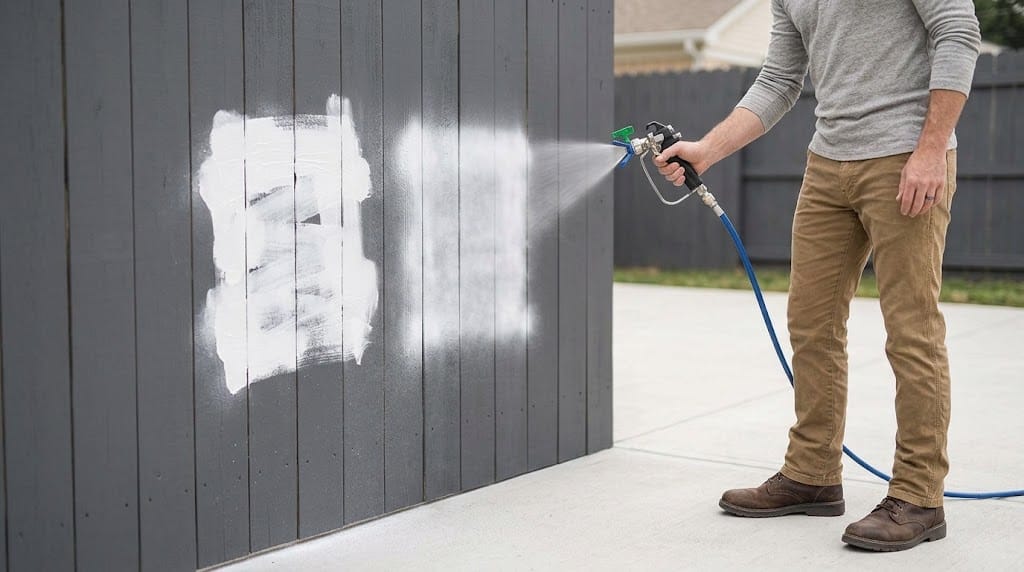
- Practice your pattern on cardboard first. A minute of practice on a scrap surface will tell you more about your pressure and distance settings than any manual can.
- Overlap each pass by about a third. This avoids the striping effect that shows up when spray passes don’t overlap enough.
- Clean the sprayer immediately after use. Paint left to dry inside the pump or tip is one of the most common reasons sprayers stop working properly, and most manufacturers recommend flushing the system the same day you use it.
- Mask more than you think you need to. Overspray travels further than expected, especially with airless sprayers on windy days outdoors.
Frequently Asked Questions
Do I need to thin my paint for a sprayer? It depends on the sprayer. Airless models are generally built to handle unthinned latex and oil-based paints straight from the can. HVLP units, especially lower-wattage ones, sometimes require thinning to avoid clogging — check your owner’s manual and use a viscosity cup to confirm before you start.
How loud are paint sprayers? Most electric sprayers run at a noise level comparable to a vacuum cleaner. It’s not damaging with brief exposure, but for extended sessions, ear protection is a reasonable precaution, particularly with higher-wattage HVLP turbines and airless motors.
Can I use a paint sprayer indoors? Yes, with proper ventilation and a respirator rated for the coating you’re using. Confined spaces trap fumes and overspray more than open rooms, so cracking windows and using fans to move air out is worth the extra setup time.
What’s the difference between a spray tip size and a nozzle size? Tip size generally refers to the orifice size on airless sprayers, which determines flow rate and pattern width. HVLP sprayers use interchangeable nozzle or air cap sizes (often measured in millimeters) to control how much material passes through for different paint viscosities.
How often should I clean my paint sprayer? Most manufacturers recommend flushing the system immediately after each use, and for HVLP units like the HomeRight Super Finish Max, after roughly every five to nine gallons of material sprayed. Letting paint dry in the lines or tip is the leading cause of clogs and premature wear.
Is it worth buying a sprayer for a single project? If the project is small — one piece of furniture, a small fence section — renting or borrowing a sprayer may make more financial sense than buying. For homeowners with recurring maintenance needs (fences, decks, exterior trim), owning a mid-range model like the Graco Magnum 257025 tends to pay for itself within one or two seasons.