Advertiser Disclosure
We independently review everything we recommend. When you buy through our links, we may earn a commission.
Best Large Print Crossword Puzzle Books for Seniors
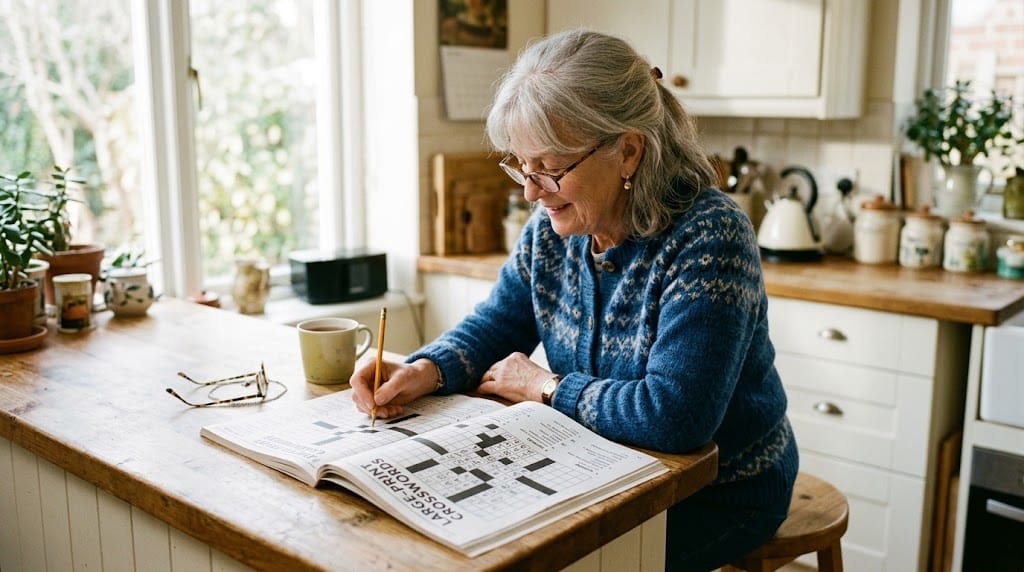
We spent several weeks working through a stack of large-print crossword books, filling in grids at the kitchen table, at the dentist’s office, and in a couple of cases, on a plane where the tray table wasn’t quite big enough for the giant page spreads. Our goal was simple — find the books that actually deliver on the “large print” promise, hold up to real use, and match the right kind of puzzle to the right kind of solver.
Everything We Recommend
✅ We recommend these products based on an intensive research process that’s designed to cut through the noise and find the top products in this space. Guided by experts, we spend hours looking into the factors that matter to bring you these selections.
⭐ 2.5 million+ people assisted in the last 30 days ⭐
Book | Best For | Difficulty |
|---|---|---|
Daily solvers who want a reliable, no-fuss format | Easy | |
Gift-giving, first-time large print buyers | Easy–Medium | |
Solvers who want variety across many volumes | Easy–Hard (varies by title) | |
Solvers who burn through puzzles fast and want volume | Easy, Medium, Hard combined | |
Anyone who finds crossword clues more stressful than fun | Easy (visual scanning, not vocabulary-based) | |
Beginners and anyone easing back into crosswords after a break | Easy | |
Solvers who also enjoy nostalgic themes and want a personal, indie feel | Easy–Medium | |
Baby boomers who want clues built around their own decades | Easy–Medium |
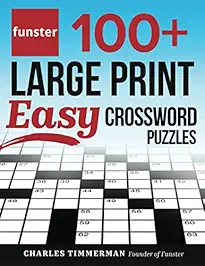
Best for: People who want a straightforward, dependable book without a gimmick attached to it.
There’s something almost old-fashioned about how unfussy this book is, and after working through a few titles that seemed more interested in cover design than grid design, that plainness was a relief. Author Charles Timmerman built his career on exactly this kind of puzzle, and it shows in the pacing — 101 puzzles that ease you in rather than throwing a rough one at you on page three. The grids are printed as full-page spreads with genuinely oversized squares, which meant our testers with slightly shaky handwriting didn’t end up with letters bleeding into the next box, a problem that derailed more than one other book we tried. It also throws in a small bonus most readers won’t expect: free downloadable word search and sudoku puzzles that extend the book past its printed page count. The trade-off is that it’s a perfect-bound paperback rather than spiral, so it doesn’t lie fully flat without a bit of coaxing or a book weight — something to know if you’re buying this for someone who solves one-handed. Compared with the Everything Easy series below, Funster’s puzzles skew very slightly more playful in clue-writing, while Everything Easy leans a touch more literal, so it’s worth flipping through a sample of both if clue style matters to the person you’re buying for.
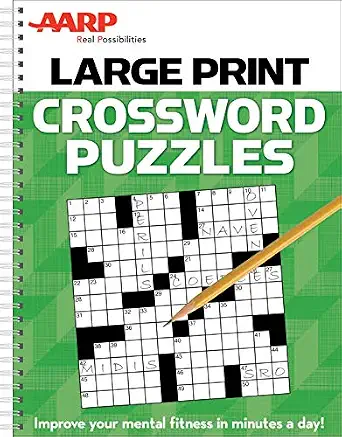
Best for: A first large print crossword book, especially as a gift.
This is the book we handed to testers who’d never tried a dedicated large print title before, mostly because the AARP name carries a kind of built-in trust that lowers the “will I actually use this” hesitation people have with gift puzzle books. It’s spiral-bound at 96 pages, and the spiral makes a real difference — it folds back on itself so a solver can prop it against a coffee mug or hold it in one hand on a couch without the pages flopping shut. The puzzle count is modest at just over 40, which is the honest trade-off here: if you’re buying for someone who finishes a puzzle every day, this book won’t last the month. Clue themes lean into pop culture, sports, and world history spanning a wide range of decades rather than clustering in one era, which we found made it a genuinely good fit for couples or families sharing one book, since nobody kept hitting stretches of clues they had zero context for. If longevity per dollar matters more than brand trust, the Puzzle Time collection further down this list stretches much further.
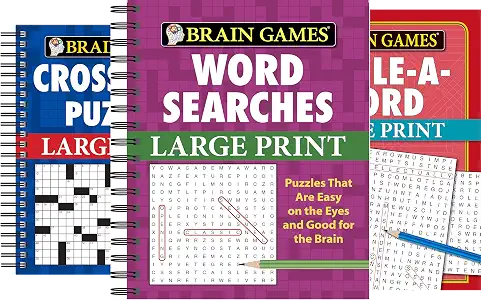
Best for: Someone who wants to buy once and have options for months, or who likes a rotating solving experience.
We’re grouping this as a series rather than a single title because that’s genuinely the appeal — Publications International puts out this line in several color-coded editions (green, blue, purple, swirl, and others), each with its own puzzle mix, and a couple of 2-in-1 and 384-page combined editions for people who want to go long. Every version we tested used the same core layout: each crossword spread across two full facing pages, which gave us the most comfortable clue-to-grid ratio of any book on this list — no need to flip back and forth or squint at a clue column crammed into a margin. Puzzles are arranged in ascending difficulty within each volume, so early puzzles genuinely are easier than late ones, which several other “graduated difficulty” books we tried didn’t actually deliver on. The one real downside is that because it’s a series, buying the “wrong” volume for someone’s skill level is easy to do if you’re not paying attention to which color or edition you’re ordering, so it’s worth checking the specific difficulty description before adding to cart rather than assuming they’re interchangeable.
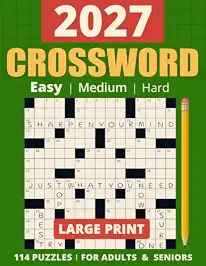
Best for: Heavy, frequent solvers who’d rather buy one thick book than restock every few weeks.
If the AARP book above is for someone dipping a toe in, this is for the person already three books deep into the hobby and tired of running out. It bundles easy, medium, and hard puzzles into one extra-large-print collection with several thousand clues total, which in practice meant our fastest tester — someone who normally finishes a standard crossword book in about two weeks — was still working through it a month later. The publisher makes a specific point of verified, non-repetitive clues, and we noticed the difference: cheaper bulk crossword books often recycle the same handful of clue-answer pairs across puzzles, which gets stale fast, and this one mostly avoided that trap. Because it packs in three difficulty tiers rather than staying purely beginner-friendly, it’s not the best first book for someone brand new to large print puzzles — the “hard” tier clues can be genuinely tricky, closer to what you’d find in a standard newspaper crossword than a gentle senior-focused title. Think of it as the AARP book’s more ambitious older sibling.
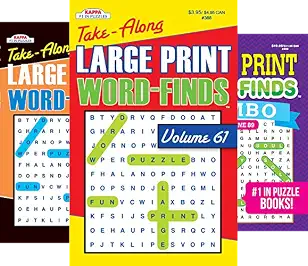
Best for: Solvers who love the ritual of large print puzzling but find crossword clues stressful rather than relaxing.
This one deserves an honest flag up front: it’s a word search book, not a crossword book, and we’re including it deliberately because plenty of readers shopping this category assume crosswords are their only large print option. They’re not. Kappa Books has been in the puzzle publishing business for decades under its “Braintainment” line, and the word-find format sidesteps the part of crosswords that some solvers genuinely find discouraging — the moment you’re stuck on a clue with no foothold at all. With a word search, the words are right there on the page; the task is visual scanning rather than vocabulary recall, which several of our testers with mild vision fatigue actually preferred over a long solving session because it required less mental backtracking. The puzzle themes rotate through nature, travel, sports, and pop culture, and solutions are printed at the back for anyone who wants to double-check a tricky find. The obvious trade-off is that if the person you’re shopping for specifically loves the “aha” of cracking a clever clue, this format won’t scratch that itch — it’s a genuinely different kind of mental workout, not a lesser one.
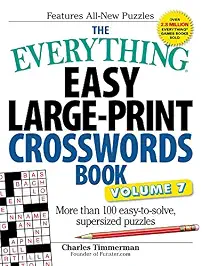
Best for: Beginners, or anyone returning to crosswords after years away from them.
Timmerman shows up twice on this list because he’s written both this series and the Funster book above, and after testing them side by side, we can say they’re not redundant — they’re aimed at slightly different moments in a solver’s routine. Where Funster felt like a steady daily habit book, the Everything Easy series (now up to nine volumes) is explicitly built around the promise of “easy to see and solve,” and it leans harder into that gentleness. Clues stick to familiar ground — classic books, well-known TV shows, popular vacation spots — without straying into obscure trivia that would stall a beginner and sour them on the hobby before it starts. One tester who hadn’t touched a crossword in over a decade specifically noted that this was the first book in our stack where she didn’t need to skip a clue in the first five puzzles, which for a returning solver matters more than it might sound. The catch is that the accessibility comes at the cost of challenge — if you’re shopping for someone who already solves comfortably and wants to be pushed, this series will likely feel too easy past the first volume or two, and the Puzzle Time collection above is the better fit for that solver.
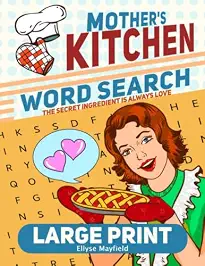
Best for: Readers who like a puzzle book with a bit of personality behind it, not just a publishing-house product.
Mayfield is an independent, Chicago-based author who writes specifically for seniors and readers with dyslexia, and that focus comes through in small but noticeable ways — puzzle instructions are written plainly, page numbers are oversized right alongside the grid numbers, and the overall design avoids the slightly cluttered look some bigger-publisher books default to. It’s part of a broader catalog of her large print activity titles, so the crossword grids share the same DNA as her well-reviewed word search books: roomy, uncluttered, and clearly meant to be solved rather than just displayed on a shelf. Where it stands out is in tone — the clue writing has a warmer, more conversational feel than the more corporate Brain Games or AARP titles, which a few of our testers genuinely commented on unprompted. Because it’s independently published rather than backed by a large puzzle house, print runs and paper stock can vary slightly between printings, so it’s worth reading recent buyer feedback before ordering if consistency between copies matters to you.
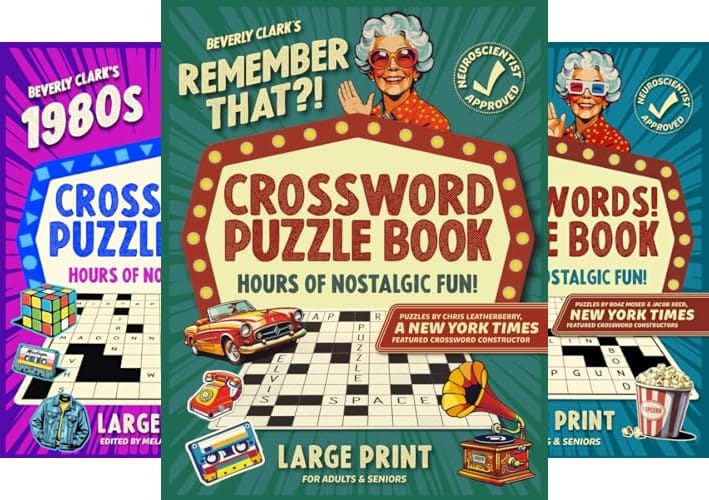
Best for: Baby boomers who want clues built around the decades they actually lived through, not generic trivia.
Clark’s crossword books lean hard into nostalgia, with clue sets built around music, television, world events, and pop culture spanning the 1950s through the 1990s, and that specificity is really the whole appeal. Generic “senior” crossword books often default to a vague, timeless trivia pool that can feel like it was written for no one in particular; this one clearly wasn’t. Testers in their late 60s and 70s lit up in a way we didn’t see with some of the more neutral titles on this list, filling in answers almost on reflex when a clue referenced a specific show or song from their own younger years — that recognition-based recall is part of what makes nostalgia-themed puzzles feel satisfying rather than just difficult. The trade-off is the flip side of the same coin: if you’re buying for someone younger, or from outside that specific cultural window, a chunk of the clues will land flat, so this is a much better fit as a gift for a parent or grandparent than as a general-purpose pickup.
Why Crossword Puzzles Are Worth Recommending
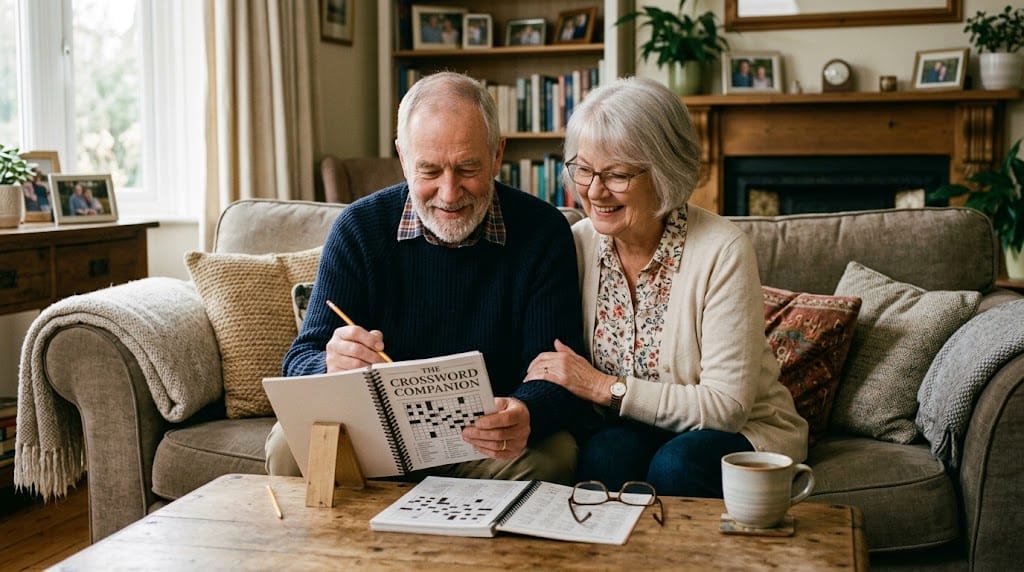
It’s easy to be skeptical of “brain game” marketing, and honestly, a lot of it doesn’t hold up to scrutiny. Crosswords are a little different, though, because there’s now a decent body of research behind them.
A randomized clinical trial run jointly by researchers at Columbia and Duke found that older adults with mild cognitive impairment who trained on crossword puzzles showed measurably better outcomes on a standard cognitive assessment than a comparison group who used computerized brain-training games — and the advantage held up at both 12 weeks and 78 weeks into the study, with the crossword group also showing less brain shrinkage on MRI scans. That’s a notable result, considering the study set out expecting the games to win (Duke University School of Medicine).
Separately, a large observational study out of the University of Exeter and King’s College London, tracking more than 19,000 adults over 50, found that people who did puzzles like crosswords and Sudoku more frequently tended to score better on measures of brain function and memory. Columbia’s own summary of the crossword-versus-games trial goes further, noting that participants who trained with puzzles also performed better in daily functioning measures over the longer follow-up period.
None of this means a crossword book is a substitute for medical care, and we wouldn’t frame it that way. But as a low-cost, screen-free activity that people genuinely enjoy doing, the evidence is more encouraging than we expected going in — and it’s part of why we think it’s worth taking the “which book” question more seriously than a quick Amazon scroll usually allows.
What Actually Makes a Crossword Book "Senior-Friendly"
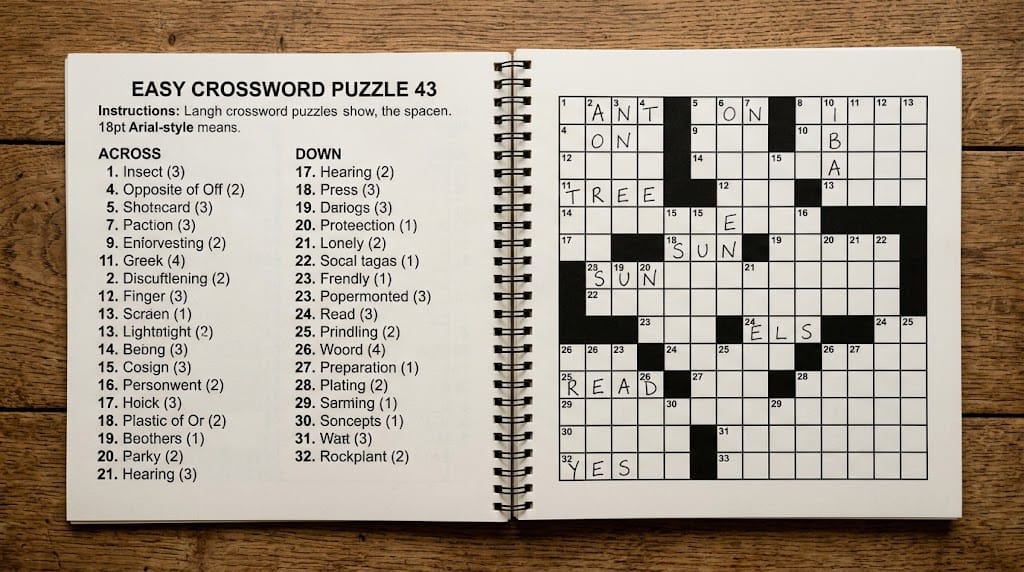
Not every book labeled “large print” earns the name. Here’s what we paid attention to during testing.
Font size, not just font claims. “Large print” isn’t a regulated term, so it can mean anywhere from a modest bump over standard paperback size to genuinely oversized type. We measured actual letter height in the grids and clue lists rather than trusting the cover copy.
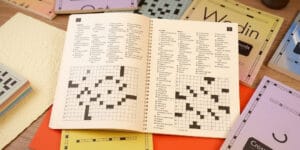
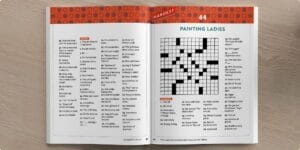
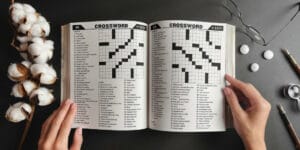
Grid-to-clue layout. Some books cram the clue list onto the same page as a shrunken grid. Others give the grid its own full page, or even a two-page spread. The second approach tends to be far more comfortable for anyone dealing with low vision, tremor, or general eye fatigue.
Paper quality and ink bleed. This one surprised us. Thin, glossy paper causes pen or pencil marks to smear or bleed through to the next puzzle, which is genuinely frustrating once you’re twenty puzzles deep in a book. Matte, slightly heavier stock solves this and is worth checking for.
Binding. Spiral and lay-flat bindings let a book sit open on a table or lap without needing to be pinned down, which matters more than it sounds like it should when someone has limited hand strength or is working one-handed.
Difficulty range and clue style. A book pitched at “seniors” that’s actually stacked with obscure trivia or aggressive misdirection clues isn’t doing anyone favors. We looked for clear labeling of difficulty and a reasonable curve — not every puzzle needs to be easy, but the progression should be honest.
Theme relevance. Clues built around decades-specific pop culture, classic film, or nostalgic references tend to land better with an older solver than clues assuming familiarity with recent internet culture. This is a genuine differentiator between books, not just marketing flavor.
If you’re shopping for more than crosswords, it’s worth reading alongside our guide to large print word search books for seniors, since a few publishers overlap and word searches solve a slightly different problem for readers who find crossword clue-parsing more taxing than the visual scanning a word search requires.
Crossword or Word Search? A Quick Gut-Check
Since one of our picks above is technically a word search rather than a crossword, it’s worth answering the question directly: which should you actually buy?
Crosswords ask you to retrieve a specific word from memory based on a clue, which is why the cognitive research above focuses on them specifically — that retrieval process is the mental “workout” part. Word searches ask you to visually scan a grid for words you already know, which is gentler and more meditative, but exercises a different skill set. Neither is objectively better. If the person you’re shopping for gets frustrated easily or has some vision fatigue that makes scanning dense clue text tiring, a word search book like the Kappa title above can be the more enjoyable daily habit. If they specifically enjoy the challenge of a tricky clue, stick with a crossword-first pick like Funster, the Everything Easy series, or the Puzzle Time collection depending on how much difficulty they’re after. It’s also worth browsing our roundup of jigsaw puzzles for adults if the goal is more of a shared, tabletop activity rather than a solo pastime — the two categories solve different needs even though they get lumped together in gift guides.
Frequently Asked Questions
What font size actually counts as “large print” for crossword puzzles? There’s no official standard, but most books marketed this way land somewhere between 14 and 20 point type in the clue text, with grid letters printed noticeably larger still. We’d treat anything below that range with some skepticism regardless of what the cover claims — check a sample page image before buying if one is available.
Can crossword puzzles actually help with memory or cognitive decline? The research is genuinely encouraging, though it comes with reasonable caveats. The Columbia-Duke trial found crossword training outperformed computerized brain games on standard cognitive measures in adults with mild cognitive impairment, and a separate large-scale study of over 19,000 adults linked more frequent puzzle-solving to better measures of brain function later in life. That said, this is an area of active, ongoing research, and a puzzle book isn’t a substitute for medical guidance if memory concerns are significant enough to be worrying.
Spiral-bound or paperback — does it actually matter? For anyone solving one-handed, working with limited grip strength, or just wanting the book to stay open on a table without a paperweight involved, spiral binding is a meaningful quality-of-life improvement, not just a nice-to-have. If the book will mostly sit flat on a table with both hands free, paperback binding is a non-issue.
Are “senior” crossword books actually easier, or just bigger print? It depends entirely on the publisher. Some books labeled for seniors genuinely simplify clue-writing and stick to familiar vocabulary; others just enlarge the font on a standard difficulty puzzle. Reading a sample puzzle or a handful of reviews mentioning difficulty is the more reliable signal than the “for seniors” label alone.
What’s a reasonable puzzle count to expect for the price? This varies a lot by format. A slim spiral-bound gift book might run 40–50 puzzles, while a bulk collection like the Puzzle Time 3-in-1 title can top 250. Neither is a bad value on its own — it depends whether you’re buying a gift meant to look nice on a shelf or a workhorse book meant to last months.
The Bottom Line
If we had to send just one reader toward a single pick, it would depend entirely on who’s doing the solving. For a first-time buyer or a gift, the AARP book’s trusted name and spiral binding make it close to foolproof. For a daily habit that needs to last, the Puzzle Time collection’s sheer puzzle count is hard to beat. For someone specifically nostalgic for their own decades, Beverly Clark’s themed clues will land in a way generic trivia never quite manages. And if crossword clues themselves are the sticking point rather than the print size, the Kappa word search title is worth trying before writing off large print puzzling altogether. None of these books is flawless — every one of them makes a trade-off somewhere between price, puzzle count, binding, or difficulty — but matched to the right solver, any of the eight above is a genuinely good way to spend an afternoon.