Advertiser Disclosure
We independently review everything we recommend. When you buy through our links, we may earn a commission.
The Best Medium Crossword Puzzle Books
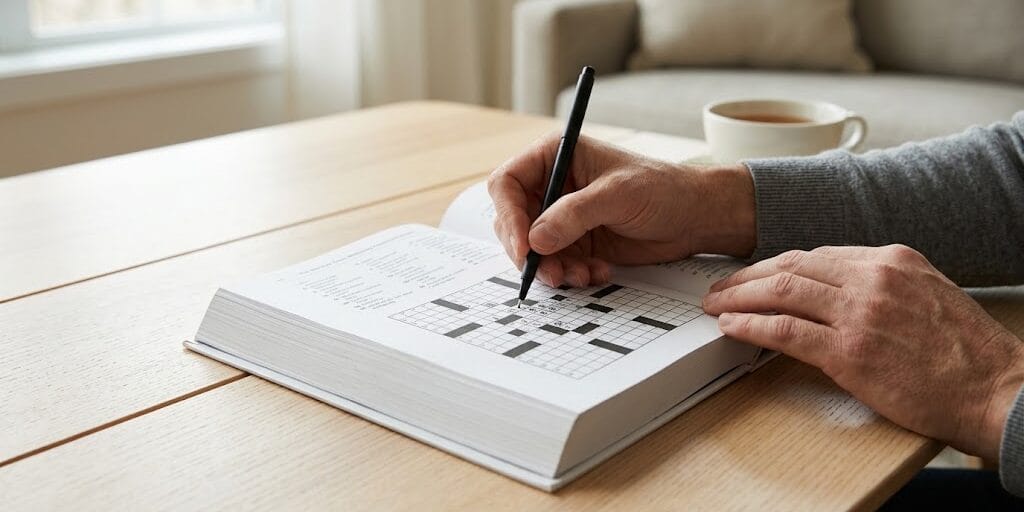
Medium crosswords have quietly become one of the most popular categories in the puzzle book world. Publishers know it, too — a quick scan of any bestseller list shows medium-level titles from The New York Times sitting right next to newer independent presses that have built entire catalogs around this one difficulty tier. That’s not an accident. It’s a reflection of how most regular solvers actually want to spend their puzzle time: engaged, not exhausted.
If you’re shopping for a specific age group instead, our guide to large print crossword puzzle books for seniors and our roundup of crossword puzzle books for kids cover those categories in more depth. This article focuses squarely on the medium-difficulty tier for adult solvers who’ve outgrown easy puzzles but aren’t chasing Saturday-level torment.
What "Medium Difficulty" Actually Means in a Crossword Book
Before we get into specific picks, it’s worth clearing something up: “medium” isn’t a regulated term. One publisher’s medium puzzle might lean closer to a Tuesday-level New York Times crossword, while another’s medium tier edges toward what longtime solvers would call a Thursday. That inconsistency is one of the biggest complaints we found buried in customer reviews across every platform we checked.
The New York Times solves this problem better than most because its difficulty grades correspond to actual days of the week — a system crossword fans have used for decades. Independent publishers don’t have that built-in reference point, so their “medium” label is more of an editorial judgment call. That doesn’t make those books worse, but it does mean your mileage may vary more with a smaller press than with an established outlet.
A few other things separate a genuinely good medium crossword book from a mediocre one:
- Clue variety. Repetitive clue banks (the same handful of clues recycled for common words like “ERA” or “ELI”) get old fast. Books that source clues thoughtfully feel fresher, puzzle after puzzle.
- Grid construction quality. A well-built grid has clean symmetry and fair crossing letters. Weak construction leaves you guessing at obscure intersections instead of reasoning your way there.
- Print and paper. Ink bleed-through ruins a puzzle book faster than almost anything else. Thicker paper stock costs a publisher more, but it’s the difference between a book that lasts and one that falls apart by puzzle forty.
- Answer key accessibility. Solutions printed in the back, in a font you can actually read, matter more than people expect until they’re squinting at 6-point text after finishing a puzzle.
With that framework in mind, here’s how our eight picks stacked up.
Our Top Medium Crossword Puzzle Book Picks
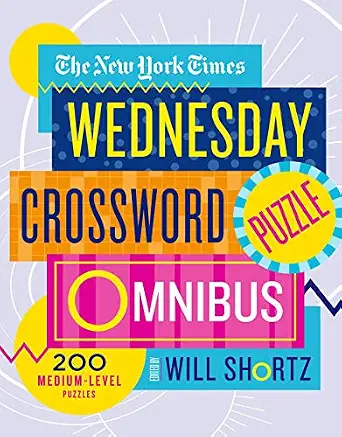
We’ll say it plainly: if you only buy one book from this list, this is the one to buy. There’s a reason the Times built an entire omnibus series around Wednesday puzzles specifically — Wednesday sits at the exact midpoint of the week’s difficulty curve, and editor Will Shortz has spent decades calibrating that tier to feel challenging without becoming punishing.
What impressed our testers most wasn’t any single puzzle but the consistency across all 200 of them. We didn’t hit the frustrating quality dips that showed up in a few of the newer, independently published books on this list — no recycled clue banks, no grids that felt slapped together to hit a page count. Every puzzle in this omnibus went through the same editorial process the Times applies to its daily print edition, and that shows in how fairly the clues cross and how satisfying the “aha” moments feel.
The trade-off is size and portability. This is a thick, sturdy omnibus meant for a desk or a coffee table, not a bag or a plane seat pocket — if you want something you can fold in half on a commute, look further down this list. The font is also standard-size rather than large print, which is worth knowing if eye strain is a concern for you (our large-print seniors guide covers better options for that specific need).
Who should buy this: solvers who’ve worked through easier crossword books and want a genuinely well-constructed step up, without jumping straight into Saturday-level difficulty. It’s also simply the safest gift option on this list — nobody’s disappointed to unwrap a New York Times puzzle book.
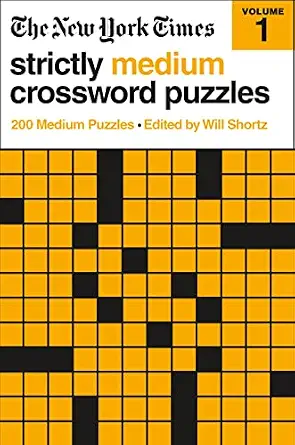
Where the Wednesday Omnibus pulls specifically from midweek puzzles, Strictly Medium takes a slightly different approach: every single puzzle in this 200-puzzle collection was selected and graded for medium difficulty regardless of what day it originally ran. In practice, that gives you a narrower, more consistent difficulty band than the Omnibus, which still has some natural variance between its “easier” and “harder” Wednesdays.
We noticed this difference most on puzzles fifty through eighty, where the Omnibus occasionally threw a curveball clue that pushed toward Thursday territory. Strictly Medium never really did that. If frustration-free, evenly paced solving matters more to you than variety, this narrower band is a genuine advantage, not just marketing language.
The trade-off here is that tighter consistency can start to feel a little repetitive if you’re working through the book cover to cover in a short window. A few of our testers who solved five or six puzzles in a sitting noticed the theme categories overlapping more than they expected. Spread out over weeks instead of days, that issue mostly disappears.
The portable paperback format is genuinely one of this book’s strengths — it’s the one on our list we actually grabbed for a flight, since it slides into a bag without adding real weight. If you want NYT-quality puzzles but need something you can carry around, this edges out the Omnibus.
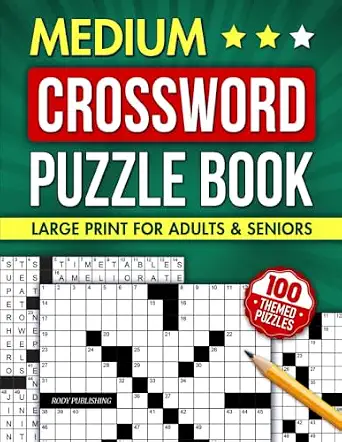
This is the book that surprised us the most. Rody Publishing built its catalog specifically around calming, focused puzzle experiences, and that intention comes through in the construction of these 100 themed puzzles. Instead of a grab-bag of unrelated clues, each puzzle centers on a single topic — history, food, geography, pop culture, and dozens of others — so every answer you fill in reinforces the theme instead of feeling random.
That structure changes how solving actually feels. One of our testers, a retired teacher who does crosswords most evenings, put it well: working through a themed puzzle feels less like guessing and more like having a conversation with a subject you already know something about. You’re not fighting against the grid; you’re exploring it. That’s a meaningfully different experience from a standard mixed-clue puzzle, and it’s part of why themed customer reviews for this book consistently mention feeling like they learned something rather than just filled in boxes.
The honest trade-off: because every puzzle commits to a theme, you’ll occasionally land on a topic that just isn’t your thing. If you don’t know much about classic film or 1990s music, that particular puzzle is going to be a slog no matter how well it’s constructed — there’s no crossing over into a more familiar category mid-puzzle the way there can be with mixed clues.
This book suits solvers who like a sense of structure and progress, and it’s a genuinely good pick for someone easing back into crosswords after a long break, since a familiar theme gives you an entry point that a completely blank medium grid doesn’t.
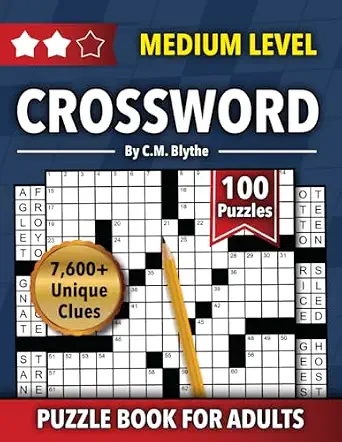
If Rody’s themed approach is the conversationalist of this list, C.M. Blythe’s collection is the no-nonsense workhorse. There’s no theming gimmick here, no gift-box branding, no large-print marketing angle — just 100 medium puzzles built with clean, fair grid construction and a clue style that leans classic rather than clever-for-clever’s-sake.
Our testers who prefer a more traditional solving rhythm gravitated toward this one specifically because it doesn’t try to reinvent the format. The clues are direct. The grids are symmetrical. The difficulty stays steady from puzzle one through puzzle one hundred, without the theme-dependent swings you get in more topic-driven books. If you just want to sit down and solve without any extra layer of decision-making, this is the most straightforward option on our list.
The limitation is also the flip side of that simplicity: there’s less personality here than in some of the other picks. If you’re the kind of solver who enjoys a wink-and-nudge clue or a themed “aha” moment tying a whole puzzle together, this book will feel comparatively plain. It does exactly what it says on the cover and nothing more — which, depending on what you’re looking for, is either exactly right or a little underwhelming.
We’d point this book toward solvers who’ve been burned by over-designed puzzle books before and just want reliable, well-built medium crosswords without extra flourishes.
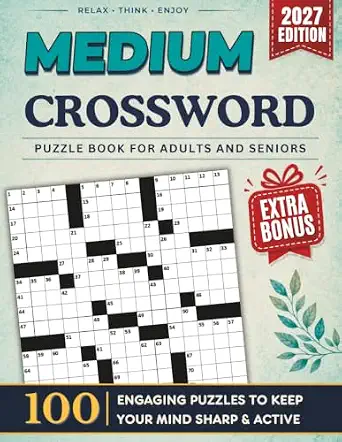
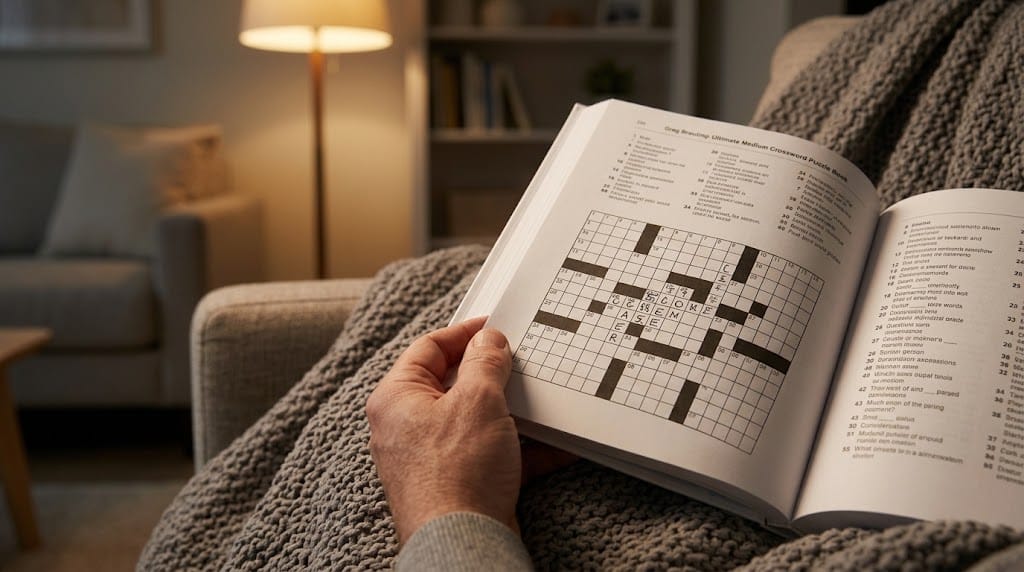
Greg Braeutigan’s puzzle books have built a loyal following in the crossword community, largely because his “Ultimate” series consistently prioritizes a larger, easier-to-read grid and clue font without explicitly marketing itself as a “large print for seniors” product. That distinction matters more than it might sound like it should — several of our testers specifically said they wanted bigger print for comfortable reading but didn’t want a book packaged around aging, and this title threads that needle well.
The 100 puzzles inside hit a genuinely medium band, with clue difficulty that felt comparable to the C.M. Blythe collection but presented in a more generous layout that’s easier on the eyes during longer solving sessions. If you’ve ever found yourself squinting at a standard-size grid under dim evening light, the difference here is immediately noticeable.
The trade-off is page count efficiency — because the print and grid are larger, this book is physically bigger and heavier per puzzle than the more compact options on this list, like Strictly Medium. It’s better suited to at-home solving than tucking into a bag for travel.
This is the pick we’d recommend for anyone who wants a comfortable reading experience first and doesn’t want that comfort tied to age-targeted branding — think younger solvers with eye strain, people who solve in low light, or anyone who just prefers a roomier grid.
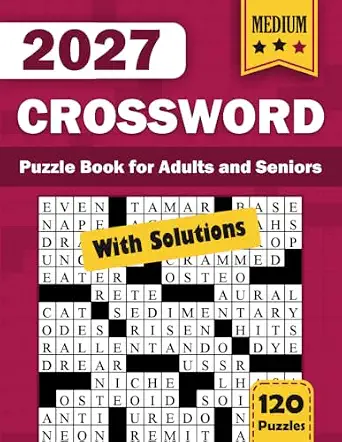
Simple math matters to a lot of puzzle book shoppers, and RodBooks Publishing wins that math outright on this list: 120 puzzles is more than every other title here except the two 200-puzzle NYT omnibuses, and it comes at a price point that’s noticeably lower than either of those. For solvers who go through puzzle books quickly — several a week, in some cases — that extra 20 puzzles compared to the standard 100-puzzle format adds real solving time without a proportional price jump.
We found the difficulty here landed right in the expected medium range, comparable to C.M. Blythe’s collection rather than the themed structure of Rody’s. Grid construction was solid, if unremarkable — nothing about it stood out as innovative, but nothing felt like filler either, which is a meaningful compliment for a book padding out to 120 puzzles.
Where this book trades down slightly is in clue creativity. Across a larger volume of puzzles, we did notice a bit more clue repetition than in the tighter, curated 100-puzzle collections, particularly toward the back half of the book. That’s a common trade-off with higher-volume puzzle books in general, not a flaw unique to this title, but it’s worth knowing going in.
If your priority is maximizing solving hours per dollar and you’re not precious about clue originality on every single page, this is the most economical pick on our list.
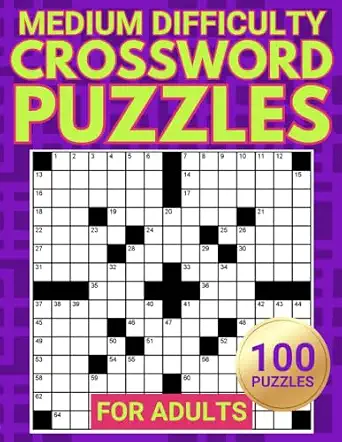
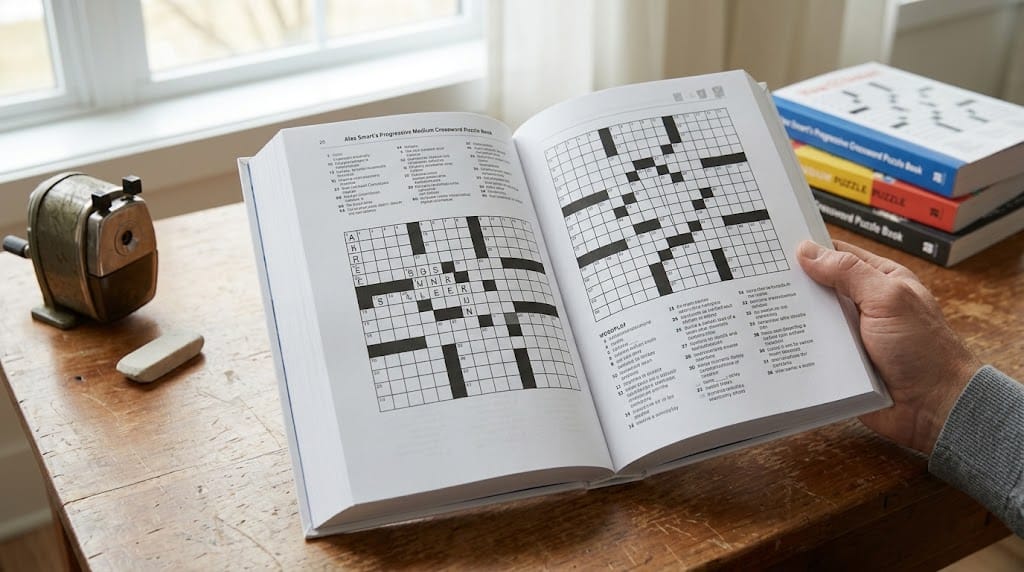
Stepping up from easy to medium crosswords can be a genuinely discouraging jump if the book you pick doesn’t ease you in. Alex Smart’s collection handles that transition better than most of the other titles we tested. The puzzles near the front of the book sit gently on the easier end of medium, and the difficulty creeps up gradually as you work through it, rather than throwing a genuinely tough grid at you on puzzle three.
That gradual curve made this the book our newer-to-crosswords tester reached for most often during testing. She’d previously stalled out on a different medium-labeled book because the difficulty jump from easy puzzles felt abrupt and demoralizing — this one didn’t have that problem. By the time she reached puzzle sixty, she was solving at a pace that would’ve felt impossible on puzzle one, which is exactly the kind of confidence-building progression a good “medium” book should offer.
The honest downside: if you’re already a confident medium-level solver, the early puzzles in this book will feel too easy, and you may want to skip ahead. It’s built as a ramp, not a flat plateau, so experienced solvers looking for consistent, no-warmup-needed difficulty should look at C.M. Blythe or RodBooks instead.
We’d point this book specifically at recent graduates from easy puzzles, or anyone returning to crosswords after a long gap who wants their confidence rebuilt gradually instead of tested immediately.
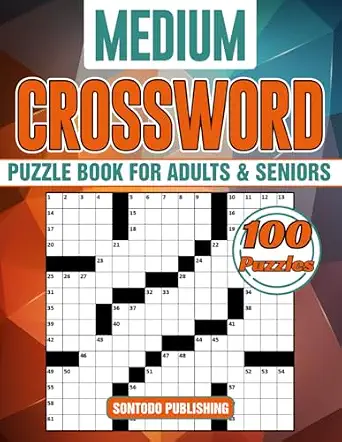
Sontodo Publishing has built its catalog with gifting clearly in mind, and it shows in the presentation as much as the puzzles themselves — clean cover design, a format that photographs well for a “here’s what I got you” unboxing, and a puzzle style that’s approachable enough to suit a wide range of solvers rather than a narrow niche. That broad appeal is actually a strength when you’re buying for someone whose exact skill level you’re not 100% sure of.
The 100 medium puzzles inside stayed reliably in the expected difficulty range throughout our testing, without the early-book easing of Alex Smart’s collection or the topic-dependent difficulty swings of Rody’s themed approach. It’s a steady, predictable medium experience — which, for a gift, is exactly what you want. Nobody wants to give a puzzle book that turns out to be secretly too hard, or too easy, for the person opening it.
The trade-off is that this steadiness comes at the cost of a distinct identity. Compared to the themed hook of Rody’s book or the print-comfort angle of Braeutigan’s, Sontodo’s collection doesn’t have a single standout feature beyond “reliably good medium puzzles in a nice package.” For your own solving, that might read as slightly forgettable. For a gift, it reads as safe, and safe is usually what you want when you’re not the one who’ll actually be filling in the grid.
Choose this one for birthdays, holidays, or “thinking of you” gifts where you want quality you can count on without needing to know the recipient’s exact puzzle preferences.
How These Eight Compare Head-to-Head
A few patterns emerged clearly once we’d tested all eight side by side. If raw construction quality and editorial consistency matter most to you, the two New York Times titles outperform every independent option on this list — that’s the benefit of decades of institutional crossword-building experience, and it’s worth paying for if quality is your top priority. Between those two, choose the Wednesday Omnibus for a substantial, at-home puzzle library and Strictly Medium if portability matters.
Among the independent publishers, Rody’s themed structure and Braeutigan’s larger print each solve a specific problem well, while C.M. Blythe and RodBooks serve solvers who want reliable, no-frills puzzles without paying for extra features they won’t use. Alex Smart stands apart as the only book on this list specifically built around difficulty progression, making it the clear pick if you’re newer to medium-level solving rather than already comfortable there. And if you’re buying for someone else entirely, Sontodo’s broad, dependable appeal makes gifting decisions easier than trying to match a themed or print-specific book to someone else’s exact taste.
Frequently Asked Questions About Medium Crossword Puzzle Books
What’s the difference between easy, medium, and hard crossword puzzles? The difference generally comes down to clue directness and vocabulary obscurity rather than grid size. Easy puzzles tend to use straightforward, literal clues. Medium puzzles introduce wordplay, less common vocabulary, and clues that require a bit of lateral thinking. Hard puzzles lean heavily on puns, obscure references, and clues that are intentionally misleading at first read.
Are New York Times crossword puzzle books harder than other publishers’ books? Not necessarily harder, but generally more consistent. Because the Times grades difficulty by day of the week — a system built and refined over decades — its “medium” tier tends to land in a more predictable range than smaller publishers, whose difficulty labeling is more subjective.
How many puzzles are usually in a medium crossword puzzle book? Most independent publishers settle around 100 puzzles per book, though some titles go up to 120 or higher for better per-puzzle value. The New York Times omnibus editions typically include 200 puzzles, reflecting their larger, more substantial format.
Do medium crossword puzzles actually help keep your mind sharp? Solving crosswords regularly engages memory recall, vocabulary retrieval, and pattern recognition — all skills tied to cognitive engagement. Medium-difficulty puzzles in particular hit a useful balance: challenging enough to require real mental effort, but not so difficult that frustration outweighs the benefit of sticking with it.
Is it better to buy a themed crossword puzzle book or a mixed-clue one? It depends on how you like to solve. Themed books, like Rody Publishing’s collection, give each puzzle a unifying subject that can make solving feel more structured and rewarding if you enjoy that topic. Mixed-clue books, like C.M. Blythe’s or RodBooks’, offer more unpredictability from puzzle to puzzle, which some solvers find more engaging over the long run.
What should I look for in a crossword book if I have trouble reading small print? Look specifically for books that advertise a larger grid and clue font, like Greg Braeutigan’s Ultimate series, rather than assuming standard puzzle books will be easy to read. If you want a book built specifically around accessibility features, our large print crossword puzzle books for seniors guide covers that category in more detail.
Final Verdict
After going through all eight of these titles clue by clue, our team keeps coming back to the same conclusion: The New York Times Wednesday Crossword Puzzle Omnibus is the strongest overall pick for most medium-level solvers, thanks to its editorial consistency and genuinely fair grid construction across all 200 puzzles. If portability matters more to you, Strictly Medium delivers that same NYT quality in a format that actually fits in a bag.
Beyond those two, your best choice really does depend on what you’re solving for. Pick Rody Publishing if themed puzzles keep you engaged, Greg Braeutigan’s Ultimate series if print size matters, Alex Smart if you’re still building confidence at the medium level, and Sontodo if you’re buying for someone else and want a safe, reliable option. Whichever one you choose, the fact that medium crosswords sit in that sweet spot between “too easy to bother” and “too hard to enjoy” is exactly why they’re worth making room for on your shelf.