Advertiser Disclosure
We independently review everything we recommend. When you buy through our links, we may earn a commission.
The Best Easy Crossword Puzzle Books for Beginners
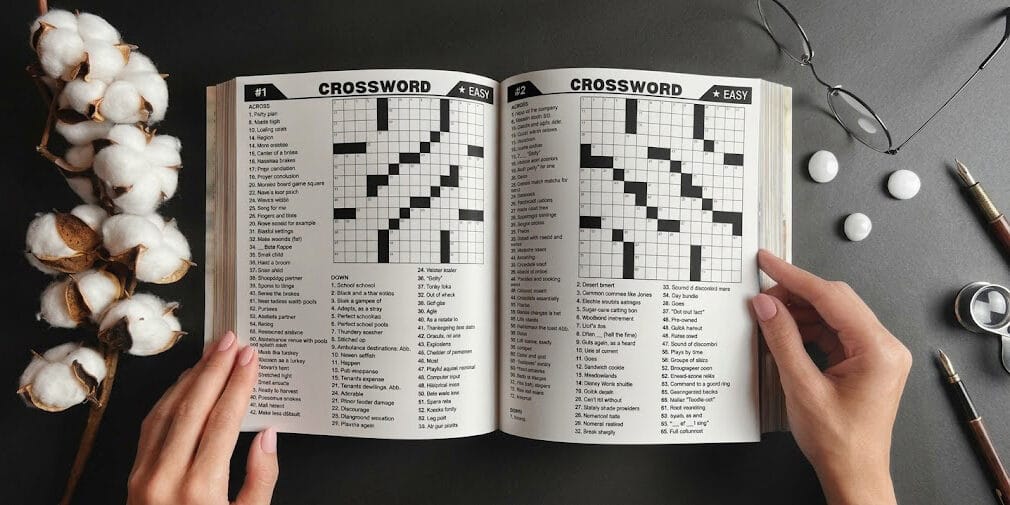
We focused on books that are specifically suited to new crossword solvers. We looked at the difficulty level, grid size, print format, answer placement, puzzle volume, and the types of clues used. We also considered who each book is likely to suit best, since the right starting point for someone completely new to crosswords isn’t necessarily the same as the right choice for someone who already finishes easy puzzles.
Our Top Picks at a Glance
Here are the six books that stand out for different types of beginners:
- New York Times Easy Crossword Puzzle Omnibus — Best overall for beginners who want to learn the classic newspaper style
- Funster 101 Quick & Easy Crossword Puzzles — Best for short solving sessions
- The Everything Easy Crossword Puzzle Book — Best for a large number of puzzles
- Myles Mellor Easy Peasy Crossword Books — Best for complete first-timers
- Stanley Newman Easy as Pie Crosswords — Best for themed puzzles
- Gregory Turner Crossword Puzzle Book — Best for large-print solving
What Makes a Crossword Book Good for Beginners?
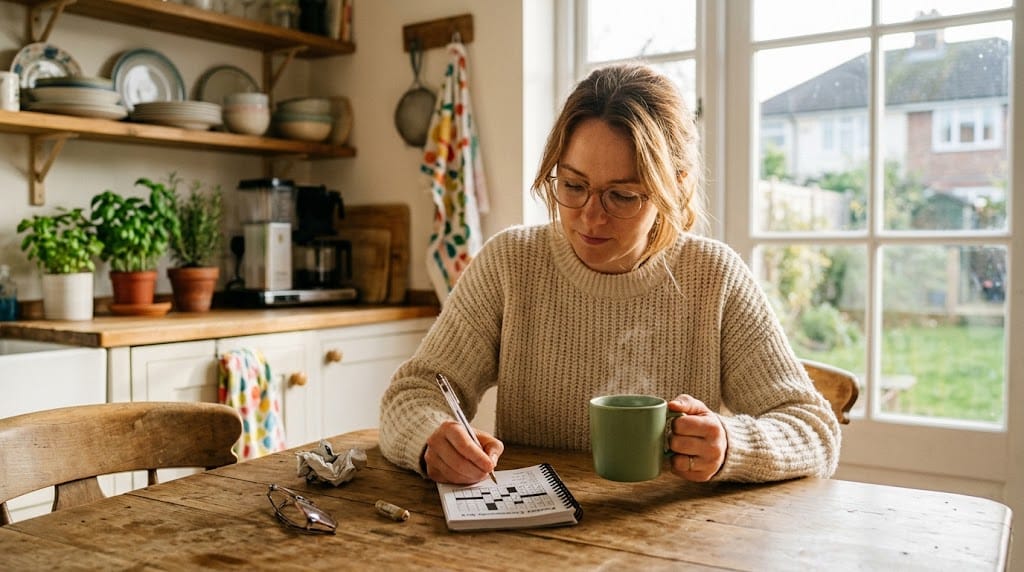
There isn’t one feature that automatically makes a crossword book beginner-friendly. Instead, several small details can make the difference between a puzzle that feels approachable and one that becomes frustrating.
Grid Size and Difficulty
A smaller 9×9 or 11×11 grid can be a comfortable starting point because there are fewer clues to work through and the puzzle usually takes less time to finish.
That doesn’t mean beginners need to avoid the standard 15×15 grid. A well-written 15×15 puzzle can be perfectly approachable when the clues use familiar vocabulary and straightforward definitions.
In practice, clue difficulty matters more than grid size alone. A small grid can still be difficult if it relies heavily on wordplay or obscure references.
Print Size and Paper Quality
Readability is easy to overlook when you’re comparing crossword books online.
The squares need to be large enough to write in comfortably, particularly if you prefer solving with a pencil. Clear printing also matters because crossword grids contain a lot of small visual information.
Large-print editions can be especially useful for people who prefer a more relaxed solving experience or spend a longer time on each puzzle.
Answer Key Accessibility
Beginners are likely to check answers more often than experienced solvers, so the location of the answer key matters.
Some books place answers immediately after a group of puzzles, while others put the entire answer section at the back. Neither approach is necessarily wrong, but a nearby answer key can make it easier to check one difficult clue without spending time searching through the book.
Theme and Clue Variety
Themed puzzles can be particularly enjoyable for beginners because the theme sometimes offers another entry point.
Once you understand the central idea, one longer answer can help you recognize another. That makes themed crosswords feel different from a simple collection of unrelated clues.
At the same time, some beginners may prefer completely straightforward puzzles while they’re learning how crossword clues work.
Binding
Binding isn’t a major consideration for everyone, but it becomes noticeable if you solve crosswords at a table, on your lap, or in a space with limited room.
A book that stays open naturally is easier to work with than one that constantly wants to close. Spiral-bound and lay-flat formats can therefore be worth considering if convenience is a priority.
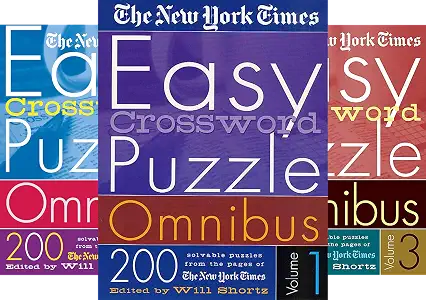
If your long-term goal is to solve the regular New York Times crossword, the New York Times Easy Crossword Puzzle Omnibus is a particularly logical place to start.
The collection brings together 200 of the easier New York Times puzzles, with many coming from the Monday and Tuesday editions. That’s useful for beginners because the difficulty of the New York Times crossword traditionally increases throughout the week.
The biggest advantage here is familiarity. Rather than learning a crossword style that is completely different from the puzzles you may eventually want to solve, you’re getting an introduction to the format associated with one of the best-known newspaper crosswords.
The clues are still capable of making you think, but the easier puzzles generally offer a more approachable starting point than later-week crosswords.
There are a couple of trade-offs. Two hundred puzzles make this a substantial collection, and the standard print format may not be the most comfortable option for someone specifically looking for large lettering.
Choose this book if: you want to become comfortable with the traditional newspaper crossword format and would rather learn with a large collection than a short beginner workbook.
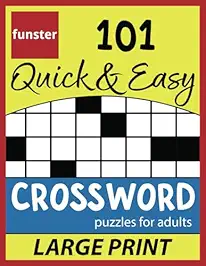
Funster takes a different approach from the New York Times collection. Its 9×9 grids are smaller, making the individual puzzles feel more manageable when you don’t have much time.
That’s particularly useful for beginners who aren’t ready to sit down with a full 15×15 crossword. A smaller puzzle gives you a chance to practice common clue patterns without feeling as though you have to finish a major project every time you open the book.
The shorter format also works well for casual solving. You can fit a puzzle into a coffee break, a short commute, or a few minutes of downtime.
The downside is simply that smaller grids don’t provide quite as much room for long answers and complex themes. Someone who already enjoys solving larger crosswords may find them less satisfying.
The collection also includes bonus word search and sudoku material, which may appeal to readers who like switching between different types of puzzles.
Choose this book if: you want crossword puzzles that are quick to start and easy to fit into a busy day.
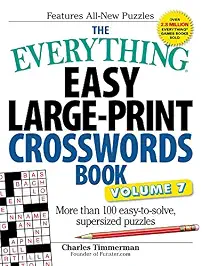
The Everything Easy Crossword Puzzle Book, from Adams Media, is a good option if quantity is one of your main priorities.
The collection contains roughly 200 puzzles and is designed to move gradually from easier material toward somewhat more challenging puzzles. That progression is useful because a beginner doesn’t necessarily want to stay at the same difficulty level forever.
The clues generally focus on familiar subjects and everyday vocabulary, which makes the book approachable without making every puzzle feel identical.
Its main advantage is straightforward: you get a lot of puzzles in one volume. If you’re looking for a book that can provide weeks or months of regular solving rather than something you’ll finish quickly, the large puzzle count is appealing.
The production quality is more conventional, though, so readers specifically looking for large print or a premium physical format may want to consider another option.
Choose this book if: you want a large collection and like the idea of gradually moving from very easy puzzles toward a little more challenge.
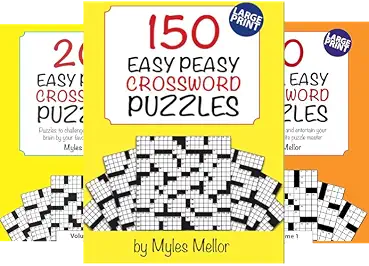
For someone who has genuinely never solved a crossword before, the Myles Mellor Easy Peasy series is one of the gentlest places to begin.
The puzzles are built around straightforward clues rather than heavily relying on wordplay or obscure references. That makes them easier to approach when you’re still learning basic crossword conventions.
The series is also available in different volumes and puzzle counts, so you don’t necessarily have to commit to one enormous collection.
The main limitation is also its biggest strength: experienced crossword solvers may find the clues too easy after they’ve gained some practice.
That’s not a problem for a true beginner. In fact, starting with a book that’s slightly below your eventual ability level can be a good way to learn how crossword clues and crossing letters work before moving up.
Choose this book if: you’ve never completed a crossword before and want the simplest possible introduction.
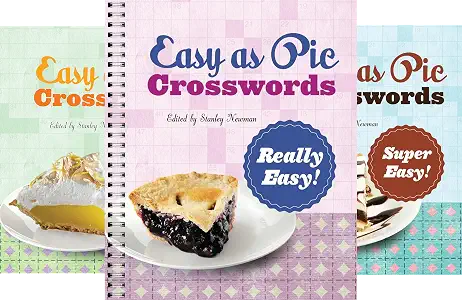
Stanley Newman’s Easy as Pie series is worth considering if you like the idea of solving puzzles around a theme.
Each volume contains themed crosswords, with longer answers connected by a central concept. For beginners, that can provide an additional clue when several answers seem difficult.
Instead of treating every clue as an isolated problem, you can sometimes use the theme to narrow down what a longer answer might be. Once you get used to that approach, it becomes an important part of how many crossword solvers think through a puzzle.
The series contains fewer puzzles per volume than some of the larger omnibus collections, so you’ll likely go through an individual book more quickly.
Choose this book if: you enjoy finding patterns and connections and want to learn how themes can help solve a crossword.
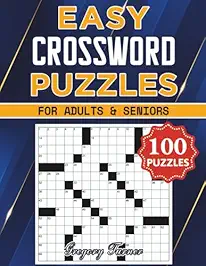
For some beginners, the biggest obstacle isn’t clue difficulty. It’s simply being able to read and write in the grid comfortably.
Gregory Turner’s crossword books put more emphasis on readability, with larger lettering and more generous grid space than many standard crossword collections.
That makes this type of book particularly appealing if you prefer solving for longer periods, have difficulty reading small print, or simply find a larger grid easier to work with.
The trade-off is that the clues are intentionally approachable, so this isn’t necessarily the book to choose if you’re already comfortable with easy crosswords and want a more demanding challenge.
Choose this book if: readability and comfortable writing space matter more to you than advanced clue construction.
How to Choose the Right Beginner Crossword Book
The easiest way to narrow down the choices is to think about how you actually want to solve.
Want to learn the traditional newspaper style?
Start with the New York Times Easy Crossword Puzzle Omnibus.
Prefer short puzzles that you can finish quickly?
Funster’s smaller grids are a better fit.
Want the largest number of puzzles in one book?
The Everything Easy Crossword Puzzle Book gives you plenty of material.
Never solved a crossword before?
Myles Mellor’s Easy Peasy series is the gentlest starting point.
Enjoy themes and pattern recognition?
Try Stanley Newman’s Easy as Pie series.
Prefer larger, easier-to-read print?
Look at Gregory Turner’s large-print crossword books.
There isn’t a universally correct choice here. A beginner who wants to eventually solve the New York Times crossword has different needs from someone who simply wants a relaxing ten-minute puzzle each evening.
The Benefits of Solving Crosswords as a Beginner
Crosswords are primarily a form of entertainment, but there is also some research interest in the relationship between mentally stimulating activities and cognitive health.
Research discussed by Harvard Health Publishing has found an association between regular crossword solving and a later onset of accelerated memory decline in some older adults with mild cognitive impairment. That is an association, however, rather than proof that crossword puzzles themselves prevent cognitive decline.
The National Institute on Aging likewise treats mentally stimulating activities as one part of a broader approach to healthy aging.
So it’s reasonable to think of crosswords as an enjoyable way to keep your mind engaged, but they shouldn’t be presented as a standalone solution for cognitive health.
Tips for Beginners: How to Get Better at Crosswords
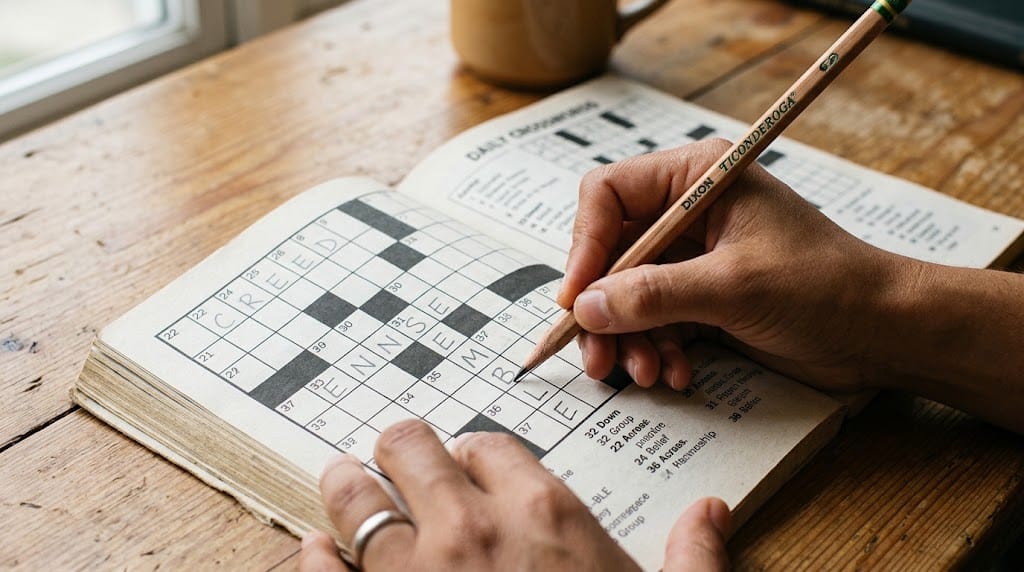
You don’t need to know hundreds of obscure words before you can become good at crosswords. A few simple habits can make the learning process much easier.
Start with the short answers.
Three- and four-letter clues are often easier to solve and can give you crossing letters that help with longer answers.
Move around the puzzle.
You don’t have to solve clues in order. If one is giving you trouble, skip it and come back after filling in some of the surrounding answers.
Pay attention to crossword conventions.
Abbreviations, plural clues, question marks, and clues written in the past tense can all provide useful information about the type of answer you’re looking for.
Use a pencil while you’re learning.
It gives you room to change an answer when the crossing letters prove you were wrong.
Solve regularly.
A few minutes several times a week can be more useful than solving one large batch every few weeks. Familiar clue patterns become easier to recognize with repetition.
Look up an answer when you’re stuck.
Checking an answer isn’t cheating when you’re learning. The useful part is understanding why that answer fits the clue and remembering the pattern the next time you encounter something similar.
Frequently Asked Questions
What’s the easiest type of crossword puzzle for a true beginner?
Look for puzzles labeled easy or beginner, especially those using direct, definition-style clues. Cryptic crosswords are considerably different and are generally better saved until you’re comfortable with standard crosswords.
Should I start with a small grid or a full 15×15 grid?
Either can work. A 9×9 or 11×11 grid usually feels less intimidating and takes less time to finish, while a 15×15 grid provides a more traditional crossword experience.
If you’re easily discouraged by unfinished puzzles, starting small is a sensible choice.
Are large-print crossword books worth it?
They can be, particularly if you prefer larger writing spaces or plan to solve for extended periods. The main benefit is comfort and readability rather than a fundamentally different type of puzzle.
How long does it take a beginner to finish an easy crossword?
There is no meaningful standard time. A beginner may take considerably longer than an experienced solver, and that’s completely normal.
The important thing is not how quickly you finish but whether you understand how the clues and crossing answers work. Speed tends to improve naturally with practice.
Is it okay to look up answers while solving?
Yes. Looking up an answer can be part of learning, especially when you’re new to crossword conventions. Try to understand why the answer fits rather than simply writing it down and moving on.
Final Thoughts
The best beginner crossword book is the one that matches your current ability and the way you want to solve.
If you want to work toward traditional newspaper crosswords, the New York Times Easy Crossword Puzzle Omnibus is a natural starting point. If you prefer short sessions, Funster’s smaller grids make more sense. Complete beginners may appreciate the simplicity of Myles Mellor, while readers who value large print may prefer Gregory Turner.
The important thing is to start with puzzles that are challenging enough to teach you something without making every page feel like a struggle. Once easy crosswords begin to feel comfortable, moving up to medium-difficulty puzzles is much easier.
If large-print puzzles are your priority, our guide to large-print crossword puzzle books for seniors is the next place to look. And once you’ve built some confidence, you can move on to our guide to medium-difficulty crossword puzzles for a greater challenge.