Advertiser Disclosure
We independently review everything we recommend. When you buy through our links, we may earn a commission.
Do Crossword Puzzles Really Boost Brain Power?

We get this question constantly on our team, especially since we’ve spent months digging into everything from large print crossword puzzle books for seniors to crossword books built for kids. So we decided to settle it once and for all: do crossword puzzles actually improve cognitive functioning, or is this just wishful thinking dressed up as a hobby?
Short answer: yes, and the evidence is stronger than you’d expect. Long answer? Keep reading, because how much crosswords help depends on your age, how often you play, and what kind of thinking you’re trying to protect.
What The Research Actually Says
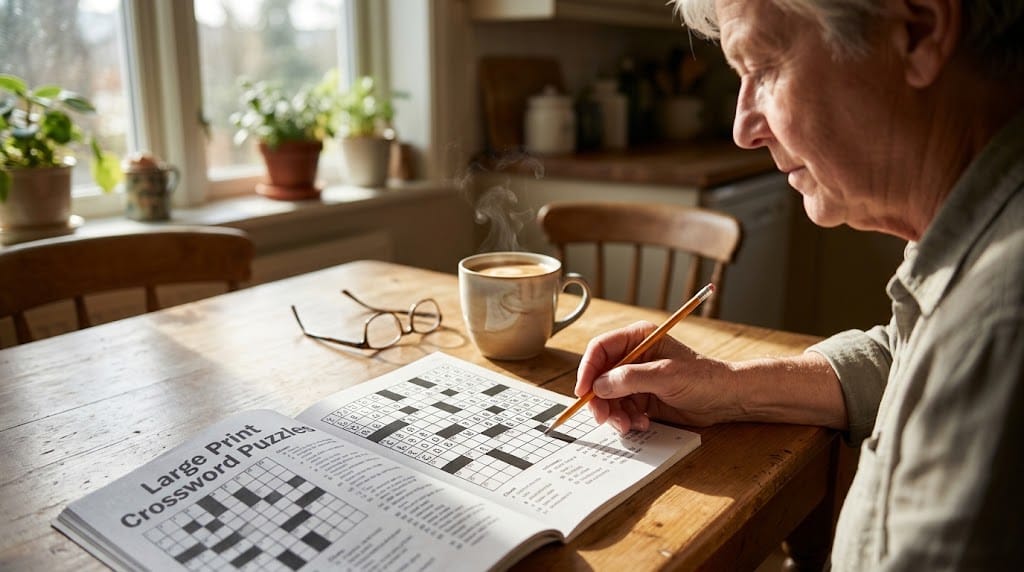
Let’s start with the study that turned heads across the neuroscience world. Researchers at Columbia University and Duke University ran a randomized controlled trial comparing web-based crossword puzzle training against computerized brain-training games in older adults with mild cognitive impairment (MCI). The results, published in NEJM Evidence, weren’t subtle. Participants who trained on crosswords showed greater cognitive improvement than those trained on cognitive video games, and even showed less brain shrinkage on MRI scans after 78 weeks.
That second part deserves a pause. We’re not just talking about people feeling sharper — researchers watched it show up on brain imaging. The study tracked 107 participants with mild cognitive impairment, randomly assigning them to either crossword training or cognitive games training, with intensive sessions for 12 weeks followed by booster sessions continuing out to 78 weeks. The crossword group came out ahead on both memory function and daily activities.
Curious whether this holds up outside a lab with older adults already showing cognitive decline? It does. A separate study out of the University of Exeter and King’s College London looked at word and number puzzle habits in a massive sample. More than 19,000 participants aged 50 and over took part, and the researchers found that the more regularly people played puzzles like crosswords and Sudoku, the better their brain function tended to be. That’s not a small pilot study you should take with a grain of salt — it’s one of the largest investigations of its kind ever conducted.
And the effect isn’t limited to Western research populations, either. A pre-post intervention study in Central Java, Indonesia, had elderly participants complete six crossword puzzle sessions over two weeks. Average Mini-Mental State Examination scores climbed from 24.74 to 26.20, a statistically significant jump with a p-value under 0.001. Translation: this wasn’t random noise. Something measurable happened in just two weeks.
Follow-up research is already underway to dig deeper. A newer 78-week COGIT-2 trial is currently comparing high-dose crossword training (four puzzles a week) against low-dose training (one puzzle a week) and a health-education control group across 240 participants with mild cognitive impairment, tracking everything from memory scores to brain imaging markers and blood biomarkers. Early findings from the earlier trial already point toward crosswords outperforming standard cognitive training on the ADAS-Cog scale used to measure Alzheimer’s-related decline.
So no, this isn’t folk wisdom passed down from your grandmother’s puzzle books. It’s backed by peer-reviewed clinical trials with real neuroimaging data behind them.
How a Crossword Puzzle Actually Works Your Brain
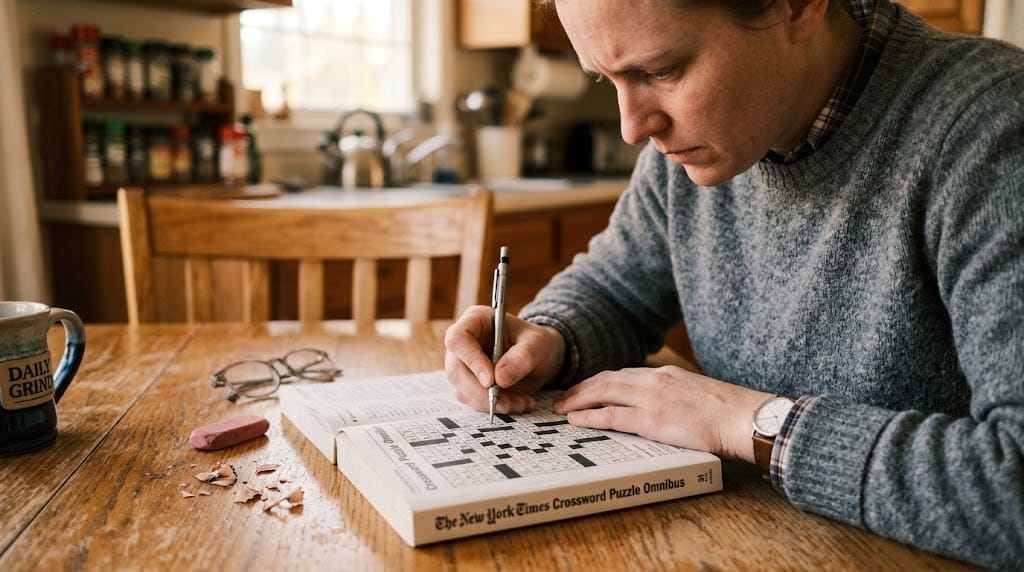
Here’s where it gets interesting. Crosswords aren’t just “word finding” — they’re a full-body workout for several distinct cognitive systems at once, which is probably why they outperform single-skill brain-training apps.
Verbal recall and language retrieval. Every clue forces your brain to search its internal dictionary and pull a specific word from memory under constraint (it has to fit the letter count, it has to match the crossing letters). This is a different skill than simply recognizing a word when you see it — it’s active retrieval, and active retrieval is one of the strongest known drivers of memory consolidation.
Working memory. You’re holding multiple partial answers in your head simultaneously while you test how they intersect. That juggling act strengthens the mental scratchpad you rely on for everything from following a recipe to remembering a phone number long enough to dial it.
Pattern recognition and inference. Crossword clues love wordplay, puns, and double meanings. Decoding them trains your brain to spot patterns and think flexibly instead of locking onto the first obvious answer — a skill that transfers surprisingly well to everyday problem-solving.
Processing speed. As you get more familiar with common crossword conventions (three-letter answers are often abbreviations, clues ending in a question mark usually signal wordplay), your brain gets faster at pattern-matching, which keeps mental processing speed from slowing down with age.
That’s four different cognitive muscles getting a workout in a single fifteen-minute puzzle. Compare that to a single-task brain-training app that only drills reaction time or number sequences, and it’s easier to understand why the Columbia-Duke trial found crosswords came out ahead.
Crosswords vs Brain-Training Apps: Who Actually Wins?

When it comes to head-to-head research, crosswords win. Not “it depends,” not “both have their place” — the randomized controlled trial data we mentioned above directly pitted crossword training against computerized cognitive games, and crosswords came out ahead on memory function, daily functioning, and brain volume preservation.
Part of the reason likely comes down to something researchers flagged directly: participants engaged more consistently with the familiar, low-friction format of crossword puzzles than with unfamiliar computerized cognitive games. A brain exercise only works if you actually stick with it, and crosswords have a hundred-year head start on being genuinely enjoyable rather than feeling like a chore disguised as a game.
That doesn’t mean brain-training apps are worthless. They’re fine as a supplement. But if you’re choosing one habit to build and stick with for the long haul, the evidence points toward the newspaper page over the app store.
Does Age Change How Much Crosswords Help?
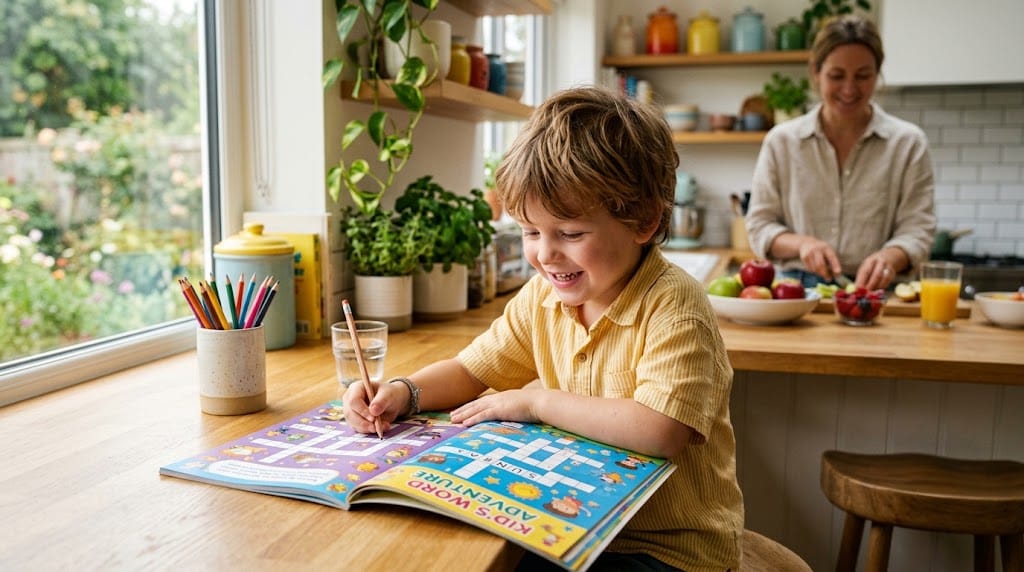
Yes, and understanding this matters if you’re picking puzzles for yourself or a family member.
For seniors and older adults, the benefits are the most thoroughly researched and the most clinically significant. This is where crosswords show measurable protective effects against cognitive decline, particularly for people already showing early signs of mild cognitive impairment. If you’re shopping for a parent or grandparent, starting with something accessible matters more than starting with something hard — we cover exactly what to look for in our breakdown of large print crossword puzzle books for seniors, since eye strain kills consistency faster than a tough clue ever will.
For working-age adults, the research is thinner but promising, largely because most clinical trials target populations already at risk for decline. Still, the underlying mechanisms — active recall, working memory, pattern recognition — don’t stop mattering just because you’re 35 instead of 75. Building the habit early is arguably a smarter long-term play than waiting until memory concerns actually show up.
For kids, crosswords serve a slightly different purpose. Instead of protecting against decline, they’re building vocabulary, spelling accuracy, and problem-solving patience from the ground up. If you’re introducing a child to puzzles, age-appropriate difficulty is everything — a grid that’s too advanced kills motivation instantly. We put together a full guide to crossword puzzle books for kids broken down by age range, so you’re not handing a seven-year-old a themed adult puzzle and wondering why they gave up in five minutes.
How Often Do You Actually Need to Play?
Based on the clinical trial protocols we referenced, the sweet spot for real cognitive benefit sits around three to four puzzles per week, done consistently over months rather than weeks. That’s a meaningfully higher bar than the “one puzzle on Sunday” habit most casual solvers fall into. The COGIT-2 trial is directly testing high-dose (four puzzles weekly) against low-dose (one puzzle weekly) protocols, which tells you researchers themselves suspect frequency matters more than most people assume.
Here’s the practical takeaway: a single crossword now and then is enjoyable, but if cognitive benefit is your actual goal, treat it like exercise. Nobody expects one trip to the gym to build strength. Crosswords work the same way — consistency beats intensity.
Frequently Asked Questions
Do crossword puzzles prevent dementia? No study has proven that crosswords prevent dementia outright, and anyone claiming otherwise is overselling the science. What the research does show is that regular crossword solving correlates with better cognitive function and, in at least one major trial, slower brain atrophy in people already experiencing mild cognitive impairment. Think of it as risk reduction and cognitive resilience-building, not a guarantee.
What age should someone start doing crosswords for brain benefits? There’s no wrong age to start, and earlier is better simply because habits are easier to build before decline becomes a concern. That said, the clearest clinical evidence exists for adults 50 and older, since that’s who most of the major trials studied.
Are crosswords better than Sudoku for brain health? They target different systems, so it’s not really a fair fight. Crosswords work verbal recall and language processing, while Sudoku works numerical and logical reasoning. The Exeter/King’s College London study actually grouped both together and found benefits from regular engagement with either — so the honest answer is that variety beats picking a single “winner.”
Does it matter if I do crosswords on paper or on an app? Not according to the research we reviewed — the major clinical trial used web-based digital puzzles and still found strong results. What matters far more is consistency and appropriate difficulty. If a paper puzzle book gets you solving more often because you’re not fighting a tiny screen or an intrusive app interface, paper wins for you personally, even if the science is format-neutral.
How long before I’d actually notice a difference? The Indonesian intervention study found statistically significant improvement in cognitive scores after just six sessions across two weeks, though that was a structured, guided intervention. For casual solo solvers, expect meaningful benefit to build over months of consistent play rather than days.
Can crosswords help with something other than memory, like vocabulary or focus? Absolutely, and this is honestly underrated. Beyond memory, regular solving strengthens vocabulary depth, sustained attention span, and tolerance for productive frustration — the ability to sit with a hard problem instead of giving up. That skill alone transfers well beyond the puzzle page.
The Bottom Line
Crossword puzzles aren’t a magic bullet, and nobody should treat fifteen minutes with a grid as a replacement for sleep, exercise, or social connection — all of which matter just as much for brain health. But the evidence is genuinely compelling: randomized controlled trials, large-scale population studies, and international intervention research all point in the same direction. Consistent crossword solving is linked to better memory function, sharper daily cognitive performance, and in at least one major trial, physically less brain shrinkage over time.
The catch is consistency. One puzzle a month isn’t going to move the needle. Three or four a week, sustained over months, is where the real research-backed benefit lives. So whether you’re picking up a puzzle book for yourself, a parent, or a curious kid, the smartest move is simple: start now, pick the right difficulty level for the solver, and treat it like the brain exercise the science says it actually is.