Advertiser Disclosure
We independently review everything we recommend. When you buy through our links, we may earn a commission.
How to Choose a Crossword Puzzle Book
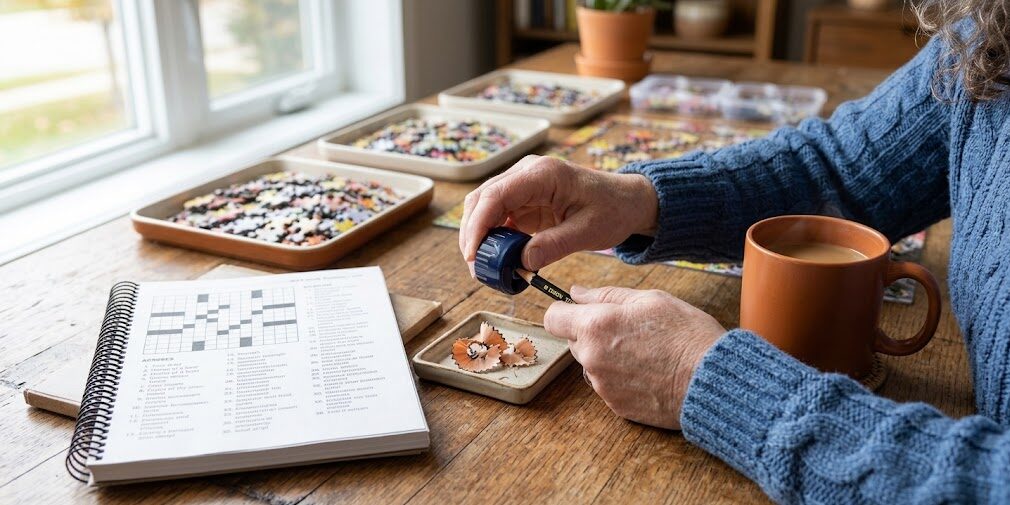
A crossword book that’s too hard turns a relaxing hobby into homework. One that’s too easy gets finished in a weekend and feels like a waste of money. Add tiny print, a spine that snaps shut on your hand and puzzles that all feel oddly the same, and it’s easy to see why so many half-finished books end up in drawers.
Our review team has spent a lot of time comparing crossword books, and the good news is that choosing well comes down to seven checks. Run through them in order, and you’ll land on a book you’ll actually finish. We’ll also name our top pick for most people, so you don’t have to guess.
Check #1: Match the Difficulty to Your Real Skill Level
This is the big one. If you get only one thing right, get this right.
Difficulty labels on crossword books are slippery. “Easy” from one publisher can feel like “medium” from another. The most reliable yardstick in the crossword world is the weekly difficulty ladder used by The New York Times. As documented in the paper’s puzzle history, the puzzles are designed to get harder through the week, with Monday easiest and Saturday hardest. Editor Will Shortz, who has run the section since 1993, has said he deliberately steepened that slope when he took over, making Mondays easier and Fridays and Saturdays tougher.
Here’s how to use that ladder when you shop:
- Brand-new solvers: Pick books built from Monday puzzles. The clues are direct, the themes are easy to spot and the answers are common words.
- Casual solvers: Tuesday and Wednesday collections add a little wordplay without punishing you.
- Confident solvers: Thursday brings tricks, like rebus squares, where one box holds several letters.
- Seasoned solvers: Friday and Saturday puzzles lean on puns, obscure references and clever misdirection.
One trap catches a lot of people: the Sunday puzzle. It looks intimidating because of its size, but it isn’t the hardest of the week. The Sunday crossword is typically meant to feel like a Wednesday or Thursday puzzle. It’s just bigger, so it takes longer.
Our rule of thumb: if you can’t finish a Monday puzzle, buy easy books. If you finish Mondays in under half an hour, move to a mixed book that climbs through the week. If you’re not sure, start easier than your ego wants. You can always level up, and early wins keep you coming back.
Check #2: Count the Puzzles and Check the Grid Size
Two numbers matter on the back cover: how many puzzles are inside, and how big each grid is.
Puzzle count changes the value math. A 50-puzzle book is a few weeks of solving for a daily player. A 200-puzzle omnibus can last months. Prices tend to land close together, which means the bigger book usually costs far less per puzzle. For example, a 50-puzzle New York Times Easy volume runs around $14 to $15, while a 200-puzzle easy volume lists at about $22 from the same publisher.
Grid size changes how a book feels. Weekday-style crosswords use a 15-by-15 grid, while Sunday puzzles stretch to 21 by 21. That’s more than double the squares. Think of a daily grid as a coffee-break puzzle and a Sunday grid as an afternoon project.
A quick way to decide:
- Solve in short bursts (commute, lunch break, waiting rooms)? Choose standard 15-by-15 grids.
- Like to settle in for an hour or two? Sunday-size puzzles will feel satisfying.
- Want to try both? Look for a book that mixes sizes.

Check #3: Look at the Print Size and Page Layout
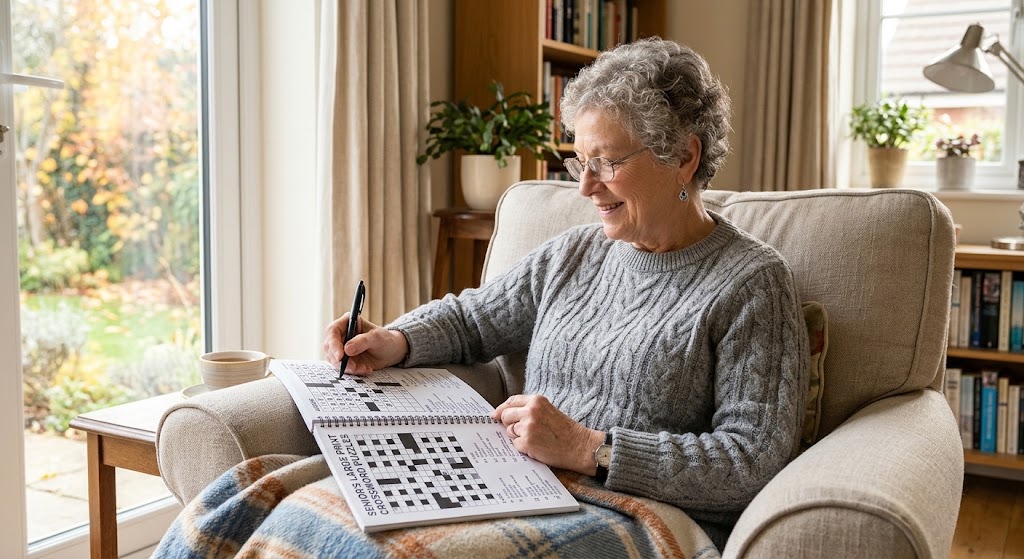
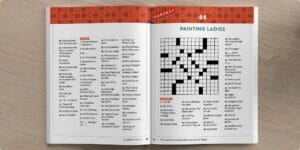
Here’s a detail most buyers ignore until it’s too late: clue text can be tiny. In a standard crossword book, the clues often run in compact columns, and the squares are sized to fit a lot of puzzle on each page.
If you squint, switch to large print. Don’t treat it as a compromise. Large-print books give you bigger grids, roomier squares, and clue text you can read without reaching for your glasses. Our team reaches for large print whenever the solver will be working in dim light, on a couch, or in a car.
Three layout signs to look for:
- Large squares: You’ll write letters more neatly and erase less.
- One puzzle per page: It’s easier on the eyes than two crammed together.
- Clues printed near the grid: You won’t lose your place flipping around.
Many large-print books also run longer. The Brain Games large-print crossword, for instance, comes in at 192 pages and is spiral-bound, which shows the pages are doing a lot of work to keep things readable. If you’re shopping for an older relative, we’ve also put together a more in-depth guide to large-print crossword puzzle books for seniors.
Check #4: Know Who Wrote and Edited the Puzzles
Crossword quality lives and dies with the people behind the grids. A great editor makes sure the clues are fair, the answers are real words, and the themes are actually funny. Weak puzzle books often skip that step, and you can feel it when you solve: awkward answers, repeated fill, and clues that make you groan for the wrong reasons.
Look for a recognizable name on the cover.
- Will Shortz: Editor of The New York Times crossword since 1993, founder of the American Crossword Puzzle Tournament and the name behind countless crossword collections. His books are the safest bet for fair, polished puzzles.
- Merl Reagle: A Sunday-crossword legend who constructed a weekly puzzle for decades. Shortz has praised Reagle’s themes as fresher and funnier than anyone else’s, and his books are loved for their humor.
- Publisher imprints like Penny Press and Dell: These produce huge volumes of crosswords, often at a friendly price. They’re a smart choice if you want quantity.
- Anonymous self-published books: Be careful here. Some are fine, but many are computer-generated grids with thin editing. If a book has no named editor and a vague description, it’s worth reading the sample pages first.
A good name on the cover isn’t a guarantee, but it’s the fastest shortcut to quality.
Check #5: Pick the Binding That Fits How You Solve
This sounds minor until you’ve fought a paperback that refuses to stay open. Binding changes how you solve more than most people expect.
- Spiral-bound: Lies completely flat and folds back on itself. This is the best choice if you solve at a table, on a lap, or in a car. Many of the Will Shortz easy-series volumes use covered spiral binding for lay-flat solving.
- Perfect-bound paperback: The classic glued spine. It’s cheaper and slimmer, but the center puzzles can curve away from you.
- Removable or perforated pages: Handy for travel, because you can tear out a single puzzle and leave the rest at home.
If you tend to solve while holding the book in one hand, spiral binding wins every time. If you’re a desk-and-coffee solver who likes a tidy bookshelf, a paperback is fine.
Check #6: Make Sure Solutions Are Easy to Find
Even good solvers get stuck. What matters is what happens next. Check that the book includes a full answer key, and look at how it’s laid out. Many books gather solutions at the back, which is exactly where you want them, because you’re less likely to see a spoiler by accident. Brain Games, for example, puts every solution in a final section at the back of the book.
A few extras are worth looking for if you’re learning:
- Short hints or tips in the introduction
- Clearly marked difficulty on each puzzle
- Solutions printed at a readable size, so you can double-check your work without squinting
Check #7: Pay Attention to Clue Style and Themes
Two books with the same difficulty can still feel completely different. One might lean on trivia and general knowledge, while another favors puns and wordplay.
Themes matter, too. Many crosswords have a hidden theme where several long answers share a trick, like adding a letter or changing a vowel. If you love that “aha!” moment, pick a book that highlights themed puzzles. If you prefer straightforward vocabulary, look for books described as “straightforward” or “classic.”
This is also where interests come in. Bible crosswords, sports crosswords, and puzzles aimed at kids all use clue styles tuned to their audience. If you’re buying for a young solver, our guide to crossword puzzle books for kids walks through age ranges and clue styles in detail.
Frequently Asked Questions About Choosing a Crossword Puzzle Book
What’s the best crossword puzzle book for beginners?
Our pick is a New York Times Easy Crossword Puzzles volume. It uses Monday-level puzzles, which are the gentlest in the paper’s weekly lineup, and the lay-flat spiral binding makes solving comfortable. If you want more puzzles for the money, step up to the 200-puzzle Essential Easy volume.
Are crossword puzzle books actually good for your brain?
The research is encouraging, but it’s worth keeping in perspective. A 2022 study in NEJM Evidence followed 107 participants with mild cognitive impairment and compared crossword training with computerized cognitive games. At both 12 and 78 weeks, crosswords beat the games on the main cognitive measure, and the crossword group also showed less brain shrinkage on MRI at 78 weeks. The crosswords used in that study were medium difficulty, roughly equal to a Thursday New York Times puzzle, and people solved four days a week for about 30 minutes each. The authors themselves noted a limitation: the study didn’t include a group that did no training at all, so more research is needed.
A separate, much larger observational study found a similar pattern. The PROTECT study looked at nearly 20,000 adults over 50 and found that the more regularly people did word and number puzzles, the better their brain function tended to be. Observational studies can’t prove cause and effect, though, so treat this as a good reason to enjoy your hobby rather than a medical promise.
How hard are Sunday crosswords compared with daily ones?
Sunday puzzles are bigger, not necessarily harder. They run on a 21-by-21 grid compared with the daily 15-by-15, and the Times aims for roughly Wednesday or Thursday difficulty. If you can finish a mid-week puzzle, you can finish a Sunday; you’ll just need more time.
Should I buy a large print crossword puzzle book?
If you ever squint at clues, struggle in low light, or just want a more relaxed solve, yes. Large print makes the grid and clues easier to read, which helps you focus on the puzzle instead of the page. For more on this, read our breakdown of crossword puzzle books designed for seniors.
Is a spiral-bound or paperback crossword book better?
For most people, spiral. It lies flat, folds back, and makes it easier to solve on a lap or in a car. Paperbacks are cheaper and slimmer, which is a fair trade if you mostly solve at a desk or want a thicker book with more puzzles.
How do I know when I’m ready for harder puzzles?
Use the finish-time test. When you can complete most Monday-level puzzles without looking up answers, try a mixed-difficulty book like ABCs of Crosswords or a medium-level collection. We cover that jump in our guide to medium-difficulty crossword puzzle books.
Do I need a special pencil for crosswords?
Not special, but a pencil with a good eraser makes a real difference. Most solvers pencil in uncertain answers, and a clean eraser saves the page. Pens are for the brave.
Pick the Book You'll Actually Finish
The best crossword book isn’t the hardest or the thickest. It’s the one you’ll still be reaching for three weeks from now. That means matching difficulty to your real skill, picking a print size and binding you can live with, and choosing puzzles from an editor you trust.
If you’re new to all this, buy The New York Times Easy Crossword Puzzles. It’s the simplest way to build confidence, and you’ll know within a few puzzles whether you’ve caught the habit. If you’re already hooked, move up to ABCs of Crosswords and watch your solving speed improve week by week.
Grab a pencil, pick your book, and start with Monday. You’ll be surprised how quickly the grid starts to fill.