Advertiser Disclosure
We independently review everything we recommend. When you buy through our links, we may earn a commission.
Best Spiral Bound Crossword Puzzle Books
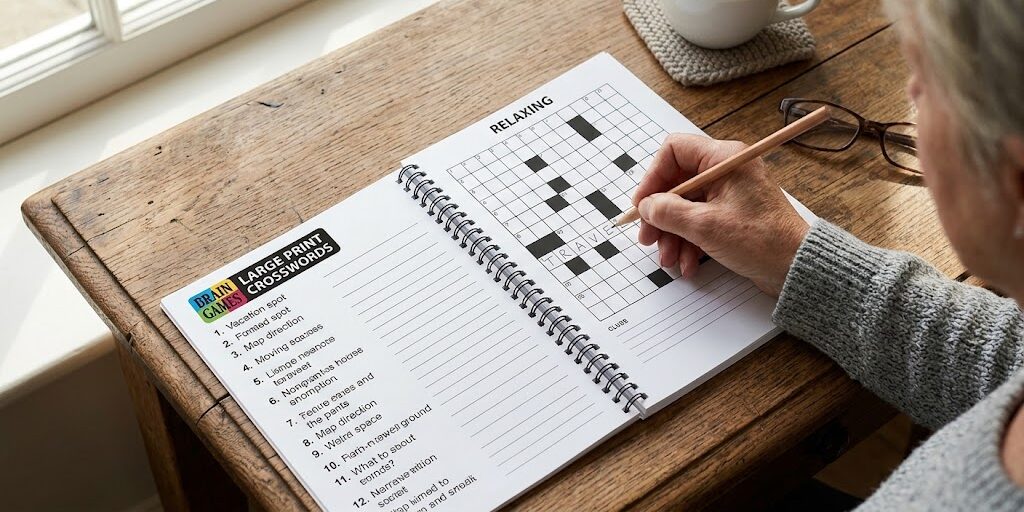
If you’ve ever wrestled a paperback crossword book into submission, you already know the problem. The spine curls up, the grid slides under the crease, and by puzzle fifteen you’re pressing the pages down with a coffee mug just to write a four-letter word. Spiral binding fixes that annoyance almost completely, which is why spiral bound crossword puzzle books have become the default choice for people who solve on the couch, on planes, and at the kitchen table.
But “spiral bound” only tells you how the book is held together. It says nothing about whether the puzzles are enjoyable, whether the print is comfortable, or whether you’ll finish the book or abandon it at page 40. Those are the details that decide whether you’re glad you bought it.
Our Quick Picks
- Best overall: Stanley Newman & Leslie Billig Sunday Crosswords series. The most satisfying puzzles of the three, and the series with the widest difficulty range.
- Best for large print and relaxed solving: Brain Games Large Print Crosswords. Big grids, big clues, and each puzzle laid out across two pages.
- Best for budget and volume: Kappa Braintainment Crosswords Spiral Puzzle Book. Typically the lowest list price of the three, with a generous puzzle count and a themed mix.
If you only read one section, make it the head-to-head comparison further down. We’ll tell you exactly who should pick which.
Why Spiral Binding Matters More Than You'd Think
Crossword books get abused in ways that other books don’t. You flip them open, press hard with a pen, fold them back on themselves, stuff them into tote bags, and reopen them with sticky fingers. A glued spine isn’t built for that. A spiral is.
Here’s what the format actually changes in daily use:
- The book lies flat, and it stays flat. This is the headline benefit. Your writing hand isn’t fighting a curved page, so your letters stay legible, and you’re less likely to smudge the clue next to your grid.
- You can fold the cover back. That turns a full-size book into a one-handed solving pad, which is handy on a train, in a waiting room, or in bed.
- Pages don’t crack from the spine. Perfect-bound books tend to shed pages as the glue dries and flexes. Spiral books mostly avoid this.
- Left-handed solvers get a break. Because spirals sit at the edge, you’re not working across a gutter. It’s a small thing until you’re the one who’s been smudging the ink for years.
There are trade-offs, and we’d rather you know them now. Spiral books are bulkier in a bag than a slim paperback. The coil can catch on a tote lining, and the wire can bend if something heavy lands on it. A few styles also leave a ridge of coil under your wrist if you solve on the right-hand page. None of these are deal-breakers, but they’re real, and in most cases they’re a fair price for a book that actually stays open.
How We Evaluated These Books
Our framework is built around the things that decide whether a crossword book earns a spot on your coffee table or ends up in a donation bag. We weighed puzzle quality and editing, difficulty range, print size and layout, page count and puzzle count, whether solutions are included, paper and binding details, and price per puzzle.
Editions of the same series vary, and so does paper quality between printings. Our recommendations below reflect what those details mean for real solving, but we’d encourage you to flip through a copy in a store if you’re picky about paper or font.
Now, the books themselves.
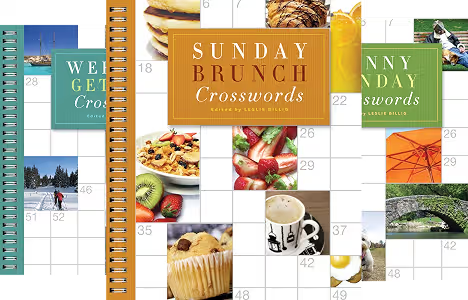
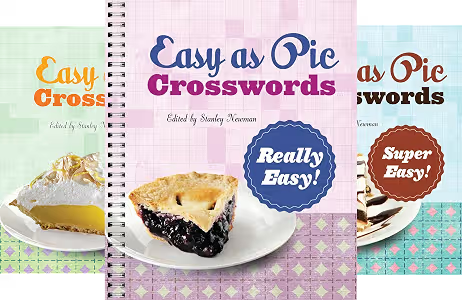
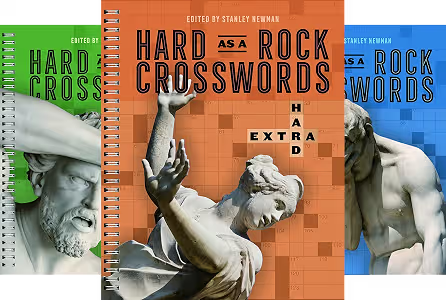
Most crossword books are collections of filler. This series feels different because it reads like a newspaper puzzle page that happens to be bound in a coil, and that makes sense once you know where the material comes from: Stanley Newman has edited the Newsday Sunday crossword since 1988 and the daily since 1992, and the Sunday Crosswords titles from Puzzlewright Press typically gather 72 Sunday-sized puzzles that originally ran in the paper, built by an all-star lineup of constructors. Leslie Billig, the other name on the series, is a longtime crossword editor who has edited her own entries in the same line, including titles such as Weekend Picnic Crosswords and Sunny Sunday Crosswords. In practical terms, this means you’re getting themed grids with a coherent idea running through the longest answers, which is the thing that makes a good crossword feel like a small mystery you’re solving rather than a vocabulary quiz you’re enduring. Picture a rainy Sunday and a pot of coffee: the large grids give you room to settle in for an hour, while the semi-concealed spiral on newer titles like Unplugged Weekend Crosswords keeps the page flat so your hand isn’t fighting the book. The difficulty is also easier to predict than in most series, because the titles are labeled by tone. Relaxing Sunday Crosswords is billed as medium difficulty, Pajama Weekend Crosswords leans medium-hard, and the daily-size Easy as Pie line, which holds 72 weekday-style puzzles in a 96-page book, is the gentler on-ramp for beginners or anyone returning to crosswords after a long break. Some titles also add short “fun fact” tidbits about select answers, which is a nice touch when you finish a puzzle and want to learn something. Reader feedback on several of the Sunday titles tends to land around the 4.7-star mark on Amazon, which is a strong showing for a category where many books are mediocre. The trade-offs are real, though. These are not large-print books, so if small type is a hurdle, you’ll find the clues tighter than in the Brain Games option below. Sunday-sized grids also demand more time and patience, so they’re a poor fit if you want a quick five-minute puzzle on the bus. And at roughly $11.99 to $12.99 list price, they cost a little more than the Kappa book, though the per-puzzle price is still modest. If you want a book that rewards you for paying attention, this is the one we’d start with, and we’d suggest picking your difficulty tier deliberately: Easy as Pie if you’re rusty, a Sunday title if you’re comfortable, and the Hard as a Rock line if you want a real fight.
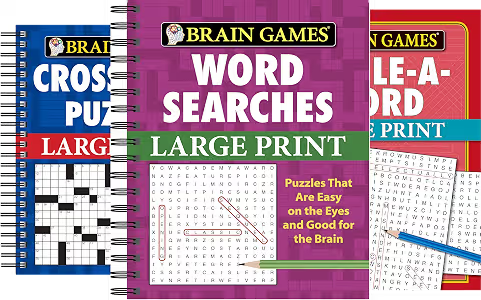
The first thing you notice about Brain Games is how little it asks of your eyes. The large print editions enlarge both the clues and the grids, and each puzzle is typically spread across two facing pages so you’re never squinting at a cramped corner or juggling a clue list that runs onto the next page. That layout matters more than it sounds. If you’ve ever abandoned a crossword because the clues were printed in a font that felt like terms and conditions, you’ll understand why a bigger grid and bigger squares change the whole experience, especially in dim evening light or for anyone who solves without reading glasses on hand. The standard 192-page spiral edition, which measures about 9.1 by 7.7 inches and weighs somewhere around a pound, usually offers more than 80 puzzles, and the answer key sits at the back of the book so you can check a stubborn word without hunting. The book lays flat, the puzzles cover everyday subjects such as food, movies, music, and hobbies, and the tone is intentionally unthreatening, which is why it’s a natural gift for a parent, grandparent, or friend who enjoys puzzles but doesn’t want to be humbled by them. Think of it as the crossword you pick up when you want to unwind, not the one you attack with a thesaurus. That’s also where the trade-offs show up. Reader feedback is a bit mixed on difficulty: some buyers describe the puzzles as challenging in the way they wanted, while others call them easy but not trivial, and since Brain Games has released many editions with different puzzle counts and covers, your experience will depend partly on which one you pick up. Some versions are even wire-bound with fewer pages, such as one 160-page edition with 70 puzzles, so it’s worth confirming the page count before you buy. Experienced solvers who like tricky wordplay, long themed answers, or a real sense of progression may find the puzzles a touch plain next to the Newman and Billig books. If comfort is your top priority, though, this is the one that wins, and nothing else here comes close on readability.
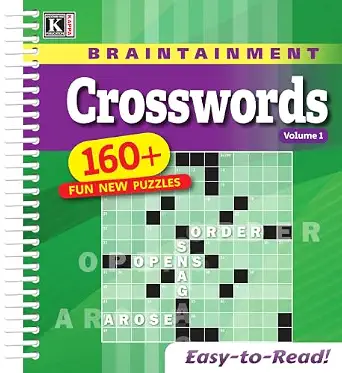
Not everyone wants to spend $12 or more on a book they’ll mostly use in short bursts, and that’s the gap the Braintainment crossword book fills. Published in September 2023, it’s a 192-page spiral-bound volume (roughly 7.8 by 9.1 inches) that has typically listed around $9.99 on Amazon, which makes it the most affordable of our three picks at list price, and some retail listings describe it as holding more than 160 puzzles. Kappa’s own description emphasizes themed variety, with topics ranging from nature and travel to sports and pop culture, plus a solutions section at the back of the book, and the lay-flat spiral is exactly what you want in something you’ll toss into a bag for a trip. That puzzle count is the real draw: if you tend to burn through crossword books quickly, a bigger stack of puzzles for less money stretches the value further, and it’s easy to imagine keeping this one in a glovebox, a carry-on, or a bedside drawer for the days when you have ten spare minutes. The book also has a respectable 4.4-star average across roughly 200 Amazon ratings at the time we checked, which suggests most buyers are satisfied with what they get. Now for the trade-offs, because there are a few. Publicly available detail about this book is thinner than for the other two, so we couldn’t confirm the exact print size, the difficulty curve, or the puzzle sources, and Kappa’s own marketing is fairly general. That means it’s harder to predict how challenging it will feel. It also isn’t marketed as large print, so people with vision concerns should look at Brain Games first. And because its strength is volume and price rather than editorial polish, we’d expect it to feel less distinctive than the Newman and Billig collections. In short: it’s a smart, low-risk buy for casual solvers who want a lot of puzzles for the money, and we’d steer more demanding solvers toward the series above.
Which should you choose?
Here’s the decision, stated plainly instead of hiding behind “it depends.”
- If you want the most satisfying puzzles, choose the Newman and Billig series. The themed construction and clear difficulty labeling make it the strongest all-around crossword experience here. It’s also the one most likely to make you want a second volume.
- If you or the person you’re buying for struggles with small print, choose Brain Games. Large print isn’t a nice-to-have for some solvers; it’s the entire point, and this book delivers it more convincingly than the other two.
- If you want the most puzzles for the least money, choose Kappa. It won’t be the most polished, but the lower price and higher puzzle count make it hard to argue with for casual use.
- If you’re giving a gift to someone you don’t know well, choose Brain Games or an Easy as Pie title. Both are forgiving and less likely to frustrate someone who isn’t sure what level they’re at.
One more comparison worth making: Newman and Billig versus Brain Games. These two are often confused because both appeal to the same “relaxed solver” audience, but they solve different problems. Brain Games is built around comfort, which means bigger type and more breathing room. Newman and Billig are built around craft, which means better themes and smarter clues. If you can read standard print comfortably, craft wins. If you can’t, comfort wins, and that isn’t a close call.
How to Choose the Right Spiral Bound Crossword Book for You
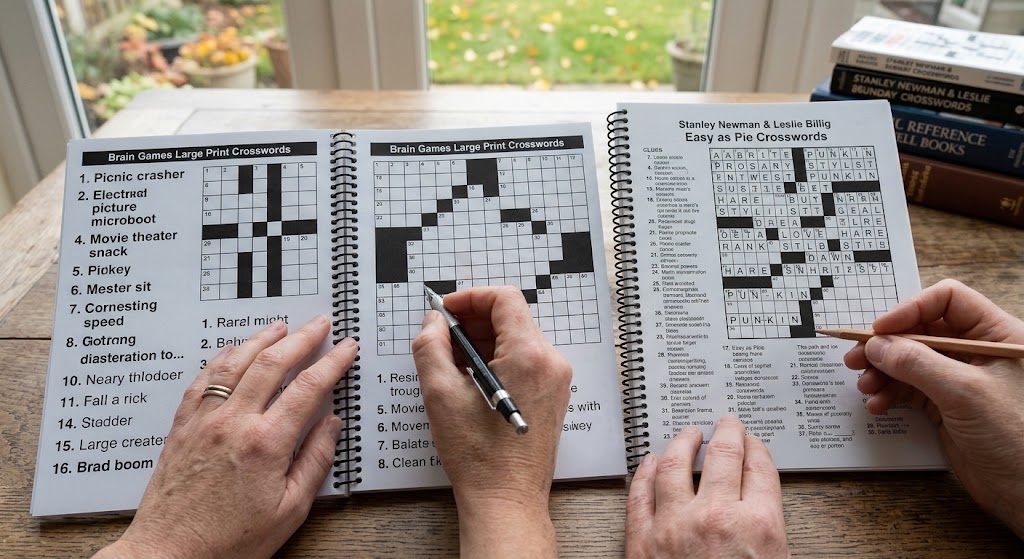
Even with our picks in hand, it helps to know what to look for when you shop on your own. These are the factors that matter most.
1. Puzzle size
Crossword grids come in two common sizes: the 15-by-15 daily format and the larger Sunday-sized format. Daily-size puzzles are quicker, often 10 to 30 minutes depending on your skill, and suit commutes and coffee breaks. Sunday-sized puzzles are bigger and usually themed, and they reward longer sessions. If you’re not sure, start with the daily size, which is what the Easy as Pie line uses.
2. Difficulty labeling
A book with a clear difficulty label saves you from the most common crossword-book mistake: buying something too hard, getting discouraged, and quitting. Look for words like “easy,” “medium,” or “challenging” in the title or description, and pay attention to reviews that mention difficulty. If a book doesn’t state its level, treat it as a moderate unknown and lean on reader feedback.
3. Print size and layout
Check whether the book is large print, whether clues appear on the same page as the grid, and whether puzzles are spread across two pages. These details affect comfort more than any other single feature, and they’re the one thing you can’t easily judge from a product photo. When the print size isn’t specified, assume it’s standard.
4. Puzzle count versus page count
A 192-page book doesn’t necessarily contain 192 pages of puzzles. Large print layouts use more pages per puzzle, and answer keys take space too. That’s why a 192-page Brain Games book and a 192-page Kappa book can hold very different numbers of puzzles. Compare puzzle counts, not just page counts, if value matters to you.
5. The answer key
Every book in this guide includes solutions in the back. It’s still worth checking, because a few budget puzzle books skimp. A good answer key should be easy to find and clearly numbered, and it should let you check a single word without spoiling the rest of the puzzle.
6. Paper quality
Smooth, durable paper makes erasing less of a chore and keeps ink from bleeding through, which matters if you solve in pen. Some newer titles in the Newman series highlight durable paper, but paper varies between printings, so if you’re picky, check recent reviews for comments on bleed-through.
7. Price per puzzle
Divide the price by the number of puzzles. A $9.99 book with 160 puzzles works out to roughly six cents per puzzle, while a $12.99 book with 72 larger puzzles works out to about eighteen cents each. That doesn’t mean the cheaper one is better, because Sunday-sized puzzles take much longer to solve, but it’s a useful way to compare apples to apples.
Frequently Asked Questions About Spiral Bound Crossword Puzzle Books
What are the best spiral bound crossword puzzle books?
For most solvers, we’d pick the Stanley Newman and Leslie Billig Sunday Crosswords series for quality, Brain Games Large Print Crosswords for readability, and Kappa’s Braintainment Crosswords for budget-friendly volume. The right one depends mainly on your print-size needs and how much of a challenge you want.
Are spiral bound crossword books better than regular paperbacks?
For solving, usually yes. A spiral lies flat and lets you fold the book back on itself, which makes writing easier and keeps the pages from cracking along the spine. The trade-off is bulk, since a spiral book takes a bit more room in a bag.
Which spiral bound crossword book is best for beginners?
We’d point beginners to the Easy as Pie titles from Stanley Newman, which are daily-size and aimed at newcomers and out-of-practice solvers, or to Brain Games if you also want large print. Both are forgiving, and both include answer keys.
Which is best for seniors or people with vision difficulties?
Brain Games Large Print Crosswords. The clues and grids are enlarged, and the two-page layout gives you more room to read and write. If you’re shopping for someone else, confirm that the edition you’re buying is labeled large print, because the Brain Games line includes several formats.
How hard are the Newman and Billig crosswords?
It depends on the title. Relaxing Sunday Crosswords is described as medium difficulty, Pajama Weekend Crosswords as medium-hard, and the Easy as Pie line as gentle. The Hard as a Rock line is aimed at solvers who want a serious challenge. Reading the description before you buy is the best way to pick the right level.
How many puzzles are in a typical spiral bound crossword book?
It varies widely. Many Sunday Crosswords titles contain 72 puzzles, Brain Games large print editions commonly contain somewhere between 70 and 90, and some Kappa listings describe 160 or more. Because layouts differ, always compare puzzle counts rather than page counts.
Do crossword books include answers?
All three books in this guide do. The solutions are in the back of the book.
Are crossword puzzles actually good for your brain?
Solving crosswords exercises vocabulary, recall, and pattern recognition, and many people find them relaxing. Still, the research on whether puzzles protect against cognitive decline is mixed, so we’d treat crosswords as an enjoyable mental activity rather than a guaranteed health intervention. Some books, including those in the Brain Games line, are marketed with brain-fitness language, but you should read that as marketing rather than medical advice.
Can I solve spiral-bound crosswords in pen?
You can, as long as you’re confident, and paper quality matters here. Durable, smooth paper handles ink better. If you’re unsure, start in pencil on a new book and test how the paper handles erasing before you commit.
What’s the best crossword book to give as a gift?
For someone whose skill level you don’t know, a forgiving option such as Brain Games or an Easy as Pie title is the safest bet. For a confident solver who enjoys a challenge, one of the medium-hard Sunday titles from Newman and Billig is a more exciting gift.
Are these books good for travel?
Yes, with caveats. The Kappa book’s spiral and relatively compact size make it easy to pack, and Brain Games books lie flat on a tray table. The Sunday-sized Newman and Billig titles are larger, so they take up more room in a carry-on, though the bigger grids are nicer once you’re settled.
Practical Tips for Getting More Out of Your Crossword Book
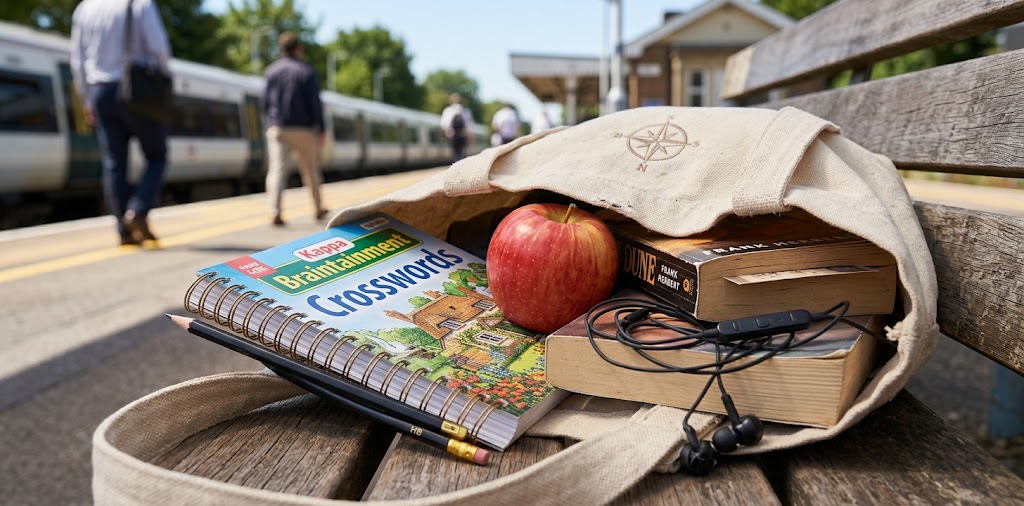
Once you’ve picked a book, a few habits make it more enjoyable:
- Start with the easier puzzles, even if you’re experienced. Early wins build momentum and help you adapt to a constructor’s style.
- Fill in the sure things first. Short, obvious answers give you crossing letters that unlock the harder entries.
- Use the theme. In themed puzzles, the longest answers usually share a trick. Figuring it out early can crack half the grid.
- Keep a small eraser handy. Spiral books are easy to carry, but you’ll still want to fix mistakes cleanly.
- Take breaks. If a corner has you stuck, step away for ten minutes. A fresh look often reveals what you missed.
- Check the answer key sparingly. Looking up a single word is fine, but resist the urge to peek at the whole solution.
If you enjoy puzzle books generally, you may also like our guide to large print puzzle books for easier reading, our roundup of crossword puzzle books for beginners, and our picks for travel-friendly puzzle books. We’ve linked them here because they’ll help most if you’re still deciding what kind of book you want.
Which Spiral Bound Crossword Book Should You Buy?
After comparing all three, our recommendation is straightforward. The Stanley Newman and Leslie Billig spiral-bound crossword series is the best choice for most people. It’s the strongest in puzzle craft, it offers the clearest difficulty range, and its readers consistently rate it well. The limitations are standard-size print and a slightly higher price, and neither should stop you unless reading comfort is a concern.
If that is a concern, Brain Games Large Print Crosswords is the right book. It sacrifices some puzzle sophistication for a layout that’s genuinely easier to read, and for many solvers that’s the better trade. Kappa’s Braintainment Crosswords is the value pick, and it makes sense if you want plenty of puzzles at a low price and aren’t picky about editorial polish. Its main drawback is that less is publicly documented about its print size and difficulty, so it’s a slightly bigger gamble than the other two.
Whichever you choose, you’ll end up with a book that lies flat, travels easily, and stays open when you need it to. That alone is a meaningful upgrade over a paperback that fights you on every page. Pick the one that matches how you actually solve, and you’ll likely finish it, which is the real measure of a good crossword book.