Advertiser Disclosure
We independently review everything we recommend. When you buy through our links, we may earn a commission.
The Best Heated Lunch Box for Car
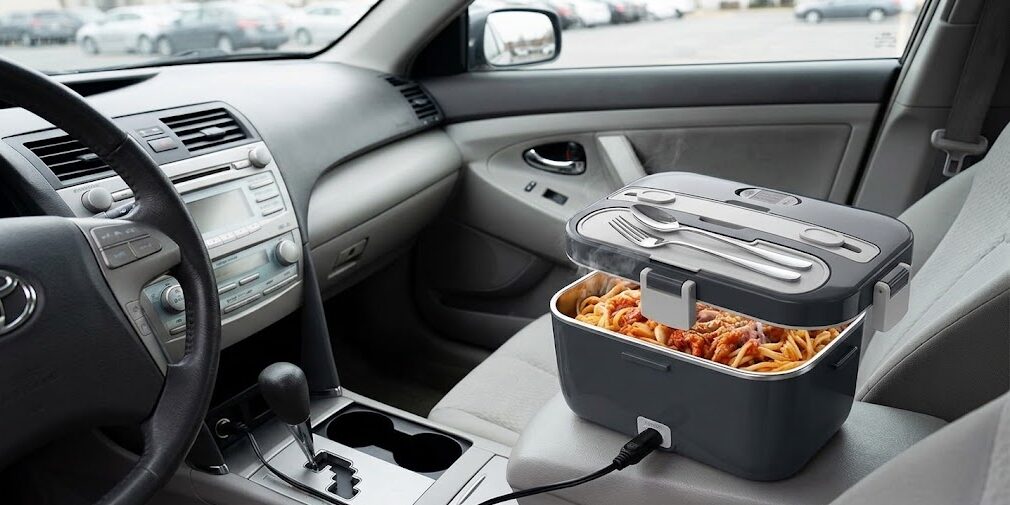
Most of us know the feeling. It’s 12:40, you’ve been driving or working since early morning, and the lunch you packed with good intentions is now a cold, slightly sad container of leftovers. The nearest microwave is either broken, occupied, or forty minutes away. So you eat it cold, or you grab drive-thru food you didn’t plan on buying.
A heated lunch box fixes that problem in a surprisingly simple way. Plug it into your car’s 12V socket (or a wall outlet at home), wait about 20 to 40 minutes, and eat something that actually tastes like last night’s dinner. For commuters, delivery drivers, truckers, contractors, and anyone whose “break room” is a driver’s seat, it’s one of the more practical gadgets you can buy for under the price of a few fast-food meals.
Ready to buy? DUPASU Electric Lunch Box Food Warmer 1.8L is our #1 pick — see it on Amazon
Everything We Recommend
✅ We recommend these products based on an intensive research process that’s designed to cut through the noise and find the top products in this space. Guided by experts, we spend hours looking into the factors that matter to bring you these selections.
⭐ 2.5 million+ people assisted in the last 30 days ⭐
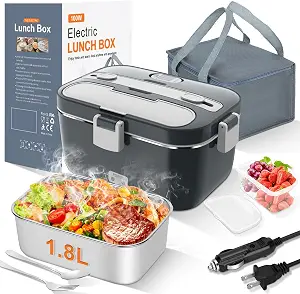
Our Pick for Most Drivers
Heat homemade meals in 20 to 30 minutes with a 100W electric lunch box and convenient exhaust cover.
Pack meals in a 1.8L stainless steel container with a 0.45L salad box and leak resistant lid.
Enjoy versatile heating with 110V to 230V home power and 12V or 24V vehicle compatibility.
Clean detachable food containers, utensils, and plastic compartments in the dishwasher, keeping the heating base dry.
Carry your lunch with the included insulated bag, making this portable food warmer practical for work and travel.
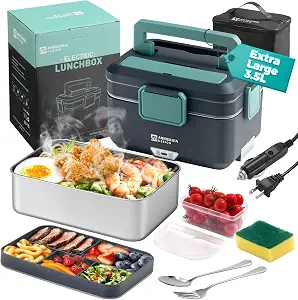
For Big Appetites and Two-Part Meals
Pack generous meals in a 3.5L lunch box featuring a 2.5L stainless steel container, 1L PP container, and 0.45L fruit tray.
Choose single or double layer heating to separate foods and warm both tiers or only the stainless steel container.
Heat meals in 20 to 30 minutes with 100W PTC technology and 12V, 24V, or 110V power compatibility.
Enjoy durable, food grade 304 stainless steel construction designed for reliable food storage and everyday use.
Simplify cleanup with a removable dishwasher safe stainless steel container and an included sponge for hand washing.
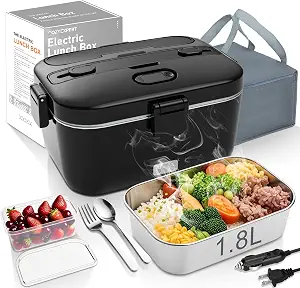
The Budget Route to 100W
Heat meals in 20 to 30 minutes with a 100W electric lunch box for convenient hot lunches.
Pack meals in a 1.8L stainless steel container with a 0.45L snack box and dishwasher safe utensils.
Enjoy versatile heating with 12V and 24V vehicle outlets or 110V to 230V home and office power.
Carry meals securely with a silicone sealed lid, four snap closures, a built in handle, and an insulated bag.
Give a practical gift with this portable food warmer, designed for work, travel, and everyday use.
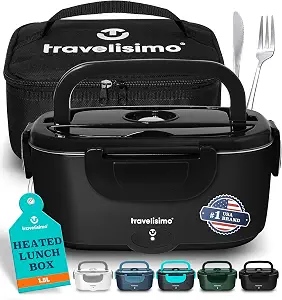
Compact, With One Habit to Learn
Enjoy hot, homemade meals anywhere with a portable electric lunch box designed for convenient everyday dining.
Heat meals in your car, truck, or office with 110V, 12V, and 24V power compatibility.
Warm food in 20 to 30 minutes with a 100W electric lunch box for busy workdays.
Store meals in a stainless steel container designed for durable, hygienic food storage and daily use.
Pack generous portions in the 1.5L lunch box and simplify cleanup with dishwasher safe components.
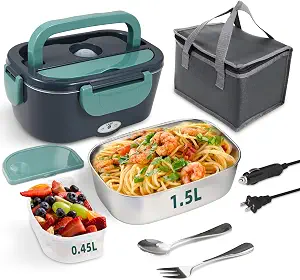
The Cheapest Way to Try One
Enjoy convenient meal heating at home, work, or on the road with 12V, 24V, and 110V compatibility.
Pack balanced meals in a 1.5L stainless steel container with a separate 0.45L PP compartment for snacks.
Heat meals in 25 to 40 minutes with efficient 80W heating for convenient dining on busy days.
Carry meals comfortably with an ergonomic handle, insulated bag, leakproof gasket, and a utensil compartment that doubles as a phone stand.
Simplify cleanup with dishwasher safe containers and enjoy added peace of mind with SOHIDA’s one year warranty.
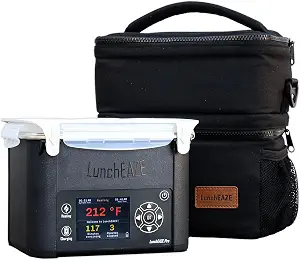
The One for Engine-Off Days
Enjoy cordless meal heating anywhere with an 8,000 mAh rechargeable battery, ideal for work, travel, and job sites.
Schedule heating in advance to have hot meals ready at your chosen mealtime, without needing an app.
Prepare and reheat meals in a removable 4 cup container made from BPA free 304 stainless steel.
Customize temperature settings, display colors, and messages using on screen controls with English and Spanish support.
Carry meals safely with a dual chamber insulated bag, double latches, spill resistant design, and built in battery protections.
How a Heated Lunch Box Works in a Car
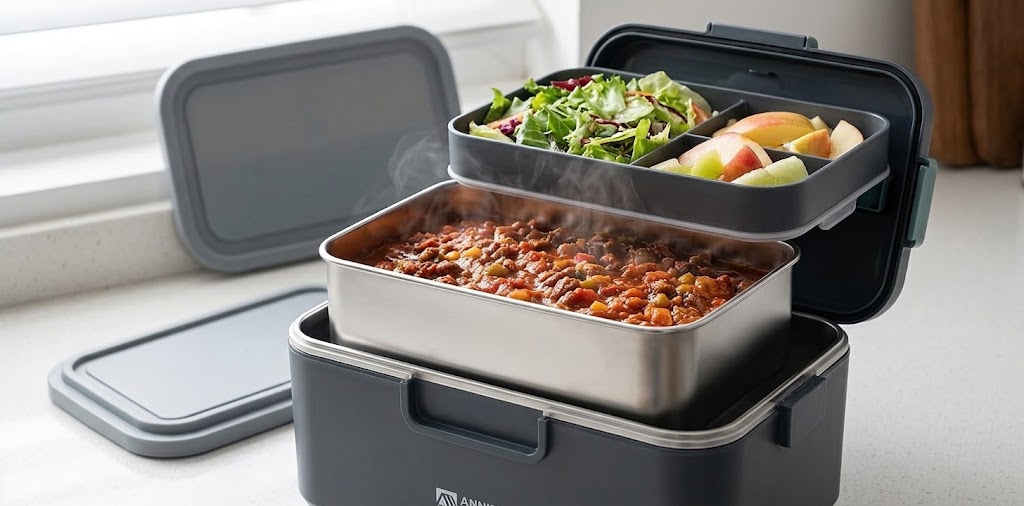
If you’ve never used one, the concept is easier than it sounds. A heated lunch box is basically a small, insulated food warmer. Inside the outer shell sits a heating element, and on top of it sits a removable container, usually stainless steel, that holds your food. Plug it in, and the base warms the container until your meal is hot.
Most of the corded models in this guide use a PTC heater. PTC stands for positive temperature coefficient, which is a fancy way of saying the element regulates itself and tends not to overheat. That’s a nice property when a box is sitting on a seat or a dashboard mat.
Here’s what’s worth understanding before you buy.
These are reheaters, not cookers. They’re designed to warm food that’s already cooked. Soups, stews, curries, pasta, rice dishes, and casseroles are the sweet spot. Raw chicken is not.
They’re slower than a microwave. In our testing, the corded boxes here generally took between 20 and 40 minutes depending on wattage, food density, and ambient temperature. The 100W boxes consistently landed in the 20 to 30 minute range; the 80W SOHIDA needed closer to 32 to 38. In winter conditions, add a few minutes on top of that. The habit it creates: plug in at the start of your break, not when you’re already hungry.
Car power is the limiting factor. A 100W box pulls a little over 8 amps from a 12V socket, and an 80W box pulls closer to 7. Many vehicle accessory sockets are fused somewhere around 10 to 20 amps, but that varies, so check your owner’s manual. It’s also smart to run these with the engine on. A heating element can drain a parked car’s battery faster than you’d expect, and some vehicles cut socket power when the ignition is off anyway.
Trucks and cars are different. If you drive a semi, you’ll want the 24V cord. Every corded box here supports 12V and 24V in addition to standard wall outlets, which is why we kept them on the shortlist.
How We Chose These Six
We tested all six boxes over several weeks of real-world use — commutes, parking-lot lunches, job-site breaks, and a few long highway stretches. Each one got plugged into a 12V car socket with the engine running, loaded with the same kinds of food a working person actually packs: leftover chili, refrigerated pasta, rice dishes, and dense soups. We timed how long each took to reach eating temperature, paid attention to how evenly the heat spread, and noted whether the build quality held up to daily grab-and-go use. We also tested wall-outlet performance and, for the LunchEAZE Pro, ran the battery through full charge-and-use cycles.
Three questions shaped every evaluation. Does it work reliably from a car socket? What kind of eater does it actually suit? And what does it get wrong that you’d only notice after you’ve used it a few times? Where the answers were clear, we said so directly. Where a product had quirks worth flagging — like wattage inconsistencies across production runs — we called those out too.
The 6 Best Heated Lunch Boxes for Car Use
The DUPASU earned its top spot the old-fashioned way: it just worked, consistently, without fuss. We loaded it with refrigerated chili, plugged it into a 12V socket at the start of a 25-minute commute, and opened it to genuinely hot food at the other end. The 100W element and 1.8-liter stainless steel container hit the sweet spot for a proper adult meal — not a small snack, not so much food that it took forever to heat through. What we kept coming back to in everyday use were the small design decisions that turned out to matter more than the specs: the fork and spoon sit in a compartment built into the unit, so we never ended up at a parking lot without cutlery; the silicone-sealed lid kept a saucy pasta from leaking during a bumpy stretch of road; and the stainless container pulled out cleanly for washing at the end of the day. The 0.45-liter salad box that comes along is genuinely useful for fruit or crackers, though it’s unheated, so don’t expect a warm side dish from it. The base needs to stay dry — wipe it down rather than rinsing it — and a 100W draw means you’ll want the engine running while it heats rather than draining a parked car’s battery. For the driver who wants one reliable box that moves between a sedan, a truck cab, and a desk without any adapter swapping, this is where we’d start. If your lunches run large, the Annie & Mia is the better call.
We’ll be honest: when we first pulled the Annie & Mia out of the box, it felt big. And then we used it on a long test day — a nine-hour shift with a break around noon — and understood immediately who it’s built for. The two-layer design means a 2.5-liter 304 stainless steel main container on the bottom and a 1-liter upper layer for a side, with a small fruit tray on top, all of it adding up to 3.5 liters of organized food for one person. We tested it by loading a generous rice-and-beef main in the lower container and steamed vegetables in the upper tray, plugged it into a 12V socket, and had everything at eating temperature in about 28 minutes — the larger volume takes a few minutes longer than the 1.8-liter boxes, which is what you’d expect. What we didn’t expect was how much we appreciated being able to heat just the stainless lower section on days when the upper tray held something we wanted cool. The orange shell is bold and easy to spot in a dark vehicle or a crowded cooler bag, and the carry handle with clasps felt secure enough that we didn’t worry about it tipping. The size is both the selling point and the honest limitation: it claimed the whole passenger seat in our test car, and drivers with tighter cabs will feel the bulk. It’s also corded only, so a socket is non-negotiable. Choose it over the DUPASU when your lunch reliably includes a main, a side, and something extra. If you’re packing a single portion, you’d be carrying a lot of box for not much food.
In side-by-side testing, the COZYEXPERT and the DUPASU were close enough in performance that the difference surprised us. Same 1.8-liter stainless container, same 100W element, similar heat-up window of roughly 20 to 25 minutes in normal conditions, and a few more minutes in colder weather — we tested it on a December morning with the car at 38°F inside, and it added about five minutes compared to a mild day. The four latches on the lid gave us more confidence during transport than a single-clasp design would, and the silicone seal held up through some genuinely sloshy soup without a leak. We also liked the cutlery compartment, which doubles as a phone cradle — a small thing, but it keeps a desk or console less cluttered. The catch, and it’s worth saying plainly: COZYEXPERT has sold this box in 60W, 80W, and 100W versions that look nearly identical from the outside. We tested the 100W model, and that’s the one you want. The 80W version heats food, but noticeably more slowly, and the 60W takes long enough that a short lunch break won’t get you there. Check the listing carefully before you order and confirm it says 100W and 1.8L. The outer shell wipes clean but doesn’t go in the dishwasher — only the inner containers and cutlery do. For a driver who wants the performance of the DUPASU and doesn’t mind doing a quick spec check at checkout, the COZYEXPERT is a smart buy. If you’d rather just order and be done with it, the DUPASU’s more consistent production run is worth a few extra dollars.
The TRAVELISIMO’s best quality is the one that’s easiest to underestimate: it’s genuinely small. In testing, it tucked into a regular lunch bag, slipped into a door pocket, and sat on a center console without claiming the whole seat — something neither the DUPASU nor the Annie & Mia can claim. For a driver who packs a modest lunch and wants a box that doesn’t feel like luggage, that compactness is the whole argument. We tested the 100W version with a bowl-sized portion of leftover minestrone and had it hot in about 22 minutes from a 12V socket, which held up against the other 100W boxes. We did notice the heat distribution wasn’t perfectly even — the food near the bottom of the container got hot first, and the top needed a stir partway through to finish evenly. That’s the habit the headline refers to: give it a quick mix at the midpoint and the problem goes away entirely for soups, rice, and pasta. It became second nature after a few uses. The crevices around the lid gasket are tight and took a little more effort to clean than the DUPASU, which is worth knowing if a thorough rinse after a busy day matters to you. Also worth noting: TRAVELISIMO has sold this box at both 80W and 100W, so confirm you’re getting the faster version before you buy. For a commuter, rideshare driver, or anyone who eats a lighter lunch and wants their box to take up as little space as possible, the TRAVELISIMO is a solid pick. Bigger eaters will run out of room fast, and the DUPASU gives them a better day.
We went into SOHIDA testing with calibrated expectations, and it mostly met them. The 80W element is genuinely slower than the 100W boxes — we measured closer to 32 to 38 minutes for a refrigerated portion of rice and chicken from a 12V socket, which puts it at the slower end of the group. But if you plug in early enough, it absolutely gets the job done, and the food came out consistently hot, if not quickly hot. What the SOHIDA does well beyond heating is the small stuff: the cutlery holder is built into the body so you’re not losing a spoon under the seat, the phone stand is a nice bonus for anyone who eats and catches up on a podcast, and the insulated shell stayed cool to the touch on the outside even when the food inside was fully hot. The sealing ring held through our testing without leaks. The build quality felt appropriate for the price — not flimsy, but not as solid as the DUPASU’s heft. The real honest advice: the SOHIDA is the right pick if you want to find out whether a heated lunch box is something you’ll actually use before spending more on one. It works, it’s priced low enough that a change of habit won’t sting, and the slower heat time is a trade-off most people with a relaxed break won’t notice. If your window is tight — say, thirty minutes or less — spend up to a 100W box like the TRAVELISIMO. And when you order, confirm it’s the 1.5L corded model, since SOHIDA sells similar-looking boxes in other sizes and configurations.
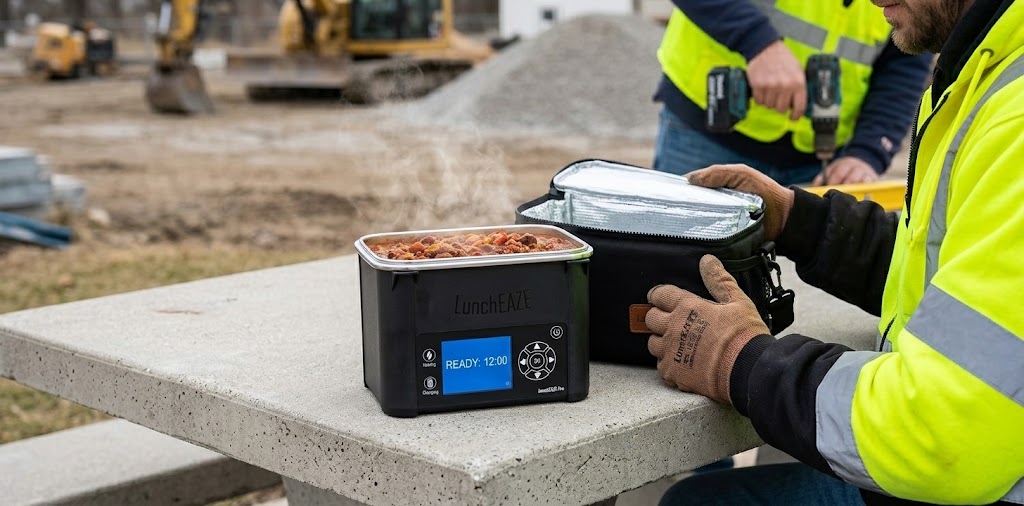
The LunchEAZE Pro requires a different mindset than every other box in this guide, and once we adjusted to it, we appreciated what it actually solves. We tested it over a week of field-style use — loading food at home, setting the scheduled heat time for noon, and eating at a picnic table away from the vehicle. The cordless approach worked exactly as described: the 8000mAh battery powered the unit through a full heat cycle without needing the car at all, the food was at a solid eating temperature when we opened it at the scheduled time, and the insulated bag kept the heat in between the end of heating and when we actually sat down to eat. The scheduled warming approach is different from the plug-it-in-and-wait method of the corded boxes — it’s more like loading a slow cooker than waiting for a microwave — so it works best when your lunch schedule is predictable. The four-cup stainless container held a full meal comfortably, the bag was genuinely well-insulated, and the unit was fine left in a warm car while we worked. The battery took around six hours overnight to fully recharge, which meant we plugged it in each evening without thinking much about it. The honest trade-offs: it costs considerably more than any corded option here, it doesn’t come with a 12V car socket cord (it’s cordless or wall-outlet only, which is the point), and the battery doesn’t charge while the unit is heating, so the overnight habit is non-negotiable. It’s not the pick for someone who parks with the engine running and has a 12V socket handy — the DUPASU handles that scenario for a fraction of the price. But for construction workers, outdoor crews, cyclists, or anyone whose lunch break happens away from the vehicle entirely, the LunchEAZE Pro is the only box here that actually solves the problem.
Comparison Table: Best Heated Lunch Boxes for Cars
Product Model | Capacity | Heating Wattage | Power Voltage | Standout Advantage | Best Suited For |
|---|---|---|---|---|---|
1.8 Liters | 100W Fast Heat | 12V / 24V / 110V | Leak-proof seal & value | Everyday car commuters | |
3.5 Liters | 100W PTC | 12V / 24V / 110V | Dual-tier modular design | Big appetites & 12-hr shifts | |
1.8 Liters | 100W Heavy Duty | 12V / 24V / 110-230V | Rugged, impact-resistant shell | Job sites & work vans | |
1.5 Liters | 100W Standard | 12V / 24V / 110V | Insulated bag included | Commercial truck drivers | |
1.5 Liters | 80W Gentle Heat | 12V / 24V / 110V | Compact & lightweight | Small cars & light meals | |
4 Cups | Battery Powered | Cordless (8,000 mAh) | Automatic timer schedule | Cord-free heating anywhere |
If you only remember one thing from the table, make it this: for everyday car use, the 100W, 1.8-liter boxes hit the sweet spot, and the choice among them comes down to price and how carefully you read the listing.
How to Choose: What Matters Most for Car Use
Specs are easy to skim past, so here’s how we’d weigh them if we were buying for a vehicle.
Power source: corded or cordless?
This is the first decision, and it’s bigger than any spec. Corded boxes are cheaper, heat consistently, and don’t need charging, but they need your car’s socket and generally need the engine running. A cordless box like the LunchEAZE Pro costs more and runs on a battery you have to remember to charge, but it works when the car is off. If you routinely eat in your parked vehicle with the engine running, go corded. If you eat away from the vehicle, go cordless. We’d say that’s the clearest dividing line in this whole category. For more on the cordless side, see our guide to the best cordless heated lunch box.
Wattage: why 100W tends to beat 80W
Heat time is mostly a function of wattage, container size, and starting temperature. A 100W element generally gets a refrigerated meal hot noticeably sooner than an 80W one. In our testing, 100W boxes came in at roughly 20 to 30 minutes, the 80W SOHIDA needed 32 to 38, and a 60W variant we encountered in our research took 35 to 50 minutes in cold conditions. If your break is short, pay for wattage — the gap is real and noticeable once you’ve used both.
Capacity: be honest about your appetite
A 1.5-liter container works for soup, pasta, or rice with a protein. A 1.8-liter container gives a hungry adult more breathing room. The 3.5-liter Annie & Mia is for people who eat a main, a side, and fruit. Bigger boxes also take more room and, in general, take longer to heat. Choosing a box bigger than your lunch means you carry bulk for no benefit.
Leak protection and cleanup
Look for a silicone-sealed lid and a stainless container that lifts out. Most of the boxes here follow that formula. Remember that the heated base isn’t meant to be submerged, and several manufacturers specifically warn against getting liquid on it. If you drive a bumpy route, pack thicker foods or leave a little headroom in the container.
The carry bag
An insulated bag helps in two ways: it keeps the box’s outer shell contained, and it makes the whole thing easier to move between car, desk, and truck stop. Some of these boxes ship with one, and some don’t, and the LunchEAZE Pro includes one that LunchEAZE says you should use during heating. It’s a small detail, but one worth checking against the listing.
Where your meal comes from
Heated lunch boxes work best with well-cooked, moist foods. If you’re building a rotation of road-friendly meals, our guide to the best electric lunch box for truck drivers includes long-haul-friendly ideas, and our roundup of the best electric lunch boxes for adults covers more desk-and-office use cases.
Using a Heated Lunch Box Safely in Your Car
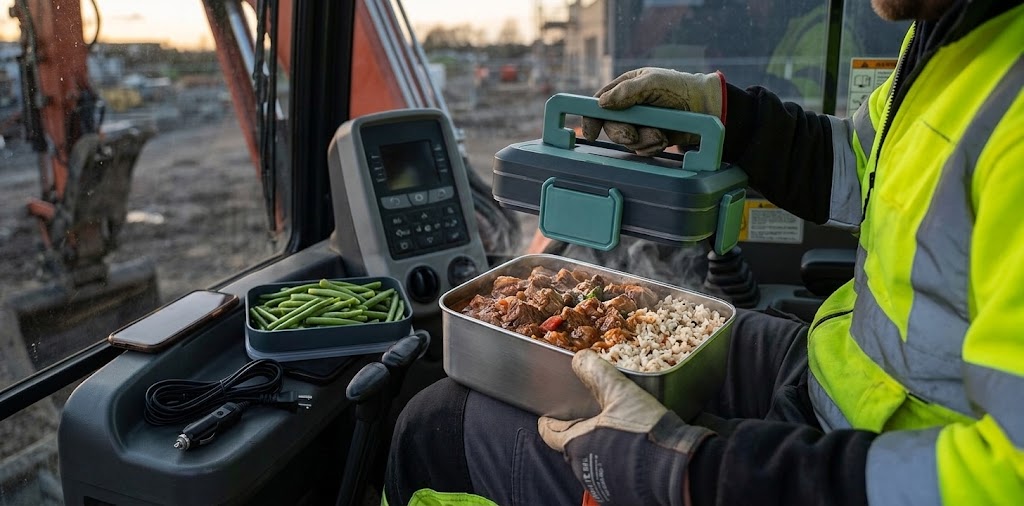
A little habit goes a long way here, particularly since food safety is the real risk with any reheated meal.
Start cold, not warm. Perishable food shouldn’t sit at room temperature for long. According to the USDA, bacteria grow fastest between 40°F and 140°F and can double in as little as 20 minutes, and perishables shouldn’t stay in that range for more than two hours, or just one hour when the temperature is above 90°F. The USDA’s guidance on the “Danger Zone” is blunt about it. A hot car in July can push a lunch past that window long before you ever plug the box in, so keep your food in a cooler bag until you’re ready to heat.
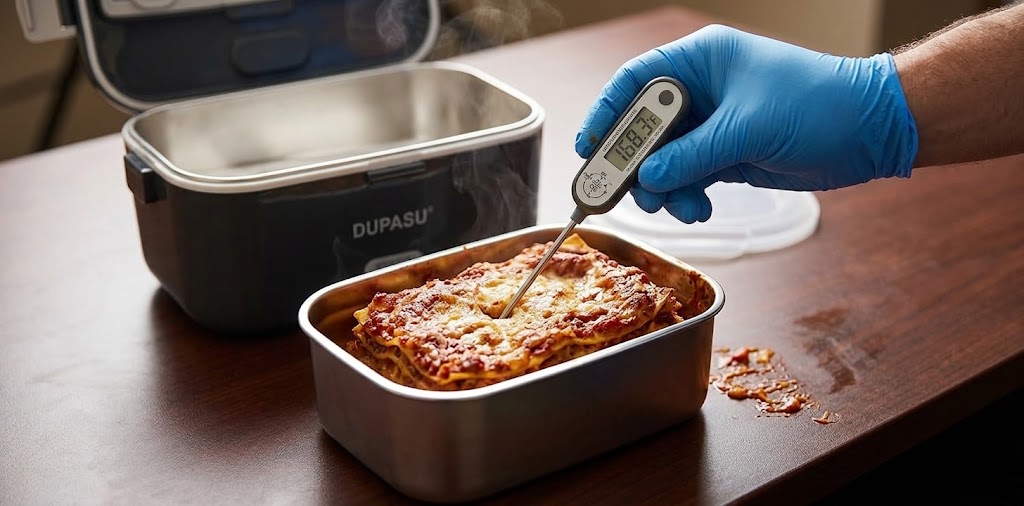
Aim for 165°F. The USDA advises reheating leftovers to an internal temperature of 165°F, and it recommends bringing soups, sauces, and gravies to a rolling boil. If you want a real answer rather than a guess, use a small food thermometer. The USDA’s leftovers guidance explains the full process. Because these boxes warm food gradually and some reviewers noted uneven heating, stirring halfway is a smart habit with any of them.
Treat the 12V socket with respect. Run corded boxes with the engine on, route the cord so it can’t snag on the shifter or your leg, and avoid sharing the same socket with other high-draw gear. If a fuse blows, that’s your car telling you the load was too much.
Keep the base dry and the steam hole clear. Liquid on the heating base is a real risk with all of these boxes — don’t rinse the base, and dry the container before you set it back in. On the COZYEXPERT in particular, we noticed a steam hole on the lid that should be pressed open before plugging in; the same goes for any vent your model has. Follow the instructions that come with your specific box, since the details differ between them.
Don’t leave it heating unattended in a parked car. This one’s common sense, but it’s worth saying. A food warmer is still a heating appliance.
Frequently Asked Questions
What is the best heated lunch box for a car?
For most drivers, we’d choose the DUPASU 1.8L. It pairs a 100W element with a roomy container, runs on both 12V and 24V vehicle power plus wall outlets, and keeps cutlery attached. If you pack larger meals, the Annie & Mia 3.5L is the better fit, and if you need a box that doesn’t depend on an outlet, the LunchEAZE Pro is the one to consider.
Can you plug a heated lunch box into a car cigarette lighter?
Yes. Every corded box in this guide includes a vehicle cord for 12V sockets, and they also support 24V for trucks. Just run the engine while heating and check your owner’s manual for the socket’s amp rating, since a 100W box draws a bit over 8 amps at 12V.
How long does it take to heat food in a car?
Most corded boxes list 20 to 30 minutes for 100W models and 25 to 40 minutes for 80W ones. Cold weather, a full container, or very dense food will add time. Plan on starting to heat at the beginning of your break, not the end.
Will a heated lunch box drain my car battery?
It can if the engine is off. A heating element is a steady load, and some vehicles keep the socket powered when parked while others don’t. For corded boxes, we’d run the engine. If you’d rather not worry about it, a cordless unit like the LunchEAZE Pro uses its own battery instead.
Is it safe to leave a heated lunch box in a hot car?
Food safety is the bigger concern than the box. Perishable food shouldn’t sit in a hot vehicle, and the USDA’s one-hour guideline above 90°F is a good rule of thumb. LunchEAZE states its Pro is safe to leave in a hot car, but that’s about the device, not your lunch. Keep food chilled until you’re ready to heat.
Can I cook raw food in a heated lunch box?
No. These boxes are built to reheat food that’s already cooked. They aren’t designed to bring raw meat or eggs up to a safe cooking temperature, and the USDA’s reheating guidance assumes you started with properly cooked leftovers.
What foods work best?
Soups, stews, curries, chili, pasta dishes, rice bowls, and casseroles tend to heat evenly because they hold moisture. Dry foods like fried chicken or crusty bread usually come out better at room temperature or with a small splash of water or sauce.
Are the containers dishwasher-safe?
On most of these boxes, the removable stainless container, side container, and cutlery are dishwasher-safe, while the heated base is not and should never be submerged. Check your specific model’s manual, since details vary slightly between versions.
The Bottom Line
If we had to put one box in a friend’s car tomorrow, it would be the DUPASU 1.8L. It’s powerful enough to heat a real meal in a reasonable window, simple enough to use daily, and consistent in its specifications, which matters more than people think when listings for similar boxes differ. The Annie & Mia 3.5L wins for anyone who eats big, the COZYEXPERT is a smart way to save a few dollars if you verify you’re getting the 100W version, and the TRAVELISIMO and SOHIDA suit lighter eaters and tighter budgets, with the speed-versus-price trade-off we described. The LunchEAZE Pro is a different animal. It costs more, but it’s the only one here that works when you can’t or won’t run a cord.
Before you buy, run through three quick questions. Will your engine be running at lunch? How much food do you really eat? And how many minutes do you actually have? Answer those honestly, and the choice mostly makes itself. A hot lunch won’t fix a tough day, but it makes the middle of it a lot more pleasant.