Advertiser Disclosure
We independently review everything we recommend. When you buy through our links, we may earn a commission.
The Best Rail and Stile Router Bits for Cabinet Doors
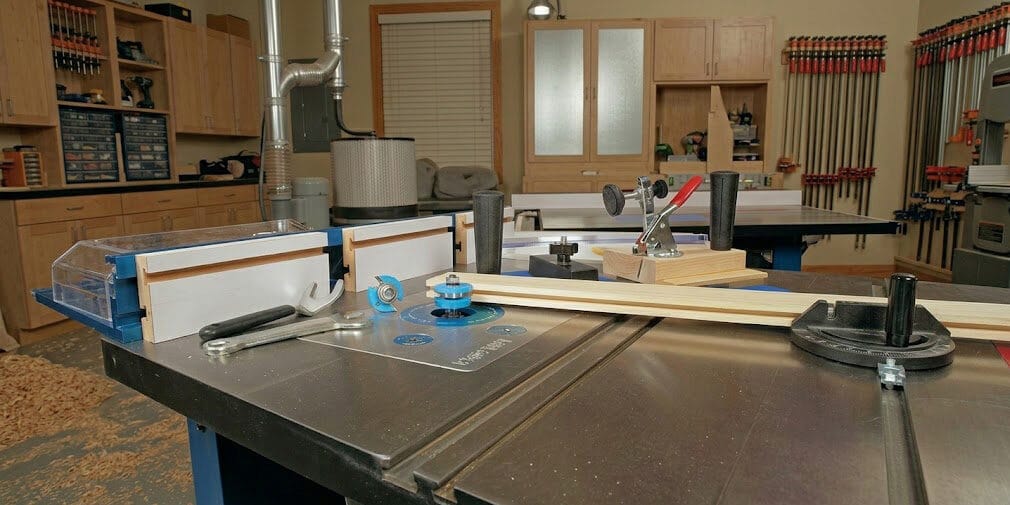
Building your own cabinet doors is one of the most rewarding milestones in woodworking. It turns a basic box into beautiful furniture, but it also demands a level of precision that can feel a bit intimidating. If your frame joints are misaligned by even a fraction of a millimeter, or if your center panels rattle every time you shut a cupboard, the magic fades quickly. That is where a dedicated rail and stile router bit set comes into play. These specialized bits cut both the interlocking tongue-and-groove joinery and the decorative edge profile simultaneously, ensuring that your frames fit together tightly and look completely seamless.
Over the years, our assessment team has routed miles of hardwood, plywood, and MDF to find out which bits make the grade. We have spent hours setting up test cuts, adjusting shim configurations, and checking for tearout under critical shop lighting. Through this process, we have learned that there is no single “perfect” bit for everyone. Some woodworkers need ultimate adjustability to match undersized plywood panels, while others prioritize a simple setup or a classic minimalist profile. In this guide, we will break down our genuine experiences with six top-tier options, highlighting their practical advantages and trade-offs so you can find the right fit for your workshop.
Everything We Recommend
✅ We recommend these products based on an intensive research process that’s designed to cut through the noise and find the top products in this space. Guided by experts, we spend hours looking into the factors that matter to bring you these selections.
⭐ 2.5 million+ people assisted in the last 30 days ⭐
Best Overall
Precision bit creates rail and stile joints for 5/8 to 1-1/4 inch thick doors.
Suitable for routers, hardwoods, softwoods, plywood, and window or cabinet woodworking applications.
Adjustable shims allow groove widths from 7/32 to 3/8 inch for flexible panel fitting.
TiCo carbide construction with Perma-SHIELD coating ensures durability, heat resistance, and reduced build-up.
Patented design produces strong, extended tenon joints with reduced tear-out for structural strength.
Best Value Set
Cuts shaker rail and stile cabinet frames with 3/8-inch depth in up to 7/8-inch stock.
Designed for creating precise rail and stile cabinet door frames with consistent woodworking results.
Premium C3 micro-grain tungsten carbide blades provide sharp, long-lasting cutting performance.
Compatible with table-mounted routers for stable and accurate cabinet door frame production.
Silver induction brazing ensures maximum strength, durability, and long-term cutting reliability.
Best for Reliability and Support
Rail and stile router bit set creates precise Shaker-style cabinet door joints with chamfered edge design.
Bearing-guided bits ensure tight cope and stick joints for accurate, professional cabinet frame alignment.
Built with 1/2 inch shanks and high-grade carbide for stability, durability, and long cutting life.
Recommended coping-first workflow improves edge accuracy and reduces tear-out on rail and stile cuts.
Designed for table-mounted routers with safety guidance, including reduced RPM use and proper clearance handling.
Best for Precision Fit with Plywood Panels
Carbide-tipped 15-degree shaker rail and stile bit features 1-inch cutting length and 1/2-inch shank compatibility.
Produces clean 15-degree shaker profiles for modern cabinet doors and refined furniture design aesthetics.
Designed for actual 1/4-inch panels, ensuring accurate fitting and professional-grade cabinet door construction results.
Creates strong tongue and groove joints with 3/8-inch depth for secure structural cabinet assembly.
Works on natural and composite wood materials, delivering smooth, precise, and consistent cutting performance.
Best Budget Bevel Entry Point
Designed for hardwood woodworking, suitable for doors, cabinets, shelves, floors, and custom furniture projects.
Built with hardened alloy blades and anti-backlash design for safer, more stable cutting performance.
Compatible with wood, MDF, plywood, particle board, and softwood, ensuring versatile material applications.
Constructed with solid steel body and YG11 carbide inserts for strength, durability, and long tool life.
Delivers smooth, efficient cutting performance with resistance to deformation during extended heavy-duty use.
Best for Decorative Round Over Detail
Unique cutter geometry minimizes tearout for smoother, cleaner woodworking surface finishes.
Patented extended tenon design removes bearing assembly to form precise long tenon profiles.
Built with TiCo high-density carbide for extended tool life and superior cutting performance.
Perma-SHIELD coating reduces heat buildup, pitch accumulation, and corrosion during heavy-duty routing use.
Engineered for durability and precision cutting stability under demanding professional woodworking applications.
What Are Rail and Stile Router Bits, and Why Do They Matter?
Before we get into the picks, it’s worth grounding the basics — especially if you’re newer to frame-and-panel construction. Rail and stile joinery is one of the oldest methods for building cabinet doors, and there’s good reason it’s still the dominant approach in both custom and production woodworking.
The concept is straightforward: rails are the horizontal frame members, and stiles are the vertical ones. The joint between them — a cope-and-stick or rail-and-stile joint — is what keeps the door square and allows the center panel to float freely as wood expands and contracts with seasonal humidity changes. That floating panel is critical; if you glue the panel solid, you’re likely looking at a split or a buckled door within a season or two.
Rail and stile router bits come in matched sets — one bit shapes the profile on the inside edge of the stiles (the “stile” cut), and the companion bit cuts the cope on the ends of the rails so the two pieces interlock. When everything is set up correctly, those two cuts nest together cleanly, producing a joint that doesn’t need clamps or nails to hold shape during glue-up.
According to our research, even well-dried hardwood can move as much as 1% in width per 4% change in moisture content — which is exactly why allowing for panel movement in door construction is so important.
Our Top Rail and Stile Router Bit Picks at a Glance
| Router Bit Set | Profile Style | Shank Size | Adjustability | Best Suited For |
| Freud 99-762 | Modern Shaker | 1/2″ | Highly Adjustable (Shims) | Custom builders handling varied plywood |
| Yonico 12249 | Traditional Ogee | 1/2″ | Fixed Stack | Budget-conscious DIYers wanting a classic look |
| Rockler Shaker | Crisp Shaker | 1/2″ | Fixed (Optimized for 5.5mm) | Woodworkers seeking a fast, plug-and-play setup |
| Whiteside 6009 | 15° Bevel Shaker | 1/2″ | Fixed (True 1/4″ Panel) | Professionals demanding flawless finish quality |
| Exqutoo ZH-0040 | Soft Bevel Shaker | 1/2″ | Fixed Stack | Hobbyists working on light, paint-grade projects |
| Freud 99-763 | Round Over Bead | 1/2″ | Highly Adjustable (Shims) | Premium traditional furniture and cabinetry |
The 6 Best Rail and Stile Router Bits We Tested
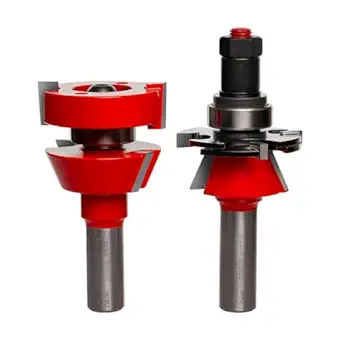
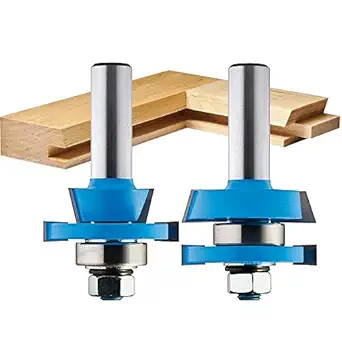
When our team first unpacked this two-piece Shaker-profile set, we wanted to see if its premium price tag translated into less frustration at the router table. It absolutely did. The standout feature here is Freud’s patented adjustable system, which uses an included micro-shim spacer kit to let you alter the groove width from 7/32″ up to 3/8″. We tested this by attempting to fit a sheet of finicky, undersized plywood into a tight Shaker frame. Instead of resorting to glue or foam spacer balls to stop panel rattle, we adjusted the shims on the bit stack, and the resulting dry-fit was remarkably snug. What surprised our testers most was the complete absence of grain tearout, even when plunging directly into the end grain of brittle red oak. This is largely due to the unique geometry of the TiCo high-density carbide teeth, which shear the wood fiber rather than smashing through it. It also features a removable top cutter portion, meaning you can easily set it up to cut deep, extended tenons for heavy-duty entry doors or extra-sturdy furniture frames. The red Perma-SHIELD coating did an excellent job of preventing pitch buildup throughout our multi-hour testing session, leaving the bits looking clean. The trade-off is the initial setup; because it is highly adjustable, you will need to spend a little extra time running test scraps to get the height dialed in perfectly. It is an investment best suited for custom furniture builders or detail-oriented hobbyists who demand a rattle-free fit every time.
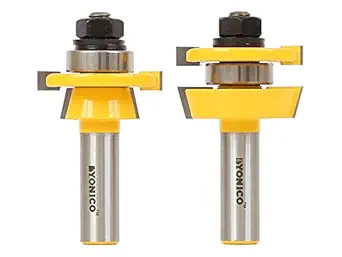
If you are a weekend warrior or a DIYer tackling a one-off kitchen remodel on a modest budget, spending a fortune on industrial-grade tooling might not make practical sense. That is where this Yonico set fits in. Sporting a classic, elegant Ogee profile, this budget-friendly duo pleasantly surprised us with its overall build quality. During our tests, we routed a complete set of utility room cabinet doors out of soft poplar and paint-grade MDF. The thick carbide tips cut cleanly, and the 1/2-inch shank felt perfectly stable in our mid-sized router table. We noticed that because the cutters are fixed and cannot be shimmed, you are locked into a standard 1/4-inch groove. When we tried feeding nominal plywood through it, the fit was a bit looser than we preferred, requiring us to use rubber space balls inside the groove to keep the panel centered. However, when working with true-to-size solid wood panels or standard MDF inserts, the joints lined up nicely without an agonizing setup process. It doesn’t feature the advanced shear angles of high-end bits, so we had to slow down our feed rate slightly on dense hardwoods to avoid minor fuzzing on the edges. That said, for the casual woodworker who wants an attractive, traditional look without a steep learning curve or a hefty price tag, this set delivers solid, dependable value.
Rockler has long been a staple in the hobbyist woodworking community, and their house-brand 1/2-inch shank Shaker set is built for outright convenience. Our testers immediately appreciated how straightforward these bits are to set up right out of the box. Unlike complex modular systems, Rockler ships these pre-assembled and matched to work with standard 1/4-inch plywood panels (specifically targeting the common 5.5mm undersized stock). We ran several linear feet of cherry wood through the stile cutter and were delighted by the crisp, clean 90-degree geometry of the Shaker profile. The joints went together with a reassuring “snap” that required minimal clamping pressure to square up. The thick carbide edges held their sharpness beautifully, showing no signs of dulling even after a long afternoon of processing stock. The clear limitation is that the set lacks micro-adjustability; if you happen to source a batch of lumber or custom thick panels that deviate from standard measurements, you cannot easily reconfigure the stack. But for woodworkers who value their shop time and prefer a reliable, plug-and-play tool that minimizes test-cutting headaches, this rugged set is an incredibly practical choice.
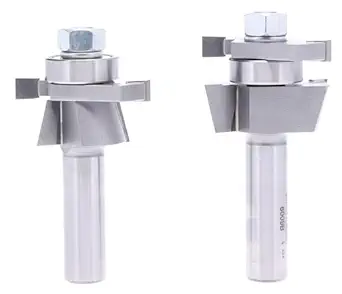
For professional cabinet makers and demanding enthusiasts, Whiteside is a name that commands immense respect, and the 6009 set reminds us exactly why. This two-piece set cuts a distinctive 15-degree micro-bevel Shaker profile rather than a harsh, blunt 90-degree drop. This subtle slope gives the finished cabinet door a sophisticated, contemporary shadow line while making the interior corners noticeably easier to wipe clean of dust. When we spun this bit up to its recommended 14,000 RPM, the absolute balance of the American-made steel was immediately apparent—there was virtually zero vibration transferred through our router table fence. We fed a stubborn piece of highly figured curly maple through it, a material notorious for catastrophic tearout, and the resulting surface felt as smooth as glass, requiring no sanding whatsoever. This pristine finish is a testament to Whiteside’s precision-ground, ultra-premium carbide edges. This specific model is tailored for actual 1/4-inch panel thicknesses and stock from 5/8″ to 7/8″ thick, making it a dream for high-end custom cabinetry. The only real drawback is that it is a dedicated, single-purpose tool with no adjustable shims, meaning your panel thickness must be spot-on. If you take pride in flawless craftsmanship and want your work to have that refined, designer look, the Whiteside 6009 is a joy to use.
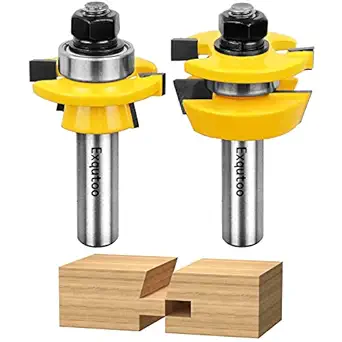
For those who want to dip their toes into cabinet door making without making a major financial commitment, the Exqutoo Bevel Shaker set offers an approachable path forward. This set features a slightly relieved bevel profile that mimics the classic Shaker aesthetic while softening the sharp edges. When our testing team ran basic pine and softwood stock through these bits, they performed admirably, chewing through the material quickly and leaving a highly paintable surface. We did observe that the carbide inserts are slightly thinner than those found on premium options, which means they will likely require more frequent sharpening if you feed them a steady diet of dense hardwoods like white oak or hickory. Additionally, we had to be meticulous with our push blocks to keep the wood perfectly flat against the table, as minor variations in pressure led to slight alignment steps at the joints. However, for a homeowner looking to build a few built-in bookshelves or spruce up a laundry room on a budget, this set gets the job done efficiently. It is a no-frills, practical entry point that proves you do not need industrial-grade equipment to create a handsome, functioning cabinet door.
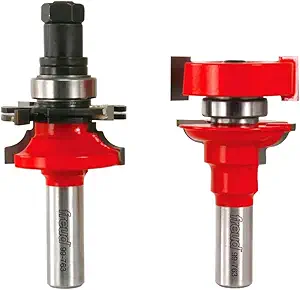
If you love the highly adjustable engineering of Freud’s system but prefer a softer, more traditional look than the stark lines of Shaker style, the 99-763 set is an exceptional choice. This set features a classic Round Over Bead profile, adding a gentle, elegant curve to the inside frame of your cabinet doors. Our team tested this set on a comprehensive kitchen mock-up using walnut, and the visual results were stunning. Just like its Shaker sibling, the 99-763 features the Quadra-Cut four-cutter design, where two small wings slice downward to score the wood fibers while two large wings shear upward. Watching this process in action on a delicate end-grain cut was a highlight for our testers; it eliminates the fuzzy, splintered edges that typically ruin traditional profiles. The adjustability allowed us to dial in our panel grooves perfectly to accommodate custom solid-wood raised panels, making it incredibly versatile. It shares the same trade-off of requiring a patient, systematic setup process to align the profiles across both bits, but the payoff is an heirloom-quality cabinet door with flawless joinery. For high-end remodeling projects or fine furniture making, this set provides an unmatched level of control and finish quality.
Crucial Buying Factors: Beyond the Price Tag
When you are comparing options, there are a few technical specs that deserve a closer look:
Shank Diameter: We strongly advise sticking with 1/2-inch shank bits for cabinet frame joinery. Rail and stile cutters are relatively large and heavy; 1/4-inch shanks tend to flex under heavy load, causing subtle profile distortions and increased vibration that compromises safety.
Adjustability vs. Fixed Stacks: Some premium sets feature modular, adjustable cutters separated by microscopic metal shims. These allow you to fine-tune the width of the panel groove. If you regularly use “1/4-inch” plywood from the big-box store—which usually measures closer to 5.5mm or 7/32 of an inch—an adjustable bit is invaluable for preventing a sloppy, rattling panel.
Carbide Quality and Coated Tooling: High-density carbide edges stay sharp longer when biting through tough end grain or abrasive glues found in plywood and MDF. Thermal-resistant coatings also help dissipate heat, preventing sticky pitch and resin buildup from burning your workpieces.
Buyer's Guide: How to Choose the Right Rail and Stile Router Bit

Choosing the right bit for your project isn’t just about picking the one with the most reviews. There are a few practical questions worth asking before you spend money.
Profile Style: Match the Door to the Space
The profile you choose sets the aesthetic tone for the entire cabinet. Shaker profiles — flat or with a subtle bevel or chamfer — are by far the most common in contemporary American cabinetry because they read as clean and versatile across painted and stained finishes alike. Ogee and classical profiles carry more traditional weight and tend to suit furniture pieces and period-style built-ins more than modern kitchens. Round over bead profiles fall somewhere in between — they have traditional roots but can read as refined rather than ornate in the right context.
If you’re unsure, shaker is almost always the safe call. There’s a reason it dominates the market.
Shank Size: Stick with 1/2″ for Cabinet Work
All six bits in our lineup use 1/2″ shanks, and that’s not a coincidence. For the diameter and mass of a rail and stile bit, a 1/2″ shank is meaningfully more stable than a 1/4″ shank — less vibration, better balance, and a more secure grip in the collet. If your router only accepts 1/4″ shanks, you’ll want to look at compact shaker sets (like the Yonico 12249Q), but for router table work, a 1/2″ shank setup is strongly recommended.
Adjustable vs. Fixed Depth: Know Your Panel Material
Fixed-depth sets — like the Yonico 12249, Rockler Shaker set, and Exqutoo ZH-0040 — work beautifully for consistent stock and specific panel thicknesses. They’re simpler to set up and generally more accessible in price. But if you’re regularly switching between veneered plywood panels (which often measure slightly under 1/4″) and solid wood raised panels (which can vary significantly), an adjustable system like the Freud 99-762 or 99-763 saves real time and eliminates a lot of trial-and-error.
Carbide Quality: It Matters More Than You Might Think
Not all carbide is the same. Budget bits often use lower-grade carbide alloys that dull faster and produce a rougher surface, especially on hardwoods. The premium options in our lineup — Freud’s TiCo Hi-Density Carbide, Whiteside’s carbide-tipped cutters, and Rockler’s K10/K20 grade — all perform noticeably better on dense or figured wood where edge quality shows up in the final finish. Carbide grain size directly affects how long a bit stays sharp and how clean a surface it leaves — micro-grain carbide generally outperforms standard-grade carbide on both measures.
Anti-Kickback Design: A Safety Feature, Not a Gimmick
Several bits in our lineup include anti-kickback geometry — a design that limits how deeply the cutter can engage the workpiece on any given pass, reducing the risk of a sudden and violent kickback event. This matters most for woodworkers who are newer to router table work, running longer pieces, or working with unpredictable grain. It’s a feature we consider worth having for all cabinet door work.
RPM Guidelines: Don’t Spin Too Fast
Larger-diameter bits like rail and stile cutters should generally run slower than small profile bits. As a practical rule of thumb, stay within the manufacturer’s recommended RPM range — most of the bits in our lineup top out at 16,000 RPM, and many perform better at 14,000–15,000 RPM where vibration is minimized.
Setup Tips That Save You Headaches
Getting a clean rail and stile joint isn’t just about the bit — it’s about the workflow around it. Here’s what our team has found actually makes a difference:
Run test pieces first, always. Set aside a few scrap pieces of the same thickness and species as your door parts and use them to dial in your fence position and bit height. This gives you a reference for what a good joint looks like before you commit to your real stock.
Route the stiles first, then the rails. The stile cut establishes the groove and profile on the inside edge of all your frame pieces. Once that’s dialed in, adjust to the rail (cope) cut and check the fit with a scrap stile piece before running all your rails. Adjusting the order gets you faster to a confirmed fit.
Make multiple shallow passes on harder woods. One aggressive pass on hard maple or white oak is more likely to cause tear-out than two controlled passes at a lighter depth. Take your time.
Keep the bits clean. Pitch and resin buildup affect cut quality and contribute to burning on denser woods. A quick wipe-down with a router bit cleaner — or even a bit of CMT Formula 2050 — keeps your bits running at their best.
Use a push stick or featherboard on the fence. Rail and stile cuts can be long, and maintaining consistent pressure against the fence the whole way matters for a flat, even profile. A featherboard isn’t optional on longer pieces.
Rail and Stile Profiles Compared
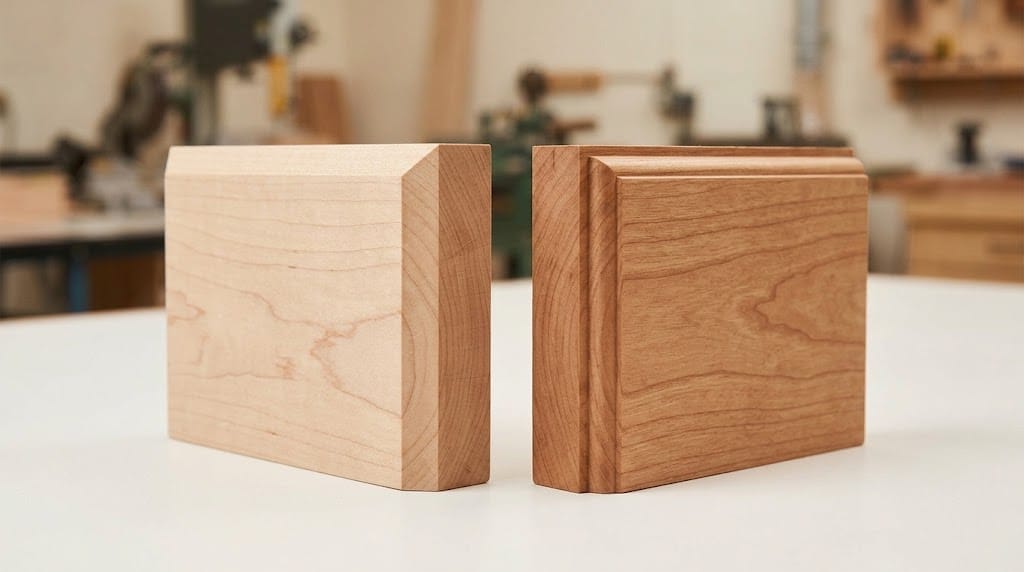
Understanding the visual difference between profiles helps you make a better decision before you buy.
Shaker (flat): Clean, square-shouldered panel groove with no decorative edge on the inside frame profile. The most minimal look — works with essentially every architectural style from transitional to modern.
Bevel/Chamfer Shaker: A 15° angled face on the inside edge of the frame, like what the Whiteside 6009 and Rockler Shaker set produce. Adds subtle visual interest without veering into traditional territory.
Round Over Bead: A small radius bead on the inside edge of the frame, like the Freud 99-763. Has a slightly warmer, more traditional character than a flat shaker but is still clean enough for contemporary builds.
Ogee: A more pronounced S-curve profile that reads as clearly traditional. Better suited to furniture and period-style cabinetry than modern kitchens.
If you’re building for resale or for a client, shaker or bevel shaker profiles are typically the safest choice for broad market appeal. If you’re building for yourself, pick the profile that actually resonates with the space.
Common Questions About Rail and Stile Router Bits
Can I use these bits in a handheld router?
Technically possible with smaller bits, but not recommended for rail and stile work. These cuts require consistent, controlled feed rates and stable support under the workpiece — conditions that are very difficult to maintain with a handheld router. A router table is the right tool for this job.
Do I need to buy a matching raised panel bit?
Not necessarily, but it helps. If you’re building flat-panel shaker doors with plywood center panels, your rail and stile set is all you need. If you’re building traditional doors with solid wood raised panels, you’ll want a raised panel bit that complements your rail and stile profile. Freud, Whiteside, and Rockler all offer matching raised panel bits for their rail and stile systems.
How long do carbide-tipped rail and stile bits last?
With normal use on hardwoods, a quality carbide-tipped bit can produce hundreds of doors before needing professional resharpening. Softer materials and MDF are actually harder on carbide than hardwood because of the abrasive filler content — if you’re doing heavy MDF production work, factor in more frequent resharpening.
What’s the difference between cope-and-stick and mortise-and-tenon for cabinet doors?
Cope-and-stick (rail and stile router bit joinery) is the production-friendly approach — fast, consistent, and strong enough for most cabinet door applications. Traditional mortise-and-tenon joinery is stronger and is still preferred for heavier exterior doors or furniture where maximum joint strength matters. For kitchen and furniture cabinet doors, a cope-and-stick done well is more than adequate.
Final Recommendations
After all the testing and table time, here’s where we’d direct different types of woodworkers:
If you build doors regularly across different thicknesses and panel types, the Freud 99-762 is worth the investment. Its adjustability removes the guesswork that costs time and stock on production work.
If you want a decorative edge detail without changing your whole setup, add the Freud 99-763 to your 99-762 system. Same workflow, meaningfully different aesthetic result.
If you’re building a kitchen of shaker doors from consistent 3/4″ stock, the Yonico 12249 or Rockler Shaker set will both do the job cleanly, with the Rockler offering a better long-term guarantee and slightly more refined carbide.
If your panels are actual 1/4″ plywood and precision matters, the Whiteside 6009 is the most dimensionally specific bit we tested, and that specificity pays off in fit.
If you’re learning the process and want to make mistakes with a bit that won’t hurt too much, the Exqutoo ZH-0040 is a reasonable place to start, with the understanding that you’ll likely upgrade once you’ve got the workflow down.
Rail and stile joinery is one of those woodworking skills that looks complicated until it clicks — and once it does, it tends to become a go-to technique for everything from kitchen cabinets to furniture. Get the right bit for your project, take the time to dial in your setup, and the rest generally takes care of itself.