Advertiser Disclosure
We independently review everything we recommend. When you buy through our links, we may earn a commission.
Jigsaw Puzzle Cut Types Explained: Ribbon Cut, Random Cut, Laser Cut, and More
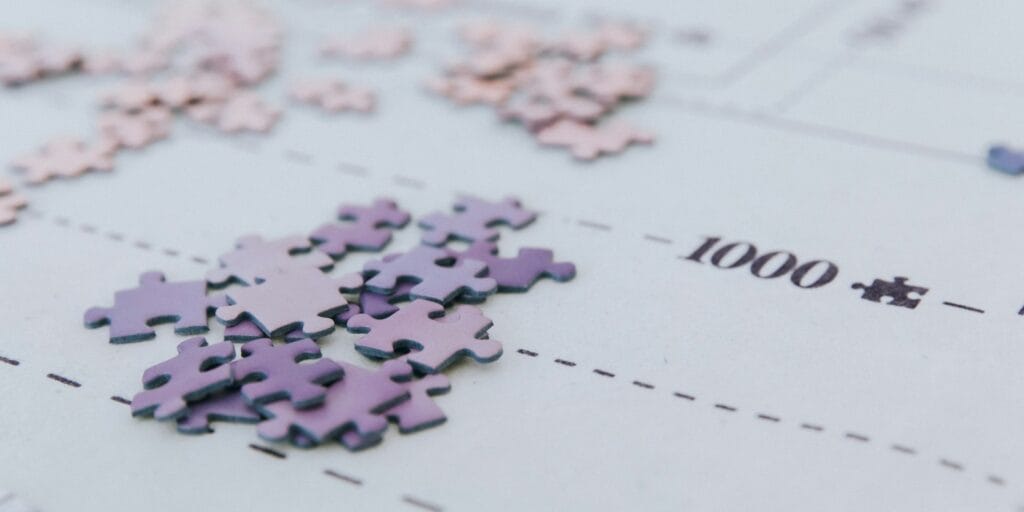
Most puzzle enthusiasts know to consider piece count and artwork when choosing their next jigsaw. Fewer stop to think about how those pieces are cut — and yet the cutting method may be the single most influential factor in determining how a puzzle actually feels to solve. It governs whether pieces are easy or difficult to distinguish, how precisely they lock together, how satisfying the final “click” is, and even how long the assembled puzzle will last.
Understanding jigsaw puzzle cut types helps you make smarter purchasing decisions, match the right puzzle to the right solver, and set accurate expectations around difficulty and experience. This guide covers every major cutting method in depth — from the ubiquitous ribbon cut to precision laser cutting — and explains exactly what each one means for your puzzling session.

A Brief History of Jigsaw Puzzle Cutting
To understand modern cutting methods, it helps to know where they originated. The first jigsaw puzzles appeared in the 1760s, when British mapmaker John Spilsbury mounted maps on hardwood boards and cut along country borders with a handheld marquetry saw. The term “jigsaw puzzle” itself came later, named after the mechanical jigsaw that eventually replaced hand-cutting during the early twentieth century.
For much of the twentieth century, steel-rule die cutting became the dominant production method. Manufacturers pressed sharp steel blades — arranged in a custom pattern — through stacked sheets of cardboard to produce dozens or hundreds of identical puzzles at high speed. That manufacturing legacy directly gave rise to the two most common cut patterns we see today: ribbon cuts and random cuts. Laser cutting, by contrast, is a genuinely modern innovation that has opened up a new tier of premium, customizable puzzle design.
The Four Main Jigsaw Puzzle Cut Types
Ribbon Cut Puzzles
What Is a Ribbon Cut?
The ribbon cut is the most common cutting method in mass-market jigsaw puzzles today. Its name comes from the long, continuous strips — or “ribbons” — of pieces that the die produces as it cuts in straight rows and columns across the puzzle sheet. When you look at the completed grid, every cut line runs either perfectly horizontal or perfectly vertical, forming a uniform grid pattern.
Within that grid, individual pieces are shaped with the classic interlocking profile most people picture when they think of a jigsaw puzzle: two protruding tabs (knobs) on one pair of opposite sides and two recessed blanks (holes) on the other pair. The exact contour of those tabs and blanks varies slightly from piece to piece, but the overall silhouette remains highly consistent throughout the puzzle.
How Ribbon Cutting Is Manufactured
Ribbon-cut puzzles are produced using a custom steel die — a flat board into which sharpened steel blades are bent and set in the desired pattern. The die is then pressed hydraulically through a stack of printed cardboard sheets, simultaneously cutting dozens of puzzles. Because the blade pattern is fixed, every puzzle produced from the same die is cut identically. Manufacturers sometimes use multiple dies with slightly different knob profiles to reduce the frequency of near-identical pieces.
The Solving Experience
Because ribbon-cut pieces follow a predictable shape logic, experienced puzzlers can use shape as an efficient sorting tool. Pieces with two tabs on the same side, or one tab and one blank in a specific arrangement, can be grouped quickly and tested methodically. This predictability also makes it easier to work around the puzzle’s border first: the straight exterior edges are easy to identify, and the grid structure ensures that once a row is assembled, it locks into place cleanly.
The main trade-off is the potential for “false fits.” When many pieces share a nearly identical tab-and-blank profile, a piece may appear to fit correctly — sliding into place with a satisfying click — only for the image to reveal a mismatch. This phenomenon is more common in higher piece-count ribbon-cut puzzles where the variety of distinct shapes is simply insufficient to differentiate every piece unambiguously.
Best suited for: Beginners, casual puzzlers, families with children, anyone who values a methodical and relaxing solving process, and puzzles intended to be completed quickly.
Random Cut Puzzles
What Is a Random Cut?
Random cut puzzles, sometimes called “free-form cut” puzzles, use a die in which the blade layout does not follow any regular grid. Instead, cuts curve, angle, and intersect in an irregular pattern across the puzzle sheet, producing pieces with widely varying shapes. Some pieces may have three or even four tabs; others may have unusual, elongated silhouettes or concave curves that do not resemble the classic puzzle-piece shape at all.
Critically, in a well-executed random cut, every single piece in the puzzle is unique. No two pieces share the same profile, which means there is exactly one location in the puzzle where each piece belongs — and no risk of it accidentally fitting elsewhere.
The Design Advantage of Random Cuts
Beyond difficulty, random cutting offers a meaningful aesthetic benefit. Because the outer edge of the puzzle does not need to follow a straight line, manufacturers can create puzzles with shaped or irregular borders — designs that, when assembled, form the silhouette of an animal, a circle, a map outline, or any other custom shape. Shaped puzzles — those that complete into a non-rectangular form — are almost universally randomly cut.
Random cutting also allows manufacturers to introduce “whimsy pieces” — pieces that have been deliberately cut into a recognizable figurative shape, such as a butterfly, a tree, a boot, or a star — embedded within the larger puzzle. These are hallmarks of premium random-cut puzzles and add an element of delightful discovery to the solving process.
The Solving Experience
Assembling a random-cut puzzle is a fundamentally different experience from working with a ribbon cut. Because shape sorting is less effective — a piece with three tabs could belong in dozens of locations — solvers must rely more heavily on color matching, pattern recognition, and image memory. This increases the cognitive engagement and, for many experienced puzzlers, the satisfaction of completion.
The additional challenge does introduce one practical difficulty: sorting and organizing pieces during setup takes longer. Many puzzlers find it helpful to sort by color region rather than shape when working with a random cut, and to keep the reference image prominently visible throughout.
Best suited for: Experienced puzzlers seeking a greater challenge, those who enjoy shaped or whimsy-piece puzzles, and anyone who finds ribbon cuts too repetitive.
Laser-Cut Puzzles
What Is Laser Cutting?
Laser cutting represents the most technologically advanced cutting method currently in commercial use. Rather than pressing a physical blade through a stack of material, a computer-controlled laser beam traces the cut pattern precisely, burning through each piece’s outline one at a time. The result is a level of precision and customization that is simply impossible to achieve with a physical die.
Most laser-cut puzzles are made from wood — typically basswood or birch plywood — rather than cardboard, though acrylic versions also exist. The laser produces extremely clean, smooth edges with no cardboard fraying, no dust particles, and no slight misalignments between pieces.
What Sets Laser Cutting Apart
The defining feature of laser cutting is the ability to produce completely arbitrary shapes with no tooling cost. Because the cut pattern is controlled by software, every single puzzle can theoretically be cut differently — and many premium laser-cut puzzle makers do exactly that, using algorithm-generated cut patterns to ensure no two puzzles in their catalog are identical. This eliminates false fits.
Laser cutting also makes it practical to produce pieces in figurative shapes at scale. Puzzle makers such as Artifact Puzzles and Nervous System have built their brands around laser-cut wooden puzzles featuring intricately shaped whimsy pieces and organic, algorithmically generated cut lines that look almost like natural formations.
According to our research, the premium puzzle segment — which includes laser-cut wooden puzzles — has grown substantially over the past several years as adult puzzlers seek higher-quality, longer-lasting products that also function as display pieces.
The Solving Experience
Laser-cut puzzles offer the most precise fit of any cutting method. Pieces seat into place with exceptional clarity, and the weight and texture of wood add a tactile quality that many puzzlers find deeply satisfying. Because the material is thicker and more durable than cardboard, assembled puzzles can be handled, stored, and reassembled repeatedly without showing wear.
The primary limitations are cost and availability. A high-quality laser-cut wooden puzzle typically costs several times more than a comparable cardboard puzzle, and the production process is slower, meaning these puzzles are generally sold in smaller quantities by specialty manufacturers rather than mass-market retailers.
Best suited for: Collectors, gift buyers, experienced puzzlers who want a premium experience, and anyone interested in puzzles as decorative or heirloom objects.
Die-Cut Cardboard Puzzles (Standard Mass-Market)
A Note on “Die Cut” as a Category
It is worth clarifying a term that creates considerable confusion: nearly all cardboard jigsaw puzzles — whether ribbon cut or random cut — are technically “die cut,” meaning they are manufactured using a steel-rule die press. Retailers and manufacturers sometimes use “die cut” as a quality-signaling term to distinguish cardboard puzzles from cheaper, less precisely made alternatives, but the term itself does not specify the cut pattern.
When a puzzle is described simply as “die cut” without further qualification, it is typically a ribbon-cut puzzle using standard interlocking shapes. Paying attention to whether the listing specifies “random cut,” “irregular cut,” or “unique piece shapes” will give you a more accurate picture of what to expect.
How Cut Type Interacts with Piece Count and Difficulty
The relationship between cut type and difficulty is not linear — it is multiplicative. A 500-piece ribbon-cut puzzle occupies a very different difficulty bracket than a 500-piece random-cut puzzle, even if the artwork is identical.
As piece count rises in ribbon-cut puzzles, the false-fit problem intensifies because the number of pieces that share nearly identical profiles grows faster than the variety of distinct profiles available in the die. This is one reason why many serious puzzlers prefer random cuts for puzzles above the 1,000-piece threshold: at that scale, shape uniqueness becomes a meaningful time-saver rather than a minor convenience.
Conversely, at lower piece counts — say, 300 pieces or below — the differences between cut types are much less pronounced, since even a ribbon cut at that scale produces pieces that are fairly easy to distinguish. For children’s puzzles and beginner formats, ribbon cuts are consistently the better choice due to their predictable, confidence-building assembly logic.
Cut Type and Puzzle Image: Matching the Two
Puzzle makers do not always choose cut types arbitrarily. The relationship between the cut pattern and the image can significantly affect the solving experience.
Ribbon cuts work particularly well with images that have strong, distinct color zones — landscapes with clear sky, ground, and subject separation, for instance — because solvers can use color to compensate for the limited shape variety. Random cuts, on the other hand, excel with complex, detailed images where texture and fine pattern detail vary continuously across the surface, since those images require sustained attention regardless of piece shape.
Images with large expanses of a single color or pattern — a blue sky, an out-of-focus background, a field of snow — are notoriously difficult with any cut type, but they are particularly challenging with random cuts because neither color nor shape provides reliable guidance. Experienced puzzlers often refer to these as “torture puzzles” and approach them as deliberate skill-builders.
Comparing Cut Types at a Glance
| Feature | Ribbon Cut | Random Cut | Laser Cut (Wood) |
|---|---|---|---|
| Piece shape variety | Low | High | Very high |
| Risk of false fits | Moderate to high | Very low | None |
| Suitable for beginners | Yes | Less so | Varies |
| Shaped/whimsy pieces | Rare | Common | Very common |
| Material | Cardboard | Cardboard | Wood or acrylic |
| Price range | Budget to mid-range | Mid-range to premium | Premium to luxury |
| Durability | Moderate | Moderate | High |
| Availability | Very wide | Wide | Specialty retailers |
How to Identify a Puzzle's Cut Type Before You Buy
Not all puzzle manufacturers clearly label their cut type on the packaging. Several indicators can help you determine what you are getting before committing to a purchase.
If the product listing or box mentions “grid cut,” “standard cut,” or simply “die cut” without elaboration, it is almost certainly a ribbon cut. Phrases like “random cut,” “irregular cut,” “unique piece shapes,” or “no two pieces alike” reliably indicate a random cut. “Laser cut” or “wooden puzzle” indicates laser cutting. Images of the puzzle pieces themselves — available on many retailer product pages — can also be revealing: a grid of similar-looking interlocking shapes signals a ribbon cut, while a visually chaotic arrangement of varied silhouettes signals a random cut.
For online purchases, reading user reviews is another useful strategy. Puzzlers frequently comment on false fits and shape variety, and those observations are more candid and specific than marketing copy.
Caring for Puzzles Based on Cut Type
The cut type also informs how you should handle and store your puzzle.
Ribbon-cut cardboard puzzles, assembled and glued, can be framed as wall art with standard framing hardware. Because the pieces interlock in a regular grid, the assembled image lies flat with minimal distortion — an ideal surface for gluing and framing. Many puzzlers working with 1,000-piece and larger ribbon-cut puzzles use puzzle mats or roll-up storage systems that allow them to preserve an in-progress puzzle between sessions.
Random-cut puzzles with irregular or shaped borders require more careful handling when moving the assembled image, since the non-rectangular perimeter is more vulnerable to breakage. Puzzle glue is still effective, but framing a shaped puzzle requires a custom or oversized mat.
Laser-cut wooden puzzles are the most durable of the three categories. They can be assembled, disassembled, and stored in their original box repeatedly with no degradation. Many come in high-quality packaging — wooden boxes, fabric pouches, or custom tins — that is itself designed for long-term storage and display.
Which Puzzle Cut Type Is Right for You?
Choosing the ideal cut type comes down to three variables: your experience level, your desired challenge, and your budget.
If you are new to puzzling, building a habit of regular puzzling, or assembling with young children, a ribbon-cut puzzle offers the most accessible and forgiving experience. The predictable shapes, clear border logic, and wide availability at every piece count make ribbon cuts the natural starting point.
If you have completed several puzzles and find yourself growing restless with repetitive shapes, a random-cut puzzle adds genuine complexity without requiring you to step up in piece count. A well-executed 500-piece random-cut puzzle can challenge you more than a 1,000-piece ribbon cut, making it an efficient way to increase difficulty without dramatically increasing the time investment.
If you are shopping for a gift, building a collection, or simply want the most premium solving experience available, a laser-cut wooden puzzle is worth the investment. The tactile quality, piece precision, and durability of a wooden puzzle transform what is otherwise a disposable entertainment product into something closer to a lasting craft object.
The Four Main Jigsaw Puzzle Cut Types
A Note on “Die Cut” as a Category
It is worth clarifying a term that creates considerable confusion: nearly all cardboard jigsaw puzzles — whether ribbon cut or random cut — are technically “die cut,” meaning they are manufactured using a steel-rule die press. Retailers and manufacturers sometimes use “die cut” as a quality-signaling term to distinguish cardboard puzzles from cheaper, less precisely made alternatives, but the term itself does not specify the cut pattern.
When a puzzle is described simply as “die cut” without further qualification, it is typically a ribbon-cut puzzle using standard interlocking shapes. Paying attention to whether the listing specifies “random cut,” “irregular cut,” or “unique piece shapes” will give you a more accurate picture of what to expect.