Advertiser Disclosure
We independently review everything we recommend. When you buy through our links, we may earn a commission.
Charles Wysocki Puzzles: Which Puzzle to Choose

If you’ve spent any time browsing jigsaw puzzles, chances are you’ve stumbled across the warm, storybook-like imagery of Charles Wysocki. His scenes of small-town America — weathervanes spinning over red barns, horse-drawn buggies clip-clopping down cobblestone streets, cats perched on windowsills while snow falls softly outside — have a way of pulling you in before you’ve even opened the box. Our team has spent a fair amount of time assembling Wysocki puzzles across multiple piece counts, and we wanted to put together a thorough guide that goes beyond the basics: who was this artist, why are his puzzles so beloved (and sometimes so divisive), and which one should you actually pick up first?
Who Was Charles Wysocki?
Charles Wysocki (1928–2002) was an American folk artist and painter who spent much of his career immortalizing a version of America that felt lived-in, cozy, and deeply nostalgic. Born in Detroit and largely self-taught, Wysocki developed a painting style that drew heavily from the traditions of American folk art — flat perspectives, rich colour, intricate detail, and an almost fairy-tale quality to ordinary rural and small-town scenes. According to the Smithsonian American Art Museum, folk art traditions like Wysocki’s occupy a unique space in American cultural history, capturing community values and everyday life in ways that resonate across generations.
His subjects tend to be outdoor Americana — harvest festivals, colonial New England villages, Fourth of July celebrations, farms at golden hour, and the occasional whimsical cat tucked into a corner. There’s a warmth to his palette that feels almost cinematic, like a memory you didn’t know you had. It’s not photorealism; it’s something better. It’s the feeling of a place rather than the exact appearance of it.
Wysocki’s commercial success came largely through collectible prints and licensed products, and his artwork found a particularly natural home in the puzzle world. Today, the vast majority of his puzzle lineup is produced and licensed through Buffalo Games, one of the leading puzzle manufacturers in North America, known for its quality cardboard stock and precise die-cut pieces. From what we’ve gathered in our research, there are well over 100 different Wysocki puzzle titles in circulation, spanning a range of piece counts and seasonal themes.
Everything We Recommend
✅ We recommend these products based on an intensive research process that’s designed to cut through the noise and find the top products in this space. Guided by experts, we spend hours looking into the factors that matter to bring you these selections.
⭐ 2.5 million+ people assisted in the last 30 days ⭐
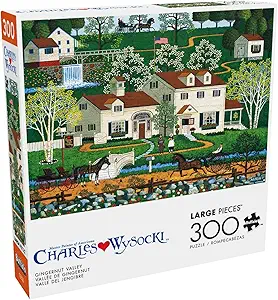
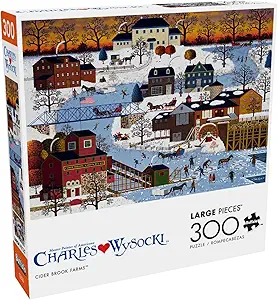
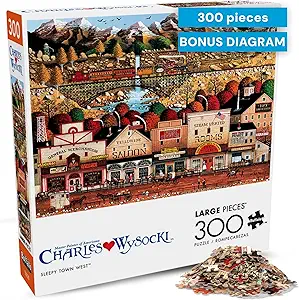
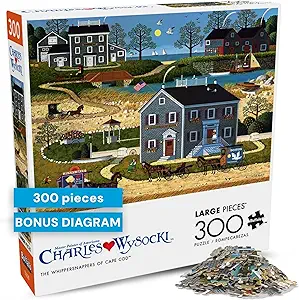
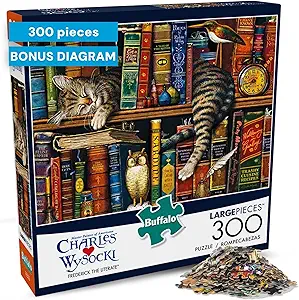
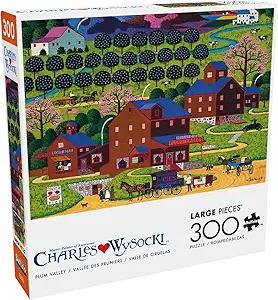
The 300-piece Wysocki puzzle was, honestly, a quiet revelation for us. We tend to approach smaller piece counts with mild scepticism — it can feel like you’re not getting the full experience — but assembling a Wysocki at 300 pieces changed that thinking pretty quickly. What surprised us most was how much of the painting’s storytelling magic survived at this scale. You still get those signature layered details, the little figures going about their day, the weathervane above the barn, the cat in the window — none of that disappears just because the piece count is lower. What does change is the pacing: a 300-piece Wysocki moves at a warm, unhurried rhythm that’s genuinely enjoyable on a relaxed afternoon. We found ourselves finishing one on a Sunday afternoon while listening to a podcast, and the whole experience felt complete rather than rushed. This is the one we’d confidently recommend to someone newer to puzzling and wants to ease into Wysocki’s detailed imagery without feeling overwhelmed, or to someone who’s bought a puzzle to enjoy with an older family member who finds large piece counts frustrating. It also makes a genuinely thoughtful gift for someone who loves Americana but doesn’t have a dedicated puzzle table — a 300-piece puzzle can realistically be completed on a kitchen table in an evening. The piece size is satisfyingly chunky, the fit is secure, and the finished image looks impressive enough to justify framing.
Best for: Beginners, casual puzzlers, family puzzling sessions, older adults, gift-giving.
Trade-off: If you’re an experienced puzzler, you may finish it faster than you’d like and wish you’d gone up a size.
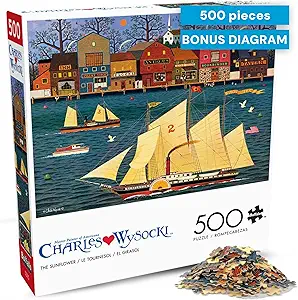
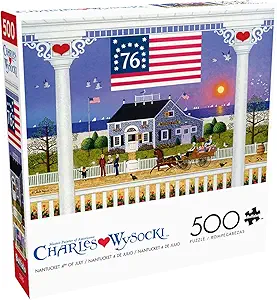
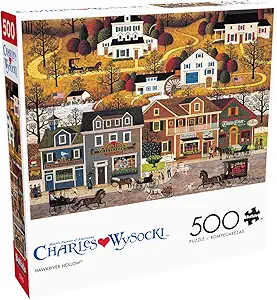
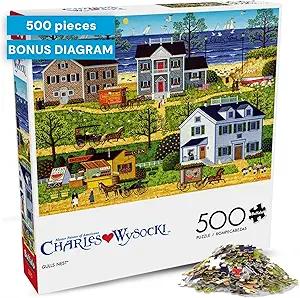
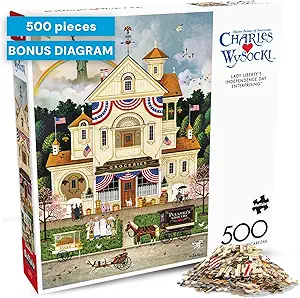
Of all the Wysocki options we tested, the 500-piece puzzle might be the one we found ourselves recommending most naturally in conversation. It hits a satisfying middle ground that’s harder to find than you’d think — complex enough to keep you genuinely engaged across multiple sessions, but manageable enough that you’re not battling the puzzle for weeks before you reach the finish line. When we worked through a 500-piece Wysocki winter village scene, we found the sorting phase was genuinely fun rather than laborious, and the assembly itself had a nice rhythm: confident early progress as the architectural elements came together, a pleasant challenge in the snow and sky sections, and then a deeply satisfying final sprint. The pieces themselves fit well — Buffalo Games’ cutting at this size tends to be sharp and consistent — and the printed colour is vivid and accurate. What we also noticed is that the 500-piece format shows off Wysocki’s compositional skills particularly well. His paintings are built to draw the eye through the scene, and at 500 pieces, you can really appreciate the structure of that composition as it emerges. This is also the size we’d recommend if you’re not sure whether you like Wysocki’s style yet — it’s enough of a commitment to give you a real taste, but not so much that you’ve invested three weekends in a style you’re still deciding about.
Best for: Intermediate puzzlers, people new to Wysocki, and anyone who wants a satisfying 2–4 evening project.
Trade-off: Experienced puzzlers who love a long challenge might find it resolves a bit quickly.
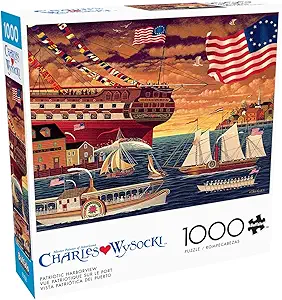
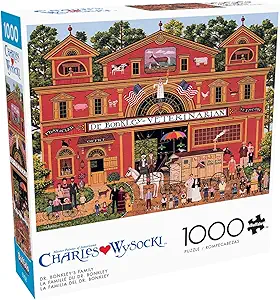
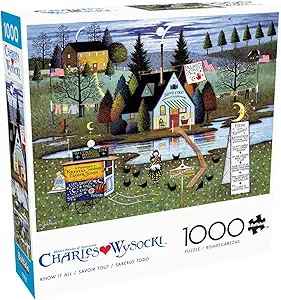
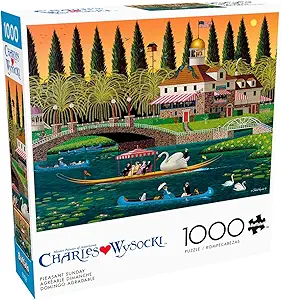
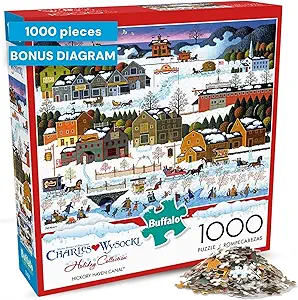
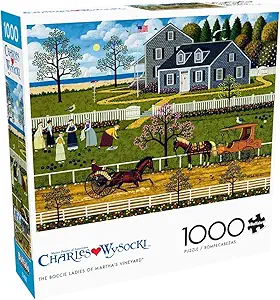
The 1000-piece Wysocki is, in our experience, what most serious Wysocki fans are actually talking about when they discuss his puzzles. This is the size that tends to dominate collectors’ shelves, the one that shows up as gifts at holiday tables, and the one that delivers the most complete version of what makes Wysocki’s artwork so compelling. At 1000 pieces, the level of detail you can appreciate in the finished image is genuinely impressive — you start noticing brushstroke choices, the way light falls across a snow-covered rooftop, the tiny figures far in the background that you didn’t even register on the box image. We assembled a New England harvest scene at this size, and there were moments — particularly in the final stages, when the whole image starts to snap into focus — that felt almost meditative. That said, we want to be real about the challenge: the sky and open water sections at 1000 pieces can be genuinely slow going. On one puzzle, we spent nearly as long on the upper sky quadrant as we did on the entire architectural foreground. If that kind of focused, patient work sounds like a feature rather than a bug to you, you’ll love this size. If it sounds like a chore, consider starting at 500 and working your way up. The 1000-piece Wysocki is also where the Buffalo Games printing quality really gets to shine — the colours are rich, and the resolution is sharp enough that you can use the reference poster effectively even for very similar-looking sections.
Best for: Experienced puzzlers, Wysocki collectors, anyone who wants a project to last several evenings, and people who enjoy moderate-to-challenging difficulty.
Trade-off: The sky and snow sections can be tedious; expect at least one slow evening working through near-identical pieces.
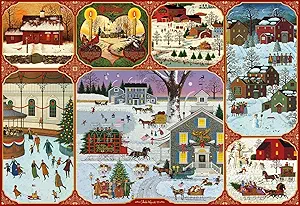
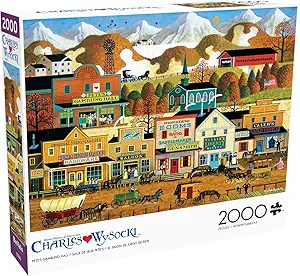
We’ll be upfront: not everyone on our team had the time or table space to fully complete a 2000-piece Wysocki during our testing period, and that’s kind of the point. This is a puzzle that asks something real of you — a dedicated surface that can stay undisturbed for days, a willingness to sit with a slow process, and a genuine love of Wysocki’s imagery, because you’ll be looking at it for a long time. What we can tell you is that the experience of working through the early stages of a 2000-piece Wysocki is deeply satisfying in a way that smaller formats don’t quite replicate. The image unfolds slowly, almost like watching a film develop. Details that seem obvious in miniature become small puzzles within the puzzle at this scale — figuring out which of twenty nearly identical blue-grey sky pieces belongs where requires a kind of focused attention that most of us don’t practice in everyday life. Buffalo Games maintains its quality standards at this size, with pieces that hold together well and don’t separate when you move sections around, which you will inevitably need to do when working with a spread this large. We’d strongly recommend a dedicated puzzle mat or board if you’re attempting this one. The finished image, when complete, is genuinely impressive at this size — large enough to frame as a meaningful piece of wall art. This is the Wysocki puzzle for someone who’s already completed several of his 1000-piece offerings and wants the deepest possible version of the experience.
Best for: Dedicated, experienced puzzlers; Wysocki enthusiasts; anyone who wants a multi-week project; people with a permanent puzzle space.
Trade-off: Requires real table space, time commitment, and patience — not a casual undertaking. Definitely not a first Wysocki.
What Makes a Wysocki Puzzle Distinctive?
Before we talk about which puzzle to buy, it’s worth understanding what makes the experience of assembling a Wysocki puzzle different from, say, a landscape photograph or a collage puzzle.
Dense, Story-Filled Imagery
The biggest thing we noticed right away is that Wysocki’s paintings are busy in the best possible way. Every image is packed with detail — a dozen characters doing different things, signs on storefronts, animals in the background, weathervanes, quilts hanging on fences, smoke curling from chimneys. This makes his puzzles genuinely engaging to work through, because you’re constantly discovering new elements you hadn’t noticed before. Even after completing a puzzle, you’ll often catch something new when you look at the finished image.
That said, this density does mean his puzzles tend to run on the trickier side of intermediate difficulty. There are large areas of visual similarity — sky, snow, foliage — that can slow you down even at lower piece counts. If you’re newer to puzzling, that’s worth keeping in mind.
The Colour Palette
Wysocki’s colour choices are rich and warm but not garish. He favours earthy reds, deep greens, ochre yellows, and muted blues, with highlights of brighter colour to draw your eye. This translates beautifully to puzzle form, because the printed colours on Buffalo Games puzzles tend to be faithful and vibrant without becoming washed out. When you’re sorting pieces, the colours are a genuinely useful sorting tool.
The “Love It or Hate It” Factor
We want to be honest here: Wysocki’s style isn’t for everyone. Among our team, reactions genuinely ranged from “I could do this every weekend” to “this is delightful once, but not my thing long-term.” The folk art aesthetic — slightly flattened, deliberately quaint — polarises people. Those who find Norman Rockwell a little too sentimental sometimes feel similarly about Wysocki. On the other hand, collectors of his work tend to be extremely devoted, often assembling dozens of his puzzles over many years. So if you’re buying this as a gift, it may be worth checking whether the recipient already has some familiarity with his style.
Buffalo Games: The Puzzle Behind the Picture
Since essentially all Charles Wysocki jigsaw puzzles are manufactured by Buffalo Games, it’s worth briefly understanding what that means for quality. Buffalo Games produces puzzles using a precision cutting process that results in pieces that fit together with a satisfying, secure snap. Their pieces are cut from thick, sturdy cardboard — not the thin, fragile variety that warps or frays — and the surface finish tends to be matte or lightly coated, which reduces glare while still showing colour depth well.
One thing we particularly appreciate about Buffalo Games puzzles is their consistency. From the 300-piece entry-level options all the way up to the 2000-piece builds, the piece quality and printing quality remain quite comparable. That’s not always true across the puzzle industry. The boxes also come with a poster of the finished image, which is genuinely useful as a reference guide while you work. The jigsaw puzzle category has seen sustained growth in recent years, and part of that growth has been driven by consumers increasingly demanding premium-quality products — a standard Buffalo Games generally meets.
For more puzzle picks across different themes and piece counts, check out our guide to the best 1000-piece puzzles for adults, which covers a wide range of artist collections and styles.
Wysocki's Recurring Themes: What to Expect
When you browse the full Wysocki catalogue, a few recurring themes come up again and again. Knowing these helps you choose a puzzle image you’ll genuinely enjoy spending 5–20 hours staring at.
New England & Colonial America
This is probably his most iconic territory. Think white-steepled churches, covered bridges, autumn leaf colours, and colonial-era architecture. These scenes tend to feel timeless and peaceful — the kind of image that fits on a wall as easily as it fits on a puzzle table.
Cats
Wysocki had a genuine affection for cats, and it shows. Many of his paintings either feature cats prominently or tuck them into corners and windowsills almost as Easter eggs. If you’re a cat person, there’s a whole subset of his work that might feel tailor-made for you. Several Buffalo Games titles lean heavily into the feline theme.
Seasonal & Holiday Scenes
Christmas, Thanksgiving, the Fourth of July, harvest season — Wysocki painted them all with particular relish. His holiday paintings tend to be especially rich with colour and activity, making them popular gift choices and a natural fit for seasonal puzzling traditions. Many puzzlers we know pull out a Wysocki Christmas puzzle every December, the way others rewatch holiday films.
Farm & Rural Life
Barns, silos, grazing animals, vegetable stands — Wysocki’s rural scenes carry a quiet, unhurried quality. These images tend to feature more open space than his village scenes, which can actually make them somewhat easier to assemble, because the large colour fields help you sort quickly.
How Difficult Are Wysocki Puzzles?
This is one of the most common questions we hear, and the honest answer is: it depends on the image more than the piece count. Generally speaking, though, Wysocki puzzles tend to run in the intermediate range. Here’s a rough breakdown:
- Sky, water, or snow sections are consistently the hardest parts of any Wysocki puzzle. Large fields of similar colour with very subtle variation will slow most puzzlers down.
- Architecture and figures are generally the most manageable, because the high detail and strong colour contrast give you clear sorting cues.
- Foliage and vegetation fall somewhere in between — autumn scenes with varied leaf colours can actually be quite forgiving, while dense green summer foliage can be surprisingly tricky.
For context, the American Mensa and various puzzle hobby organisations often categorise jigsaw puzzles by visual density and colour variety as key difficulty indicators. Wysocki scores high on both, which is part of what makes his puzzles feel rewarding rather than simply tedious.
Tips for Assembling Wysocki Puzzles
Whether you’re new to his work or you’ve assembled a dozen already, a few strategies tend to make the process smoother.
Sort by colour and texture first, then by edge shape. Wysocki’s paintings are colour-rich enough that sorting into broad colour families before you start building saves significant time. Edge shape alone won’t carry you very far in the dense mid-sections.
Build the architecture early. In almost every Wysocki scene, the buildings and structural elements offer the clearest sorting cues. Getting these down first gives you anchoring reference points for the harder sections around them.
Leave the sky for later — but not last. Sky sections are typically the hardest part of a Wysocki puzzle, and tackling them when you’re fresh tends to produce less frustration than saving them for the end when you’re tired and close to finishing.
Use the reference poster. Buffalo Games includes one in every box, and unlike some puzzles where the image is too small to be useful, Wysocki’s dense compositions make the poster genuinely valuable. Don’t be shy about referring to it often.
Take breaks. Seriously — fresh eyes after a night of rest will find connections your tired brain missed the evening before. This is especially true for Wysocki sky and snow sections.
How to Choose the Right Wysocki Puzzle for You
With well over 100 titles to choose from, picking a specific Wysocki puzzle can feel a little overwhelming. Here are the questions we’d ask:
What season resonates with you most? Wysocki has strong offerings across all four seasons, but his autumn and winter scenes are particularly beloved. If you’re assembling in December, a snowy New England village scene will feel perfectly in tune with the moment.
Do you prefer figures and activity, or quieter pastoral scenes? His “busy village” paintings are more challenging; his farm and landscape scenes tend to be a bit more approachable.
Are you a cat person? Because if so, there’s a whole corner of his catalogue that might genuinely delight you.
Who are you buying it for? A devoted Wysocki collector probably already has many of the most popular titles; for gift-giving, look for recent releases or explore the full Wysocki collection to find something they might not have.
For puzzle buyers who love artwork-based puzzles beyond Wysocki, our team also explores artists like Norman Rockwell and Terry Redlin — you can find related picks in our themed puzzle collections.
Frequently Asked Questions
Are Charles Wysocki puzzles discontinued?
No — new titles continue to be released through Buffalo Games, and many classic images remain in regular production. Some older or limited-edition titles do cycle out of print, but the core Wysocki catalogue remains widely available.
What company makes Charles Wysocki puzzles?
The overwhelming majority of Wysocki jigsaw puzzles are produced by Buffalo Games. They hold the primary licensing rights for his artwork in puzzle form, and the production quality is generally consistent and reliable.
How hard are Charles Wysocki puzzles compared to other artist puzzles?
They tend to fall in the intermediate-to-challenging range, primarily because of the visual density of his paintings and the large areas of similar colour (sky, snow, foliage). Compared to, say, a landscape photograph puzzle, Wysocki’s images generally offer more detail cues, which makes them easier to sort. Compared to simple still life or single-subject puzzles, they’re noticeably more complex.
Are Wysocki puzzles a good gift?
They tend to make excellent gifts for people who already appreciate Americana art, folk art traditions, or cozy aesthetic sensibilities. For someone unfamiliar with his work, a 300 or 500-piece puzzle is a low-stakes introduction. For a known Wysocki fan, a 1000 or 2000-piece puzzle in a theme you know they love is likely to go over very well.
Can I frame a completed Wysocki puzzle?
Absolutely — this is fairly common among dedicated collectors. Buffalo Games puzzles, once glued on the back with puzzle glue, hold together well for framing. Many of Wysocki’s images are beautifully suited for wall display, particularly the seasonal and holiday scenes.