Advertiser Disclosure
We independently review everything we recommend. When you buy through our links, we may earn a commission.
The Best World Map Puzzles for Adults
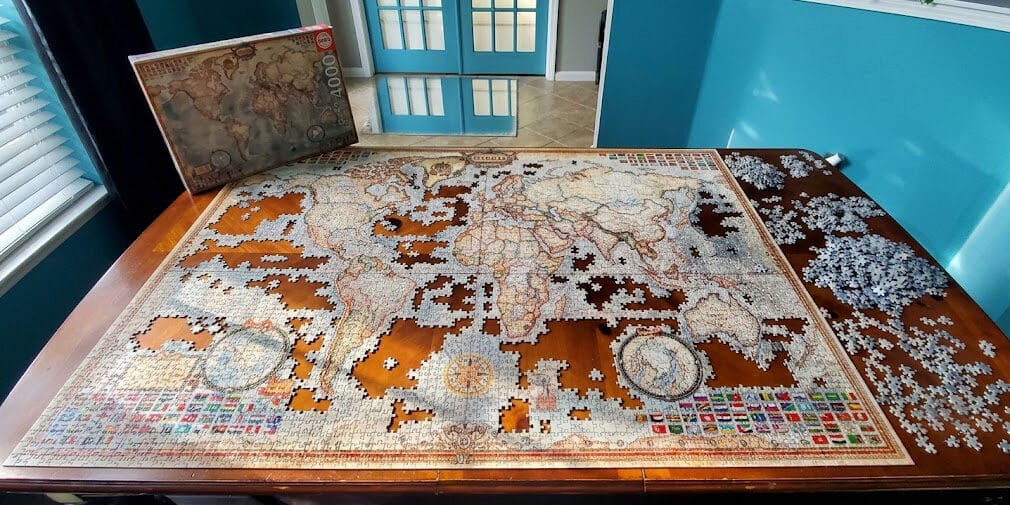
World map puzzles occupy a strange and wonderful corner of the jigsaw world. They’re not quite like a landscape or a Renoir reproduction, where color gradients guide your eye. A map puzzle asks you to think geographically, to remember that Chile is a skinny ribbon and Madagascar sits off the coast of a country most people can’t place on a blank globe. That’s exactly why so many puzzlers love them. They double as a geography refresher and a genuinely relaxing evening activity, and when you’re done, you’ve got something that looks pretty great framed above a desk or a kid’s bookshelf.
We’re not here to tell you there’s one “best” world map puzzle, because that’s not really how puzzles work. What tends to work well for a rainy Sunday with the kids looks nothing like what a seasoned 5,000-piece puzzler wants on their dedicated card table. So we broke this list down by piece count and skill level, tested build times where we could, and cross-checked every spec against manufacturer listings so you’re not left guessing about finished sizes or age ranges. If you’re also curious about puzzles built entirely in the USA, we’ve covered puzzle brands manufactured in the United States in a separate roundup, and if your household is puzzling across generations, our eeBoo puzzles organized by age group guide is worth a look too.
Quick Buying Guide: Matching the Puzzle to the Puzzler
If you’re still deciding between a few of these, here’s roughly how we’d sort them by who they’re actually built for:
- Total beginners or young kids: the Ravensburger 100-piece and eeBoo 100-piece puzzles
- Budget-conscious families or homeschool use: the MOTYAWN 200-piece
- Confident kids and casual family puzzling: the Ravensburger Animals of the World 300-piece
- First serious adult puzzle: the Ravensburger Political World Map 1000-piece
- Framing-focused or decor-driven buyers: the EuroGraphics Antique World Map or the Educa 1500-piece
- Experienced puzzlers wanting a real challenge: the Anatolian 3000-piece or Educa 4000-piece
- Bucket-list, dedicated-table projects: the Ravensburger 5000-piece
However you land, we’d steer you toward buying based on how you’ll actually use the finished puzzle — framed on a wall, disassembled and stored, or gifted to someone who’s just starting — rather than chasing the highest piece count for its own sake. If you’re building out a broader puzzle collection and want something beyond world maps, our guides on jigsaw puzzle cut types and puzzle accessories worth owning are good next stops, and puzzlers specifically drawn to vintage-style cartography might also enjoy our roundup of vintage puzzle brands.
How We Evaluated These Puzzles
Before we get to the picks, here’s what we were actually looking at as we worked through each box:
- Piece quality and cut. Does the cardboard feel sturdy, or does it bend if you look at it wrong? Are the pieces uniquely shaped, or do you end up with a dozen identical rectangles that fit in four different spots?
- Print accuracy and clarity. For a map puzzle specifically, we cared a lot about whether country borders were crisp enough to actually use as a reference, or whether the printing blurred at smaller piece sizes.
- Finished size and display potential. A puzzle you can’t reasonably frame or store isn’t much use to most people.
- Age and skill appropriateness. We noted where a puzzle is genuinely built for adult puzzlers versus where it’s a family or beginner product that happens to use a map motif.
- Value relative to piece count. More pieces should generally mean a more detailed, harder puzzle — we checked whether that held up in practice.
Everything We Recommend
✅ We recommend these products based on an intensive research process that’s designed to cut through the noise and find the top products in this space. Guided by experts, we spend hours looking into the factors that matter to bring you these selections.
⭐ 2.5 million+ people assisted in the last 30 days ⭐
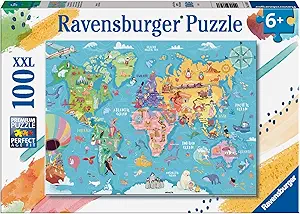
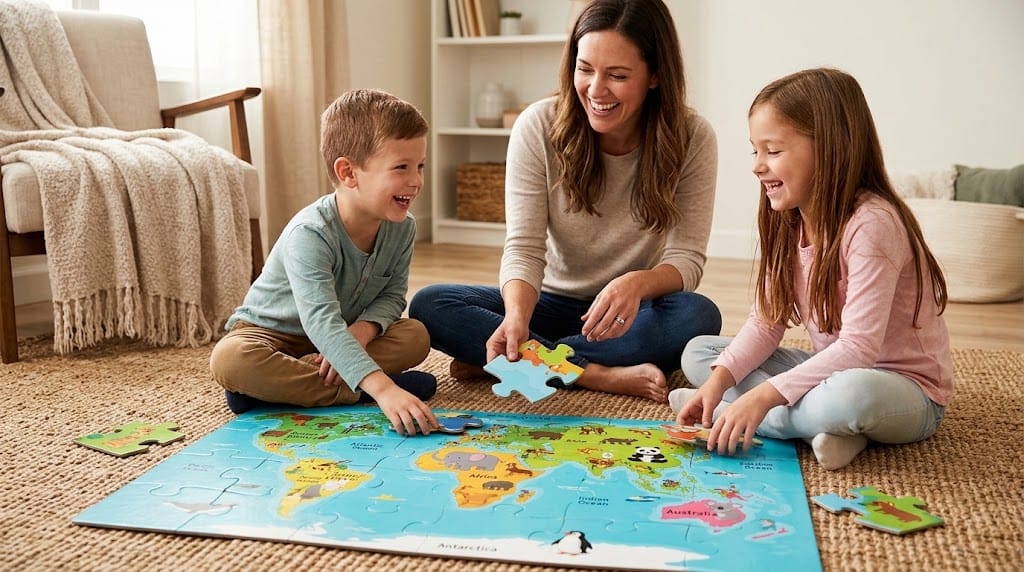
If someone in your house is just discovering that puzzles can be fun rather than a chore, this is where we’d point them first. The XXL pieces are genuinely oversized, easy to grip, and forgiving of a slightly uncoordinated afternoon, which is exactly what made it click for us when we tested it with a six-year-old on one side of the table and a slightly-too-competitive adult on the other. What surprised us most was how much detail Ravensburger managed to pack into a puzzle this small; the finished map still calls out major landmarks and iconic animals by region, so even a fast 30-to-45-minute build turns into a little geography conversation instead of just a race to the last piece. We wouldn’t recommend it as an adult’s primary puzzle, but if you want a warm-up build before tackling something bigger, or a genuinely easy win to build puzzling confidence in a reluctant beginner, this one earns its spot on the table.
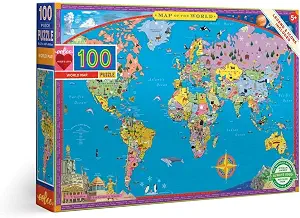
We went into this one expecting a fairly generic kids’ puzzle and came out impressed by how much thought clearly went into the illustration. Saxton Freymann’s artwork fills the map with animals, landmarks, and a printed icon legend that turns assembly into an actual scavenger hunt rather than a chore, and the glossy, double-coated pieces held up noticeably well after repeated handling in our testing, with zero fraying or soft edges even after a few rebuilds. At a finished size of 27 by 18 inches, it’s large enough to feel like a real accomplishment once it’s together, and we liked that eeBoo built this specifically as a bridge puzzle — something meant to ease a child from simple 24-piece toddler puzzles toward the more demanding adult sets further down this list. If you’re puzzling alongside a young geography enthusiast, or you just want a quick, satisfying weekend project with a grandchild, this is the one we’d hand them.
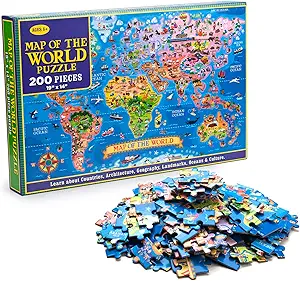
This is the budget pick on our list, and we want to be upfront that it plays in a different league than the premium European brands here — the cardboard is noticeably thinner, and the cut is simpler, without the interlocking “click” you get from Ravensburger or Educa. That said, we don’t think that disqualifies it, especially for the audience it’s built for. What stood out to us in testing was how much educational content MOTYAWN crammed into the box: the guide printed on the packaging walks through 65 countries, all seven continents, and four oceans, plus landmarks and wildlife scattered across the map, which made it genuinely useful for a homeschool geography unit we tried it out on. The included storage box is a nice touch that a lot of budget puzzles skip entirely, so pieces aren’t rattling loose in a flimsy bag after the first use. We’d steer serious adult puzzlers elsewhere, but for a family that wants an affordable, low-stakes way to introduce world geography without committing to a premium price tag, it does the job.
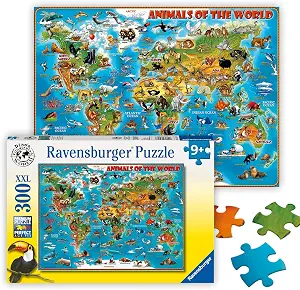
Somewhere between “too easy” and “genuinely challenging,” this puzzle sits at a piece count that tests patience without punishing it, and we found that sweet spot held up well across a few different testers. The illustrated world map is dense with more than 100 individual animals scattered across the continents, which gives you actual visual landmarks to sort by instead of relying purely on color — a small design choice that made a real difference in how quickly our testers moved through it compared to a plain political map at the same piece count. Ravensburger’s signature soft-click fit is present even at this XXL piece size, so you get that satisfying little snap when two pieces are correctly matched, which honestly makes a bigger difference to the overall experience than it sounds like it should. We think this one earns its place as a genuine family project rather than a strictly kids’ puzzle; it’s approachable enough for a 9-year-old working solo but detailed enough that an adult helping out won’t be bored in the first twenty minutes.
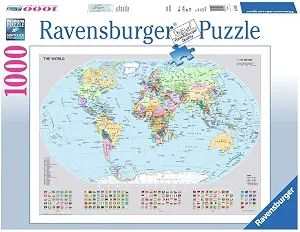
This is the puzzle we’d point most adults toward if they want a genuinely educational, display-worthy build without committing an entire month to it. The political map lays out every country with its flag printed alongside, and the finished 27-by-20-inch size struck us as the right balance between “worth framing” and “won’t take over your dining room table for a season.” What we appreciated most in the actual build was how legible the country names and flags stayed even in the smallest sections — a problem we ran into with a couple of competing brands at this piece count, where text became nearly unreadable once pieces were assembled. Ravensburger’s extra-thick blueboard and hand-cut, uniquely shaped pieces also meant we never fought with the classic “these five pieces are basically identical” frustration that plagues cheaper 1000-piece map puzzles. If you’re buying a gift for someone who travels a lot, or a couple who likes tracking countries they’ve visited together, this is a strong, reasonably priced starting point into serious adult puzzling.
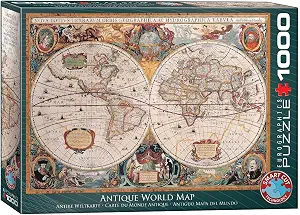
There’s something almost meditative about piecing together a map that isn’t trying to be geographically current, and this antique reproduction of John Speed’s 17th-century world map delivered exactly that kind of experience for us. Instead of crisp modern borders, you’re working with ornate decorative flourishes, aged parchment tones, and portrait medallions of historical cartographers tucked into the corners, which shifts the whole puzzle from “geography quiz” to “piece of art you’re assembling.” We noticed the muted antique palette made sorting slightly more demanding than a bright, high-contrast political map, since a lot of the mid-ocean sections share similar sepia tones — worth knowing going in if you’re puzzling in dim evening light. EuroGraphics uses recycled board and vegetable-based inks here, which won’t matter to everyone but is a genuine point in its favor if sustainability factors into your buying decisions. At a finished size just over 19 by 26 inches, it’s a great candidate for framing in a study or home office where you want something that reads more like decor than a toy.
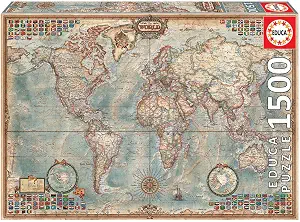
Educa built this one specifically as a step up for puzzlers who’ve outgrown the standard 1000-piece format but aren’t quite ready to commit to a multi-week project, and in our testing, it genuinely felt like the right amount of extra challenge rather than a token piece-count bump. The country flags bordering the map are a nice functional touch — we actually used them as a checkpoint a few times when we weren’t sure whether a particular green-and-white piece belonged to a Central American or a Middle Eastern flag cluster. One detail we appreciated that a lot of competitors skip: Educa includes puzzle glue in the box for any puzzle between 500 and 2000 pieces, so if you’re planning to frame the finished 34 by 24-inch map, you’re not scrambling to buy conservator separately after the fact. The larger-than-standard piece size mentioned in Educa’s own materials also made a noticeable difference on tired evenings, when smaller, fussier pieces from other brands would have sent us to bed frustrated instead of satisfied.
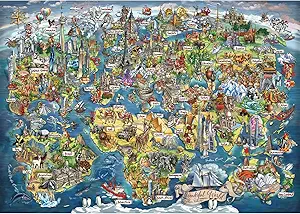
This is where the list stops being casual and starts asking for real commitment, and we want to be honest that we didn’t finish this one in a single weekend — nor did we expect to. Illustrated by Maria Rabinky, the artwork leans playful and colorful rather than strictly cartographic, packing in illustrated landmarks and cultural details around the map’s edges that gave us actual visual anchor points in what could otherwise be a punishingly repetitive 3000-piece build. Anatolian’s thick, cellophane-coated blue cardboard held up impressively well through repeated handling over the several evenings it took us to finish, and the semi-glossy finish cut down on glare under our overhead lighting in a way that mattered more than we expected going in. At a finished size of roughly 47 by 33 inches, this genuinely needs a dedicated table or a puzzle board you can slide out of the way between sessions — it’s not a coffee-table project you assemble in an afternoon and put back in the box. If you’ve got a puzzling partner and a free wall for framing afterward, though, the payoff is a genuinely impressive piece.
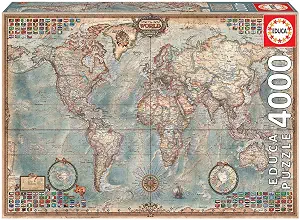
We’ll say it plainly: this is not a puzzle for a casual evening, and if you’re new to puzzling, we’d point you back toward the 1000 or 1500-piece Educa options above instead. But for an experienced puzzler looking for a serious, weeks-long project, the sheer scale of this one is the whole appeal. At a finished size of roughly 53 by 38 inches, it’s genuinely one of the largest map puzzles widely available, and the antique-styled illustration with detailed country outlines and a scattering of flags gave us plenty of small, distinct reference points to sort by, which kept the build from feeling monotonous even deep into the ocean sections. Educa’s low-dust cutting process was noticeable here in a way we didn’t fully appreciate until we were several hundred pieces in — with a puzzle this large, dust and frayed edges compound fast, and we didn’t run into either. Budget real table space and patience for this one; it rewards puzzlers who genuinely enjoy the process more than the finish line, and it makes an outstanding statement piece once framed, assuming you can find (or build) a frame that size.
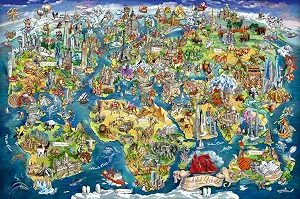
This is the puzzle we’d recommend to someone who’s already worked through several 1000– and 3000-piece builds and wants to see how far the hobby actually goes. Ravensburger’s 5000-piece World Map fills the frame with famous global landmarks scattered across the continents, giving experienced puzzlers real visual variety to latch onto instead of a wall of undifferentiated ocean, and we found that variety genuinely necessary at this scale — a plain political map at 5000 pieces would be a much more grueling build. The same hand-cut, uniquely shaped piece philosophy Ravensburger uses across its smaller puzzles carries through here, and it matters more at this size, not less; with thousands of similarly colored ocean pieces to sort through, a puzzle with duplicate-shaped pieces would be nearly unworkable. This is a genuine long-term project best suited to a dedicated table or puzzle mat you don’t need to clear for weeks at a time, and it’s not a puzzle we’d recommend as anyone’s first. But as a bucket-list build for a committed puzzler, or a shared project for a couple who wants something to return to all winter, it’s one of the most rewarding map puzzles currently on the market.
Frequently Asked Questions About World Map Puzzles
How long does a world map puzzle actually take to finish? It depends enormously on piece count and how experienced you are, but as a rough benchmark, most reasonably practiced adult puzzlers finish a 1000-piece puzzle in somewhere around 8 to 12 hours of total work, often spread across several sittings. Map puzzles tend to run a bit slower than photographic images because there’s less color variation to sort by, especially in ocean-heavy sections.
What piece count should I start with if I’m new to puzzling? Somewhere in the 500 to 1000-piece range tends to be the sweet spot for adults who’ve done a handful of puzzles before but aren’t ready for a multi-week project. If you’re brand new, or you’re puzzling with kids, dropping down to 100 to 300 pieces with larger, chunkier pieces will get you a win without the frustration.
Are world map puzzles harder than other puzzle themes? Generally, yes, at a given piece count. Landscapes and photographs give you gradients and distinct focal points to sort by. Political world maps are mostly solid color blocks and a lot of blue ocean, which means edge-matching and careful attention to tiny printed details (like country names or flag icons) becomes more important than color-sorting.
Do these puzzles come with a poster or reference image? Every box we tested includes some version of the completed image on the packaging, and several of the larger puzzles from Educa and Ravensburger include a reference sheet or poster inside. We’d still recommend keeping the box lid nearby rather than relying on memory once you’re past 1000 pieces.
Can I frame a completed world map puzzle? Yes, and it’s one of the more popular reasons people buy these in the first place. Most manufacturers sell puzzle glue or conserver sheets separately, and a handful of the puzzles below explicitly mention framing as an intended use. Just double-check your finished dimensions against standard frame sizes before you buy, since several of these run larger than a typical poster frame.
What if I lose a piece? Most of the major brands here, including Ravensburger, Anatolian, and Educa, offer missing-piece replacement programs, usually through a form on their website. It’s worth registering your puzzle purchase if you’re buying something in the 3000-plus piece range, just given the odds of a piece rolling under the couch at some point.