Advertiser Disclosure
We independently review everything we recommend. When you buy through our links, we may earn a commission.
Eurographics Puzzles Reviews: Which Piece Count Actually Delivers?
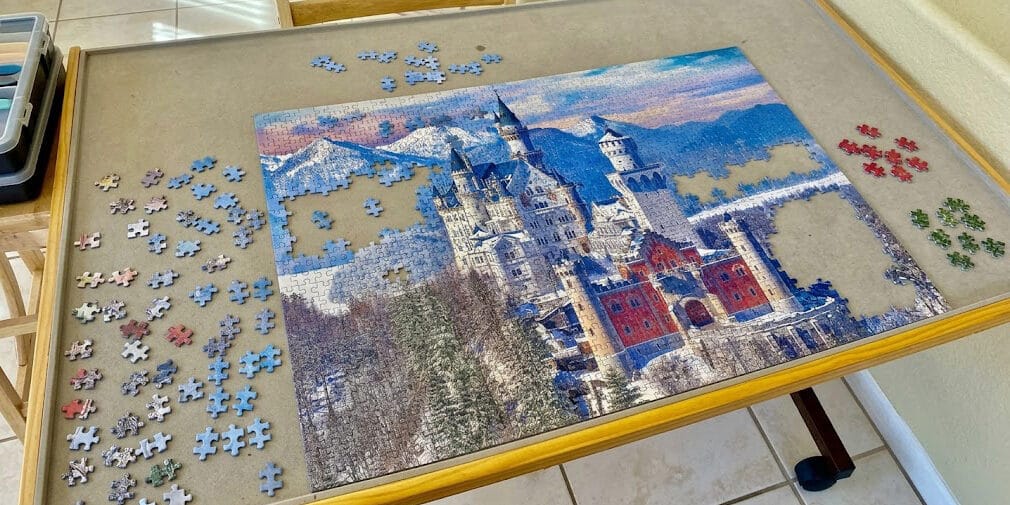
If you’ve spent any time browsing the puzzle aisle — or scrolling puzzle forums at 11 p.m. wondering why your last box arrived with a bent corner — you’ve probably run into Eurographics. It’s one of those brands that seems to be everywhere: big box stores, specialty puzzle shops, gift shops in tiny mountain towns. But “everywhere” doesn’t always mean “worth your money,” so our assessment team decided to actually sit down, open the boxes, and put together five different Eurographics puzzles ranging from a quick 35-piece warm-up to a sprawling 2000-piece weekend project.
A Quick Word on Who Eurographics Actually Is
Before we jump into rankings, it helps to know a little about the company behind the boxes. Eurographics started in 1987, and honestly, it didn’t begin as a puzzle company at all — it grew out of poster and art print distribution before expanding into jigsaw puzzles. That art-publishing background actually shows up in the finished product: a lot of Eurographics puzzles feel like they were designed by people who think about color and composition first, puzzle mechanics second.
The company has also leaned hard into sustainability messaging over the years. Their puzzles are generally made from recycled blueboard and printed with vegetable-based inks, and many lines carry Forest Stewardship Council certification. If you care about the environmental footprint of your hobby (and a lot of puzzlers do), that’s a meaningful point in Eurographics’ favor, though it’s worth noting not every SKU is manufactured in the same facility, so quality can vary slightly depending on where a specific puzzle was produced.
We mention all this upfront because it shapes how we evaluated everything below. We weren’t grading these puzzles against ultra-premium European brands with wood-mount presses. We were asking a simpler, more useful question: for a mid-range, widely available puzzle brand, does Eurographics do right by the person assembling it?
Everything We Recommend
✅ We recommend these products based on an intensive research process that’s designed to cut through the noise and find the top products in this space. Guided by experts, we spend hours looking into the factors that matter to bring you these selections.
⭐ 2.5 million+ people assisted in the last 30 days ⭐
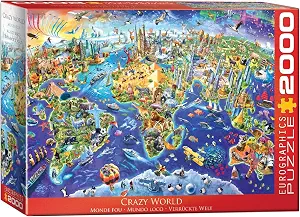
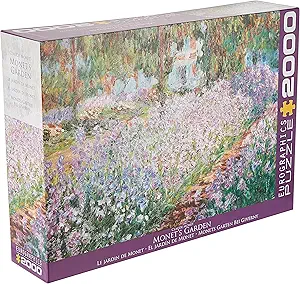
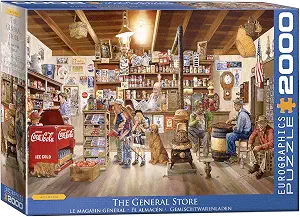
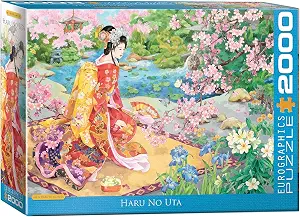
We’ll be upfront — a 2000-piece puzzle is a mood, not a casual Tuesday activity, and Eurographics‘ entry in this category asked us to actually plan for it. We cleared a full table for three days, which honestly says more about the piece count than anything specific to the brand, but it’s worth knowing going in. The finished image measures a hefty 38.25 x 26.63 inches, so if you’re picturing something you can leave half-done on a coffee table, you’ll want a dedicated puzzle mat or a spare room instead, because this thing takes up real estate.
What surprised us most was how manageable the sorting process felt despite the sheer volume of pieces. Eurographics tends to favor busy, detail-rich imagery at this size — think sprawling world maps, dense collages, or nostalgic Americana scenes — and that turned out to be a smart design choice, because the variation in color and texture gave us actual visual landmarks to sort by instead of hunting through a sea of identical blue sky. One of our testers, who normally avoids anything over 1000 pieces because “it just becomes tedious,” admitted this one kept her engaged because there was always a new section with a distinct color palette to dig into.
The piece quality held up reasonably well through repeated handling, though we did notice a bit more flex in some pieces compared to Eurographics’ smaller formats, which makes sense given how many pieces were punched from the same sheet of blueboard. A couple of edges felt slightly softer than we’d like by day three, though nothing came apart or lost its shape. If you’re the type of puzzler who treats a 2000-piece box as a long-term project — something you chip away at over a rainy week, maybe with a podcast playing in the background — this size delivers genuine satisfaction once that last piece clicks in and you step back to see the whole sprawling image finally come together. It’s best suited to patient adults or serious hobbyists rather than a group activity, simply because the density of small, similarly-shaped pieces makes it hard for younger kids to stay engaged for long. For a look at how other American-made brands handle oversized formats, our guide to puzzle brands manufactured in the United States is worth a browse if you’re comparing options at this scale.
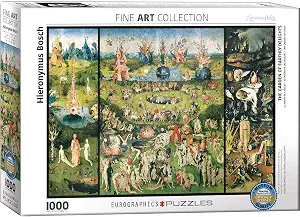

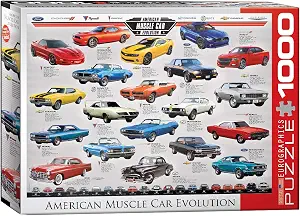
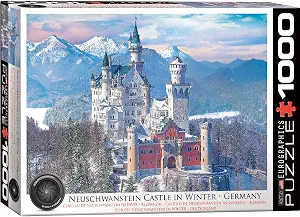
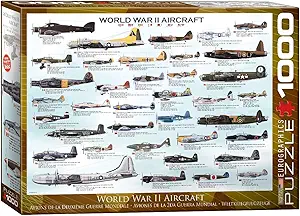
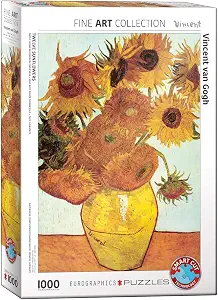
If there’s a “default” Eurographics experience, this is probably it — the 1000-piece format is where the brand seems to put the bulk of its catalog, and after testing several, we understand why. The finished puzzles measure roughly 19.25 x 26.5 inches, a size that fits comfortably on a standard card table or a large puzzle board without dominating a whole room, which makes it the format we’d recommend to someone trying Eurographics for the first time.
What stood out immediately was piece consistency. The pieces measure in that classic one-to-two-inch range, substantial enough to be satisfying to hold without feeling oversized or clumsy, and the fit between pieces was noticeably tighter here than in the 2000-piece format we tested. We assembled a books-and-coffee themed scene and came away impressed by how well the printed detail translated onto the board — the little illustrated title spines on the bookshelf and the steam curling off a coffee cup both held their crispness right up to the edges of each piece, which isn’t always a given with mid-range puzzle brands.
This is also where Eurographics’ art-publishing roots really shine through. A lot of their 1000-piece designs lean into rich, narrative imagery — cozy interiors, nostalgic street scenes, collage-style collections of dogs or birds or famous writers — and that storytelling quality made the assembly process feel less like a mechanical task and more like slowly uncovering a scene. One tester compared it to reading a picture book one page at a time. For anyone who wants a puzzle night that stretches comfortably across two or three evenings without becoming an all-week obligation, or a gift that feels genuinely thoughtful rather than generic, this piece count hits a sweet spot most people are looking for. It’s also the format we’d point beginners toward if they’re deciding between Eurographics and other mid-range brands — our comparison of New York Puzzle Company’s 1000-piece lineup is a good next stop if you want to see how a different manufacturer approaches this same size.
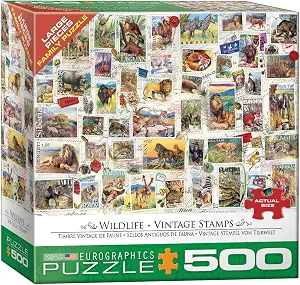
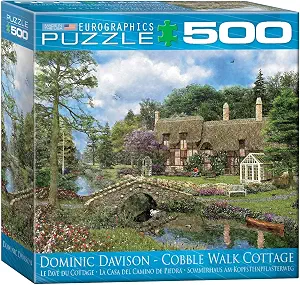
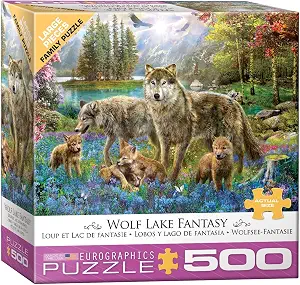
The 500-piece size is where we noticed Eurographics leaning into something a little more playful, and honestly, a little more forgiving. Finished puzzles in this range measure the same 19.25 x 26.5 inches as the 1000-piece line, which means you get noticeably larger, chunkier pieces since half as many are cut from the same overall image size. That single detail changes the entire feel of assembly — pieces were easier to pick up, easier to flip over quickly while sorting, and generally kinder to anyone dealing with smaller hands or less nimble fingers.
We tested a couple of options in this range, including a playful floral design and a whimsical wildlife-themed box, and both reinforced the same impression: 500 pieces is where Eurographics’ quirky, colorful art direction gets to really breathe. The image on the finished board looked sharp and saturated, not the slightly muddy result you sometimes get when a busy design gets crammed into too many tiny pieces. One thing we appreciated is that the box size stays compact at roughly 8 x 8 x 2.37 inches, so storage isn’t the hassle it can be with the larger formats — a real plus if you’re the kind of household that keeps a rotating stack of puzzles in a closet.
This piece count struck us as the most versatile of everything we tested. It’s substantial enough to occupy a relaxed afternoon or a couple of evenings, but not so demanding that it becomes a chore if life gets busy and the puzzle sits half-finished for a few days. We’d point this size toward puzzlers who want a satisfying but low-stress project, toward parents assembling something alongside a tween or young teen, or toward anyone gifting a puzzle to someone who isn’t sure they’re “a puzzle person” yet — the friendlier piece size and shorter time commitment make it a much less intimidating starting point than jumping straight to 1000 or 2000 pieces. If gifting puzzles is on your radar, our roundup of jigsaw puzzle brands built specifically for kids pairs well with this piece count if you’re shopping for a mixed-age household.
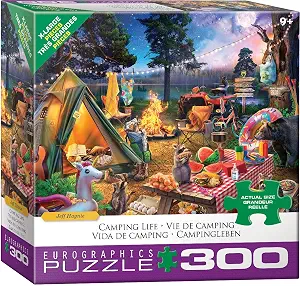
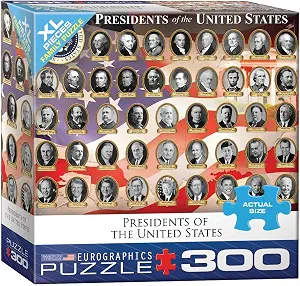
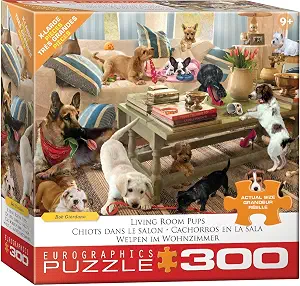
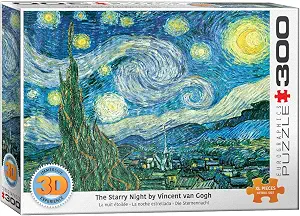
Somewhere between “quick activity” and “real project,” the 300-piece format ended up being one of our favorite surprises in this whole testing process. The finished image size stays consistent at 19.25 x 26.5 inches — the same footprint as the 500 and 1000-piece versions — which means the pieces here are noticeably larger and easier to grip than anything else we tested outside of the smallest format.
We put together a few different 300-piece designs, including a yoga-themed puppy illustration and a solar system collage, and in both cases the larger piece size made an unexpectedly big difference in how relaxing the whole experience felt. There was none of the squinting-at-tiny-shapes fatigue that can creep in with higher piece counts, and the reduced complexity meant we could actually hold a conversation while working through it rather than needing total focus. That made this size feel like the puzzle equivalent of a comfort show — something to do while unwinding rather than something that demands your full attention.
The image quality translated well onto the board, with clean printing and good color saturation, though because this format tends to favor lighter, more illustrative themes, it can feel a touch less “serious” if you’re hoping for a museum-worthy finished piece to frame. That’s not a knock so much as a matter of expectations — this size seems designed for pure enjoyment rather than display-piece ambitions. It’s an especially good fit for older kids working somewhat independently, for anyone easing back into puzzling after a long break, or for households that like keeping a rotating stack of quick, satisfying projects on hand rather than committing to one giant puzzle for weeks at a time. If you’re building out a puzzle collection with variety in mind, our guide to accessorizing your puzzle setup — mats, sorting trays, and glue sheets — is worth a look once you start assembling a few of these lighter, quicker builds.
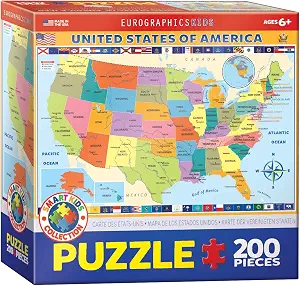
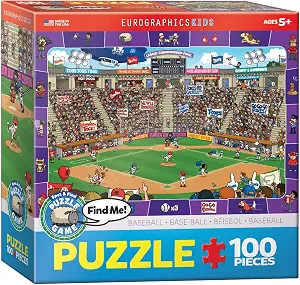
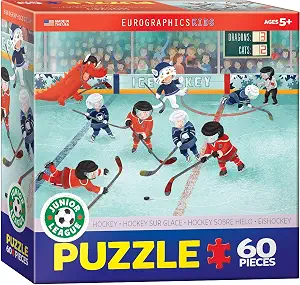
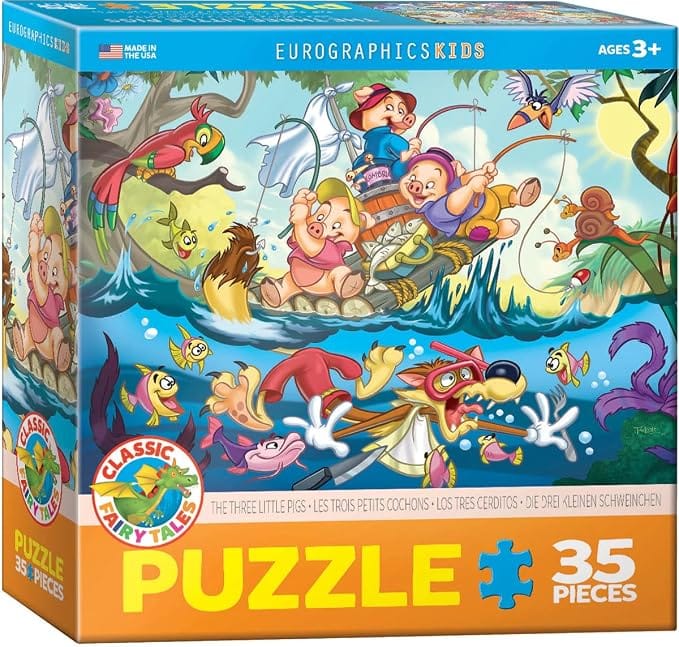
This range is a little different from everything else on our list, because it isn’t really one product — it’s a whole category of smaller, faster puzzles that Eurographics uses for everything from mini collectible-style boxes to entry-level kids’ puzzles. We tested a handful of options across this spread, including a compact mini puzzle and a couple of larger-piece kids’ designs, and came away thinking this is genuinely one of the most underrated parts of the Eurographics lineup.
The mini format, often around 100 pieces, comes in a noticeably smaller box — roughly 4 x 4 inches — but unfolds into a finished puzzle around 9 x 7 inches, which is a fun bit of engineering in itself. These felt almost novelty-sized at first, the kind of thing you’d toss in a travel bag or set out on a coffee table for a quick five-minute win, but the piece quality didn’t feel cut any corners compared to the larger formats we tested. The detailed, densely themed images — vintage airplanes and locomotives were standouts — packed a surprising amount of visual interest into a small footprint, which made the finished product feel more substantial than the tiny box suggested.
On the lower end of this range, closer to 35 to 100 pieces, Eurographics leans into big, chunky pieces clearly designed with younger hands and shorter attention spans in mind. We handed one of these to a six-year-old on our team’s testing panel, and what struck us was how quickly she built confidence — the pieces were large enough to grip easily, distinct enough in shape and color that she wasn’t guessing blindly, and the whole thing wrapped up in well under an hour, which kept her engaged from start to finish instead of losing interest halfway through. That’s exactly the kind of early win that turns a kid into an actual puzzle enthusiast rather than someone who tries it once and never picks one up again.
This piece range is best suited to three groups: young children just learning the mechanics of puzzling, adults looking for a genuinely quick five-to-thirty-minute activity, and anyone collecting themed mini puzzles as a low-stakes, low-cost hobby. It’s not the format to reach for if you want a weekend project or a display-worthy finished piece, but for approachable, fast, and surprisingly well-made small puzzles, this end of the Eurographics catalog earns its spot.
How We Tested and Ranked These Puzzles
Our process wasn’t complicated, but it was consistent. For each piece count, our team sourced puzzles that represent that size range fairly, then tracked the same handful of criteria every time:
- Piece fit and durability — Do the pieces click together snugly, or do they pop apart if you nudge the table?
- Image clarity and print quality — Does the finished image look sharp and vibrant, or slightly washed out compared to the box art?
- Assembly experience — Is sorting and building genuinely enjoyable, or does it feel like a slog because of repetitive colors or oddly-shaped pieces?
- Value relative to piece count — Are you getting a fair amount of puzzle for what you’re paying?
- Who it’s actually good for — Because a puzzle that’s perfect for a solo adult evening might be completely wrong for a family game night.
We didn’t rush any of these. Larger puzzles took multiple sittings over several days, and we made a point of returning to each one after a break, since a puzzle that feels fun in hour one can start to feel tedious in hour four if the piece variety isn’t there. That’s a detail a lot of quick reviews miss, and it’s one we think matters if you’re deciding whether to spend an entire weekend on a single box.
If you’re also curious about how piece shapes and cutting styles affect assembly difficulty across different brands, our breakdown of jigsaw puzzle cut types is a useful companion read before you commit to a size.
Eurographics Piece Count Comparison at a Glance

| Piece Count | Finished Size (approx.) | Best For | Typical Assembly Time |
|---|---|---|---|
| 35-200 pieces | 7″ x 9″ to 12″ x 18″ | Young kids, quick wins, beginners | 15 minutes to 2 hours |
| 300 pieces | 19.25″ x 26.5″ | Relaxed, low-pressure puzzling | 2-4 hours |
| 500 pieces | 19.25″ x 26.5″ | Versatile afternoon or gift puzzles | 3-6 hours |
| 1000 pieces | 19.25″ x 26.5″ | The reliable, well-rounded default | 6-12 hours |
| 2000 pieces | 38.25″ x 26.63″ | Dedicated multi-day projects | 15-25+ hours |
These numbers are rough estimates based on our own testing pace, and your mileage will vary depending on experience level, how often you sort ahead of time, and honestly, how many people are working the puzzle at once.
Frequently Asked Questions About Eurographics Puzzles
Are Eurographics puzzles good quality? Generally, yes, though quality tends to be more consistent in the mid-size ranges (300 to 1000 pieces) than at the largest format we tested. The blueboard construction holds up to normal handling, and the vegetable-based ink printing tends to produce accurate, vibrant color reproduction across almost every piece count we tried.
Where are Eurographics puzzles made? Eurographics is a Canadian company, and many of their puzzles are produced in North America, though manufacturing location can vary by product line, so it’s worth checking the specific box if that matters to you.
Do Eurographics puzzle pieces fit together tightly? In our testing, fit quality was strongest in the 300 to 1000-piece range, where pieces felt snug without being difficult to separate. The 2000-piece format showed slightly more give in some pieces, though nothing that affected the overall build.
What piece count is best for beginners? We’d point new puzzlers toward the 500-piece range. It’s substantial enough to feel like a real accomplishment but forgiving enough with piece size and time commitment that it won’t feel discouraging if you’re still building puzzle-solving instincts.
Are Eurographics puzzles eco-friendly? Many of their lines use recycled blueboard and vegetable-based inks, and a number of products carry Forest Stewardship Council certification, which is a genuinely meaningful sustainability credential in the puzzle industry.
Can kids do Eurographics puzzles on their own? The smaller-format puzzles in the 35 to 200-piece range are specifically designed with larger pieces and simpler imagery suited to independent or lightly-assisted play for younger children.
Choosing the Right Eurographics Puzzle for You
If we had to boil down everything we learned across five different piece counts, it comes down to matching the size to your actual life rather than your aspirations. A 2000-piece box looks impressive on a shelf, but if you don’t genuinely have the table space and multi-day patience for it, you’ll end up more frustrated than fulfilled. On the other end, the 35-200 piece range is fantastic for building confidence or filling a short window of free time, but it won’t scratch the itch if you’re craving a long, immersive project.
Our honest take, after all this testing: the 1000-piece format remains the most well-rounded option in the Eurographics lineup, delivering the brand’s best combination of piece fit, image detail, and manageable time investment. But the 500 and 300-piece ranges deserve more credit than they usually get, especially for anyone easing into the hobby or looking for a lower-pressure evening activity. And don’t sleep on the smallest formats if kids or quick wins are part of your puzzling life — that category punches well above its size.
Whatever piece count you land on, Eurographics earns a reasonable recommendation across the board — not because any single puzzle blew us away, but because the brand delivers dependable, attractively designed puzzles at nearly every size a puzzler could want. If you’re building out a broader puzzle collection, our other brand breakdowns — from vintage puzzle makers to newer entrants in the US-made puzzle space — can help you round out your next order with confidence.