
Advertiser Disclosure
We independently review everything we recommend. When you buy through our links, we may earn a commission.
Waterdrop G3P600 vs G3P800: Which RO System Actually Wins
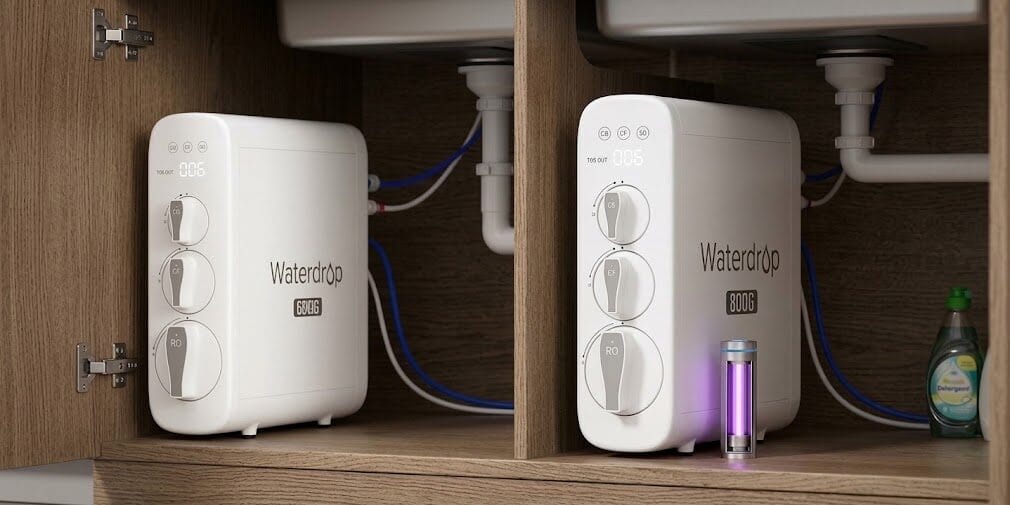
For most households, the Waterdrop G3P600 is the smarter buy. It covers everyday drinking, cooking, and coffee-making needs at a fraction of the G3P800’s price, and its 600-gallon-per-day capacity is already more than a typical family of four will use in a month, let alone a day.
The G3P800 earns its higher price tag in a narrower set of situations: large households (five-plus people), homes drawing from well water with known contamination, or small businesses like cafés, clinics, or gyms that need to fill multiple containers back-to-back without a slowdown. If that’s you, keep reading — the extra stages, the UV light, and the broader certification list aren’t just upsells. They’re real functional upgrades.
Waterdrop G3P600 vs G3P800
Both units are tankless reverse osmosis systems, which means they filter water on demand instead of storing pre-filtered water in a holding tank under your sink. That’s a genuine space saver — Waterdrop’s own listings put the footprint savings at around 70% compared to traditional tank-based RO systems. Both install in roughly 30 minutes with no plumber required, both use a twist-and-pull filter cartridge system that takes seconds to swap, and both connect to a smart faucet that displays live TDS (total dissolved solids) readings and filter-life countdowns right on the LED screen.
⭐ 2.5 million+ people assisted in the last 30 days ⭐
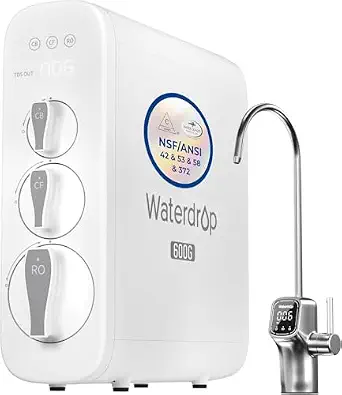
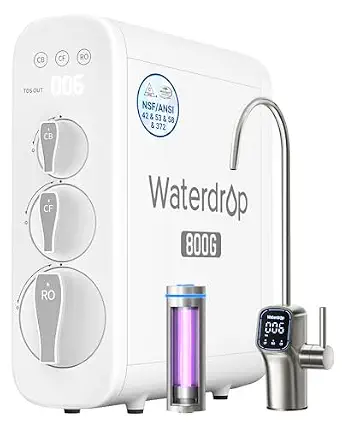
Feature | Waterdrop G3P600 | Waterdrop G3P800 |
|---|---|---|
Daily output | 600 gallons per day | 800 gallons per day |
Filtration stages | 8-stage | 10-stage |
Pure-to-drain ratio | 2:1 | 3:1 |
Fill time (approx.) | ~8 seconds per 8 oz cup | ~5–6 seconds per cup |
NSF/ANSI certifications | 42, 53, 58, 372 | 42, 53, 58, 372 |
UV sterilization | Not standard | Standard (LED UV, up to 99.9% bacteria/virus reduction) |
CF filter life | 6 months | 6 months |
CB filter life | 1 year | 1 year |
RO filter life | 2 years | 2 years |
Typical street price | Roughly $400–$550 | Roughly $750–$1,000 |
Filtration and Certifications: Not the Differentiator You'd Expect
Here’s something that trips up a lot of shoppers: certification isn’t where these two models split. Both the G3P600 and the G3P800 carry the full NSF/ANSI 42, 53, 58, and 372 lineup. NSF 58 verifies TDS reduction, NSF 372 confirms the hardware itself is lead-free, NSF 42 covers aesthetic effects like chlorine taste and odor, and NSF 53 — the one that matters most if you’re filtering for health reasons rather than just flavor — independently verifies reduction of contaminants tied to actual health risks, including lead, PFAS, VOCs, and cysts.
So if you were assuming the pricier G3P800 is the “real” health-certified option while the G3P600 is just the budget pick, that’s not accurate. Both models are backed by the same independent, NSF-accredited testing for lead and PFAS reduction. If a well-water report or a lead service line is the reason you’re shopping for an RO system in the first place, the G3P600 gives you that same certified protection at a lower price point — this isn’t a reason by itself to spend more on the G3P800.
Where the two do diverge on the filtration side is stage count: the G3P600 runs an 8-stage process, while the G3P800 adds one or two more stages depending on the bundle, plus a higher-capacity membrane built to keep up with its faster flow rate.
Flow Rate and Speed: Is the G3P800 Actually Faster?
Yes, and the gap is bigger than it sounds in a spec sheet. The G3P600 fills an 8-ounce cup in roughly 8 seconds; the G3P800 does the same job in about 5 to 6 seconds. Stretch that across a gallon jug and the difference compounds — filling a full gallon takes noticeably longer on the G3P600 than on the G3P800.
For a single glass of water, nobody’s going to notice a two-second gap. But if your household is filling a kettle, a pasta pot, a pitcher, or several water bottles back-to-back every morning, that extra flow rate stops being a nice-to-have and starts saving real time. Multiply that by a family of six or a small office break room, and the G3P800’s speed advantage becomes one of its strongest selling points.
Waste Water Efficiency: 2:1 vs 3:1, and the Math Everyone Gets Wrong
Here’s where we need to slow down, because a surprising number of comparison sites have this backward. The G3P600 runs a 2:1 pure-to-drain ratio; the G3P800 runs 3:1. Several articles frame the G3P600’s ratio as the more water-efficient option. It isn’t.
Do the actual division. A 2:1 ratio means for every 2 units of purified water, the system sends 1 unit down the drain — that’s 0.5 gallons wasted per gallon produced. A 3:1 ratio means 1 unit wasted for every 3 units purified — that’s roughly 0.33 gallons wasted per gallon produced. Lower is better here, and 0.33 is lower than 0.5. In plain terms: the G3P800 wastes less water per gallon of clean water it makes, not more.
That doesn’t erase the G3P600’s other advantages — it’s still the better overall value for most homes — but if water conservation specifically is your deciding factor, the edge goes to the G3P800, not the model everyone assumes.
UV Sterilization: Standard vs. Optional
The G3P800 ships with a built-in UV sterilizing light as standard equipment. It’s an LED-based unit rather than an old-school mercury bulb, it only activates while water is actually flowing (so it isn’t burning power 24/7), and Waterdrop rates its lifespan at up to 50 years with essentially no maintenance. The system automatically zaps bacteria and viruses that might otherwise survive in the internal waterway or linger near the faucet — reverse osmosis membranes catch the vast majority of contaminants, but stagnant water sitting in tubing between uses can still harbor microbial growth, which is exactly the gap UV sterilization is designed to close.
The G3P600 doesn’t include this feature in its standard configuration. For most municipal water customers, that’s not a dealbreaker — city water is already treated and monitored. But if you’re on a private well, in an area with a boil-water advisory history, or you just want that extra layer of insurance, the G3P800’s built-in UV sterilization is a genuine point in its favor, not a marketing checkbox.
Price and Value: Is the Extra Cost Worth It?
Street pricing moves with sales, but as a rule of thumb, expect to pay somewhere in the $400–$550 range for the G3P600 and $750–$1,000 for the G3P800 before discounts. That’s not a small gap — you’re often looking at close to double the cost for the upgraded model.
So what does that extra money actually buy? Roughly 200 more gallons of daily capacity, two to three additional filtration stages, broader NSF certification (specifically NSF 53), a faster fill rate, a more water-efficient drain ratio, and a standard UV sterilization light. None of that is filler. But for a household of two to four people whose main use case is drinking water, coffee, and cooking, 600 gallons a day is already overkill — you’re unlikely to ever come close to maxing out the G3P600’s capacity, which means you’d be paying a premium for headroom you’ll never use.
Who Should Buy the Waterdrop G3P600
Pick the G3P600 if you’re a household of one to four people using RO water primarily for drinking, cooking, and coffee or tea. You’ll get certified TDS reduction, lead-free construction, an 8-stage filtration process, and a smart faucet with live TDS readouts — all for roughly half the price of the flagship model. Unless you have a specific reason to need more (a large family, a documented contamination issue, or a business use case), the G3P600 covers everything a standard kitchen needs, and the money you save is real money, not a corner cut.
Who Should Buy the Waterdrop G3P800
Choose the G3P800 if any of these apply to you: your household has five or more people regularly drawing water, you run a small business (café, gym, clinic, salon) where multiple people fill containers throughout the day, you want built-in UV sterilization as a non-negotiable feature, or your usage is high enough that the faster flow rate and higher gallon-based filter capacity will actually get used. In any of those scenarios, the extra cost buys capability you’ll actually use, not just a bigger number on a spec sheet.
Our Verdict
The Waterdrop G3P600 wins on value, and it’s not close. For the vast majority of homes, it delivers the same NSF-certified health-effect filtration as its bigger sibling, plus a smart faucet and more daily capacity than you’ll ever tap out, at roughly half the price. The G3P800 isn’t overpriced for what it is — the standard UV light, the faster flow, and the more efficient 3:1 drain ratio are all legitimate upgrades, not fluff. It’s simply built for a different customer: larger households and light commercial use where speed and volume genuinely matter, not for households chasing a certification the cheaper model already has.
If you’re on the fence and your household falls in that “average family” zone, buy the G3P600 and put the savings toward filter replacements down the line. If you’ve got a specific reason — more people, more usage, or a preference for built-in UV sterilization — the G3P800 is worth the additional dollars.
Frequently Asked Questions
Is the Waterdrop G3P800 twice as good as the G3P600? No — it’s faster and more heavily certified, but “twice as good” oversells it. The core filtration technology and certified TDS reduction are present on both. The G3P800’s advantages (NSF 53, UV sterilization, faster flow, better drain efficiency) are real but incremental, not a doubling of quality.
Which model wastes less water, the G3P600 or the G3P800? The G3P800. Its 3:1 pure-to-drain ratio wastes about 0.33 gallons per gallon of purified water produced, compared to roughly 0.5 gallons on the G3P600’s 2:1 ratio. Several sites claim the opposite, but the math favors the G3P800 here.
Can the Waterdrop G3P600 remove PFAS and lead? Yes. The G3P600 carries NSF/ANSI 53 certification, the standard specifically covering health-effect claims like lead and PFAS reduction, alongside NSF 42, 58, and 372. It’s backed by the same independent certification as the G3P800 on this point, so you don’t need to pay for the pricier model just to get certified PFAS and lead reduction.
Do I need a plumber to install either system? No. Both the G3P600 and G3P800 are designed for DIY installation, typically around 30 minutes, using the included fittings and an instructional guide. No specialized plumbing skills are required for a standard kitchen sink setup.
Is the UV sterilization light on the G3P800 necessary for city water? For most municipal water customers, it’s a nice extra rather than a necessity — city water is already treated. It becomes more valuable for well-water households or anyone wanting an added layer of protection against bacteria that could develop in internal tubing between uses.
How often do I need to replace filters on these systems? Both models use a similar three-filter setup: roughly every 6 months for the carbon pre-filter, annually for the carbon block filter, and every 2 years for the RO membrane. The G3P800 additionally caps filter life by gallons filtered, so high-usage households may hit that limit before the time-based schedule does.

