Advertiser Disclosure
We independently review everything we recommend. When you buy through our links, we may earn a commission.
The Best Mechanical Pencils for Writing
If you’ve ever grabbed a cheap mechanical pencil from the bottom of your bag and spent the next ten minutes nursing broken lead, you already understand what’s at stake here. A good mechanical pencil doesn’t just write — it disappears in your hand. You stop thinking about the tool and start thinking about what you’re putting on the page.
We’ve been through a lot of pencils on this team. Cheap ones, expensive ones, gimmicky ones that sounded brilliant in the product description and felt awkward in practice. What we’ve learned is that the best mechanical pencil for you depends on how you write, how long you write, and honestly — how much patience you have for lead breakage. That last one matters more than most reviews admit.
Why a Good Mechanical Pencil Is Worth the Thought
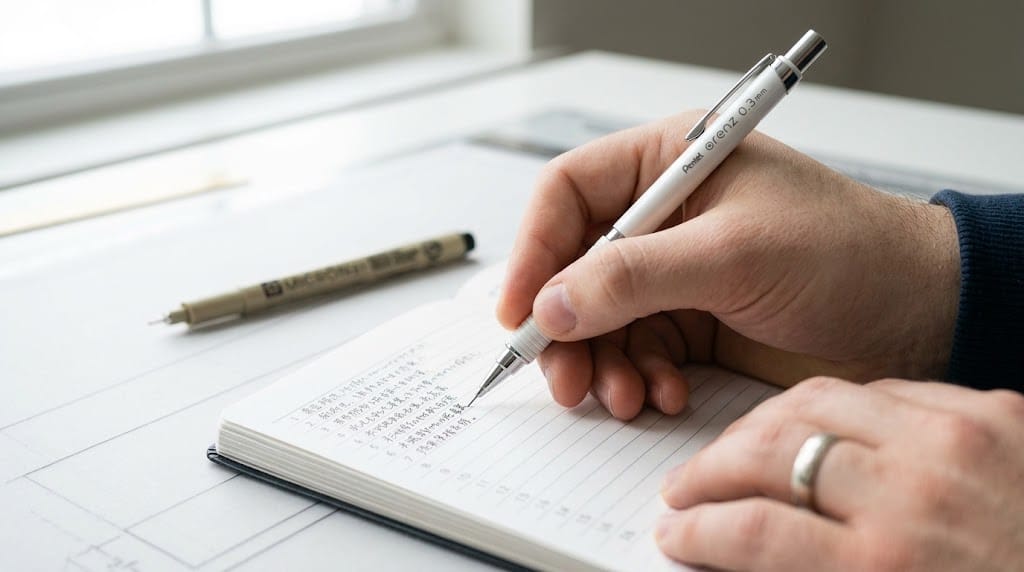
Before we get into the picks, it’s worth understanding what separates a mechanical pencil that just works from one that actively makes writing better.
The clearest advantage mechanical pencils have over wood-cased pencils is consistency. You don’t lose length or balance as the pencil wears down, and you don’t have to stop mid-thought to find a sharpener. The combination of lead diameter, grip texture, and barrel weight tends to have a bigger impact on writing fatigue than most people expect.
There’s also the question of precision. Thinner leads — especially 0.3mm — hold their point regardless of writing pressure or angle, which makes them popular with people who write small or need consistently tight lines. Meanwhile, 0.5mm tends to be the sweet spot for general note-taking: fine enough to stay readable on standard lined paper, but sturdy enough that routine writing rarely breaks it.
And then there are the engineering tricks built into modern pencils — auto-rotating cores, anti-breakage springs, shake-to-advance mechanisms — that sound like marketing language until you realize how much a single broken lead during an exam or a meeting can derail your focus.
The short version: it’s worth picking thoughtfully. Here’s where we landed.
A Quick Comparison at a Glance
Pencil | Lead Size | Mechanism | Best For |
0.5mm | Auto-rotating lead | Writers who want consistently fine lines | |
0.5mm | Fixed tip, full metal | Professionals, draftspeople, heavy users | |
0.3mm | Sliding sleeve | Ultra-fine, detail-oriented writing | |
0.5mm | Push-button | All-around reliability, students | |
0.5mm | Dual-spring anti-break | Writers who press hard or break lead often | |
0.5mm | Shake mechanism + lock | Students, quick note-takers | |
0.5mm | Push-button | Classrooms, bulk office use |
Our Top Picks: Best Mechanical Pencils for Writing
✅ We recommend these products based on an intensive research process that’s designed to cut through the noise and find the top products in this space. Guided by experts, we spend hours looking into the factors that matter to bring you these selections.
⭐ 2.5 million+ people assisted in the last 30 days ⭐
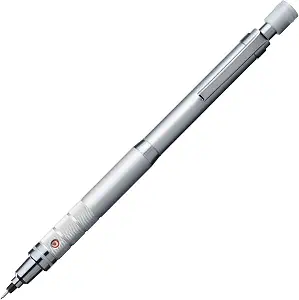
There’s a real problem with most mechanical pencils that nobody talks about until they’ve experienced it: the more you write, the flatter your lead gets. You start a sentence with a sharp tip and end it with a chisel edge, which means thicker lines, smudgier marks, and an uneven look across a full page of notes. The Kuru Toga Roulette was designed specifically to fix that. Its internal spring-loaded clutch rotates the lead incrementally every time you lift the pencil from the paper — not enough to feel, but enough to wear the lead evenly and keep a conical tip throughout the entire writing session. When our tester first tried it during an afternoon of lecture notes, the observation was immediate: the line width at the end of the hour was essentially identical to the one at the beginning. The Roulette model takes the standard Kuru Toga engine and packages it in a heavier, more premium body — a knurled aluminum grip that sits firmly in the fingers without biting, and a gunmetal or silver finish that feels serious without being showy. It’s not the right pencil for sketching (the auto-rotation can work against you there), and at around $8–$12 for a single pencil, it costs a bit more than the basic options below. But for students, writers, or anyone who fills pages regularly and cares about the quality of their marks, this one tends to be the recommendation we reach for first.
Trade-offs: Only available in 0.5mm; the auto-rotation mechanism doesn’t benefit sketching or drawing use cases.
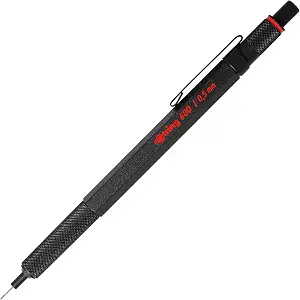
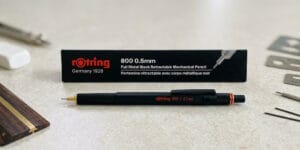
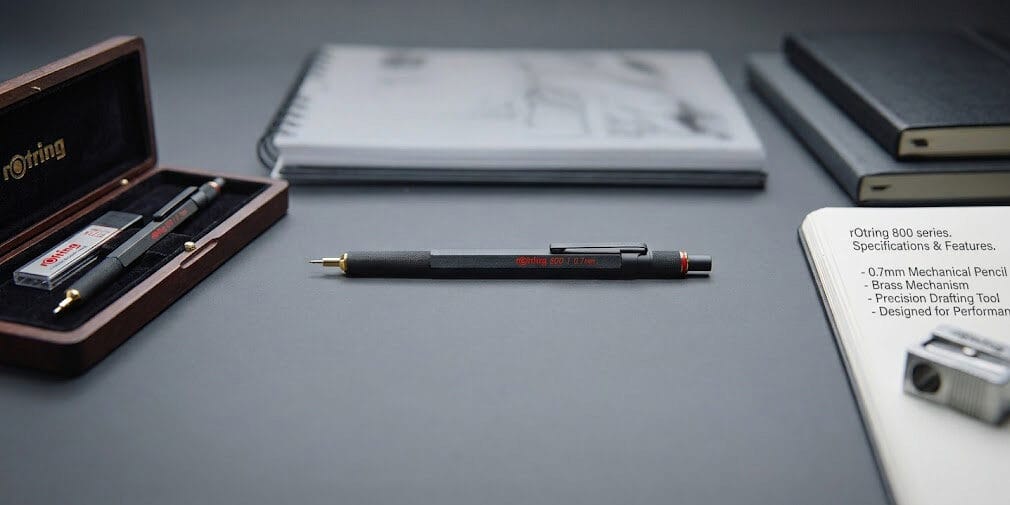
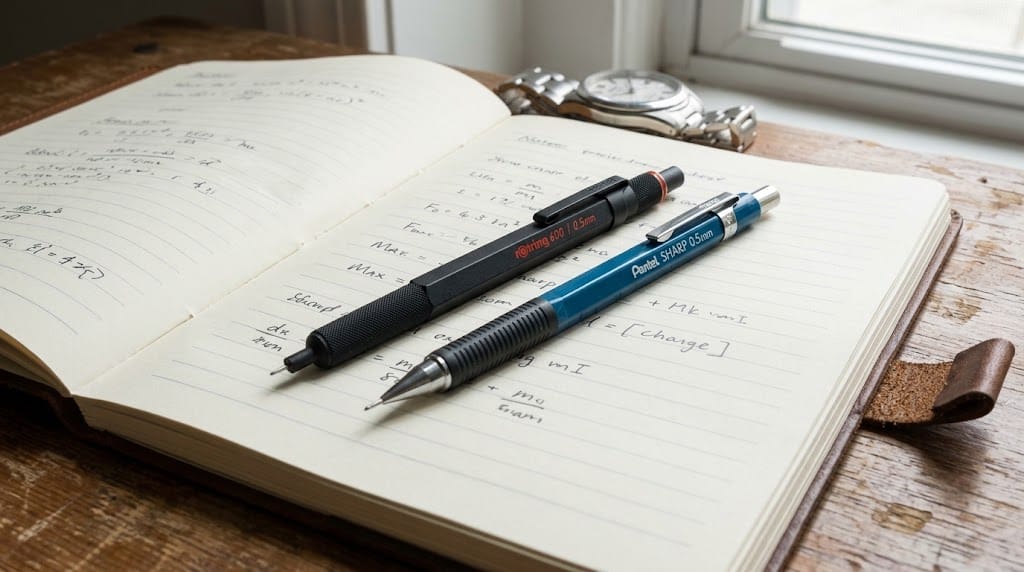
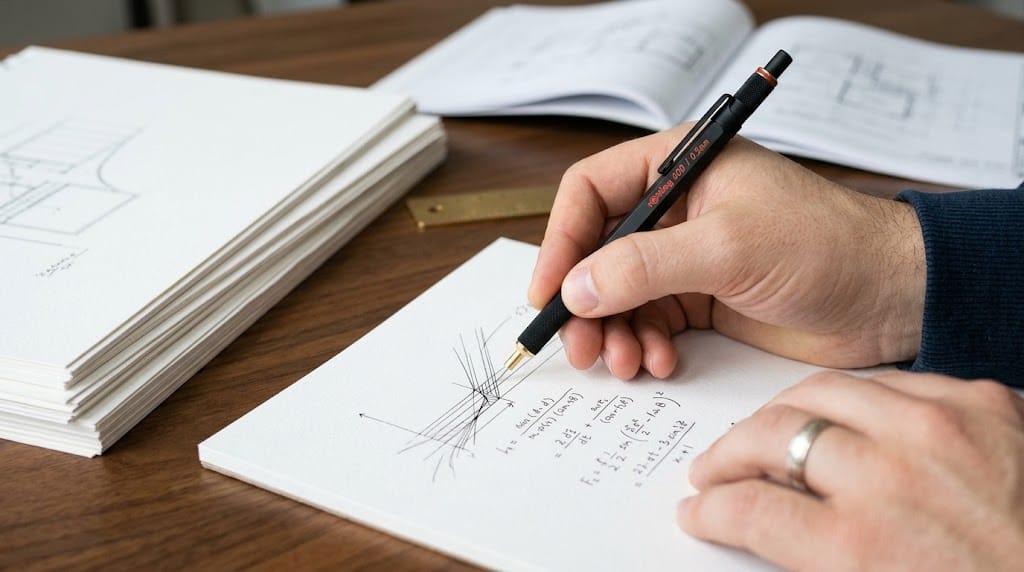
The rOtring 600 has had a devoted following since the late 1980s, and that loyalty isn’t built on hype. It’s built on a full brass body, a knurled metal grip that’s grippy without being harsh, and a hexagonal barrel that prevents rolling and adds a subtle reference point for consistent finger placement. When one of our team members — someone who had used inexpensive mechanical pencils exclusively for years — first picked up the 600, the reaction was straightforward: “I didn’t know a pencil could feel like this.” The balance is exceptional. It’s heavier than a plastic-bodied pencil, around 22 grams, but it distributes that weight in a way that feels intentional rather than cumbersome. The fixed 0.5mm tip is longer than average, which reduces the likelihood of the lead snapping under normal writing pressure, and the HB lead it ships with writes smoothly without being mushy. The knurled grip has come up in almost every review we’ve read — reviewers consistently note that it’s secure enough to prevent slipping without creating the soreness you’d expect from metal-on-finger contact over long sessions. This is a pencil for someone who spends a lot of time writing and wants their tool to meet them at that level. The price sits in the $25–$30 range, which is genuinely worth it if you write daily — it’s built to last years with reasonable care. The one caveat worth knowing: the tip is not retractable, so you’ll want a cap or case if you’re carrying it loose in a bag.
Trade-offs: Higher price point; non-retractable tip requires careful storage; slightly heavier, which some writers prefer and others don’t.
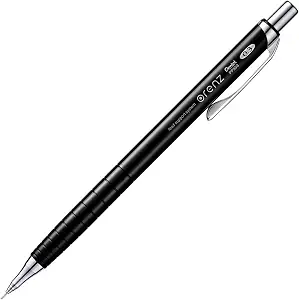
The 0.3mm lead category is a frustrating one for most pencil users, because the math of it seems straightforward — thinner lead, finer lines — but the reality usually involves broken lead every few sentences. Pentel’s Orenz sidesteps this problem with an elegant sliding sleeve mechanism: you click once (just once — clicking more will cause breakage), and the metal pipe extends around the lead, staying in contact with the paper as you write. The lead itself barely pokes out beyond the sleeve, which means it’s effectively braced at all times. The result is 0.3mm writing that stays intact under normal pressure. During testing, a team member who typically avoided thin leads because of breakage frustration wrote several pages without a single snap. The Orenz doesn’t feel fragile in use — the metal tip glides against paper with a satisfying lightness, and the line it produces is genuinely fine, consistent, and dark enough to photograph clearly in notes. It’s particularly well-suited to anyone writing on the smaller side — cramped notes in margins, kanji, technical annotations, or small-format journals where 0.5mm starts to feel a bit chunky. The tradeoff is a slight learning curve: the one-click rule takes some getting used to, and writers who press hard may find the sleeve shifts more than expected. But once you’re calibrated to it, the Orenz is one of those products that makes you wonder why you waited so long to try 0.3mm.
Trade-offs: Requires discipline around the one-click rule; not ideal for heavy-handed writers; 0.3mm is niche — not everyone needs this level of fineness.
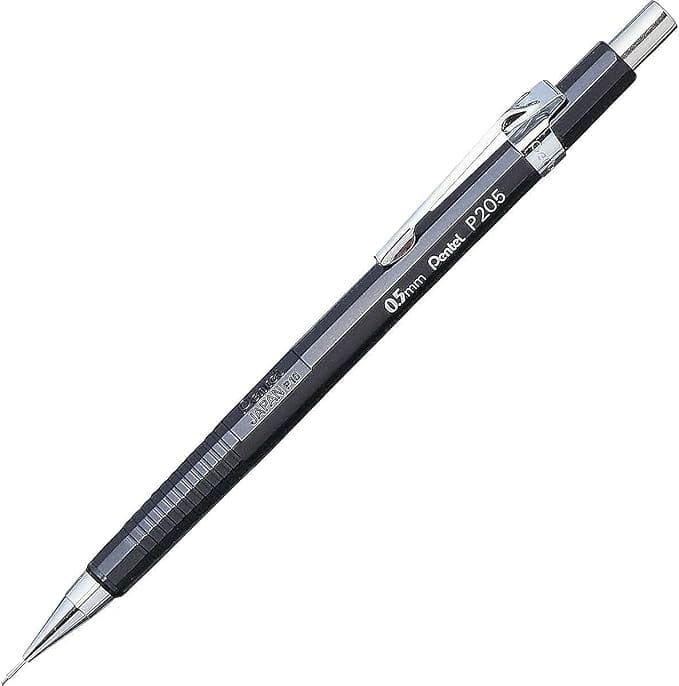
Some pencils earn their reputation not through clever engineering but through sheer, unapologetic reliability — and the Pentel Sharp P205A is that pencil. It’s been around for decades; it’s used in classrooms, offices, and architecture studios, and the reason it keeps showing up is simple: it works every time, without drama. The hexagonal barrel is precision-balanced — it sits in the hand with a low center of gravity that makes line control feel natural — and the 4mm fixed sleeve makes it compatible with rulers and templates, which is why drafting professionals have been drawn to it for years. Our tester who prioritizes getting thoughts on paper without fussing with the pencil found the P205 refreshingly straightforward. The click mechanism is positive and satisfying, the lead advances reliably, and the ribbed finger grip provides enough texture to maintain control without being uncomfortable over long sessions. At roughly $5–$8 a pencil, it delivers genuine drafting-pencil performance without requiring you to think carefully about your purchase. It’s also available in multiple barrel colors — a small thing that makes it easier to keep track of on a crowded desk. The eraser is tucked under the cap, which is a mild inconvenience, but the pencil itself rarely gives you enough reason to reach for it. If you’re looking for a single mechanical pencil to handle everything from homework to meeting notes to quick sketches without any surprises, the Pentel Sharp is likely the one.
Trade-offs: No special anti-breakage technology; eraser is under the cap rather than immediately accessible; no retractable tip.
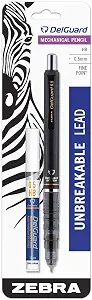
If you’ve ever been mid-thought in a meeting and snapped your lead for the third time that hour, the Zebra DelGuard was designed with you specifically in mind. Zebra’s patented dual-spring mechanism approaches anti-breakage from two directions simultaneously: one spring softens the pressure when you’re writing straight down, and a second spring absorbs the diagonal force that comes from naturally angled writing. Together, they give the lead enough flexibility to survive the kind of pressure that would snap a standard 0.5mm lead instantly. The white barrel version has a clean, simple aesthetic — it won’t turn heads, but it won’t look out of place anywhere either — and the retractable tip means you can toss it in a pencil case without any anxiety about bending the sleeve. Our tester, who described themselves as a “heavy writer” who habitually pushes down too hard, went through an entire exam prep session without a single break. That alone was enough to make them a convert. The DelGuard is lightweight and primarily plastic, which means it won’t satisfy anyone looking for the premium feel of metal-bodied pencils. But that lightness makes it genuinely comfortable for long writing sessions, and the eraser under the cap is solid and usable. It’s refillable with Zebra DelGuard lead and eraser refills, so the initial purchase stretches further than its modest price suggests. For students, daily note-takers, or anyone who has given up on thin lead because it keeps snapping — this is where to start.
Trade-offs: Plastic build lacks the premium feel of metal-bodied pencils; lightweight, which some writers don’t prefer; primarily 0.5mm only.
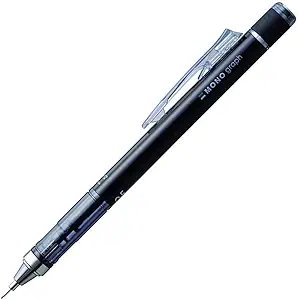
The shake-to-advance mechanism isn’t new, but Tombow’s take on it in the Mono Graph Shaker is notably refined — quiet, reliable, and actually useful rather than just a novelty. A quick flick of the wrist extends the lead without you having to fumble for the eraser cap, which sounds like a minor convenience until you’re sitting in a lecture where you’re switching between listening and writing every thirty seconds. What genuinely surprised our tester was the lock mechanism built into the clip: push the clip up and the shaker function disables, so the lead won’t accidentally extend in your pocket or pencil case. It’s the kind of thoughtful detail that suggests the designers actually used this pencil. The 4mm sleeve protects the lead from breaking under heavier pressure, and the rubber grip section offers a comfortable hold that doesn’t create friction over extended sessions. JetPens noted that the Mono Graph Shaker has one of the quietest shaker mechanisms they’d tested, which matters if you’re in a quiet library or exam room and don’t want to disturb anyone around you. The twist eraser is a genuine bonus — it extends as you use it and is replaceable when it runs out, which puts it well above the under-cap erasers on most pencils in this price range. At around $5, it offers more thoughtful design per dollar than almost anything else on this list. It’s not a heavy-use professional tool, but as a daily carry for students and active note-takers, it genuinely earns its place.
Trade-offs: Plastic build; the shaker mechanism, while quiet, may still be audible in very quiet environments; best for standard writing rather than precision drafting work.
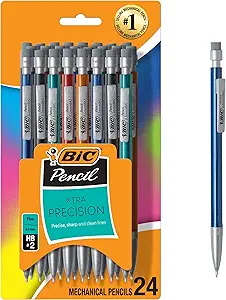
Not every pencil decision is about finding the single best writing instrument. Sometimes you need a whole class stocked, or you want pencils distributed across every workstation in an office, or you need a reliable backup that you won’t feel bad about losing. The BIC Xtra-Precision 24-pack handles all of those scenarios cleanly. Each pencil in the pack is no-frills in the best sense — a straightforward click-to-advance mechanism, 0.5mm #2 lead that lays down smoothly without smudging, a built-in eraser, and a clip that attaches to notebooks or pockets without drama. BIC’s own data puts each pencil at the writing equivalent of 2.5 wood case pencils, which means the per-unit value is genuinely strong. Our team used a few from the pack for a week of standard note-taking and found nothing to complain about — the lead was consistent, the click mechanism never jammed, and the assorted metallic barrel colors make it easy to distribute pencils to a group and keep track of whose is whose. These aren’t pencils that will make you feel something. They’re pencils that will be where you need them, work without complaint, and not require you to think about them. For a classroom teacher, an office manager restocking the supply closet, or anyone who wants reliable pencils available in quantity, this 24-pack is the straightforward answer. BIC is consistently the number-one-selling mechanical pencil brand in the United States, and while that doesn’t automatically make it the right choice, it does reflect genuine market trust built over time.
Trade-offs: No premium feel; plastic body; individual pencils are disposable rather than built for decades of use; no anti-breakage technology.
How to Choose the Right Mechanical Pencil for Your Writing
Start with Lead Size
Lead diameter shapes the whole writing experience. Here’s a rough guide:
- 0.3mm — The finest option; great for small handwriting, detailed annotation, technical work. More prone to breakage, which is why the Pentel Orenz’s sleeve system is so useful at this size.
- 0.5mm — The most versatile choice. Fine enough for clean, readable notes; sturdy enough that breakage isn’t a constant concern. Most of our picks land here.
- 0.7mm — Better for people who write with heavier pressure or prefer bolder lines. Less common in premium pencils but widely available.
- 0.9mm — Closest to a standard pencil feel; almost no breakage risk; less common but worth seeking out if fine lines aren’t your priority.
If you’re not sure where you land, 0.5mm is almost always the right starting point.
Think About Grip and Weight
Grip matters more than it seems, especially if you write for more than 20–30 minutes at a stretch. Knurled metal grips (like the rOtring 600 and Kuru Toga Roulette) offer excellent control and don’t degrade over time, but they can cause mild discomfort for people who hold the pencil tightly. Rubber and textured plastic grips (like the Tombow Mono Graph and Zebra DelGuard) tend to be more forgiving over long sessions.
Weight is similarly personal. Heavier pencils — generally full metal bodies — feel more deliberate and controlled in the hand. Lighter plastic pencils reduce fatigue over long sessions. Neither is objectively better; it depends on your writing posture and pressure habits.
Match the Mechanism to Your Habits
- Push-button (standard click): The most common, reliable, and straightforward. Found in the Pentel Sharp and BIC Xtra-Precision.
- Auto-rotating lead: Specifically the Kuru Toga system. The best option if line uniformity matters to you and you do a lot of printing rather than cursive.
- Shake to advance: The Tombow Mono Graph Shaker. Ideal for rapid note-takers who don’t want to click constantly.
- Sliding sleeve: Pentel Orenz. Designed specifically for 0.3mm and fine-lead writing where breakage is the main enemy.
- Dual-spring anti-break: Zebra DelGuard. For writers who consistently snap lead regardless of the pencil.
Consider Durability vs. Portability
If this pencil is going to live on your desk and be used daily for years, a metal-bodied pencil like the rOtring 600 makes sense. If it’s going in a bag, being handed to a student, or serving as a backup, the lightweight plastic pencils offer better practical durability in real-world use (they don’t bend their tips the way metal-tipped drafting pencils can when dropped).
Don’t Ignore the Eraser
Most built-in erasers are modest at best. If erasing is a meaningful part of your workflow — you’re editing, drafting, or correcting frequently — it’s worth pairing your mechanical pencil with a dedicated eraser. The Tombow Mono is a widely trusted standalone eraser, and Staedtler’s eraser line is similarly well-regarded. A good dedicated eraser will almost always outperform whatever’s tucked under the cap.
Eco-Friendliness
If sustainability factors into your choices, look for refillable pencils rather than disposable ones. Most of the picks on this list are refillable — you can purchase lead refills and eraser refills rather than buying new pencils. The BIC pack’s pencils are technically disposable, though some users do refill them as well.
What We Wish More Reviews Would Tell You
A few things that tend to get glossed over in most roundups:
Lead grade matters alongside lead size. HB is the default in most mechanical pencils, and it’s usually fine. But if you prefer darker lines (especially for scanning notes or photographing them), B or 2B leads in the same diameter can make a significant difference. Most high-quality mechanical pencils accept third-party lead refills.
The climate in your writing space affects lead performance. This sounds unusual, but lead is more likely to break in cold, dry environments and generally performs more smoothly with a bit of humidity. If you’re writing in a cold classroom in winter and can’t figure out why your lead keeps snapping, that’s not always a problem with the pencil.
Rotation habits affect wear. With standard pencils, unconsciously rotating the pencil between strokes helps keep the tip even. This is essentially what the Kuru Toga automates — but it’s worth knowing that the habit itself, if you develop it, improves performance on any pencil.
Premium doesn’t always mean better for your use case. The rOtring 600 is a genuinely exceptional pencil, but if your writing is fast and informal — lecture notes, to-do lists, quick sketches — a Tombow Mono Graph Shaker or Pentel Sharp will serve you better because you won’t be thinking about protecting a $30 pencil while you write.
Frequently Asked Questions
What’s the best lead size for everyday writing? For most people, 0.5mm is the right choice — it handles everything from note-taking to casual sketching without being too prone to breakage or too chunky. 0.3mm is worth trying if you write small or need fine detail; 0.7mm is worth trying if you tend to break 0.5mm lead regularly.
Are expensive mechanical pencils actually worth it? It depends on how much you write. If you use a mechanical pencil for occasional notes, a $5–$8 pencil like the Pentel Sharp or Zebra DelGuard is genuinely all you need. If you write for hours daily and care about the tactile experience, a $25–$30 pencil like the rOtring 600 can meaningfully improve the experience and will last much longer.
Can I use any brand of lead in a mechanical pencil? Generally, yes — lead refills are standardized by diameter (0.5mm, 0.3mm, etc.), so third-party refills from brands like Pentel, Uni, or Staedtler will work in most pencils. The exception is some Kuru Toga models, which accept all leads but perform best with Uni’s own lead due to the rotation mechanism.
What’s the difference between a drafting pencil and a regular mechanical pencil? Drafting pencils — like the rOtring 600 and Pentel Sharp P205 — have a longer, fixed lead sleeve that makes them compatible with rulers and templates, and they generally have a lower center of gravity for finer control. Regular mechanical pencils prioritize comfort and convenience for everyday writing. Both can handle either use case; the difference is in emphasis.
How do I prevent lead breakage? The biggest causes of breakage are: too much lead extended beyond the tip, writing at too steep an angle, and pressing too hard. If breakage is a recurring problem, try extending less lead (one to two clicks rather than three or four), writing at a slightly lower angle, and considering a pencil with active breakage prevention like the Zebra DelGuard.
Final Thoughts
There’s a mechanical pencil on this list for essentially every type of writer. If you write a lot and want your lines to look consistent throughout, start with the Uni Kuru Toga Roulette. If you want something that feels genuinely professional and will last you a decade, the rOtring 600 is worth every dollar. If you’re constantly breaking 0.5mm lead, the Zebra DelGuard will solve that problem immediately. And if you just need reliable pencils stocked across a classroom or office without any fuss, the BIC Xtra-Precision 24-pack handles that cleanly.
The best mechanical pencil is always the one that gets out of your way and lets you focus on what you’re actually writing. Use this guide to find yours — and then stop thinking about the pencil.