Advertiser Disclosure
We independently review everything we recommend. When you buy through our links, we may earn a commission.
The Beginner's Guide to Jigsaw Puzzles
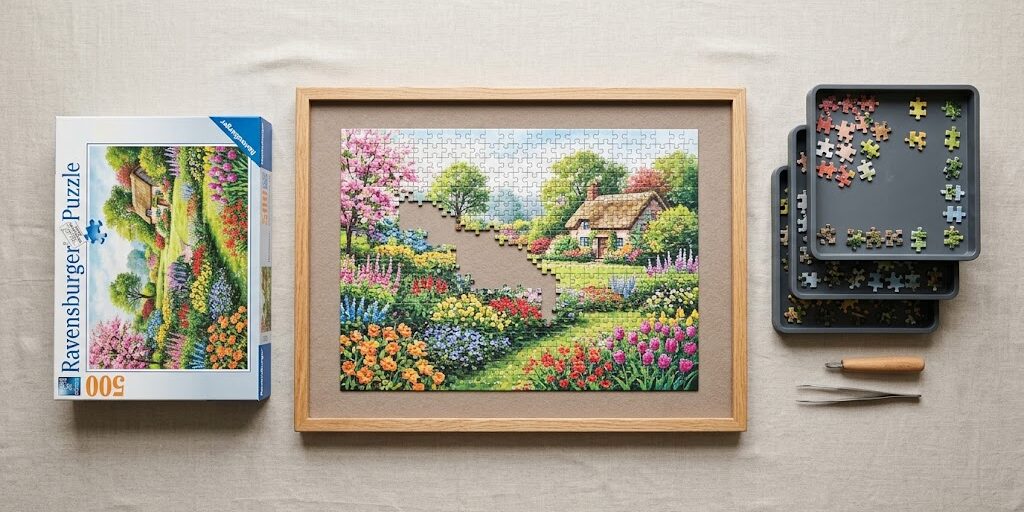
Your first jigsaw puzzle can go one of two ways. You finish it, feel unreasonably proud, and order another before the box hits the recycling bin. Or you give up: four hundred half-sorted pieces, a dining table you can’t eat at, and a cat with opinions about the whole project.
We’d like to steer you toward the first outcome, so we’re going to be more direct than most beginner guides. Buy a 500-piece puzzle. Pick a busy, colorful picture. Sort before you build. Never force a piece.
The 60-Second Plan
- Buy a 500-piece, ribbon-cut puzzle with a busy, colorful picture.
- Clear a table bigger than the finished puzzle, or grab a puzzle board.
- Light the table brightly and evenly.
- Flip every piece face-up, pull out the edges, and sort the rest by color and pattern.
- Build the frame, then finish one distinctive section at a time.
- Don’t force pieces. Rotate them, take breaks, and keep the box picture where you can see it.
Where Jigsaw Puzzles Came From
Jigsaws started life as school supplies. Most accounts credit John Spilsbury, a London engraver and mapmaker, who mounted maps on wood and cut them along borders in the 1760s so children could learn geography by putting the world back together. By 1763, he was advertising himself as a “map dissector”, according to Old World Auctions’ history of dissected maps, and the product was called a dissected map, not a puzzle.
Don’t expect tidy dates. Depending on the source, Spilsbury’s first dissected map lands anywhere between 1762 and 1767, and Geography Realm’s overview notes that scholarship has challenged the idea that he was first at all. A Madame de Beaumont, who wrote about her son learning geography from wooden maps, may deserve part of the credit.
Here’s the myth worth dropping: the name. You’ll often hear that “jigsaw” comes from the saw that cut those early maps. But the first recorded use of the phrase “jigsaw puzzle” dates to 1906, according to Guinness World Records, well over a century after Spilsbury. His customers never called them jigsaws.
The hobby caught on fast. Geography Realm reports that London had nearly twenty puzzle makers by the end of the 1700s. The modern boom is easier to date: UK jigsaw sales grew almost 40% in 2020 and passed £100 million for the first time. Lockdowns pushed people toward puzzles, but plenty of them stayed after the world reopened. That tells you something about the hobby itself.

Do Jigsaw Puzzles Really Help Your Brain? What the Research Says
Two claims show up in nearly every puzzle guide: puzzles sharpen your mind, and puzzles help ward off dementia. The first is fair. The second stretches the evidence, and the best study we found says so.
The cleanest test is a randomized trial from Ulm University in Germany, published in Frontiers in Aging Neuroscience. It enrolled 100 healthy adults aged 50 and over. Half puzzled for at least an hour a day for 30 days and got a short cognitive-health counseling program. The other half got the counseling alone. The puzzlers got better at puzzles. They did not get measurably better at global visuospatial cognition, which was the outcome the researchers were hoping to move.
Two other findings are more encouraging. People with more lifetime puzzling experience scored better on visuospatial cognition, even after the researchers accounted for other risk and protective factors. And puzzle skill tracked closely with overall visuospatial ability. The authors also lay out how much a jigsaw asks of you at once: visual perception, mental rotation, scanning and sorting speed, working memory, reasoning, and more.
So here’s where we land. Puzzles are a real workout for spatial thinking, and long-time puzzlers tend to test well. But that’s an association, and one trial that tested a month of puzzling found no measurable boost. If someone promises that a 500-piece landscape will prevent cognitive decline, they’re selling more than the science delivers.
The mood benefit is easier to defend. The same researchers point to fun, flow, and a sense of mastery as ways puzzling can lift your mood, and to puzzles as a way to cope with stress. That fits why people keep going back to them. You’re hunting for one specific piece, your phone is face-down somewhere, and the rest of your brain goes quiet for a while.
Puzzles are also quietly social. Leave a half-built puzzle on a coffee table, and someone will drift over, pick up a piece, and start talking. Nobody’s competing. Nobody has to perform. For families, roommates, and couples, that’s a pretty good deal for the price of a cardboard box.
How Many Pieces Should a Beginner Start With?
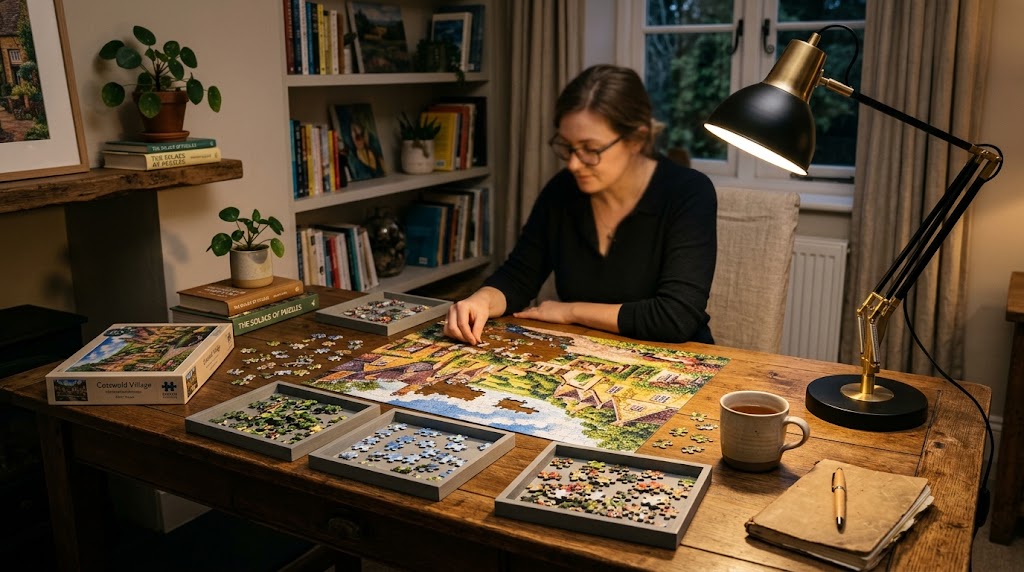
Start with 500. That’s our call, and here’s the reasoning.
Advice across the web is split: some retailers say 100 to 300 pieces, some say 300, and plenty say 300 to 500. We think the lower numbers undersell you. A 300-piece puzzle is small enough to solve by brute force, so you can finish it without learning anything. A 500-piece puzzle is big enough that sorting, framing, and working in sections actually pay off, and those are the habits you’ll use on every puzzle afterward. You also get the full arc of the hobby: the messy middle, the snowball, the last-twenty-pieces rush.
| Piece count | Best for | Rough time for a first-timer (est.) | Our verdict |
|---|---|---|---|
| 100–300 | Kids, a one-evening win, testing the hobby | 1–4 hours | Good for children and for “I’m not sure I’ll like this” |
| 500 | Adult beginners | 6–10 hours, in 2–3 sittings | Start here |
| 750–1000 | After two or three finished puzzles | 12–25 hours | Wait |
| 1500+ | Committed puzzlers with a dedicated table | Weeks | Not your first |
Times are our planning estimates, not measured values. They vary widely with the picture, the lighting, and how many people are helping.
In our trial, the puzzling group connected an average of about 3589 pieces in 49 hours. By our math, that’s roughly 73 pieces an hour. At that pace, 500 pieces take about seven hours, and 1000 take about fourteen. Those were adults over 50 puzzling at home, not a controlled group of beginners, so treat it as a ballpark. Still, it’s much more useful than “a few sessions”.
Drop to 300 if you’ll only get 30- to 60-minute sessions, you’re puzzling with a young child, or you want a guaranteed finish before a deadline. Skip 1000 for now because it’s not impossible, but it’s a long haul with a spread-out pile that you may not be ready to commit to. A stalled puzzle teaches nothing. A finished 500 teaches you most of what a 1000 will.
If you want a shortlist to start from, our roundups of Ravensburger 500-piece puzzles and Galison 500-piece puzzles are where we’d begin.
Pick the Picture Before You Pick the Brand
Here’s the part most beginners get backwards: the image changes difficulty more than the piece count does. A busy 500-piece scene can be easier than a 300-piece puzzle that’s mostly sky.
Try the landmark test before you buy. Look at the picture and try to name six separate landmarks: a red awning, a bicycle, a street sign, a yellow umbrella. If you can, you have six places to start building. If you find yourself saying “it’s mostly blue”, put it back.
| Picture type | Beginner difficulty | Why |
|---|---|---|
| Illustrated scenes, collages, food markets, maps, vintage posters | Easiest | Lots of distinct colors, and text and logos act as free landmarks |
| Busy cityscapes, detailed landscapes, animals against textured backgrounds | Easy to medium | Plenty of anchors, with a few plain patches |
| Big skies, water, snow, sunsets | Medium to hard | Large areas where color gives you nothing and only shape helps |
| Gradients, abstract art, one-color designs | Hardest | You’re matching by piece shape alone |
Save the hard categories for puzzle five or later. They’re a different skill, and a good one, but they’re a terrible first date.
Cut Style and Piece Quality: What the Box Won't Tell You
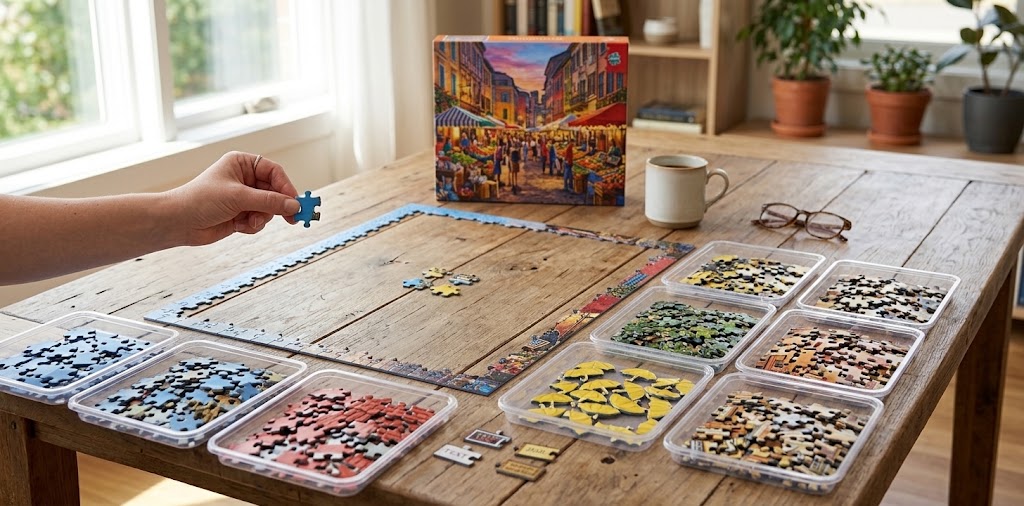
The way a puzzle is cut changes how it feels more than most beginners expect, and it’s rarely printed on the front of the box.
Ribbon cut puzzles are cut on a grid, so pieces follow a predictable pattern. You’ll sometimes see this called “2-in 2-out”: each piece has two tabs sticking out and two sockets cut in. Random cut puzzles ignore the grid, so piece shapes vary, and you can’t count rows and columns. Many puzzlers love them. They’re also harder to predict.
For your first puzzle, pick ribbon cut. The grid helps you sanity-check where things belong, and it means one less variable to fight. Random cut makes a great second or third experiment. We cover the differences in more detail in our guide to jigsaw puzzle cut types.
Some puzzles also hide whimsy pieces: individual pieces shaped like animals, letters, or objects, scattered among the standard pieces. They’re a fun bonus and a nice little tell when you spot one.
As for quality, you can’t judge a puzzle from the front of the box, but you can look for a few things:
- Thick, firm pieces that click into place and don’t bend or curl.
- A matte finish. Glossy surfaces bounce light back at you, and that gets old fast under a lamp.
- Reviews that mention fit, dust, or peeling. If several reviewers say pieces fray or the picture flakes at the edges, skip it.
- A reference poster or a resealable bag. Both are small extras that make a real difference on puzzle night.
If your eyesight isn’t what it used to be, or you simply hate squinting at tiny shards of cardboard, look for large-piece formats. They come in adult designs, not just kids’ pictures. Check the box for age guidance and finished dimensions before you buy.
Formats to Skip Until Puzzle Three (or Five)
The puzzle world gets weirder and more wonderful past the standard rectangle. Just not yet.
- Double-sided puzzles put an image on both sides of every piece. It’s as chaotic as it sounds.
- 3D puzzles build curved structures like landmarks or globes. They’re a different hobby and a great one, but they don’t teach you flat-puzzle technique.
- Shaped puzzles form a butterfly or a lighthouse instead of a rectangle. With no straight border, you lose your easiest first step.
- Mystery puzzles hide the picture. Fun, but you’ve given away your biggest advantage.
- Gradient puzzles are, well, you read the table above.
Once you’ve finished two or three standard puzzles, come back to this list and pick one.
What You Actually Need to Buy
You don’t need much, but a few items change the whole experience. Here’s what we’d get, in order.
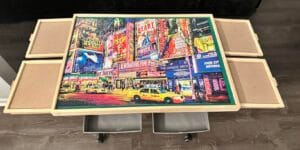
1. A puzzle board. If you don’t have a table you can leave alone for a week, this is the single most useful purchase. A board gives you a flat, portable surface with edges that keep pieces from sliding away, and you can carry it to the couch or slide it under a bed. We’d pick a rigid board over a roll-up mat for a first puzzle, because it gives you real edges and a flat, stable base. Mats are better for storing a puzzle that’s half done than for building one. For more options, see our guide to puzzle accessories.
2. Good light. A bright, adjustable desk lamp is plenty. Daylight is better when you have it. If you only buy one thing besides the puzzle, buy this.
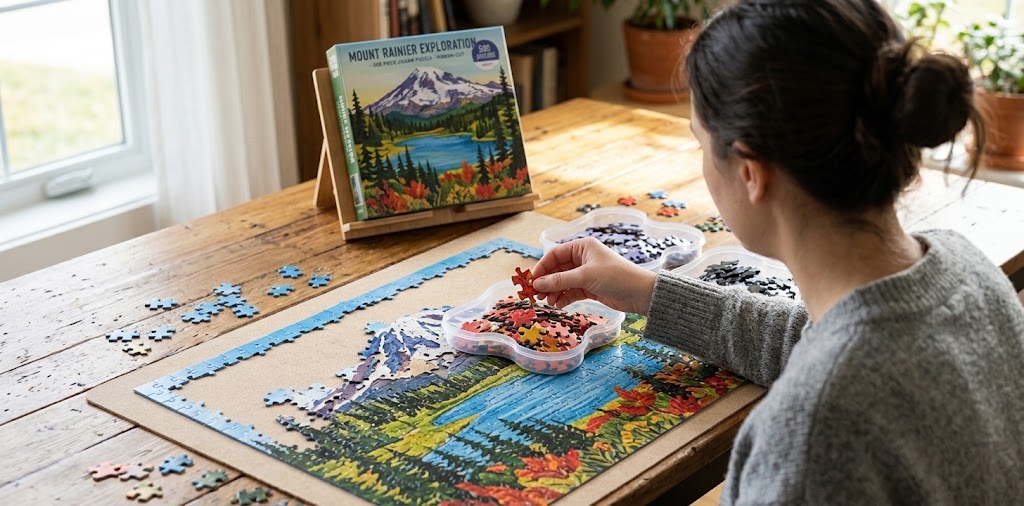
3. Sorting trays. Muffin tins, bowls, takeout containers, or baking sheets all work. Lids help if you’re sharing the room with someone curious.
4. A reference image you can prop up. Use the box lid, or the poster if one’s included. Put it where you can see it without picking it up.
What to skip: puzzle glue until you’re done, a frame until you know you love the picture, and any gadget that promises to find pieces for you.
As for budget, we’d rather you spend a little more on the puzzle than on accessories. Premium puzzles tend to cost more mainly because of thicker pieces, better printing, and a snugger fit, and a first puzzle that fits well is worth more than a drawer full of gear. Check current listings before you buy, since prices shift.
How to Read a Puzzle Listing Before You Click Buy
Product pages bury the details that decide whether a puzzle is a good first pick. Here’s the five-point check we run before anything goes in the cart.
- Piece count and finished size. Confirm it’s 500 pieces and that the finished dimensions fit your table with room to spare.
- The picture, at full size. Zoom in and run the landmark test. Thumbnails flatten busy pictures and hide the dull patches.
- Cut style. Look for “ribbon cut” or a grid-style cut. If the listing doesn’t say, check the reviews or the maker’s site, and treat silence as a yellow flag for a first puzzle.
- Extras. A poster, a resealable bag, and a sturdy box are small details that you’ll notice for the entire project.
- The missing-piece policy. Some makers and shops will send replacements and some won’t. Read the policy before you buy, not after you’re one piece short.
If you’re not sure you’ll enjoy the hobby at all, try a free online jigsaw first. It won’t replace the feel of real pieces, but it’ll tell you in ten minutes whether hunting for matches is your kind of fun.
Set Up Your Workspace (Five Minutes That Save Hours)
A bad setup turns a relaxing hobby into a back-and-forth with your own table. Fix these four things first.
Size the surface. Check the finished dimensions on the box and add four to six inches on every side for sorting trays and elbows. Don’t trust rules of thumb here. One source lists a 500-piece puzzle at about 18″ × 24″, another at about 49 × 36 cm (roughly 14″ × 19″), and the real answer depends on the brand. The box wins.
Pick a spot that won’t be disturbed. The dining table works only if nobody needs to eat at it. If someone does, a board is your friend.
Light it right. Navy and black look identical under a dim bulb, and so do deep green and dark teal. Put the lamp to the side, not directly over your head, so it doesn’t reflect off the pieces into your eyes.
Make it comfortable. You’ll be here for a while. A supportive chair and a table at elbow height beat any stretching routine. If your neck is sore, you’ve been hunched for too long. Stand up and walk around the table for a minute.
Protect it from pets and small children. A cat can undo three hours of work in four seconds. A door that closes, a board with a lid, or a high shelf you can slide the board onto will save your sanity.
How to Solve Your First Jigsaw Puzzle
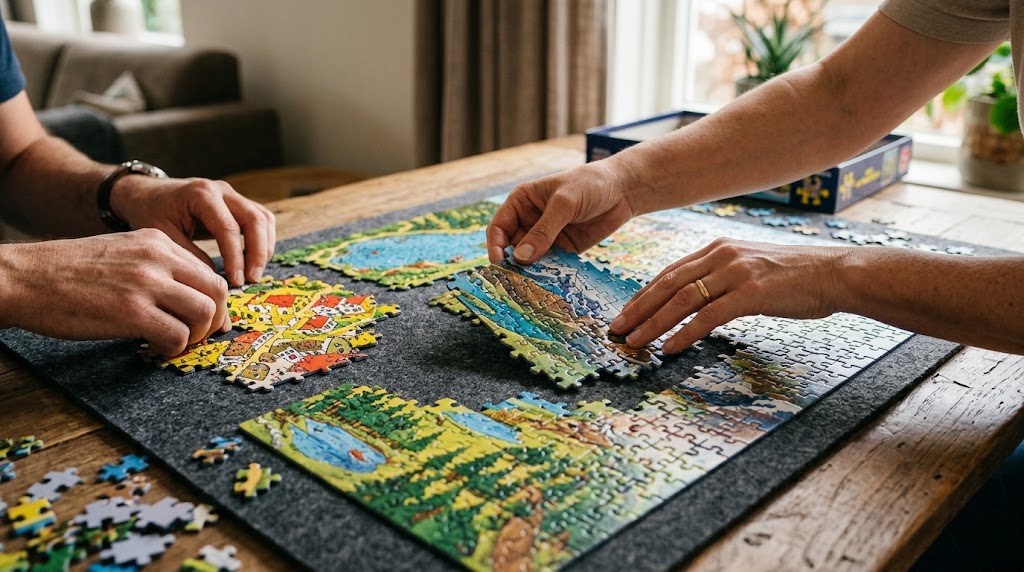
This is the method we’d hand to a friend who’s never done a puzzle. It works because it takes the chaos out of the early stages and gets you to the satisfying middle fast.
1: Flip every piece face-up
Open the box, pour the pieces out, and turn every single one picture-side up. Yes, every one. It takes a few minutes and feels tedious, but you can’t find pieces you can’t see. While you flip, glance at the box image and notice the big color areas, the text, and any tricky patches. Then prop the image up where you can see it.
2: Pull the edges
Run through the pile and pull anything with a flat side. Corners (two flat sides) are easy to spot, and there are only four. Put the edge pieces in their own tray.
3: Sort the rest into trays
Rough groups are fine. Aim for five to eight trays: one for each big color family, one for anything with text, and one for oddballs. Resist the urge to sort perfectly. You’re making smaller piles to search, not filing a tax return. The twenty minutes you invest here will save you hours later.
4: Build the frame (but don’t get stuck on it)
Assemble the border using the box picture to place edge pieces. Frames are satisfying, and they set your boundaries, but they aren’t sacred. If the frame stalls with three gaps left, move on. Sneaky edge pieces often hide in your interior piles and show up later.
5: Build islands, not just a frame-in
Here’s a trick the usual guides skip. Pick the most distinctive area of the picture, like a bright red barn or a block of text, and build it as a floating island anywhere on the table. You don’t have to attach it to the frame. Once you have two or three islands, use the box picture to slide each one into its correct position, and they’ll connect on their own. Islands give you momentum, and momentum is what keeps beginners going.
6: Solve the boring areas by shape, and work the gap, not the piece
Eventually you’ll hit the sky, the water, or the wall of one color. Color stops helping here, so you switch to shape. Look at a piece’s tabs (the parts that stick out) and sockets (the parts cut in). Count them and note where they sit. A piece with a tab on top and a socket on the left only fits a spot that has the matching socket and tab.
Then flip your approach. Instead of picking up a random piece and asking where it goes, pick a gap with two or three surrounding pieces already in place and scan your tray for the shape that fills it. Working the gap is slower per attempt but much more reliable than working the piece.
7: The home stretch, and the missing-piece check
As you approach the finish, every remaining piece has fewer places to go, and the pace picks up. Place the last piece, take a moment, and look at what you built.
If you come up one short, don’t panic. Check under the table, inside the box, on the floor, in the carpet, and in any pet bed that might have collected a trophy. If it’s really gone, contact the manufacturer or retailer, since some offer replacement pieces. Then take a photo, text it to someone who’ll appreciate it, and enjoy it.
When you get stuck, try four moves in this order: rotate the piece (a gradient piece can look wrong just because it’s turned), switch from working the piece to working the gap, re-sort one tray by shape instead of color, and walk away for an hour. Fresh eyes find connections you were blind to.
Tips That Make the Middle Faster
The messy middle is where most first puzzles stall. These habits keep it moving.
Puzzle in 20-minute bursts when you’re stuck. Set a timer, work one tray hard, then stop. Short, focused runs beat a two-hour stare at the same patch of sky.
Test candidates against the box, not your memory. Hold a suspect piece next to the matching area of the picture. Your eyes will catch a color mismatch faster than your recollection of the image.
Keep an “unsure” tray. Anything you can’t place goes there instead of back in a color pile. When a tray finally runs dry, the unsure tray usually holds the answers.
Finish one small area before starting another. A finished corner of the picture shrinks the search for everything around it. Half-built patches all over the table just spread your attention thin.
Take a progress photo at the end of each session. It’s motivating, and it helps you spot a misplaced section when something stops fitting.
Leave a note for yourself. Before you stop for the night, write down which tray or section you were working on. Picking up cold the next day is half the battle.
Don’t hover over other people’s pieces. If you’re puzzling with a partner, hand over the piece you’ve been testing for ten minutes. A fresh set of eyes will often place it in seconds.
Common Beginner Mistakes
We’ve seen all of these. Several of them we’ve made ourselves.
Starting too big. A 2000-piece fantasy castle looks incredible on a shelf. It looks less incredible spread across your table for three weeks. Start with 500, and level up when the habit is built.
Buying by price or box art alone. A gorgeous picture that’s 40% sky is a puzzle for experts. Use the landmark test from earlier.
Skipping the sort. “I’ll just start and see what happens” means you’ll spend three times as long hunting for pieces. Sort first.
Sorting only by color. Color gets you started, but shape is what finishes the hard areas. Re-sort a stuck tray by tab and socket pattern.
Forcing pieces. If a piece needs a push, a bend, or a pep talk, it doesn’t go there. A real fit feels smooth and definite. Forcing creates false connections and warps pieces.
Working in dim light. If an area feels “impossible”, move the lamp before you blame yourself.
Hold the box lid in one hand. Prop the picture up. Your hands should be doing the work.
Ignoring posture. Four hours hunched over a table is a bad plan. Stretch, stand, and walk around the table every so often.
Puzzling With Other People
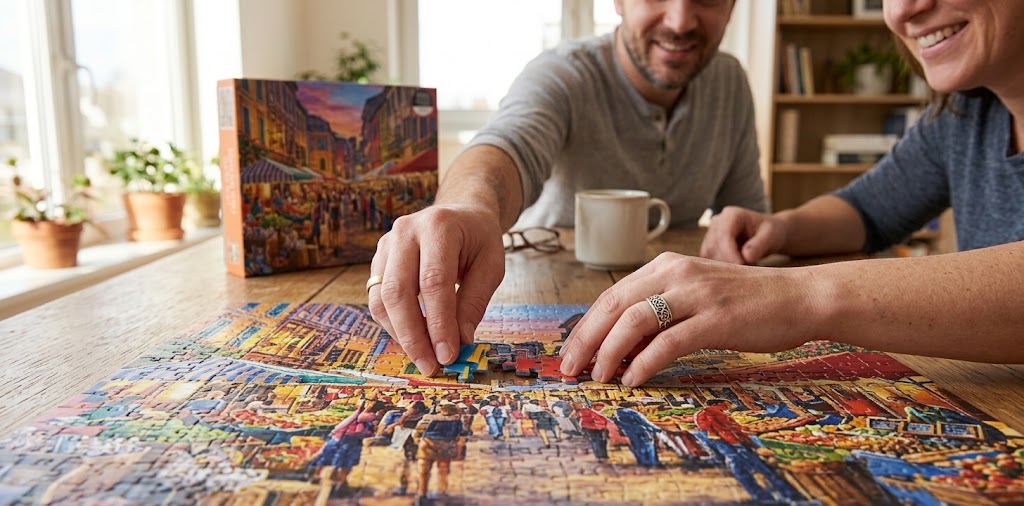
A puzzle is one of the few hobbies you can share without anyone having to be good at it.
With a partner or friends: split the jobs. One person sorts, one builds, or assign each person a color family. Just don’t let anyone claim a section for themselves, because that’s how arguments start.
With kids: younger children do better with fewer, larger pieces and a bright picture. Start with a small puzzle and let them place the last few pieces, which is the best part. If you’re shopping for a child, our guide to jigsaw puzzle brands for kids covers what to look for by age.
With older family members, or if your own eyes or hands need help, a few small changes go a long way. Choose large-piece puzzles with high-contrast pictures, use a bright lamp, and work at a table that’s the right height. A board with edges means a nudge won’t scatter everything. If gripping small pieces is hard, bigger pieces and a lighter touch make a real difference.
After Your First Puzzle: How to Level Up
Once you’ve finished a puzzle or two, the hobby opens up. Here’s a simple rule for progress: change one variable at a time. Move up in piece count, in image difficulty, or in cut style. Don’t do all three at once.
A sensible path looks like this:
- Finish a second 500-piece puzzle with a slightly harder picture (more sky, fewer landmarks).
- Jump to 750 or 1000 pieces with a busy picture.
- Try a random-cut puzzle at 500 pieces.
- Take on a gradient or big-sky picture when you want to practice shape matching.
- Branch out to 3D, shaped, double-sided, or mystery puzzles.
Along the way, you’ll want company. Online puzzle communities, local swap groups, and puzzle exchanges are great for trading boxes, getting recommendations, and finding the brands you like. And if you like timing yourself, speed puzzling is a real thing, with events and competitions. Even if you never enter one, timing a puzzle is a fun way to track your progress.
What to Do With a Finished Puzzle
You placed the last piece. Now what?
Keep it on display. Puzzle glue (a clear adhesive) locks the pieces in place, and a finished puzzle makes surprisingly good wall art. There are also professional preservation services if you’d rather have it done for you.
Take it apart and do it again. You’ll be faster the second time, and it’s still satisfying.
Pass it on. Swap with friends, donate to a library or senior center, or leave it in a community book exchange.
Store it properly. Bag the pieces, slide the bag into the original box, and keep boxes upright like books. If a puzzle is missing a piece, label the box so the next person knows.
Jigsaw Puzzles for Beginners: Frequently Asked Questions
What’s the best piece count for a beginner?
- It’s big enough to teach you real technique and small enough to finish in a couple of sittings. Drop to 300 if you only have short sessions or you’re puzzling with a young child.
How long does a 500-piece puzzle take?
Plan on roughly six to ten hours, spread over two or three sittings (our estimate). One study’s puzzlers averaged about 73 pieces an hour by our math, which puts 500 pieces near seven hours. A busy picture speeds things up, a big sky slows them down, and a partner cuts the time a lot.
How do I start a jigsaw puzzle?
Flip every piece face-up, pull out the edges, sort the rest by color and pattern, then build the frame. After that, build the most distinctive section first and work outward.
Do I have to do the edges first?
For your first puzzle, yes. The frame gives you structure and a size to work within. Once you’re comfortable, you can skip it and start with the most recognizable section instead.
Is 1,000 pieces too hard for a beginner?
It’s not too hard so much as too long. You’d spend weeks on a project before you’ve built the habits that make big puzzles manageable. Finish a couple of 500-piece puzzles first.
What’s the easiest kind of puzzle picture?
Busy illustrated scenes, collages, food markets, maps, and vintage posters. They have lots of distinct colors and text to anchor on. Big skies, water, and gradients are the hardest.
Ribbon cut or random cut for a first puzzle?
Ribbon cut. The grid is predictable and easier to sanity-check. Try random cut once you’ve finished a puzzle or two.
How big is a 500-piece puzzle?
It varies by brand. Sources we found list sizes from about 14″ × 19″ (49 × 36 cm) up to about 18″ × 24″. Check the box, then add four to six inches on each side for your workspace.
What if I’m missing a piece?
Check under the table, in the box, on the floor, and anywhere a pet might have carried it off. If it’s truly gone, contact the manufacturer or retailer, since some offer replacement pieces.
How do I keep pets and kids from wrecking my puzzle?
Use a puzzle board you can move, work in a room with a door that closes, or store the board on a high shelf between sessions.
Do jigsaw puzzles help prevent dementia?
Nobody has shown that. A randomized trial found that 30 days of puzzling improved puzzle skill but did not measurably change visuospatial cognition, though people with more lifetime puzzling experience tended to score better. Puzzles are a great mental workout and a good way to unwind. Just don’t count on them as medicine.
Should I sort by color or by shape?
Color first, shape second. Color gets you moving in the first hour, and shape takes over once a section runs out of color clues. Re-sort a stuck tray by tab and socket pattern when that happens.
Can I do a puzzle without looking at the box picture?
You can, but not for your first one. The picture is your map, and using it isn’t cheating. It’s the whole point. Once you’ve finished a few puzzles, working without it is a fun challenge.
Welcome to the Club
Here’s the thing about jigsaw puzzles: you don’t have to be good at them to love them. You just have to start, and starting is easier than it looks. Pick a 500-piece puzzle with a busy picture, light the table well, sort before you build, and take your time.
The rest is the quiet hour after everyone’s gone to bed, the rainy Sunday that turns into the best afternoon in months, and the moment you realize you haven’t checked your phone in two hours. Clear a table, pour out the pieces, and begin with one edge.