Advertiser Disclosure
We independently review everything we recommend. When you buy through our links, we may earn a commission.
The Best Puzzles for 2-Year-Olds
If you’ve ever handed a two-year-old a puzzle and watched their whole face light up when a piece finally clicks into place, you already know why we can’t stop buying these things for our test group of toddlers. Puzzles are one of the rare toys that manage to be genuinely fun and genuinely good for a two-year-old’s brain, and after weeks of scattering wooden pieces across our office floor (and finding a few stray ones in couch cushions weeks later), we’ve landed on 11 puzzles we’d actually recommend to a friend.
Quick Comparison: Which Puzzle Fits Your Toddler?
- Brand-new to puzzles? Start with the Melissa & Doug Vehicle Jumbo Knob Puzzle or the Benresive 6pcs Animal set — both forgive imperfect technique.
- Loves vehicles specifically? The Yetonamr 6 Vehicle Shape set or the Melissa & Doug 4-Pack (which includes a vehicle theme) are your best bets.
- Needs something for travel or waiting rooms? The MTYOKILN Magnetic Maze and AugToy Shape Sorting set both travel well and don’t scatter loose pieces easily.
- Gets bored fast? The edutree 6-Pack or Melissa & Doug 4-Pack give you built-in variety without multiple purchases.
- Responds to sound and music? The Melissa & Doug Farm Animals Sound Puzzle is the clear standout here.
- Are you tired of losing pieces under the couch? The SYNARRY set with its built-in storage rack solves that specific headache.
If your toddler eventually graduates past pegs and chunky knobs, it’s worth browsing our guide to jigsaw puzzle brands built for kids for the natural next step in piece count and complexity.
The 11 Best Puzzles for 2-Year-Olds
✅ We recommend these products based on an intensive research process that’s designed to cut through the noise and find the top products in this space. Guided by experts, we spend hours looking into the factors that matter to bring you these selections.
⭐ 2.5 million+ people assisted in the last 30 days ⭐
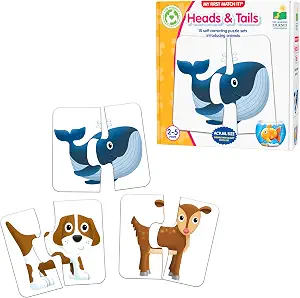
This one quietly became a favorite in our testing group, mostly because it doesn’t look or feel like a “baby puzzle” even though it’s built specifically for the youngest puzzlers. The set includes 15 two-piece, self-correcting animal cards — you match each animal’s head to its correct tail — and the self-correcting design means no two cuts are the same, so your toddler genuinely cannot force the wrong pieces together. That sounds like a small thing until you’ve watched a 2-year-old get frustrated with a “regular” puzzle that lets them jam mismatched pieces in and then melt down when it doesn’t look right. Here, there’s no wrong answer that visually resolves, which keeps the whole experience low-stress. One tester’s daughter, who’s a fairly easily frustrated two-year-old, played with this set independently for nearly 15 minutes on her first try, which is basically toddler eternity. Because it starts at just two pieces per card, it also grows with your child — you can hand them two card options at first, then gradually offer more choices as their matching skills improve. This is a strong pick for parents whose toddler is just starting to show interest in puzzles, or for anyone who wants something that builds pre-reading matching skills without feeling like flashcards.
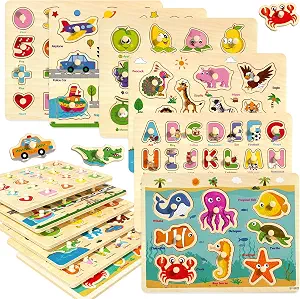
If your toddler is the type who wants variety, not one puzzle they master and set aside, this six-pack solves that problem well. Each of the six boards covers a different theme — think alphabet, numbers, animals, vehicles, and shapes — so you effectively get a rotating stack of “new” activities without buying six separate products. The pieces are solid wood with a smooth, rounded finish, and in our testing, the paint held up surprisingly well through repeated handling and the occasional puzzle piece getting gnawed on during a teething flare-up. What we appreciated most is how the set scales in difficulty across the six boards; some are simpler shape-and-peg matches, while others ask your toddler to recognize a specific letter or number, so you’re not stuck re-buying puzzles every few months as your child’s skills grow. The one thing to know going in: peg puzzles like this one work best when your toddler is in a cooperative mood, since precise alignment can be genuinely tricky for smaller hands early on. We’d point this set toward families who want a well-rounded “core” puzzle set for home or a classroom setting, rather than parents looking for one single showpiece puzzle.
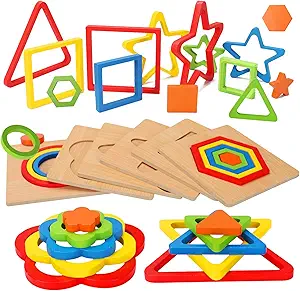
This is less a traditional puzzle and more a full sensory activity box, and that’s exactly why it earned a spot on this list. The set includes multiple boards and roughly 30 small wooden blocks across different colors, shapes, and categories, which gives your toddler several ways to play: matching blocks to their boards, sorting by color into bins, or simply naming shapes as they go. In practice, this variety mattered a lot for one of our longer test sessions — a toddler who typically taps out of an activity after five minutes stuck with this one for almost twenty, mostly because she kept inventing new “games” with the pieces on her own. Because it’s compact and lightweight, it also travels well; a couple of our testers threw it in a diaper bag for a road trip and reported it held attention far better than a screen (a genuinely rare feat for a car ride). We do want to flag that with 30 small pieces, this set demands more supervision than the chunkier peg puzzles on this list, so it’s best suited for two-year-olds who are past the mouthing-everything phase, or for supervised playtime rather than solo play.
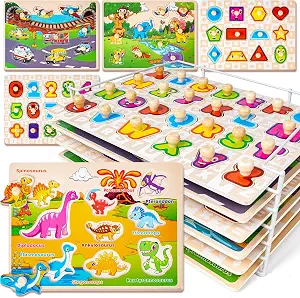
What sets this one apart is the built-in storage rack, which sounds like a minor detail until you’ve spent a weekend finding puzzle pieces under the couch. The six-puzzle set slots neatly into its own wooden rack, so cleanup becomes part of the activity rather than a parent’s evening chore — and in our experience, toddlers actually enjoy the “put it back in its slot” step almost as much as solving the puzzle itself. The pieces are noticeably thick and chunky, with smoothly sanded edges that held up well even when one of our younger 2-year-old testers tried to test their durability by throwing one across the room (they survived; the floor was fine too). The printed images are done in a scratch-resistant, waterproof coating, which matters more than it sounds like it should, since toddler hands are rarely clean during puzzle time. We’d recommend this set to parents who are tired of losing puzzle pieces to the abyss under furniture, or who want a puzzle activity that doubles as a light lesson in tidying up after yourself.
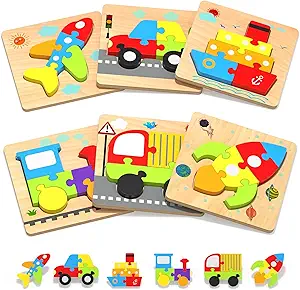
For the toddler who is obsessed with anything that moves — cars, trucks, planes, you name it — this set is close to a guaranteed hit. It includes six vehicle-themed peg puzzles covering land, sea, and air: a car, truck, aircraft, rocket, steamship, and train. What we liked in testing is how each piece works almost like a tiny toy on its own; toddlers didn’t just slot the pieces in and move on, they picked up the train piece and “drove” it around the table first, which is exactly the kind of open-ended, imaginative play you want alongside the actual puzzle-solving. The vehicle theme also naturally invites conversation — parents in our test group found themselves narrating (“the rocket goes up, up, up!”) far more with this set than with some of the more generic shape puzzles, which is a nice bonus for language development. Piece thickness felt right for two-year-old hands, not so thin that they’d snap under a determined toddler grip. This is the pick we’d steer any vehicle-obsessed household toward, especially if your two-year-old already has a favorite toy truck they refuse to put down.
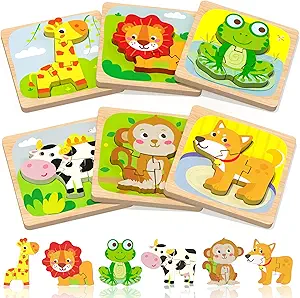
This set keeps things refreshingly simple: six individual animal-shaped wooden puzzle pieces — a giraffe, frog, monkey, cow, lion, and puppy — each roughly the size of a small placemat, with the picture printed underneath the pieces so toddlers get a visual match cue as they work. What stood out to us in testing wasn’t complexity; it was approachability. Because each animal is its own standalone puzzle rather than part of one big board, a toddler can grab just one, finish it in under a minute, and feel a genuine sense of accomplishment before moving to the next. That quick-win structure turned out to matter a lot for one of our shorter-attention-span testers, who cycled through all six animals in a single sitting purely because each one felt achievable rather than overwhelming. The wood is solid with a water-resistant paint finish, and the animal shapes themselves are large enough that we never saw a piece get lost or misplaced during testing, which is more than we can say for some smaller puzzle sets. We’d recommend this one specifically for younger or newer-to-puzzles two-year-olds who need confidence-building wins before tackling anything more complex, or as a gentle “first puzzle set” for a first birthday gift that’ll still get played with well past the two-year mark.
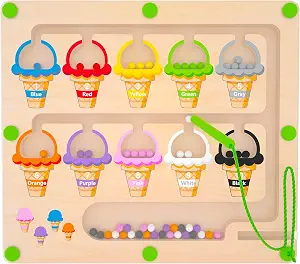
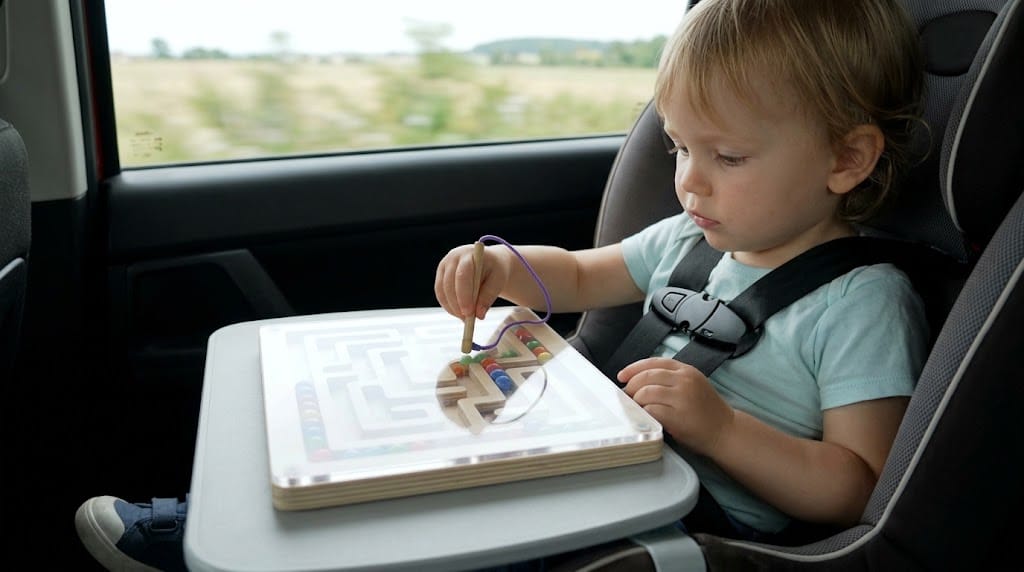
This is the pick we’d call a “step-up” toy rather than a traditional puzzle, and it’s a genuinely clever one. The wooden board features colorful ice cream cone designs, each representing a number from one to ten, and your toddler uses a magnetic wand to guide small beads from a central track into the matching cone — sneaking in both color recognition and early counting practice without ever feeling like a lesson. In our testing, this held attention noticeably longer than most of the peg puzzles on this list, largely because the magnetic “chase the bead” mechanic has a game-like quality that keeps kids engaged well past the two-minute mark most static puzzles get. Because there are no small loose pieces to lose (the beads stay contained inside the acrylic-covered maze), it’s also one of the lower-supervision options here, which parents in our group appreciated during, say, a phone call they couldn’t step away from. It’s worth noting this one skews slightly older in some of its marketing (toward 3 and up), so a two-year-old may need a little hand-over-hand help at first to get the wand technique down — but once they do, it becomes a favorite fast. We’d point this toward parents looking for a travel-friendly, mess-free option, especially for road trips or waiting rooms.
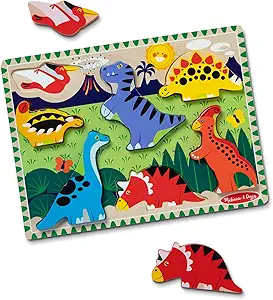
Melissa & Doug puzzles show up on nearly every toddler gift list for a reason, and this dinosaur chunky puzzle earns its spot honestly. Seven oversized wooden pieces, each shaped like a different dinosaur, fit into their matching cutouts on a sturdy board, with full-color pictures underneath each piece to guide correct placement. What impressed our testers most was the sheer durability — this is the kind of puzzle that survives being dropped, sat on, and dragged across the room without so much as a chipped edge, which matters a lot once you’ve lived through a toddler’s version of “gentle” handling. The extra-thick pieces are genuinely easy for smaller hands to grip and lift, and because dinosaurs are such a reliably popular toddler obsession, we found this puzzle held attention across multiple sessions rather than becoming a one-and-done novelty. It’s a great pick for the dinosaur-loving two-year-old in your life, and honestly a safe, low-risk gift option if you’re buying for someone else’s toddler and don’t know their exact skill level yet — seven pieces is forgiving enough for a true beginner while still feeling like a real accomplishment once completed.
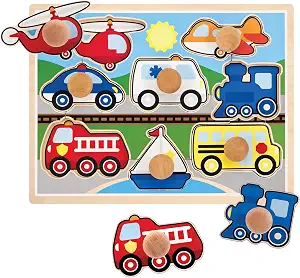
If your toddler needs the biggest, easiest-to-grab pieces on this entire list, this is the one. Eight oversized wooden vehicle pieces — a mix of air, land, and sea transportation — each come with a jumbo knob specifically designed for toddlers who haven’t fully developed the pincer grip needed for smaller peg puzzles. In our testing, this was consistently the easiest puzzle for our youngest 2-year-old testers to manage independently, since the knob essentially does the gripping work for them; there’s no fumbling to pick up a flat piece off a table. Underneath each piece is a full-color matching picture, so even before a toddler places anything correctly, they can start associating the shape with the image, which builds toward the “aha” moment when it clicks into place. We also appreciated that Melissa & Doug rates this puzzle for ages 1 and up, which tracks with what we saw — it’s genuinely accessible even for toddlers on the younger end of two, not just kids who are already puzzle-experienced. This is our top recommendation if you’re buying for a toddler who’s newer to puzzles overall, or one who’s shown frustration with smaller, flatter pieces in the past.
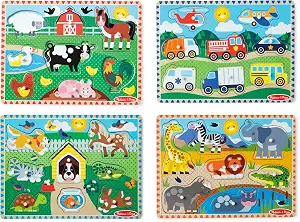
This bundle is the practical, “just buy the whole rotation” pick on our list, and it’s the one we’d hand to a parent who doesn’t want to research four separate purchases. You get four themed peg puzzles — vehicles, farm animals, safari animals, and pet animals — each with seven or eight pieces, easy-grasp pegs, and a matching picture underneath every piece. What we noticed in testing is how naturally these four puzzles rotate through a toddler’s interests over time; a two-year-old who’s deep in a “farm animal” phase this month might pivot to safari animals next month, and having all four on hand means you’re not scrambling to buy a new puzzle every time their obsession shifts. The wooden pieces felt slightly lighter than some of the chunkier options on this list, which made them a touch easier for smaller hands to lift out and reset, without sacrificing durability during our stress-testing (read: toddlers dropping them repeatedly to see what would happen). Because you’re getting four puzzles for close to the price of two standalone Melissa & Doug sets, this is also simply a strong value pick if you’re trying to build out a toddler’s puzzle collection without buying one at a time. We’d recommend this bundle for parents who want breadth over depth — more themes to keep a toddler engaged, rather than one deeper, more complex puzzle experience.
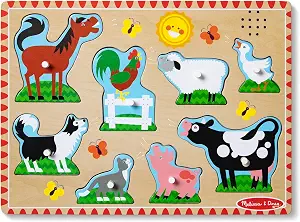
We saved this one for last because it consistently earned the strongest reactions from our toddler testers, and we suspect it’ll do the same at home. This eight-piece wooden peg puzzle works like a classic Melissa & Doug farm puzzle, but with a genuinely fun twist: place each animal piece correctly, and a light-activated sensor triggers a realistic sound — the pig oinks, the cow moos, the rooster crows — turning a fairly standard matching activity into something closer to a mini performance. In our sessions, this sound feedback did something the silent puzzles on this list simply couldn’t: it gave toddlers an immediate, satisfying signal that they’d gotten it right, without needing a parent to confirm it for them. That independence factor is a big deal at two, when kids are hungry for “I did it myself” moments. It does require two AAA batteries, which aren’t included, so factor that into your purchase if you want it working right out of the box. We’d call this the best pick on our list for auditory learners, for toddlers who respond strongly to music and sound, or honestly for any parent who wants a puzzle that’ll hold attention a little longer than most, purely because “doing it again to hear the sound” adds built-in replay value most static puzzles don’t have.
Why Puzzles Matter So Much at Age Two
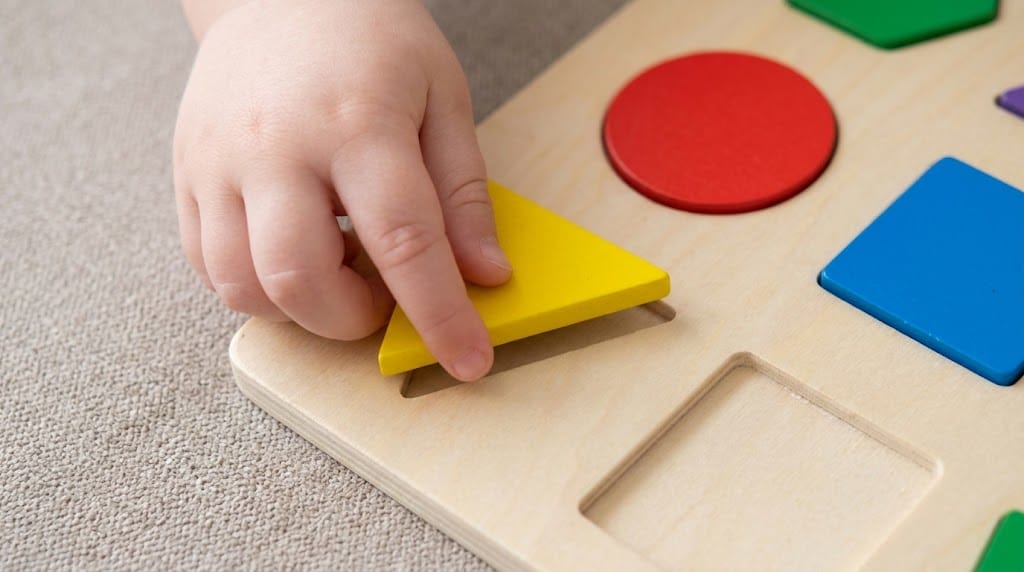
Two is a wild developmental window. According to the American Academy of Pediatrics, toddlers between 18 and 36 months are rapidly developing fine motor control, hand-eye coordination, and early problem-solving skills — and puzzles happen to hit all three at once. Research on early childhood play, including studies published through the National Association for the Education of Young Children, has repeatedly linked puzzle play with stronger spatial reasoning skills later in school, along with improvements in patience and self-correction (the “try again” instinct that toddlers desperately need to build).
Practically speaking, a good puzzle for a 2-year-old should have:
- Large, easy-to-grasp pieces. Tiny interlocking jigsaw pieces are more of a 4-year-old skill. At two, chunky knobs, thick wooden pieces, or peg-style handles matter far more than piece count.
- Low piece counts. Somewhere between 2 and 15 pieces tends to be the sweet spot. More than that, and most 2-year-olds lose interest fast.
- Built-in “self-correction.” Puzzles where only the right piece fits the right slot reduce meltdowns and build independence, since your toddler doesn’t need you hovering to tell them they got it wrong.
- High-contrast, engaging art. Toddlers this age respond to bright colors and recognizable, real-world images (animals, vehicles, shapes) far more than abstract patterns.
- Sturdy, non-toxic materials. Two-year-olds still mouth things occasionally, and puzzles get thrown, sat on, and dragged across hardwood floors more than any adult would like.
How We Chose These Puzzles
Our assessment team didn’t just read spec sheets — we actually set these puzzles up in front of toddlers and watched what happened. We looked at how long each piece held attention, how often a parent had to step in to help, whether the pieces survived a toddler-strength tug-of-war, and whether the puzzle actually taught something (colors, numbers, animal names) rather than just being pieces in a box. We also factored in price relative to piece count and durability, since a $30 puzzle that falls apart in a month isn’t actually a good value no matter how cute the box art is.
If you’re also building out a toddler puzzle rotation, it’s worth pairing chunky peg puzzles like the ones below with a couple of floor puzzles for young children, which tend to work better for slightly older toddlers who are ready to sit through a longer activity, or with a themed set like our Peppa Pig puzzle roundup if your two-year-old is deep in a specific character phase.
Frequently Asked Questions
How many puzzle pieces should a 2-year-old be able to handle? Most 2-year-olds do best with puzzles in the 2- to 15-piece range. Younger or newer-to-puzzles toddlers tend to do better closer to the 2- to 8-piece end, while a toddler who’s been puzzling for a while might comfortably handle a 12- to 15-piece set, especially self-correcting or peg-style puzzles.
Are wooden puzzles better than cardboard ones for toddlers? Generally, yes, for this age group specifically. Wooden puzzles tend to hold up far better under the kind of rough handling — dropping, chewing, sitting on — that’s basically guaranteed with a two-year-old, and thicker wooden pieces are easier for developing hands to grip than thin cardboard.
What’s the difference between a peg puzzle and a jumbo knob puzzle? Peg puzzles use a small raised peg or handle on each piece, while jumbo knob puzzles have a larger, rounder knob specifically designed for toddlers with less-developed pincer grip. If your two-year-old is newer to puzzles or has smaller hands, jumbo knob styles tend to be easier to start with.
How long should a 2-year-old be expected to sit and focus on a puzzle? This varies a lot by child, but in our testing, attention spans ranged anywhere from two or three minutes on a first try up to fifteen or twenty minutes once a toddler was familiar with a puzzle. It’s completely normal for a two-year-old to need several short attempts before a puzzle “clicks,” so try not to read a short session as disinterest.
Is it safe to leave a 2-year-old alone with a wooden puzzle? Most of the puzzles on this list use large, choking-hazard-free pieces designed for this age group, but any puzzle with smaller loose components (like sorting blocks or magnetic beads) is better used with supervision, at least until you’re confident your toddler has moved past mouthing small objects.
Do puzzles really help with toddler development, or is that overstated marketing? There’s real substance behind it. Puzzle play has been consistently linked to gains in fine motor skills, hand-eye coordination, and problem-solving persistence in early childhood research, and the self-correcting nature of many toddler puzzles specifically supports independent learning, since kids get immediate visual feedback without needing an adult to intervene every time.
Our Final Take
None of these 11 puzzles is going to be a perfect fit for every two-year-old, and that’s genuinely fine — this age group is defined by wildly different interests, hand strength, and patience levels from one kid to the next. What we’d suggest, based on everything we saw in testing, is starting with one chunky, forgiving option (the Melissa & Doug Vehicle Jumbo Knob Puzzle or the Benresive Animal set are both safe starting points) and layering in a themed set or two as your toddler’s confidence builds. Puzzles aren’t a toy you buy once and check off a list — they’re more of an evolving rotation that grows alongside your child, and honestly, that’s part of what makes them worth the investment in the first place.