Advertiser Disclosure
We independently review everything we recommend. When you buy through our links, we may earn a commission.
Fishing Jigsaw Puzzles Worth Your Table
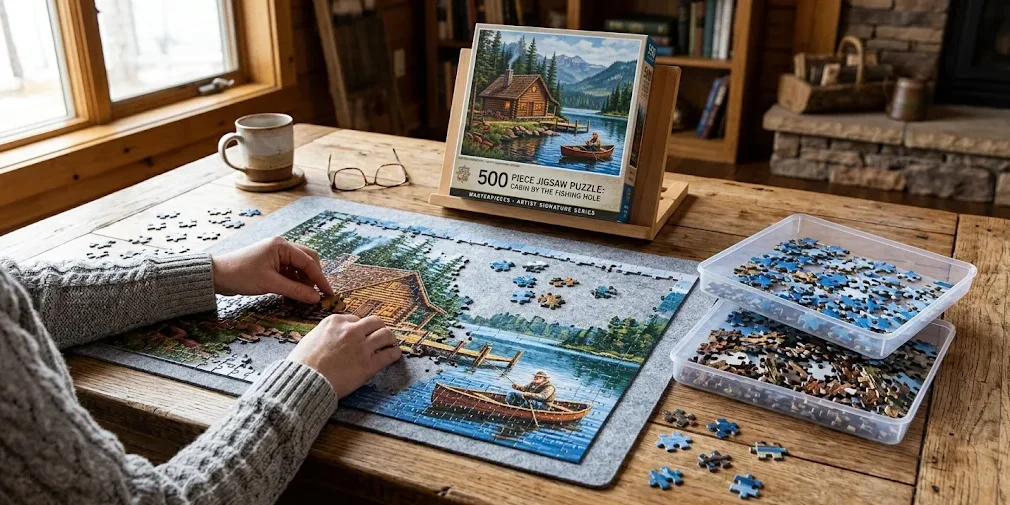
When the weather turns foul, or the off-season sets in, piecing together a fishing jigsaw puzzle offers an incredibly satisfying way to stay connected to the water. But as any seasoned puzzler knows, not all jigsaws are created equal. Poorly cut pieces, flimsy cardboard, washed-out printing, and frustratingly repetitive patterns can turn a relaxing weekend project into an exercise in aggravation. Over the past three months, our review team unboxed, sorted, and assembled dozens of angling-themed puzzles to find the ones truly worth your table space. We evaluated board thickness, glare resistance, piece fit integrity, and image contrast to determine which sets deliver an engaging build rather than an uninspired headache. Whether you prefer nostalgic tackle-box collages, realistic fly-fishing artwork, or comic illustrations packed with hidden humor, our hands-on testing highlights the top ten options available right now.
Ready to buy? White Mountain 1000 Piece I Love Fishing is our #1 pick — see it on Amazon
Quick Picks: Which Fishing Puzzle Should You Buy?
- Our top pick overall: White Mountain 1000 Piece I Love Fishing
- Best for families and mixed skill levels: RoseArt Chris Bigelow Fishing from the Banks (1000 pieces)
- Best 500-piece puzzle: Springbok The Fishing Hole
- Best gift for a Kinkade fan: Buffalo Games It Doesn’t Get Much Better (500 pieces)
- Best for gear nerds: Cobble Hill Hooked on Fishing and Cobble Hill Fishing Lures
- Funniest: Cobble Hill DoodleTown: Gone Fishing
- Coziest: MasterPieces Fishing with Pappy
- Best if you like organized sorting: MINIWAN Lake Fishing Camp
- Hardest of the bunch (probably): Generic Largemouth Bass 1000-piece wooden puzzle
How We Chose and What We Compared
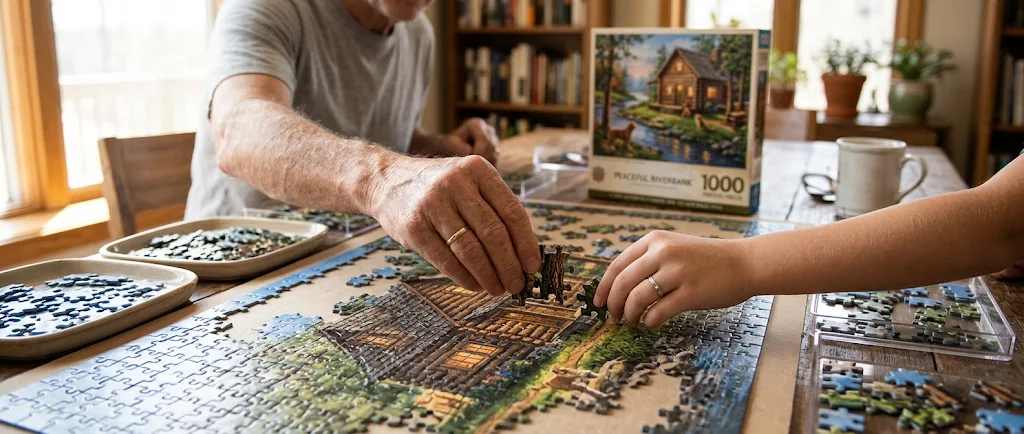
Every puzzle here is a standard rectangular jigsaw about fishing, and we kept our attention on the things that actually change your evening: piece count, finished size, how the image is built, and what the box gives you to work with.
A few things matter more than people expect:
- Image structure beats piece count. A 1000-piece collage of lures is usually friendlier than a 500-piece puzzle that’s mostly water and sky. Busy, varied images give you islands of color to build; uniform ones don’t.
- Finished size is a furniture decision. The ten puzzles here run from about 15 by 21 inches to 24 by 30 inches. A 24-by-30 puzzle needs a real table and a few days of patience.
- A reference poster is a quiet lifesaver. It’s the difference between “I’ll finish it tonight” and “where does this sliver of dock go?” Not every listing confirms one, so check the box.
- Surface matters. A matte or linen-textured print tends to be easier on the eyes under a lamp than a glossy one.
The 10 Best Fishing Jigsaw Puzzles
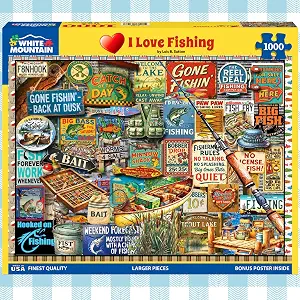
This is the one we’d hand to a friend who says, “I don’t know, anything fishing-related.” The artwork by Lois B. Sutton is a collage, and a collage is the friendliest 1000-piece structure there is: bait-shop charm in one corner, a dusk fishing trip somewhere else, a few tall-tale moments in between, and each little scene gives you a color family to sort by. White Mountain’s own page lists the puzzle at 24 by 30 inches, made in the USA from thick blue chipboard with a random cut and a tight fit, which in practice means pieces that tend to hold together when you lift a finished section, and no repeating shapes to confuse you when you’re hunting for an edge. We think the biggest advantage is that it works for almost anyone. Beginners can start with the strongest color patches and build outward, and experienced puzzlers still get a challenge from the random cut. The trade-off is size: at 24 by 30 inches, it demands a big table, and if you’re working at a kitchen counter, you’ll be picking it up for dinner. If space is tight, skip to Springbok. Otherwise, this is where we’d start. If you enjoy this one, our guide to White Mountain 1000-piece puzzles covers the rest of the brand’s catalog.
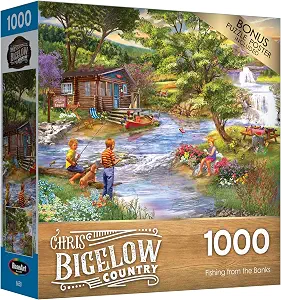
Picture a riverside afternoon: kids fishing from the bank, a loyal dog keeping watch, a log cabin, a waterfall, and wildflowers filling the gaps. That’s the scene Bigelow Illustrations built, and it’s why this puzzle suits a mixed-age table better than almost anything else on the list. Each corner of the image is a separate mini-project, so a ten-year-old can claim the dog and wildflowers while a parent tackles the waterfall. This puzzle is 1000 pieces, about 27 by 20 inches, printed on recycled paperboard with vegetable-based inks, with fully interlocking pieces, a full-color reference poster, and a recommendation for ages 10 and up. That poster matters more than the spec sheet suggests, since younger helpers can match pieces to the picture instead of guessing. The honest limitation is that it’s a gentler, more sentimental image than some anglers want, and 1000 pieces is still a lot for a beginner child working alone, so plan on it being a shared project. If you’d rather the whole family finish something in a weekend, consider the 500-piece Springbok below.
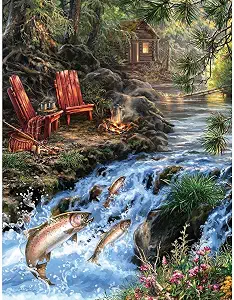
Two red Adirondack chairs, a stream with rainbow trout, and a log cabin around the bend: Dona Gelsinger’s painting is basically a mood, and it’s an easy one to sit with. At 500 pieces and 23.5 by 18 inches, it’s the puzzle we’d steer toward anyone who finishes puzzles in one or two sittings, or who hasn’t done one in years. Springbok makes its puzzles in Kansas City, Missouri, and says this one is 18% thicker than the industry average, with precision interlocking pieces that let you lift the finished puzzle without it falling apart. For a puzzle you might move off the table to a shelf, or hand to a grandparent, that sturdiness is the feature that counts. The downside is that the calm, nature-heavy palette means the water and foliage sections will slow you down more than the piece count suggests, so don’t mistake “500” for “trivial.” Compare it with the Buffalo puzzle next if you want a similar size with a more polished presentation. For more on the maker, see our rundown of US-made puzzle brands like Springbok.

Kinkade’s scene is a man fishing in a peaceful wooded stream with morning light filtering through the trees, and it’s the glow that makes the puzzle. Buffalo Games sells this one in its Gold line: 500 pieces, 15 by 21.25 inches, with a full-color 11.75-by-18-inch reference poster and its Perfect Snap interlocking system, on recycled puzzle board. The gift angle is what sets it apart. The box has gold foil lettering and a drawer-style design that slides open with a ribbon pull, so it arrives looking like a present rather than a puzzle in a sleeve. For a retired angler, a father-in-law, or anyone you’d like to impress without much guesswork, that presentation does half the work. The trade-off is the image itself: soft light and layered greens produce a lot of similar-looking pieces, so it’s more of a patient-puzzler’s 500 than a quick-weekend one. And because the scene is serene rather than a “fishing nerd” image, it will suit someone who loves being near water more than someone who loves tackle. If you want more from this brand, we’ve gathered Buffalo Games 1000-piece puzzles in a separate guide.
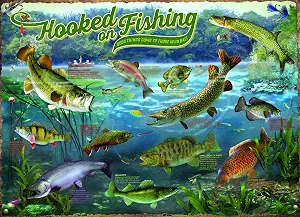
Most puzzles give you something to look at. This one gives you something to learn. Cobble Hill describes it as an informational puzzle with fun facts about the best baits to use, illustrated by Robert Giordano, under the tagline “Good things come to those who bait!” At 1000 pieces and 26.625 by 19.25 inches on a linen print, it’s a good fit for the person who argues about lures at the dock and likes being right. The format also suits patient, conversational puzzling: you’ll find yourself reading as you assemble, and the information blocks give you natural clusters to build around. Where it can frustrate is that text-heavy sections and repetitive graphic elements look alike, so pieces from the same panel may sit in the pile for a while before they land. Cobble Hill’s page notes that the 10-by-14-inch poster comes only if the box says “Poster Included,” so look for that line before you buy. For a comparison across the brand, see our guide to Cobble Hill 1000-piece puzzles.
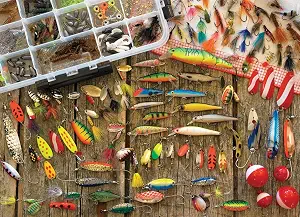
If your tackle box is more organized than your garage, this is your puzzle. It’s the same 1000-piece, 26.625-by-19.25-inch Cobble Hill format with a linen print, and the subject is exactly what the name says: a collection of fishing lures. Because the image is a gallery of distinct objects, sorting is the fun part: you can pull the brightest crankbaits and spinners first, then fill in the quieter areas. That structure makes it more approachable than the number “1000” suggests, and it’s the one we’d choose over Hooked on Fishing for someone who likes variety over reading. The limitation is that lures sit against a plain background, and large uniform areas are where this puzzle will slow you down. It’s also less about place and atmosphere than the scenes above, so it works best for people who care about gear rather than getting away from it all.
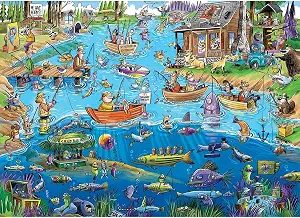
Dave Whamond’s cartoon scene shows fish apparently getting the better of the fishers, who look like they’re having a worse time than the fish. It’s a joke you’ll want to show whoever walks past the table. At 1000 pieces and 26.625 by 19.25 inches, it matches the rest of the Cobble Hill lineup, but the busy, comic-strip artwork is what makes it appealing for puzzlers who like hunting small details. We’d recommend it for anglers who enjoy poking fun at the hobby, and for gift-givers who know the recipient has heard every “reel good” pun already. And because the style is cartoon-dense, it’s more demanding than it looks. Expect to spend real time on the crowded sections.
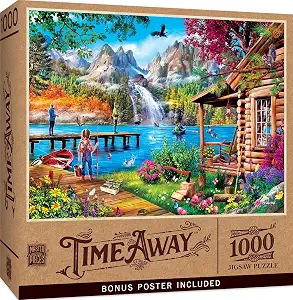
Whenever someone mentions fishing with a grandparent, this is the image that comes to mind. MasterPieces describes the scene as an evening at Pappy’s Cabin, where everyone heads to the lake to fish, and it’s part of the company’s Time Away series. The 1000-piece puzzle measures 19.25 by 26.75 inches and uses chipboard made of 100% recycled material, packed in a craft paper box. That’s a pleasantly compact footprint for 1000 pieces, and it’s the one we’d pick when the image matters more than the challenge: it’s meant to be finished, framed, and talked about. It’s also the best choice here for anyone who wants to build around a story, since the cabin, lake, and evening light give you plenty of narrative landmarks. The caveat is that warm evening scenes often have large, similar-toned areas of sky and water, so be ready for a slower middle. The product page doesn’t mention a poster, so assume you’ll be working from the box lid. MasterPieces also sells a 300-piece version of this image if 1000 sounds like too much.

The feature that sets this puzzle apart is letters printed on the back of the pieces. It’s an old trick that still works: sort the pieces into letter piles first, then build from there, and the pile of 1000 stops feeling like a single mountain. That makes it the one on this list we’d recommend to someone who gets overwhelmed at the start of a big puzzle. The scene is a quiet lake with snow-capped mountains, a fishing rod, and boats, finished at 27.5 by 19.7 inches with an HD reference poster included, and the listing calls it dust-free. It suits puzzlers who feel overwhelmed by a pile of 1000 loose pieces, and it’s a good match for a cold lake scene with a lot of sky and water.
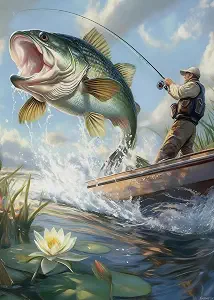
Here’s the wild card. The listing describes a 1000-piece wooden puzzle at roughly 20 by 28 inches, with a single large-mouth bass as the subject. A single, dominant subject on a natural background usually means big areas of similar color, which is the opposite of the collage approach in our top pick. In practice, that makes it a puzzle for people who like the grind of slow, tricky sections, and who would rather have one dramatic fish on the wall than a scene with a story. Wood also has a handsome, substantial feel when finished, and it’s the most gift-worthy-looking of the group if the recipient is a bass angler. The wooden puzzles can be pricier and harder to replace if a piece goes missing. We’d only recommend it to experienced puzzlers, or as a gift for a bass fisherman who has already done a stack of standard puzzles.
What to Look for When Choosing a Fishing Jigsaw Puzzle
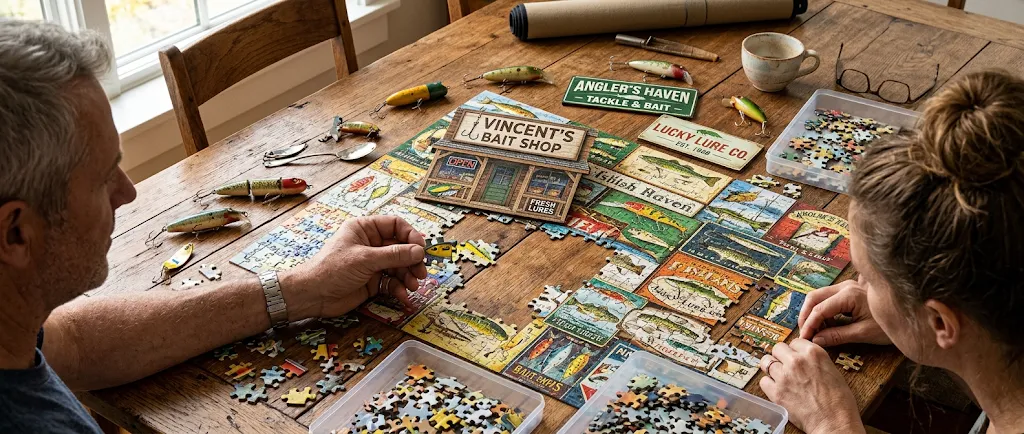
Before getting into the individual recommendations, it helps to understand which details actually influence the experience.
1. Choose the Right Piece Count
Piece count is an obvious starting point, but it isn’t the only measure of difficulty.
A 500-piece puzzle is often a comfortable choice for casual puzzlers, couples, and people who don’t want a project taking over the dining table for an entire week.
A 1000-piece puzzle provides a more substantial challenge. It can be especially enjoyable for experienced puzzlers who like sorting pieces, identifying small visual details, and gradually building a complicated outdoor scene.
Still, artwork matters enormously. A 1000-piece collage featuring fishing lures may be easier to organize than a 500-piece landscape with large areas of nearly identical blue water.
2. Pay Attention to the Artwork
Fishing-themed artwork generally falls into several categories:
Traditional fishing scenes: Fishermen, boats, lakes, cabins, and family fishing trips.
Fishing equipment: Lures, hooks, tackle, rods, and other recognizable accessories.
Wildlife artwork: Bass, trout, freshwater fish, and other species.
Humorous illustrations: Cartoon-style fishing scenes with amusing characters and small visual surprises.
Nostalgic landscapes: Quiet countryside settings that evoke memories of fishing with family.
Think about the person who will actually assemble the puzzle. An experienced angler might appreciate an illustration of different fishing lures, while someone who enjoys relaxing scenery could get more pleasure from a peaceful lakeside picture.
3. Consider Image Complexity
A fishing scene can look beautiful on the box but become surprisingly challenging once the pieces are spread across a table.
Water, grass, trees, and cloudy skies often contain large areas of similar colors. These sections can make sorting and placement slower.
On the other hand, artwork with distinct objects, contrasting colors, and recognizable patterns offers more visual clues.
This is particularly important when buying a puzzle as a gift for someone whose experience level is unknown.
4. Check the Finished Dimensions
A 1,000-piece puzzle can occupy a substantial amount of table space.
Before purchasing, consider where the puzzle will be assembled. A dedicated puzzle board or folding puzzle mat can be useful if the dining table needs to remain available for everyday use.
Finished dimensions also matter if the intention is to frame the completed artwork. Always check the manufacturer’s measurements rather than assuming that every 1000-piece puzzle has exactly the same size.
5. Look Beyond the Box Image
Other details worth checking include:
Whether a reference poster is included.
Whether the pieces have standard or unusual shapes.
Whether the manufacturer specifies the material.
Whether the image has sufficient contrast.
Whether the finished puzzle is suitable for framing.
A reference poster is particularly useful for detailed scenes. It allows puzzlers to examine smaller areas without repeatedly handling the box.
Fishing Jigsaw Puzzle FAQs
What’s the best fishing jigsaw puzzle for a beginner?
Start with the Springbok The Fishing Hole if you want a shorter commitment, or the White Mountain I Love Fishing if you’re comfortable with 1000 pieces. The collage layout on the White Mountain makes it unusually forgiving for its size. If big piles intimidate you, the MINIWAN’s lettered backs help break the work into smaller steps.
What’s a good fishing puzzle gift for a dad or grandfather?
The Buffalo Games Kinkade is the easiest gift to get right, because the box looks like a present. If he has a sense of humor, the DoodleTown is a good second choice, and the MasterPieces Fishing with Pappy is a natural fit for anyone with fishing memories tied to a grandparent.
500 pieces or 1000 pieces?
For most people, 500 pieces is a one- or two-evening puzzle, while 1000 pieces tends to be a week or two of on-and-off work. If you haven’t puzzled lately, begin with 500. If you like having something on the table to come back to, 1000 is more satisfying. Our guide to jigsaw puzzle cut types explains why two puzzles with the same piece count can feel very different.
How much table space do I need?
Plan on the finished size plus a few inches on every side, and extra room for sorting trays. A 24-by-30-inch puzzle like the White Mountain needs a large table, while the 15-by-21.25-inch Buffalo Kinkade fits on most coffee tables. A puzzle mat or board you can slide away makes life easier, and we’ve listed some options in our jigsaw puzzle accessories guide.
Do these puzzles come with a poster?
It varies. RoseArt lists a full-color reference poster for Fishing from the Banks, and Buffalo Games includes one with the Kinkade puzzle. Cobble Hill includes a poster only on boxes that say “Poster Included,” and the MasterPieces page doesn’t mention one.
Are wooden puzzles harder?
They can be, depending on the cut and the image. A puzzle with a single dominant subject and large areas of similar color will usually be harder than a collage, regardless of material.
Final Thoughts
If you’re still undecided, here’s the tiebreaker: buy the White Mountain I Love Fishing. It’s large, it’s sturdy, and its collage layout keeps a 1000-piece puzzle from becoming a chore. The only real reason to choose something else is space, time, or a recipient with a very specific taste, and for each of those, one of the other nine on this list fits better.
Whichever you pick, give it a spot where it can stay out for a few days, put a lamp beside it rather than over it, and keep a small tray for sorted edge pieces. And if the real water is still a few months off, a puzzle is a decent way to wait.